
See the methodology for the table above.
Before you respond to the “For Sale” ad, check out this How to Buy a Used Car article for a step-by-step checklist.
Price History Comparison | Honda Accord Vs. Toyota Corolla
Average Market Value – Based on Owners’ Self-Reported Mileages | Honda Accord Vs. Toyota Corolla
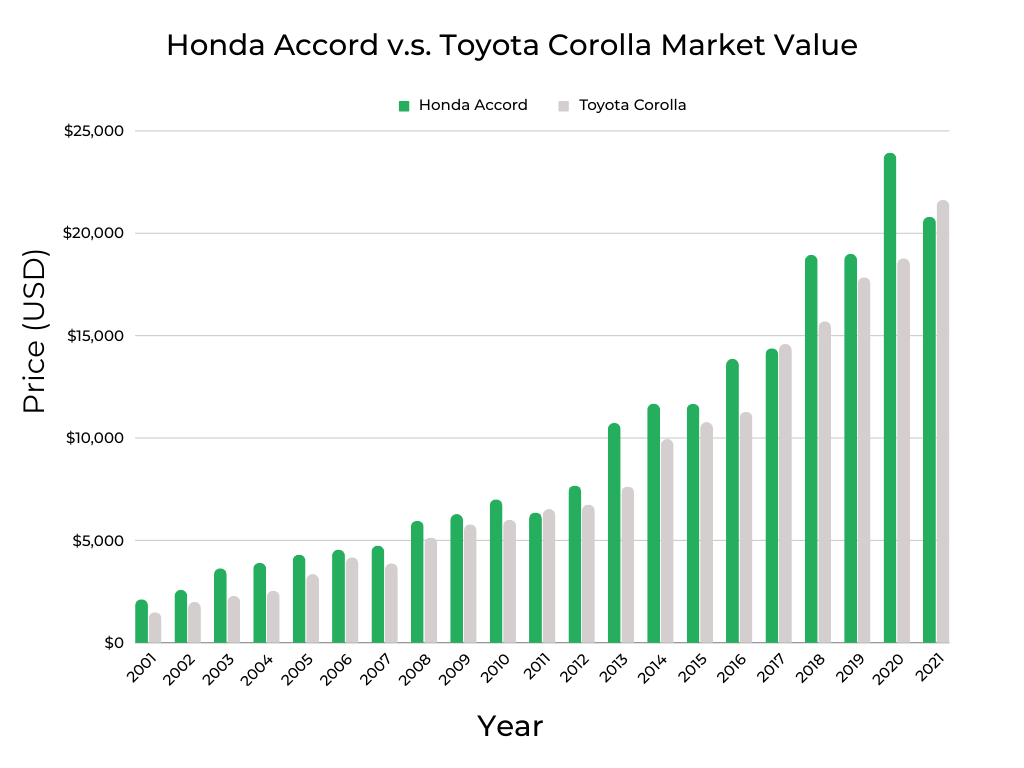
Price is a huge factor for most car buyers, so seeing average market values across different model years can be helpful for planning. Here’s a look at Kelley Blue Book (KBB) market values for the Honda Accord (green) and Toyota Corolla (gray).
There are no surprises here. The Accord shows consistently higher prices than the Corolla because this Honda usually costs more when new. The Accord sits higher up in Honda’s model range pecking order. The Corolla is more of an entry-level vehicle.
Further, values increase with each more recent model year, which makes sense. Newer cars are usually worth more than older ones. There may be some modest fluctuations due to mileage and factors (which are reflected in this data based on information from FIXD owner surveys).
There’s a curious spike in the value of the 2020 Accord, but a dive into the details fails to uncover an explanation. The surveyed cars for this data point average 37,500 miles, typical for a vehicle of this age. We’ll just have to chalk it up as being an anomaly.
As you review this chart, remember that this KBB data reflects private-party sales, which can be half of what you might pay at a dealer. One way to offset higher retail prices is by looking for older examples or ones with higher mileage.
Be sure to read our Best and Worst Years series of articles highlighting the Honda Accord and Toyota Corolla winners and losers.
Depreciation vs. Maintenance Expenses
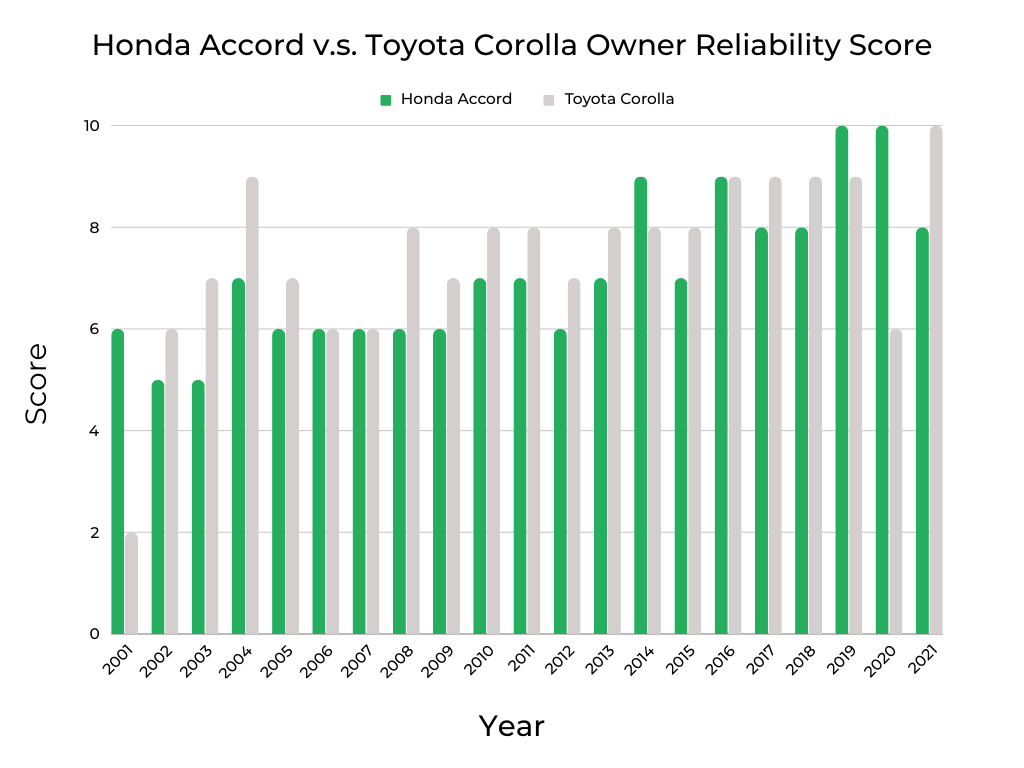
Spending a lot of time looking at engine reliability data, it takes a lot to surprise me, but I was gobsmacked to see the FIXD Reliability Scores for the Accord and Corolla. The Accord came out ahead for 15 out of 21 years, while the Corolla ranked on top for only one year. Both cars tied for five years.
In comparing the model year pairs, the Accord had fewer check engine lights than the Corolla for almost three-fourths of all 21st-century editions. I never would have guessed this in a million years.
Let’s look at the data differently. Based on a FIXD Reliability Score of 5 (out of 10), which is average, the Accord’s engine reliability was above average (6 or better) for 15 out of 21 years. Yet, the same can be said for only eight Corolla model years. Palm meets forehead.
To be fair, not every check engine light (CEL) is a death sentence. It only takes a bad gas cap seal or loose wire to trigger a dashboard warning. Still, the contrast in engine reliability is eye-opening.
That said, CELs don’t seem to cause Corolla owners to turn sour on their cars. Except for the 2001 model year, the Owner Reliability Score never dropped below 6 (out of 10). Meanwhile, the 2002 and 2003 Accords received the lowest Owner Reliability Scores of 5. Otherwise, no Accord ranked below 6.
In looking at model year pairs, Corolla owners rate their vehicles higher for 14 out of 21 years, compared to 4 years for the Accord. It’s safe to say that a check engine light isn’t a discouragement.
Review the Best and Worst Years articles on the Honda Accord and Toyota Corolla to learn more about these vehicles’ FIXD Reliability and Owner Reliability Scores.
Longevity Comparison | Honda Accord Vs. Toyota Corolla
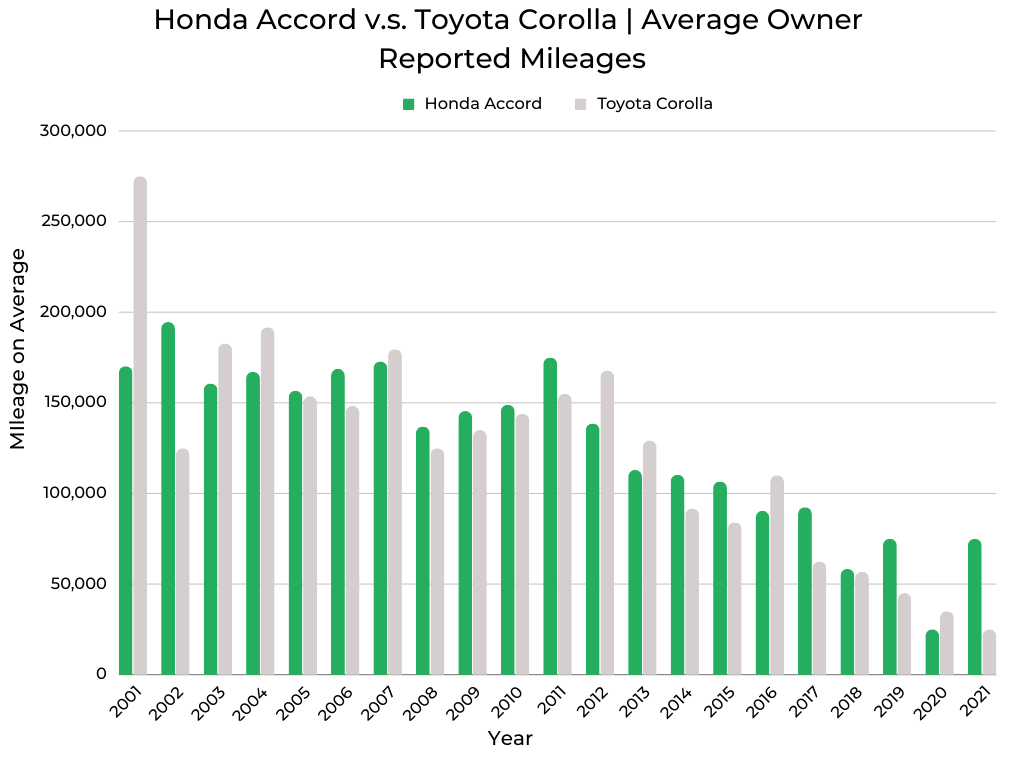
When looking at mileage history, the Accord and Corolla become more closely matched again. FIXD owner surveys show that crossing the 150,000-mile mark is a regular occurrence for both vehicles, with several model years approaching 200,000 miles. The 2001 Corolla is the class overachiever, with reported mileage averaging almost 275,000 miles.
Let’s examine Accord and Corolla longevity by exploring listings on autotrader.com (November 20, 2023). Based on the 2001-2010 model years, 1,769 Accords and 1,103 Corollas are for sale nationwide. Of these, 249 Accords (14.1%) and 95 Corollas (9.4%) had 200,000 miles or more.
That’s not enough distinction to show which car has a greater longevity potential. Instead, this information and the owner survey data point to 150,000-200,000 miles being the most likely lifespan for both the Accord and the Corolla.
Can these cars go beyond 200,000 miles? Of course, but this is an exception, not a sure thing. Keep in mind that a vehicle’s lifespan is impacted by maintenance and accident-free driving.
Review the individual articles on the best and worst years of the Honda Accord and Toyota Corolla for a more thorough look at longevity.
2023 Honda Accord Vs. Toyota Corolla | A Guide to Trim Levels & Optional Features
Trim Levels: Starting Prices
Looking at new Accords and Corollas begins with a review of starting prices. As mentioned, these cars represent different positions in the respective automaker’s model range, so don’t expect the trims and prices to align. However, understanding what these cars go for can help with the shopping process and budget.
For instance, if the $21,700 starting price for a base Corolla LE is at the top of your price range, you probably don’t want to waste time looking at the Accord. The cheapest Accord (the entry-level LX trim) begins at $27,295.
Similarly, shopping for the least-expensive hybrid uncovers an even more significant price gap. The Accord Sport Hybrid stickers are at $31,345, compared to $23,050 for the Corolla Hybrid LE. This is a difference of $8,295. Again, these cars don’t match regarding features, size, and other factors, but stepping up to an Accord comes with a steep price.
The most expensive Corolla is the Hybrid XLE Sedan ($26,850). Going the same route with the Accord means buying the Touring Hybrid trim at $37,340. What does the over $10,000 price difference get you? A more powerful engine, luxury goodies (like leather upholstery), and more room.
There’s another way to look at prices for these Hondas and Corollas. For less than the price of an Accord LX ($27,295), you can get a well-equipped Corolla XLE ($26,850). This is the car shopper’s paradox. Do you buy an entry-level “nicer” car or a loaded lesser model? There’s no right or wrong response. Only your comfort level and paycheck will provide the answer.
| 2023 Honda Accord Model | Starting Price |
| LX | $27,295 |
| EX | $29,060 |
| Sport Hybrid | $31,345 |
| EX-L Hybrid | $32,990 |
| Sport-L Hybrid | $33,325 |
| Touring Hybrid | $37,340 |
| 2023 Toyota Corolla Model | Starting Price |
| LE | $21,700 |
| SE | $24,140 |
| XSE | $26,850 |
| Hybrid LE | $23,050 |
| Hybrid SE | $25,490 |
| Hybrid SE Infrared Edition | $26,025 |
| Hybrid XLE | $26,850 |
| SE Hatchback | $23,155 |
| XSE Hatchback | $26,580 |
2023 | Honda Accord Vs. Toyota Corolla | Specifications | Safety, Interior, and Exterior Features
Sizing up the Honda Accord and Toyota Corolla involves a look at each vehicle’s specifications. Here’s what you need to know.
Vehicle Class & Body Style:
The Accord and Corolla have one characteristic in common: they’re both considered mid-size sedans, according to the U.S. Environmental Protection Agency (EPA). But this is where the similarities stop. With at least 102.8 cubic feet inside, the Accord has a substantially larger cabin than the 88.6 cubic feet inside a Corolla sedan.
However, for those who like the convenience of five doors, the Corolla does offer a hatchback body style, something that’s been unavailable with the Accord since the 1980s. Yet with 84.6 cubic feet, the Corolla Hatchback is even smaller than its four-door stablemate.
Later in the article, I’ll explain how these differences in passenger volume translate into interior dimensions.
| Class | Mid-Size Sedan | Mid-Size Sedan/Hatchback |
| 4-Door Sedan | LX, EX, Sport Hybrid, EX-L Hybrid, Sport-L Hybrid, Touring Hybrid |
LE, SE, XSE, LE Hybrid, SE Hybrid, SE Infrared Edition Hybrid, XLE Hybrid |
| 5-Door Hatchback | N/A | SE Hatchback, XSE Hatchback |
Powertrain:
Engine Options & Specifications:
It’s easy to sum up what’s under the hoods of Accords and Corolla in one sentence. Both automakers like hybrids, but Toyota isn’t keen on turbos like Honda.
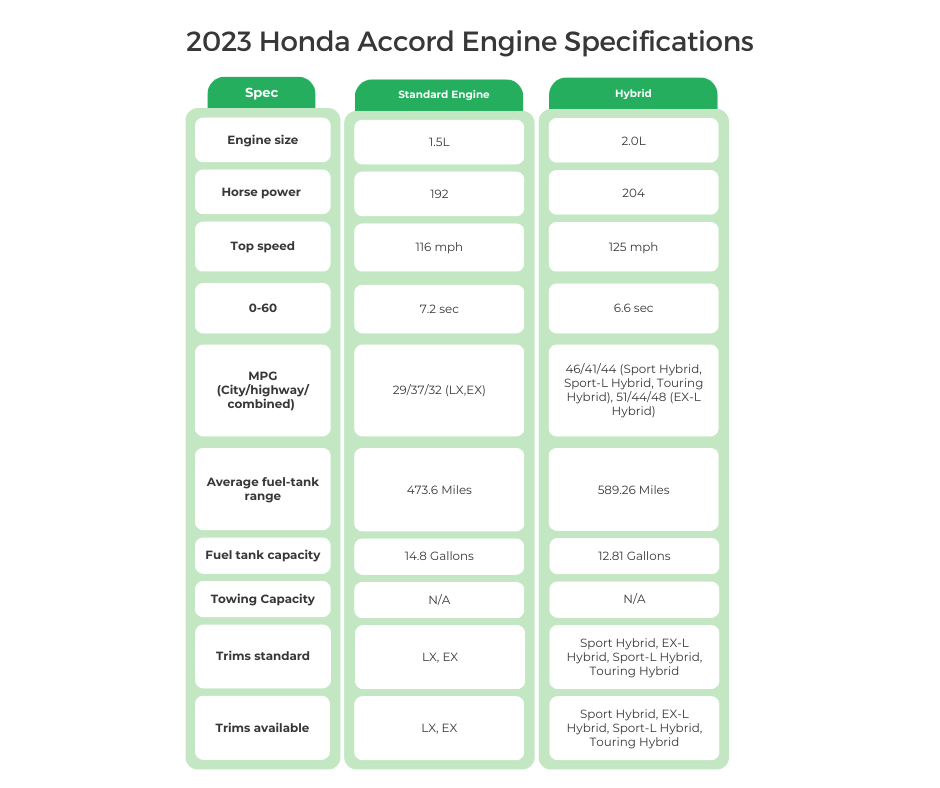
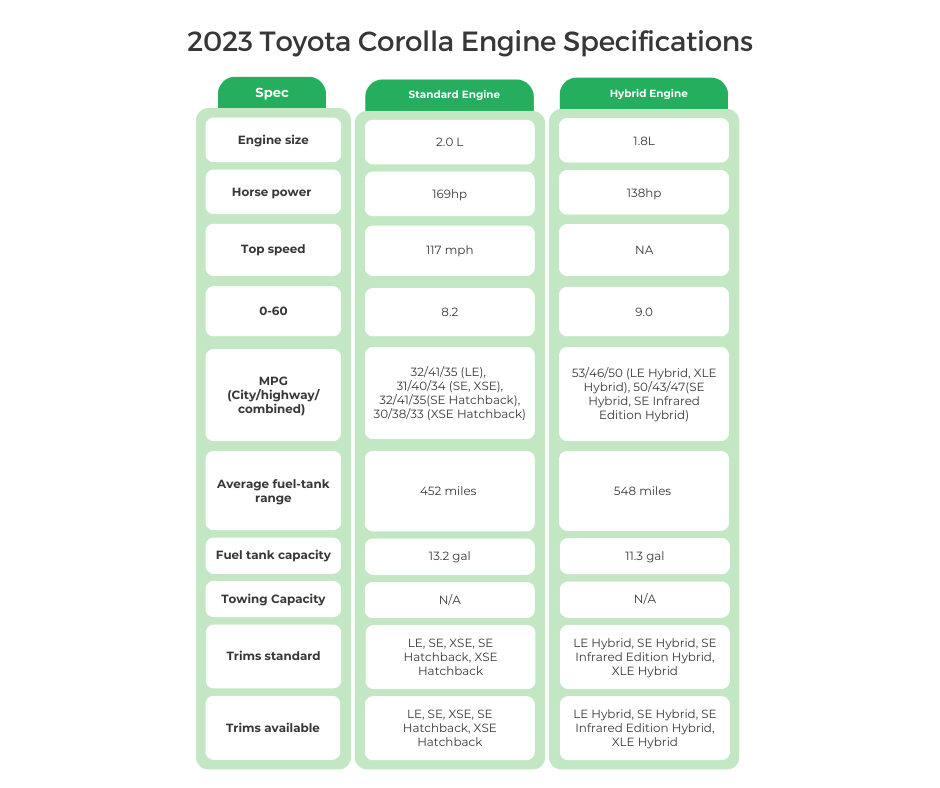
Honda gives the base Accord a 192-horsepower turbocharged four-cylinder engine, enabling this Honda to reach 60 mph from zero in an almost zippy time of 7.2 seconds. Meanwhile, the base engine for the Corolla befits an entry-level vehicle. It’s a plain-Jane 169-horsepower 2.0-liter four-cylinder powerplant (no turbos here) that meanders to 60 mph in 8.2 seconds. A one-second gap may not seem like much difference, but you’ll notice it behind the wheel.
While both manufacturers use hybrids, they take separate paths with how the technology is used. Honda engineered the Accord Hybrid for a blend of performance and economy. Its 6.6-second time for a 60 mph run is impressive, especially for a mainstream family sedan. Equally as remarkable is the ability to squeeze up to 51 miles out of a gallon of gas from a vehicle this size.
On the other hand, performance is an afterthought with the Corolla Hybrid. Its 0-60 mph time (9.0 seconds) is “pokey” at best. But that’s OK; its fuel economy, at up to 53 mpg, is notable, especially from a car that’s not an econobox.
One way to explain the price difference between the Accord and Corolla for the 2023 model is what’s in the respective engine bays.
Transmission Options & Specifications:
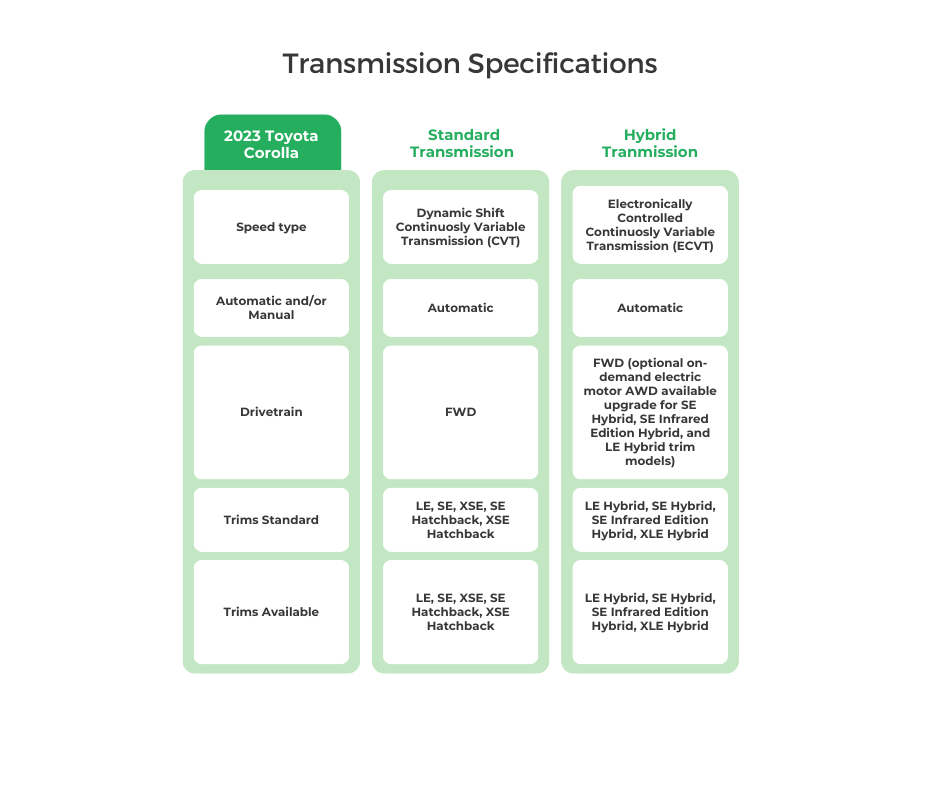
Honda and Toyota read from the same playbook when it comes to transmissions for the Accord and Corolla. Both rely on a continuously variable transmission (CVT) for versions with a conventional gasoline engine. While the CVT self-shifts like a traditional automatic transmission, it depends on a belt system versus individual gears. Honda and Toyota use an electronic CVT (eCVT) for the hybrid versions of these cars.
See the “Tech Talk” section below the charts to learn about CVTs and eCVTs.

TECH TALK: CVTs
A continuously variable transmission (CVT) does not use gears like a typical automatic transmission. Instead, it has two pulleys connected by a belt. One pulley connects to the engine, and the other connects to the wheels. The belt transfers the power between the pulleys. This setup allows the pulleys to continuously change positions as needed. The CVT automatically adjusts the pulleys as required, providing smooth and efficient power delivery.
An electronic continuously variable transmission (eCVT) uses electronic controls and electric motors to vary gear ratios instead of a belt and pulley system. Unlike a regular CVT, an eCVT has no physical pulleys or belts—the gear ratio is adjusted seamlessly by controlling the speeds of electric motors and generators. This electronic control allows faster, smoother gear ratio changes compared to a traditional CVT. An eCVT also provides more flexibility, needing less space and having fewer moving parts.
Drivetrain:
Honda lets you have any drivetrain with the Accord, as long as it’s front-wheel drive. There’s no other choice. On the contrary, Toyota has an all-wheel drive option for the Corolla Hybrid Sedan. Otherwise, Corollas are also front-wheel drive.
| 2023 Honda Accord Wheel Drive | FWD | AWD | RWD |
| LX | S | ||
| EX | S | ||
| Sport Hybrid | S | ||
| EX-L Hybrid | S | ||
| Sport-L Hybrid | S | ||
| Touring Hybrid | S |
| 2023 Toyota Corolla Wheel Drive | FWD | AWD | RWD |
| LE | S | ||
| SE | S | ||
| XSE | S | ||
| Hybrid LE | S | E | |
| Hybrid SE | S | E | |
| Hybrid SE Infrared Edition | S | E | |
| Hybrid XLE | |||
| SE Hatchback | S | ||
| XSE Hatchback | S |
U = Available in upgrade
E = Electronic On-Demand AWD (Electric motor in Hybrid trims with on-demand AWD capabilities), available as an optional upgrade
Safety:
NHTSA Safety Ratings
Unsurprisingly, the Accord and Corolla are used chiefly for family transportation. FIXD surveys report that 52% of Accord owners use their cars to haul loved ones. It’s 43% for those with a Corolla in the driveway. Likewise, these cars are called upon for other tasks: commuting and long-distance driving (collectively referred to as “lots of driving” in the owner surveys). These activities account for 42% and 37% of the Accord’s and the Corolla’s use, respectively.
All this time behind the wheel translates into a need for driving a safe vehicle. Both automakers readily understand that to successfully sell a “family car” in the U.S., it has to get a thumbs up for safety testing.
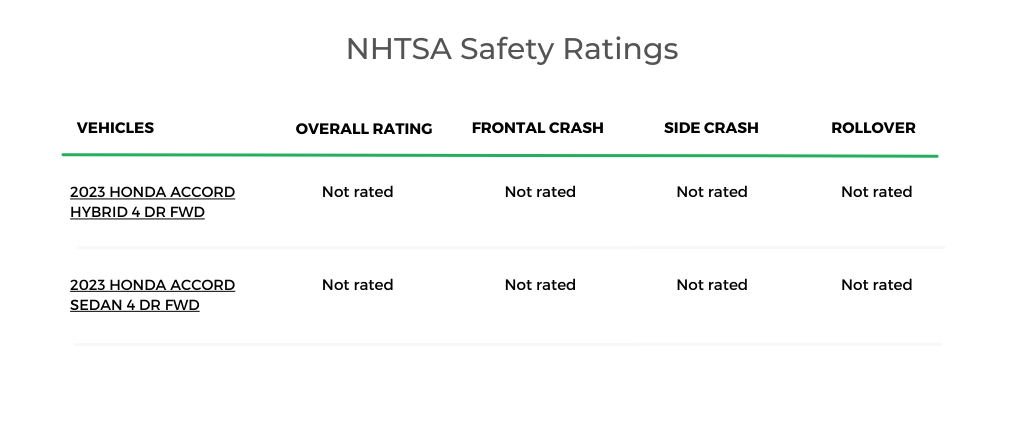
There’s been no crash testing by the National Highway Traffic Safety Administration (NHTSA) for the 2023 Accord. This isn’t unusual because 2023 marks the first year of the 11th-generation Accord. Sometimes, government testing doesn’t happen until the second or third year of the new generation hits the market. So, for the moment, I can’t say how the latest Accord performs in government testing. Past models from recent years have done well, which is encouraging. But we’ll have to wait for definitive results.
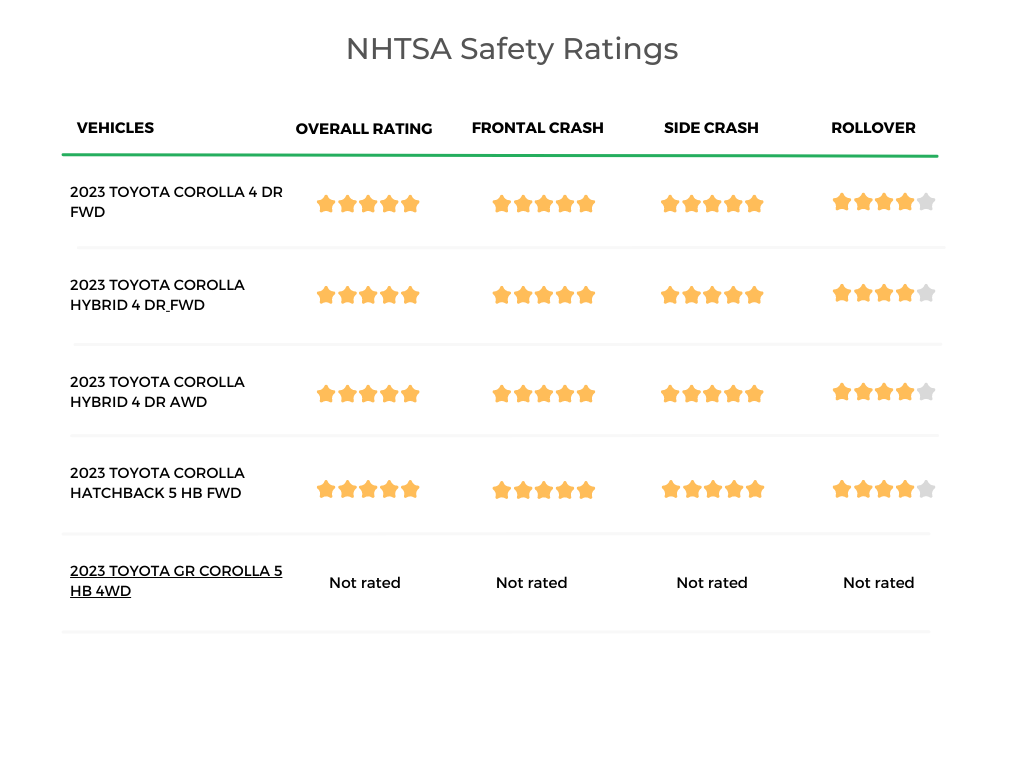
On the other hand, the 2023 Corolla aced in crash tests with NHTSA. Not only did it receive a perfect 5 (out of 5) in overall performance, but the frontal and side-impact tests were equally admirable. If there’s one area for improvement, it’s a 4 in rollover testing. Other cars in its class, like the 2023 Honda Civic, received a perfect rating in this area.
IIHS Awards:
The Insurance Institute for Highway Safety (IIHS) takes a somewhat different approach to safety testing. In particular, it focuses on its small frontal overlap crash test, which the organization feels represents a more real-world scenario (a single car running into a fixed object). IIHS also looks at side impact crashes, roof strength, headlight effectiveness, and advanced driver safety technologies (like automatic emergency braking).
While tested vehicles receive a Good, Acceptable, Marginal, or Poor grade, the true measure comes if a car gets a Top Safety Pick or Top Safety Pick+ designation. If “Good” is a “B” grade, Top Safety Pick notches things up to an “A-,” and the Top Safety Pick+ signifies an “A+.”
With a Top Safety Pick+ award, the 2023 Honda Accord edges out the Top Safety Pick achievement of the 2023 Toyota Corolla.
| IIHS Award | Tested Vehicle | ||
| 2023 Honda Accord | MidSIZE CAR / 4-DOOR SEDAN | 2023 TOP SAFETY PICK + | 2023 Honda Accord EX 4-door |
| 2023 Toyota Corolla | 4 Door Sedan | 2023 TOP SAFETY PICK | 2019 Toyota Corolla SE 4-door hatchback, 2022 Toyota Corolla LE 4-door sedan |
| Hatchback | 2023 TOP SAFETY PICK | 2019 Toyota Corolla SE 4-door hatchback | |
Airbags & Head Restraints:
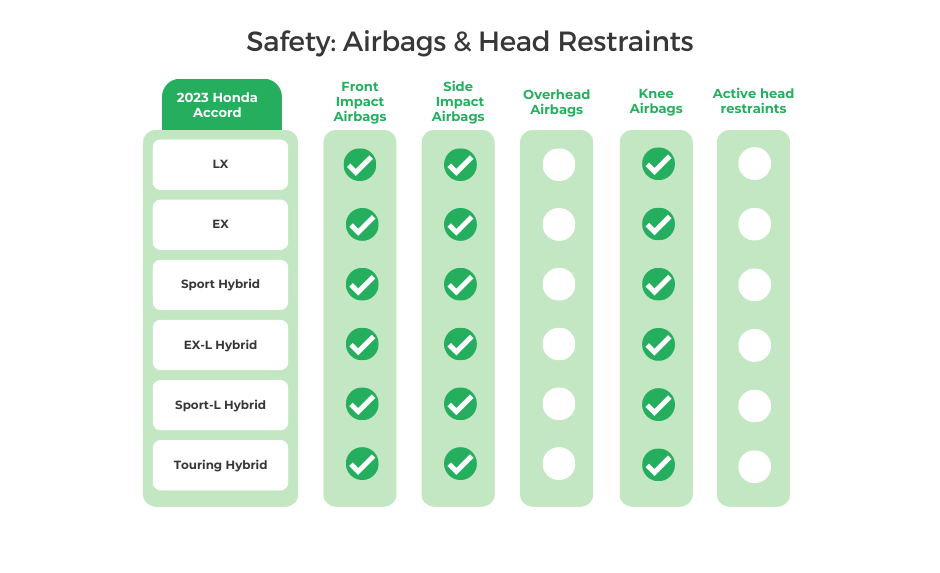
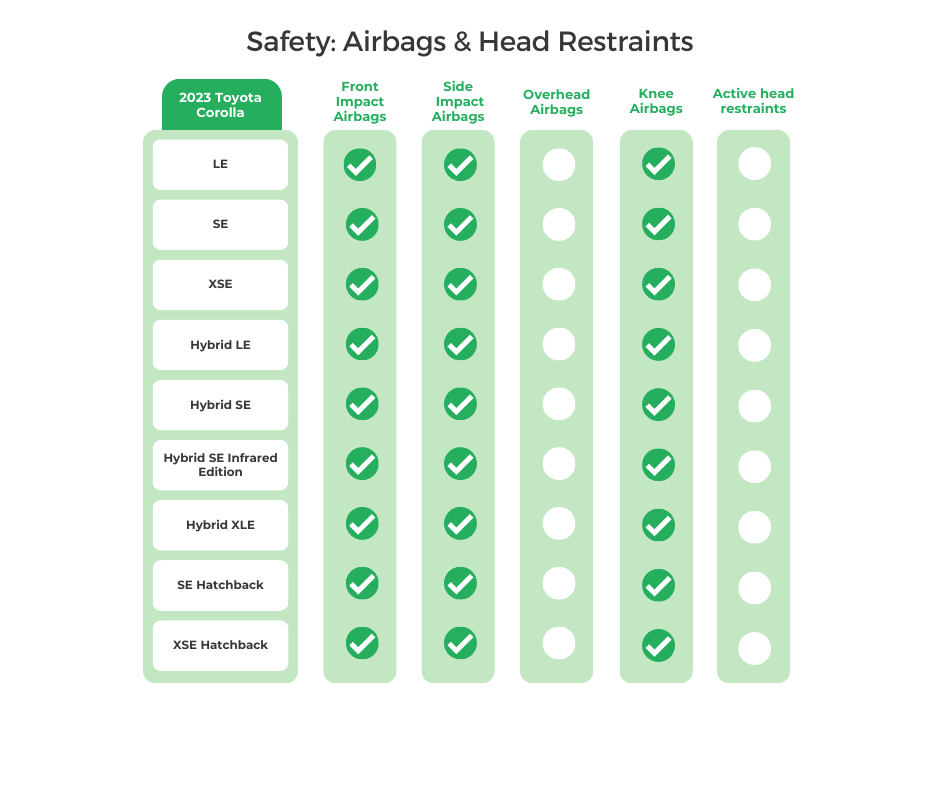
Airbags are a staple of every family car, so naturally, they’re abundant in the Accord and Corolla. In addition to front-row airbags, both vehicles have side curtain units that protect occupants in case of a side collision or rollover. Honda and Toyota get bonus points for equipping the second row with side impact airbags, a feature once reserved for pricier cars. The Accord and Corolla have front knee airbags that position occupants to minimize injuries during a frontal collision. However, the Accord has knee airbags for both front passengers (the Corolla only has it for the driver).
Neither the Accord nor the Corolla comes with overhead airbags. This newer technology replaces traditional front-row units (steering wheel and dashboard) with overhead devices. Active head restraints are usually found in specialty and high-end vehicles to minimize whiplash injuries. Mainstream cars like the Accord and Corolla aren’t usually equipped with this feature.
Semi-Autonomous Driving:
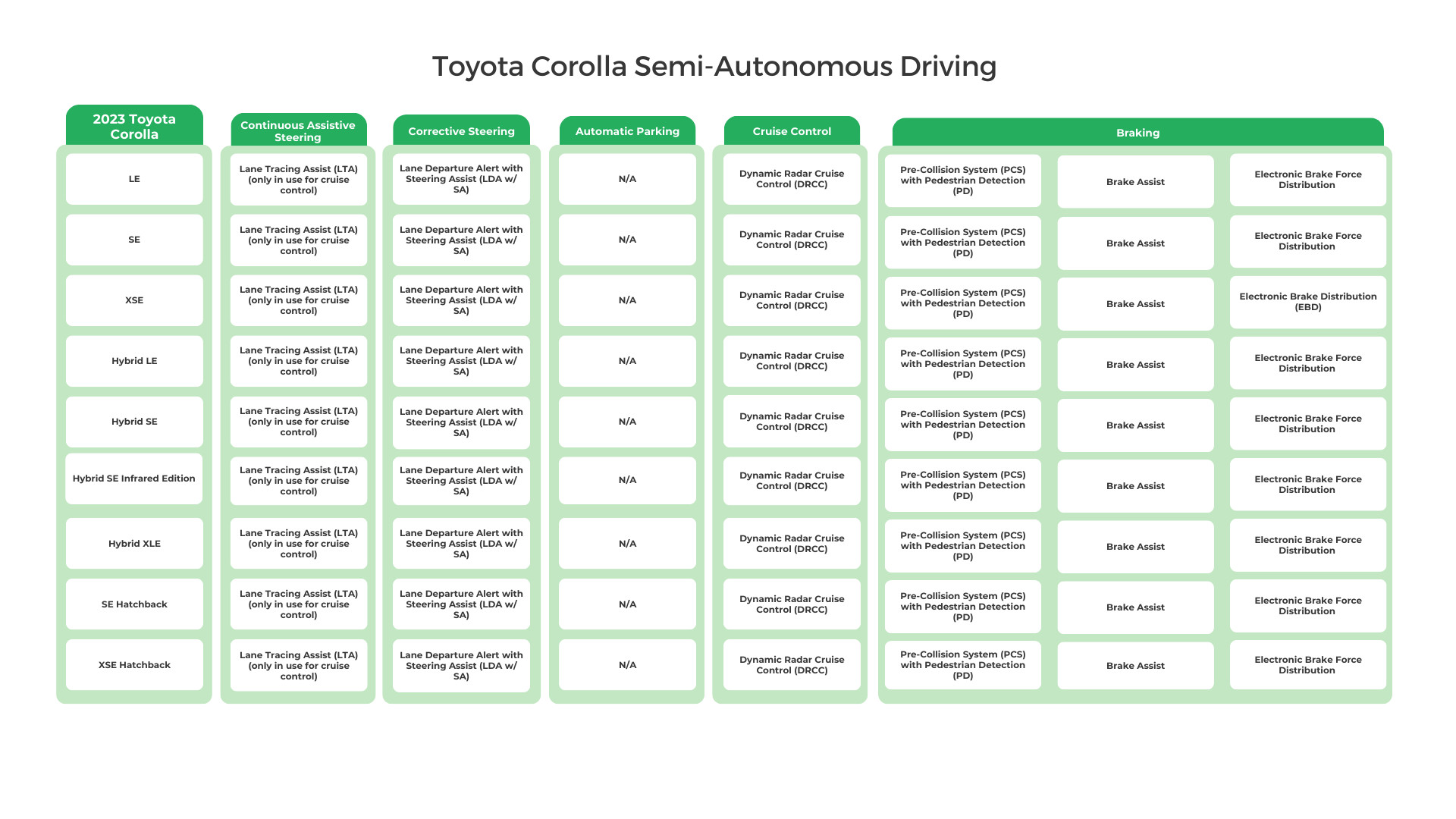
Don’t expect high-tech features like hands-free driving in the Accord or Corolla. But these cars do have some elements of semi-autonomous driving. Primarily, these Hondas and Corollas come with adaptive cruise control (ACC), or a fancier-sounding Dynamic Radar Cruise Control in Toyota-speak.
ACC automatically adjusts a vehicle’s speed to maintain a safe distance from the car in front. It uses sensors to detect how fast and how close the next vehicle is, then applies brakes or accelerates accordingly to keep the car a safe distance away. A driver must still hold the steering wheel and always be alert.
The Accord and Corolla include lane-keeping assist technology (although the Corolla’s system is active only with ACC) and road departure mitigation (which signals the driver and applies subtle steering correction).

Driver Warning Systems & Telematics:
Advanced driver assistance systems (ADAS) are standard in most new cars. Honda bundles this tech under the Honda Sensing name, while Toyota calls its system Safety Sense (Toyota Safety Sense).
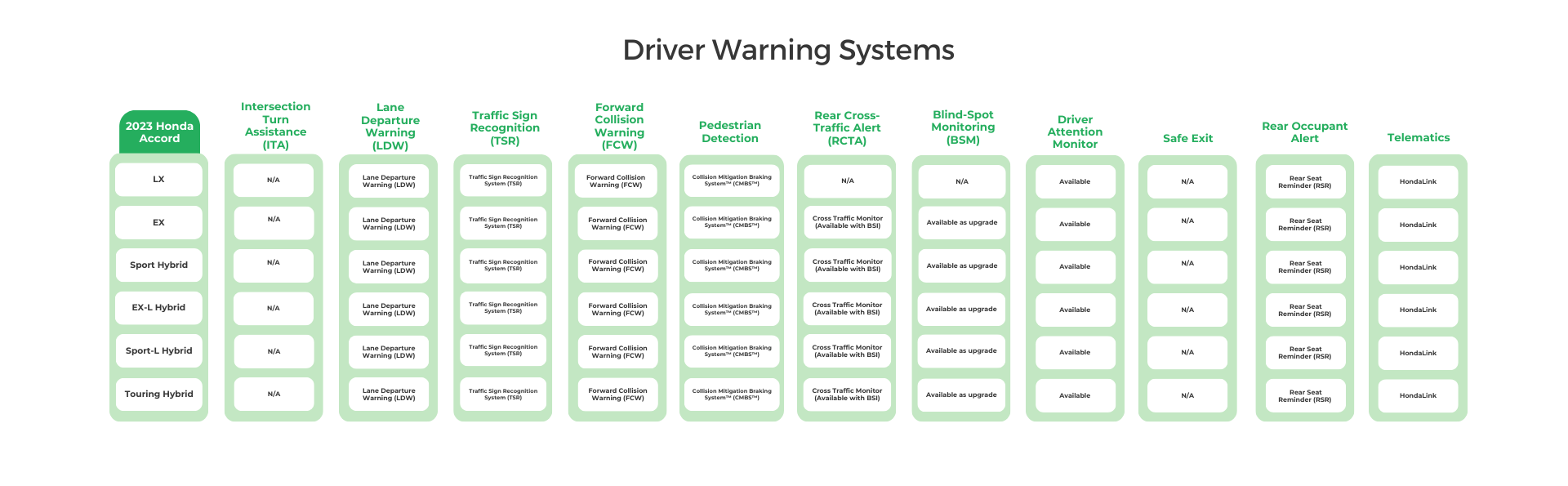
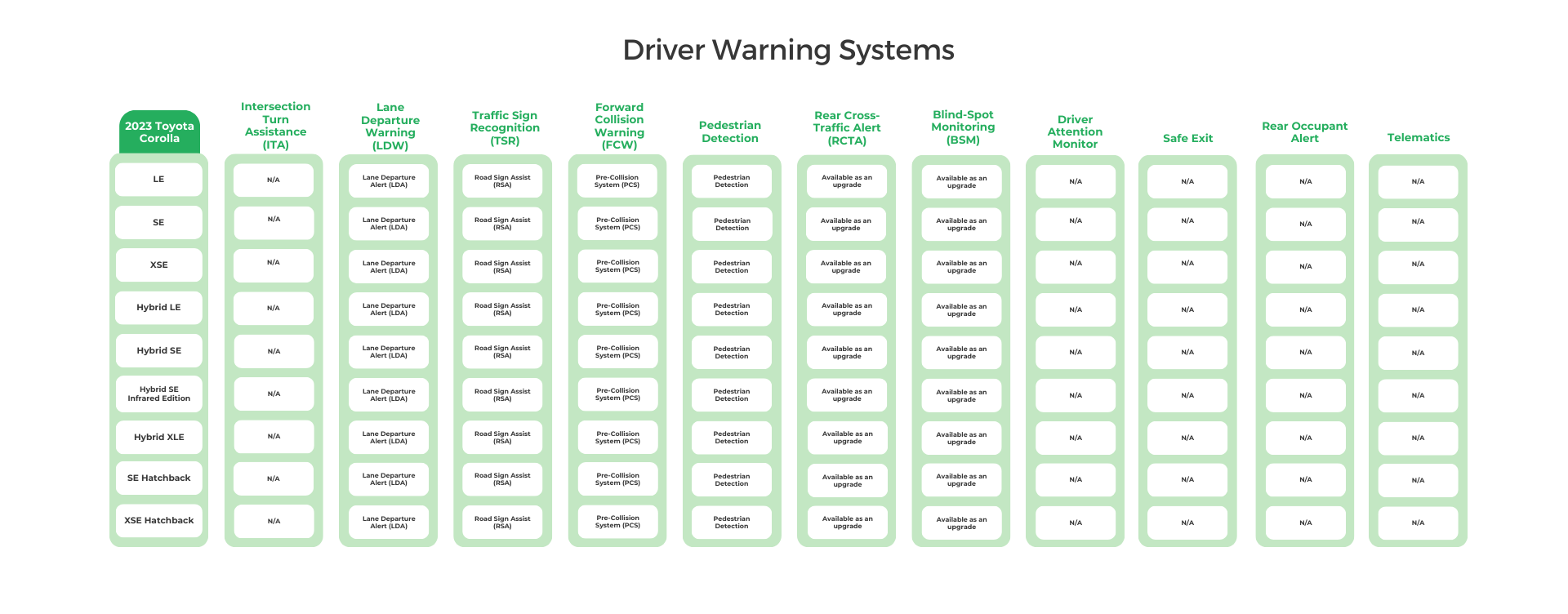
In the 2023 Accord and Corolla, these systems at least include forward collision warning (FCW), automatic emergency braking (AEB) with pedestrian detection, lane departure warning (LDW), and traffic sign recognition (TSR).
However, other driver-assist features are reserved for the options list or pricier trims. Neither base models of the Accord nor the Corolla get blind-spot monitoring (BSM) and rear cross-traffic alert (RCTA). This helpful tech is extra with all other Accords and most Corolla trims (BSM and RCTA are standard on select Corolla editions).
If ADAS technology appears like alphabet soup, check out an effort from AAA, Consumer Reports, J.D. Power, and other groups working to standardize the terminology for these systems.
Road Visibility Features:
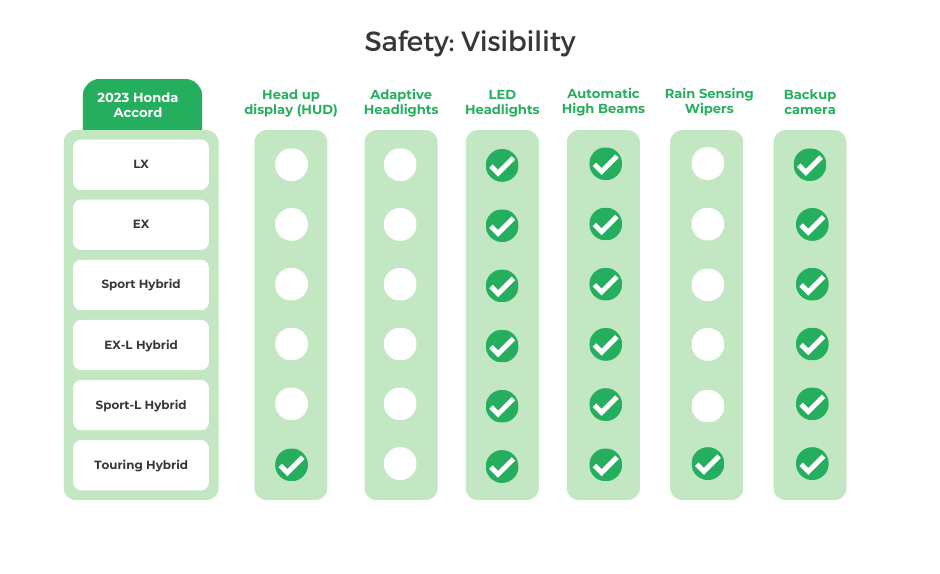
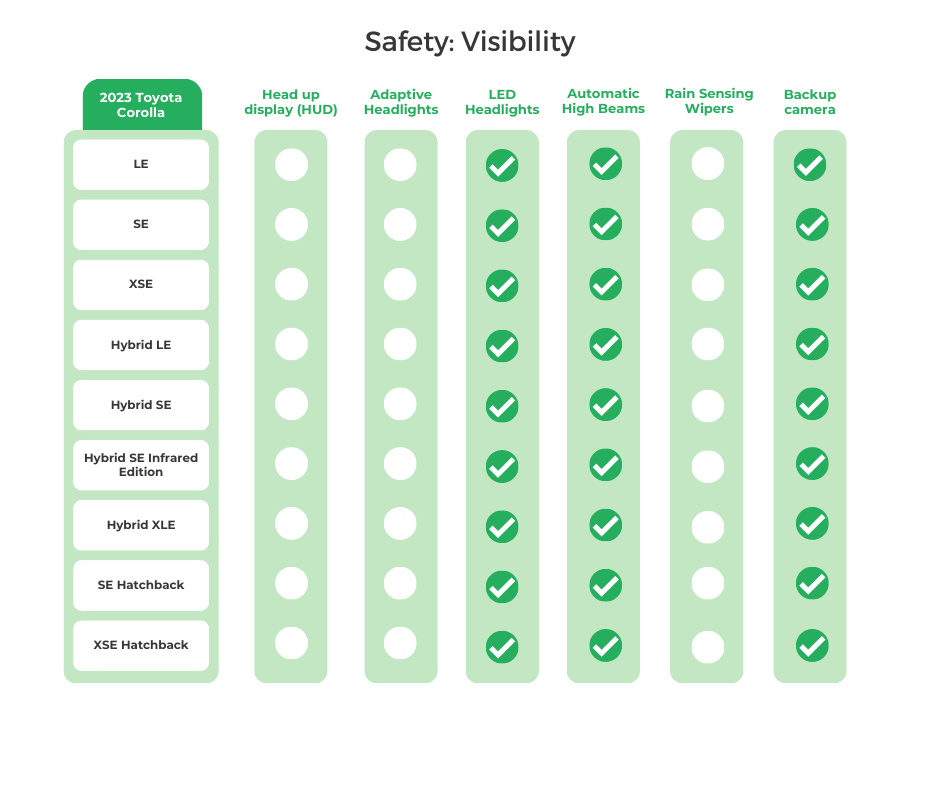
LED headlights provide brighter, whiter light and use less energy compared to standard halogen headlights. They’re standard on all Accord and Corolla trims. Automatic high beams are included, too.
But you’ll have to select the top-tier Accord (the Touring Hybrid) for more advanced visibility features. This Honda gets a head-up display (which projects important driving information like speed and navigation directions onto the windshield in front of the driver) and rain-sensing windshield wipers.
Interior:
Interior Features:
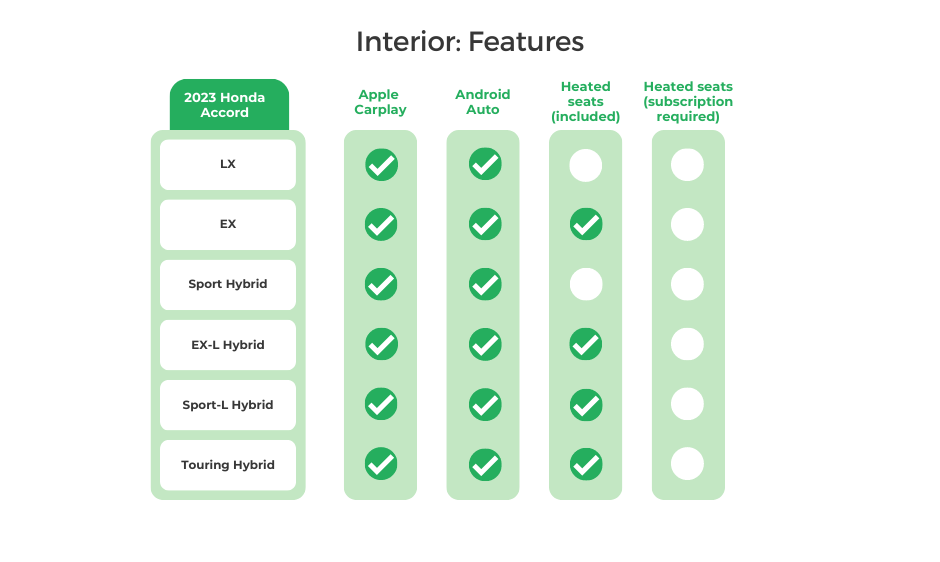
Honda and Toyota realized that cell phones are necessary for today’s drivers, so Apple CarPlay and Android Auto are standard on all 2023 Accord and Corolla trims.
However, you’ll have to be more selective if heated front seats are a must-have. They’re standard with all Accord trims except the LX and Sport Hybrid. Meanwhile, only two Corolla Sedan editions (XLE and Hybrid XLE) and one hatchback version (XSE) get this feature.
And speaking of heated seats, some automakers offer this feature through a subscription service. This hasn’t yet happened in the U.S., but in certain countries, BMW offered heated seats for a monthly fee. The advantage is you can shut off the service during warm months, but you’ll need to keep paying (or pay a one-time upfront fee) to activate the heated seats. Recently, BMW announced it was backing away from this practice. Moving forward, the automaker will only charge a subscription for software-based services (like upgraded navigation). Hardware-based features will be part of the vehicle’s initial purchase price.
One industry study shows mixed results for consumer acceptance of features on demand (FoD), with about one-fifth not even being aware of the concept.

Interior Dimensions:
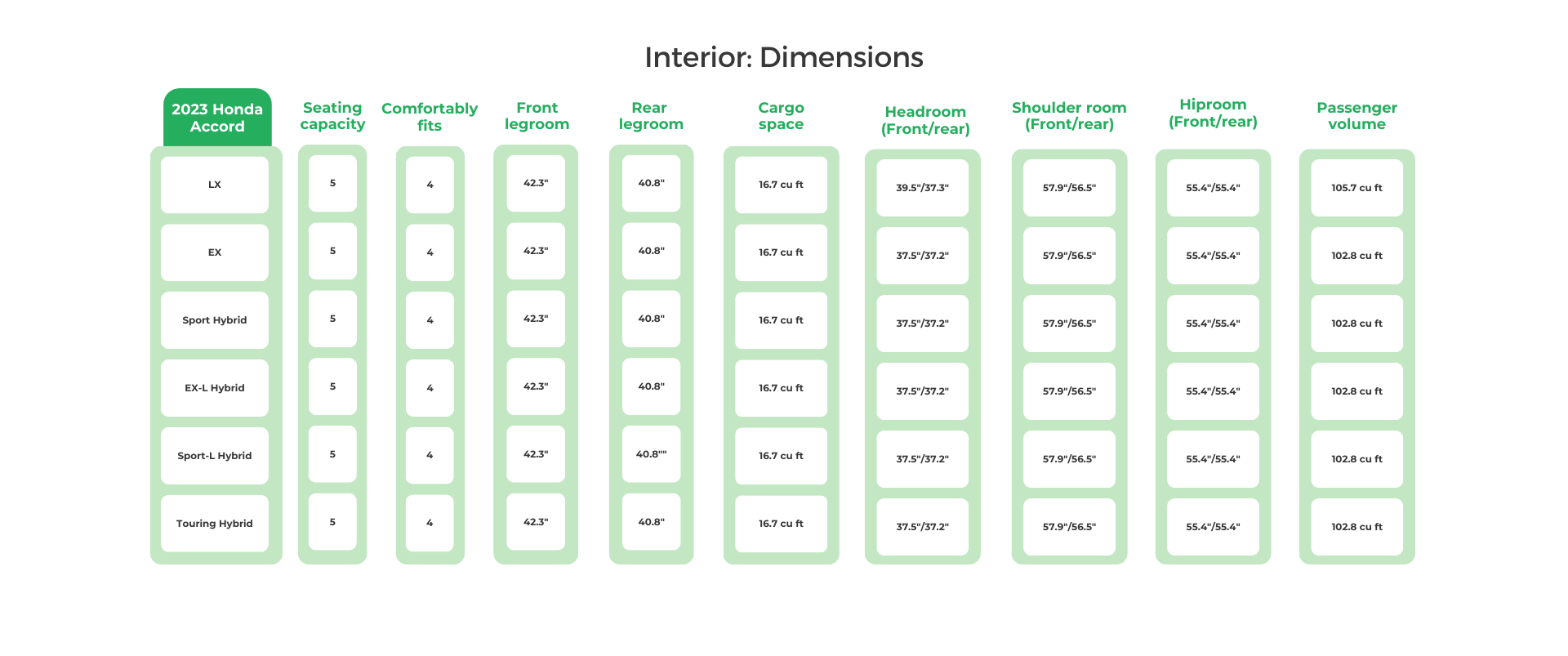
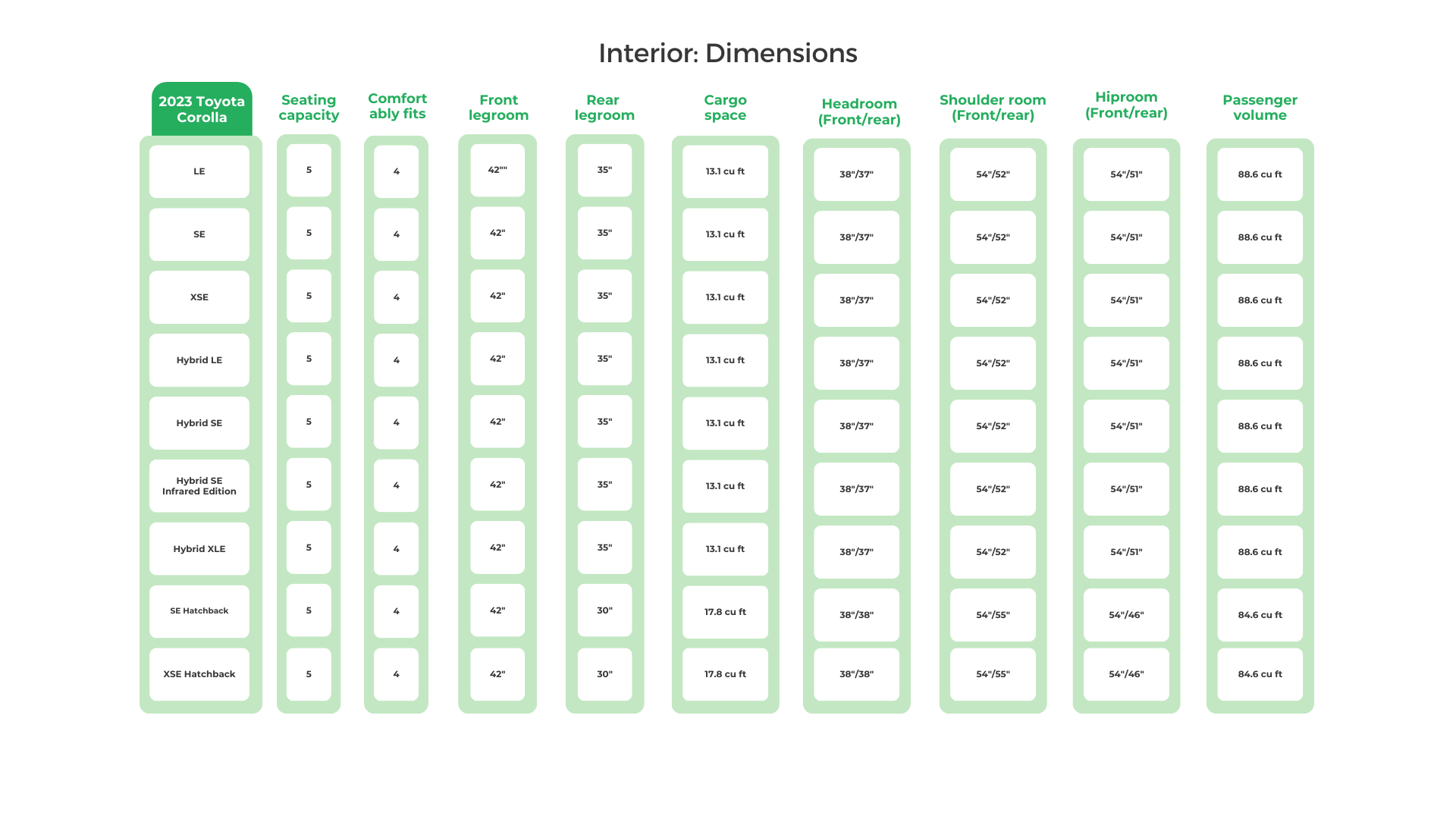
If maximum rear legroom is mandatory, you’ll need to cough up the bucks for the Accord. The extra 5.8 inches in the Accord’s backseat over the Corolla Sedan is substantial. This difference is even more significant against the Corolla Hatchback, which has only 30 inches of rear legroom (the Accord has 40.8 inches). Similarly, the Accord excels with greater shoulder and hip room in both rows.
However, the front seat is another matter, as the spaces in these cars are almost identical. The Accord has 42.3 inches of front legroom, compared to 42 inches for the Corolla (Sedan and Hatchback).
There’s also less contrast with cargo space. The Accord’s trunk is 3.6 cubic feet larger than the Corolla Sedan. At the same time, the Corolla Hatchback’s 17.8 cubic-foot cargo area just tops the Accord’s 16.7 cubic-foot trunk.
Exterior:
Exterior Features:
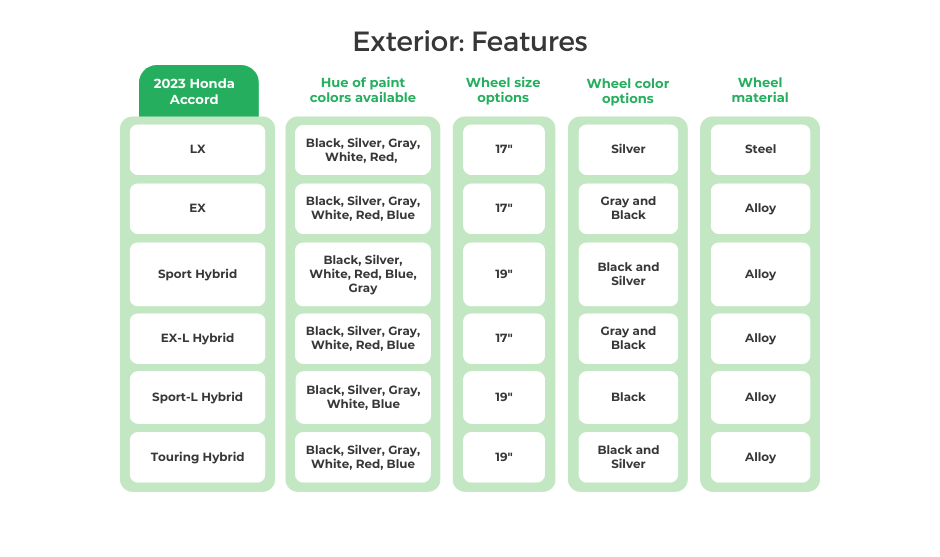
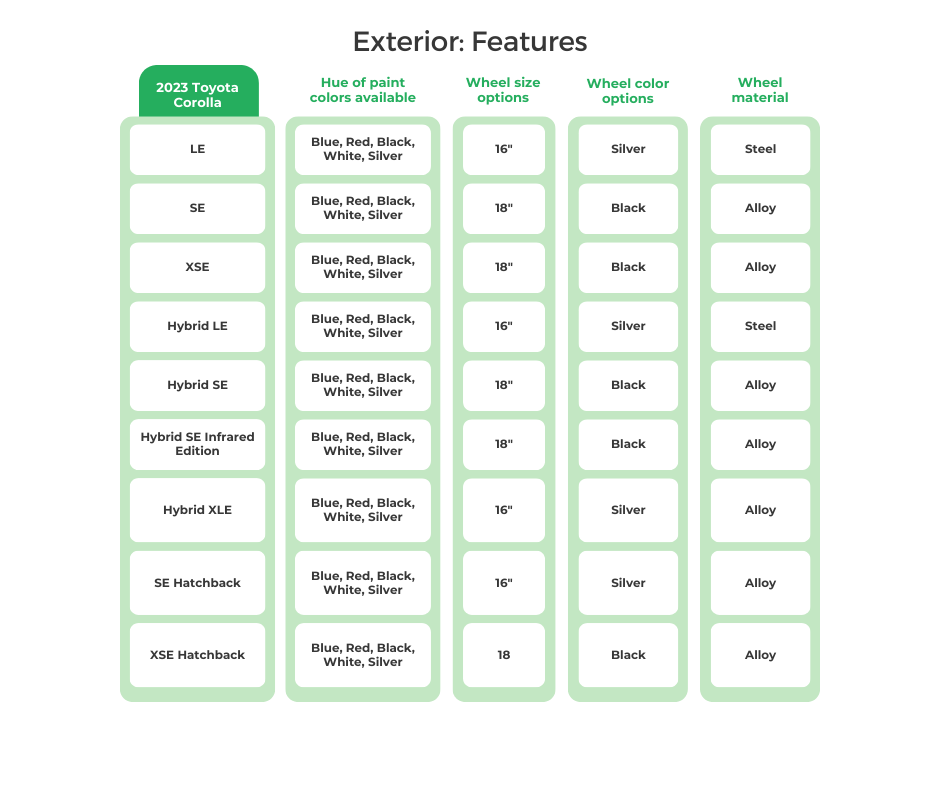
Wheels may also be an afterthought for many car buyers. But wheel size can impact ride quality. Larger rims can translate into better traction and cornering but may result in a bumpier ride. Bigger wheels also offer better aesthetics by filling out the wheel wells more completely. This is why the higher the trim, the larger the wheel. Different materials (steel or alloy) and finishes also help separate the wheels among the various trim levels.
Color choices for family cars like the Accord and Corolla are filled with the typical monotone lineup: black, white, gray, and silver. If that’s too boring, there are options for blue or red. The relatively more exciting options lie with the Corolla Hatchback: Finish Line Red or Inferno orange.
Exterior Dimensions:
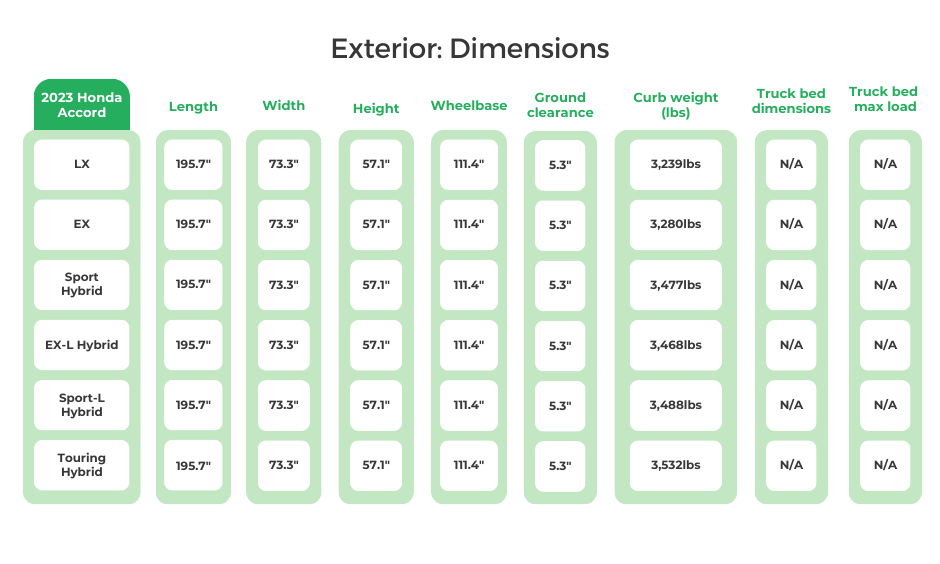
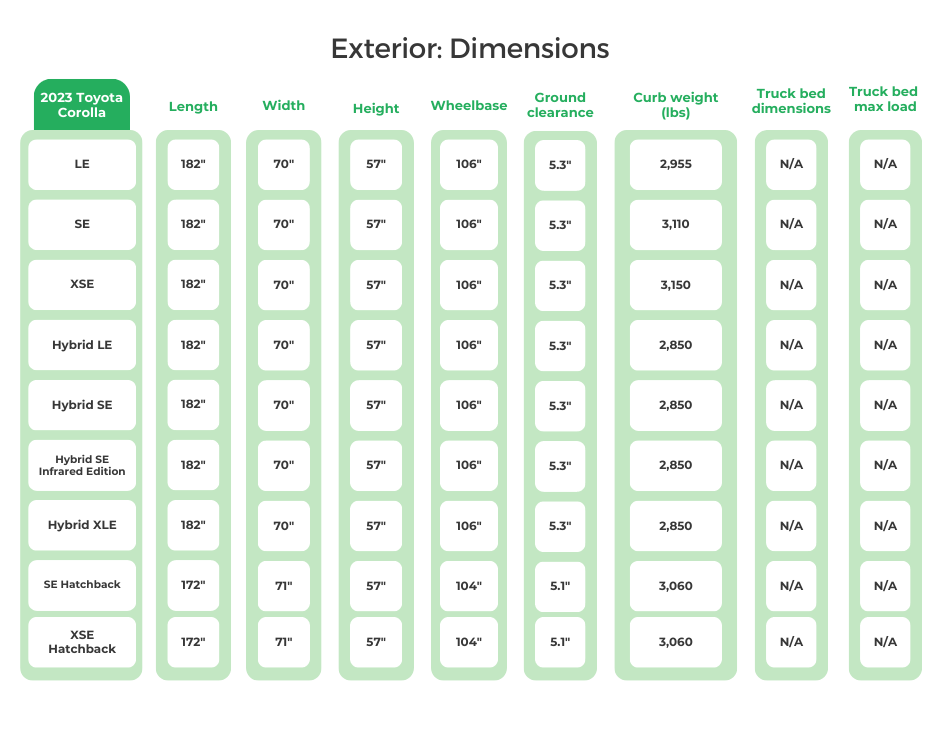
The Honda’s interior space advantages obviously come from a bigger exterior. At 195.7 inches long, the Accord is substantially larger than the 182.0-inch Corolla Sedan. Compared to the 172-inch Corolla Hatchback, this Honda is just shy of being two feet longer. Of course, the Accord is wider (by more than three inches over the Corolla Sedan).
Owners who park in suburban lots and plus-sized garages may not care about these differences. However, someone who has to deal with compact parking spaces and cramped urban public garages will be concerned. The decision process needs to include where and how you use a car.
Yet, there’s another trade-offs to consider. The Corolla’s reduced length translates into a shorter wheelbase. So, its ride is choppier than the Accord (especially on less-even road surfaces, like highway expansion strips).
Warranty
At first glance, the factory warranty coverage appears identical. Both cars are protected by a three-year or 36,000-mile bumper-to-bumper warranty and five years or 60,000 miles of powertrain safeguards for the engine, transmission, and drive. There’s some difference with roadside assistance, as Honda provides an extra year and 11,000 more miles of coverage.
However, a closer inspection reveals something important to hybrid buyers. Honda protects the hybrid battery (sometimes called the traction battery) for eight years or 100,000 miles, while Toyota covers its hybrid batteries for ten years or 150,000 miles. It’s vital if you’re the car owner who buys a vehicle and keeps it for a long time.
| 2023 Honda Accord Factory Warranty Coverage: | 2023 Toyota Corolla Factory Warranty Coverage: | |
| Basic warranty: | 36 months/36,000 miles | 36 months/36,000 miles |
| Powertrain warranty: | 60 months/60,000 miles | 60 months/60,000 miles |
| Corrosion perforation warranty: | 60 months/unlimited miles | 60 months/unlimited miles |
| Air conditioning warranty: | 24 months/24,000 miles (A/C refrigerant) |
12 months/12,000 miles |
| Battery warranty: | 96 months/100,000 miles (Hybrid Battery) |
120 months/150,000 miles (Hybrid Battery) |
| Emissions warranty: | Federal: 36 months/36,000 miles California: 36 months/50,000 miles | Federal: 36 month/36,000 miles (defect), 24 months/24,000 miles (performance) California: 36 months/50,000 miles (performance) |
| Roadside assistance coverage: | 36 months/36,000 miles | 24 months/25,000 miles |
| Total unique recalls: | 0 | 1 |
Driver Experience | A Summary of The Top Honda Accord Vs. Toyota Corolla Reddit Posts:
There are active discussions on Reddit about how the Honda Accord and Toyota Corolla stack up. Here’s an overview of some of the conversations from r/whatcarshouldIbuy.
The Honda Accord is generally preferred over the Toyota Corolla for its superior driving dynamics, interior spaciousness, and ease of access. As one Redditor noted, the Accord “would be much easier to get in and out of compared to smaller cars, especially in parking lots,” emphasizing the importance of testing passenger entry and exit during a test drive. Additionally, another user preferred the Honda Accord, citing the way Honda drives compared to Toyota.
However, it was also pointed out that “if driving dynamics and space are not major factors, then the Corolla would be a suitable choice.” The Toyota Corolla remains a very practical option for buyers who don’t require a large amount of interior room or prioritize performance and handling over efficiency and value.
Who Should Buy These Cars: The Legacy of The Honda Accord and Toyota Corolla
Let’s face it: No one buys family cars like the Accord and Corolla for the sheer thrill of driving or enjoying cutting-edge technologies. These Hondas and Corollas are all about getting from point A to point B safely and with confidence and fuel economy. These qualities are needed for family hauling, commuting, and long-distance driving, as highlighted in the FIXD owner surveys.
But every car has its limits. Unscientific research suggests that the Accord and Corolla have a useful lifespan of 150,000-200,000 miles.
| Frequent Use Categories: | Honda Accord | How Useful? (Out of 5 Stars) |
Toyota Corolla | How Useful? (Out of 5 Stars) |
| Family Vehicle | ***** | **** |
| Lots of Driving (travel/long commute) | **** | ***** |
| Hauling/Towing | * | * |
| Office on Wheels | * | * |
| Sport/Fast Driving | * | * |
| Luxurious Driving | * | * |
| Outdoor/Off-Road | * | * |
Best & Worst Years | Honda Accord Vs. Toyota Corolla | 2001-2024
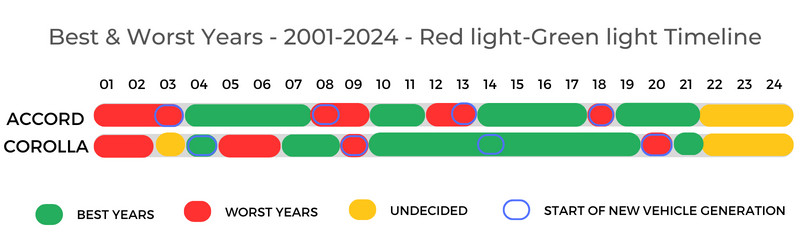
As the graphic shows, avoiding the earliest examples of the 21st-century Accords and Corollas is wise. Those looking for a low-budget car can start with the 2004 model year. In particular, the Accord offers the most options for older cars deserving of a thumbs up.
Starting with the 2010 model year, most of these Hondas and Toyotas are worthy buys. Just skip the 2012-2013 and 2018 Accord and avoid the 2020 Corolla. The advantage of having so many “green light” years to choose from is that it opens up a larger market. Having many choices is always a good thing when it comes to car buying.
I’ll also call attention to the undecided years (yellow) only because there isn’t enough information to give these editions a thumbs up or down.
Important Features Timeline | Honda Accord Vs. Toyota Corolla
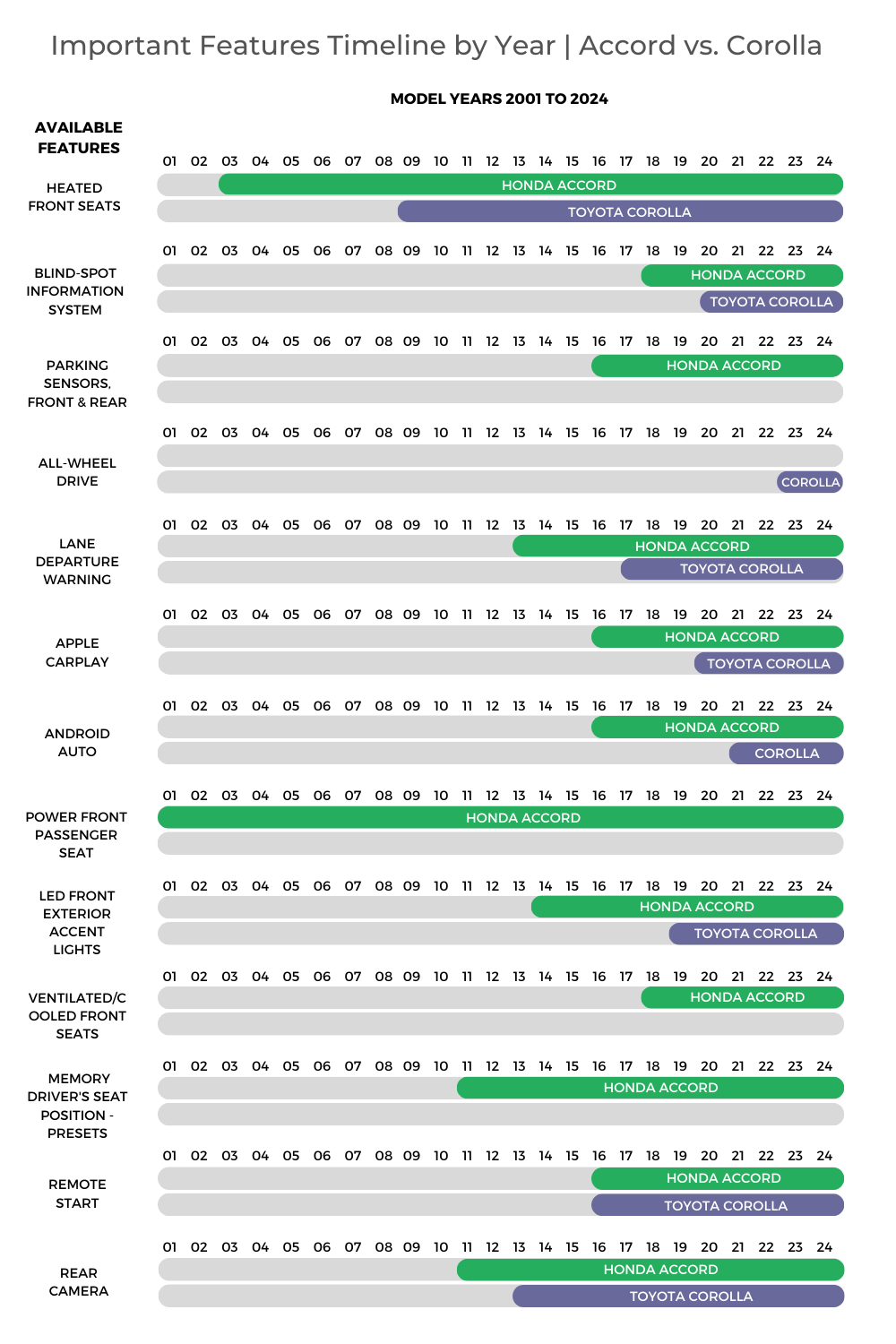
Given the Accord’s more premium status in Honda’s lineup, it’s typical to see this car get the latest features before the Corolla. In the auto business, the more expensive vehicles get the newest gadgets and gizmos before the entry-level cars. Eventually, many of these features trickle down to the automaker’s more affordable offerings.
At the same time, making specific deluxe equipment available in an economy car doesn’t make business sense. Toyota doesn’t expect too many Corolla buyers to want ventilated front seats or a driver’s memory system. The same can be said for a power front passenger seat. However, even buyers of wallet-friendly cars like the Corolla have certain expectations, such as for phone connectivity (Apple CarPlay and Android Auto).
One standout feature of the Corolla is the availability of all-wheel drive (AWD) for hybrid models. It’s an option more common to upscale small cars (like the BMW 3 Series and Mercedes-Benz C-Class) and something Honda doesn’t even bother with. Toyota also offers AWD on the larger Camry. It’s an unusual approach, but the company is wisely trying to keep its passenger cars competitive in an auto market dominated by crossovers and SUVs.
Maintenance Costs (Year-by-Year Average) | Honda Accord Vs. Toyota Corolla
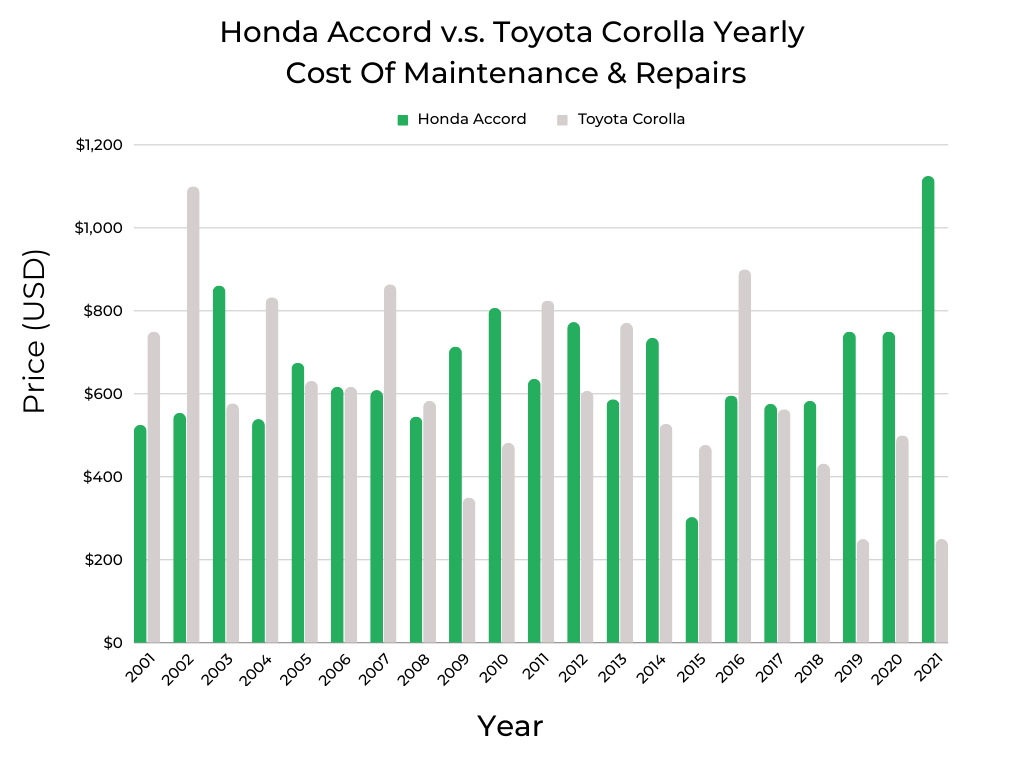
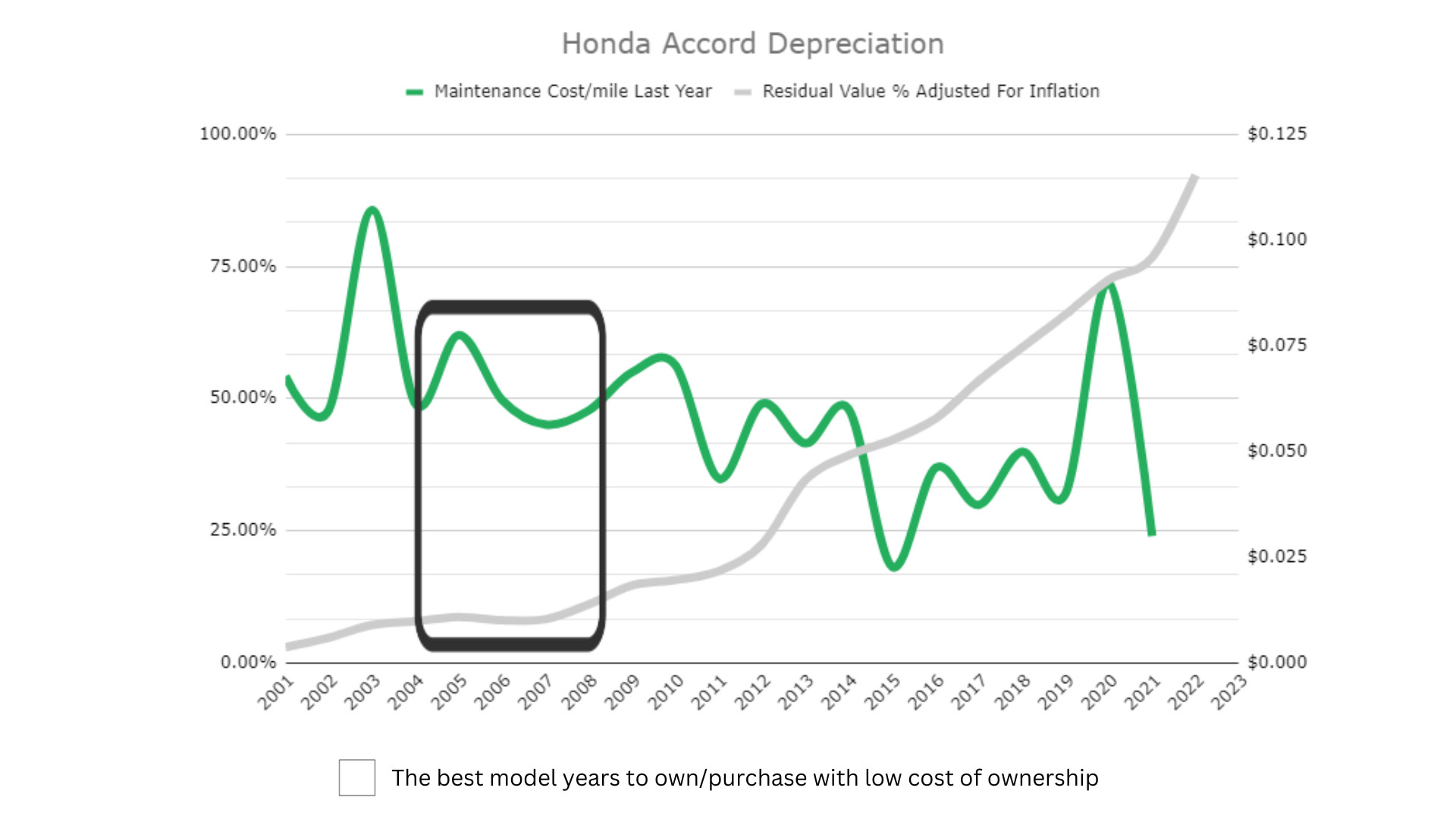
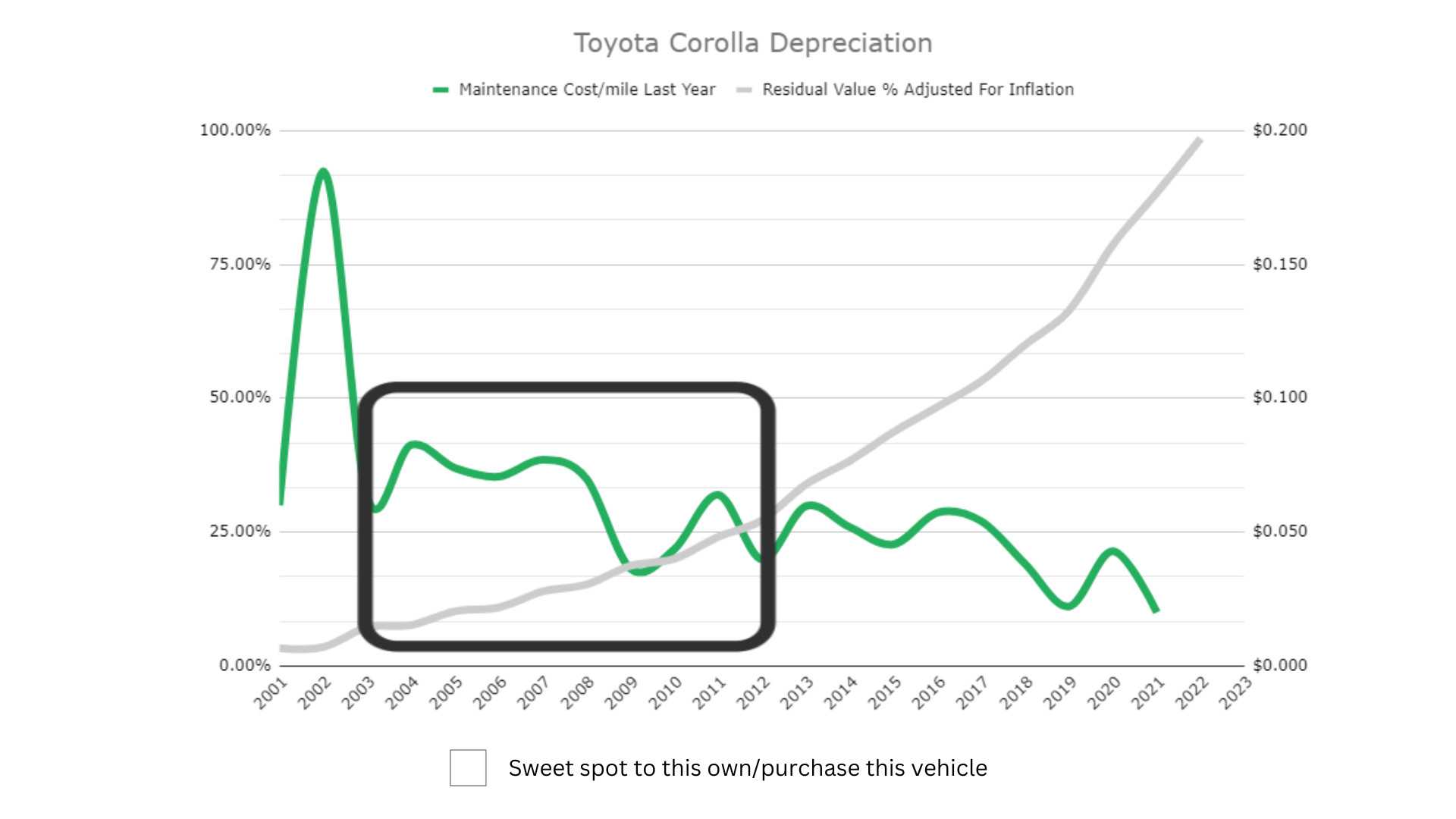
Overall, Accords and Corollas are inexpensive to maintain. FIXD survey data shows that owners in 2022 spent an average of $660 on their Accords and $614 for their Corollas. Each model has some years with above-average costs, but these tend to be older examples.
For instance, owners of 2003, 2010, and 2021 Accords and 2001-2002, 2004, 2007, 2011, 2013, and 2016 Corollas spent 20% above average for maintenance and repairs. It’s no coincidence that many of these high-cost model years got a thumbs down in the best and worst year comparisons.
Upkeep costs did spike for the 2021 Accord and 2016 Corolla, but a data dive shows these model years had high mileage. So, some of these costs are likely due to tire and brake replacement, which isn’t tied to reliability.
Review the best and worst years of the Honda Accord and Toyota Corolla to learn more about these vehicles’ maintenance and repair costs.
Safety Rating Comparison | Honda Accord Vs. Toyota Corolla
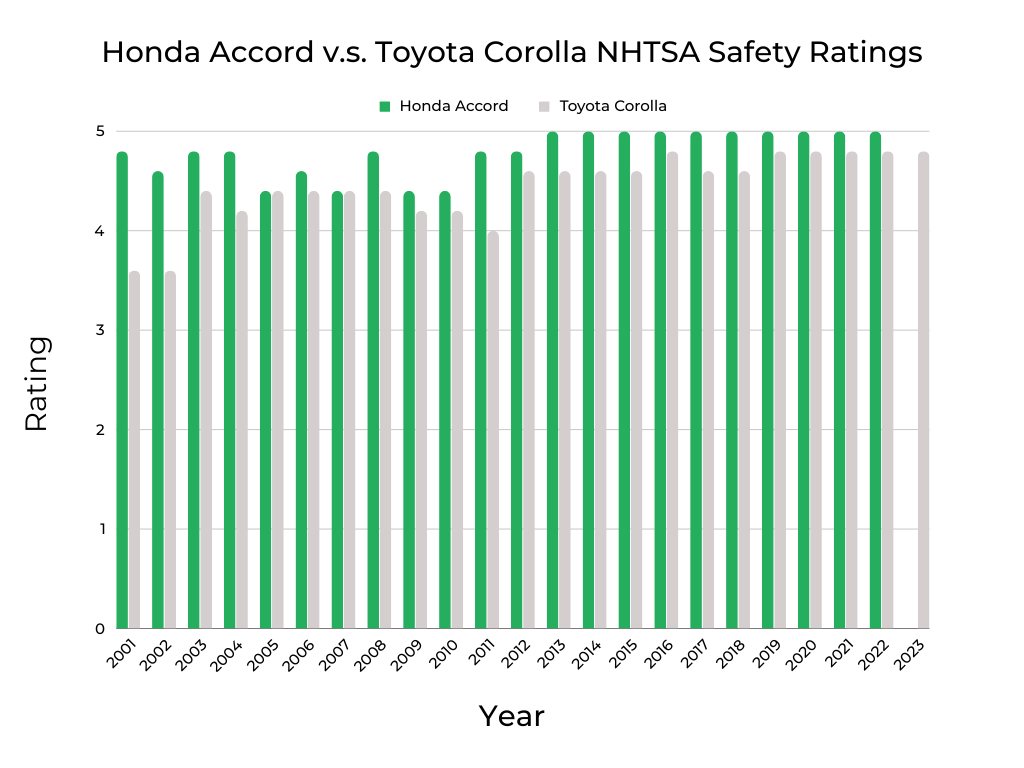
While perfection (5 out of 5) in crash testing is always ideal, any NHTSA score of at least 4 is still respectable. At no point in the 21st century has the Honda Accord dipped below this crucial benchmark. In fact, the chart shows that the Accord received a flawless rating for several years.
The Corolla also did well in government testing, with only the 2001 and 2002 tests falling below par. New (and more stringent) NHTSA testing for 2011 caused the Corolla results to drop for that model year, but the car’s testing improved the following year.
So, neither car is a slouch when it comes to safety. However, those who demand crash test excellence will want to steer towards the Accord. Its consistently better safety scores, especially in recent years, have strong appeal.
More details about crash test safety scores are covered in articles about the Honda Accord and Toyota Corolla.
Fuel Efficiency Comparison | Honda Accord Vs. Toyota Corolla
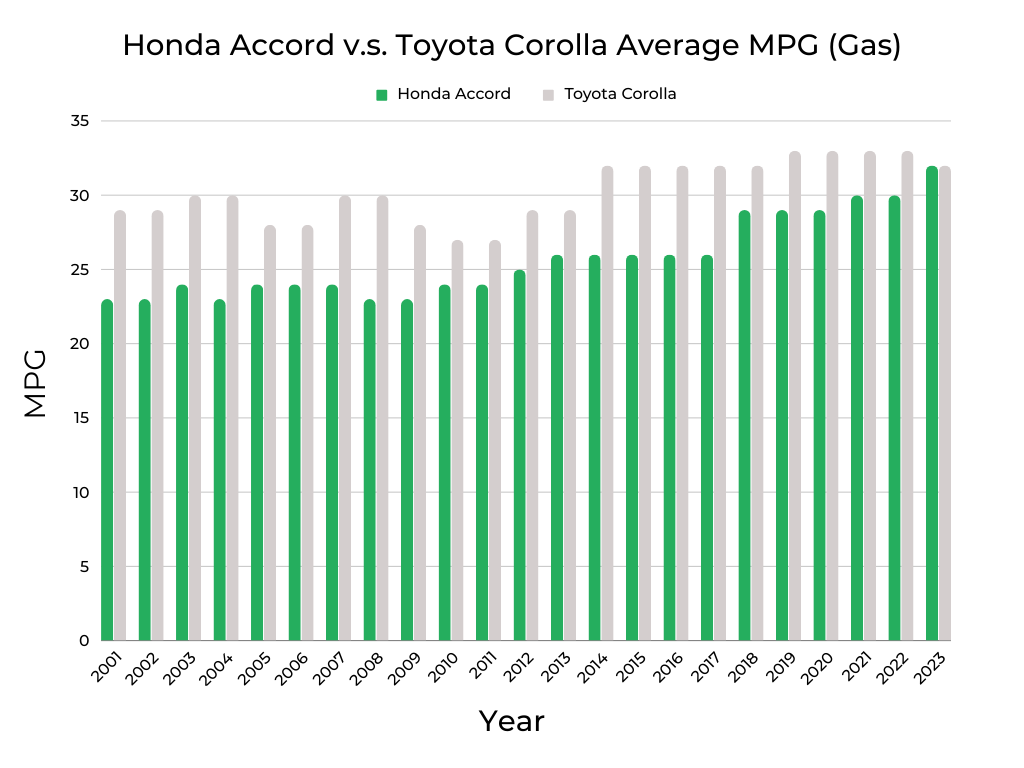
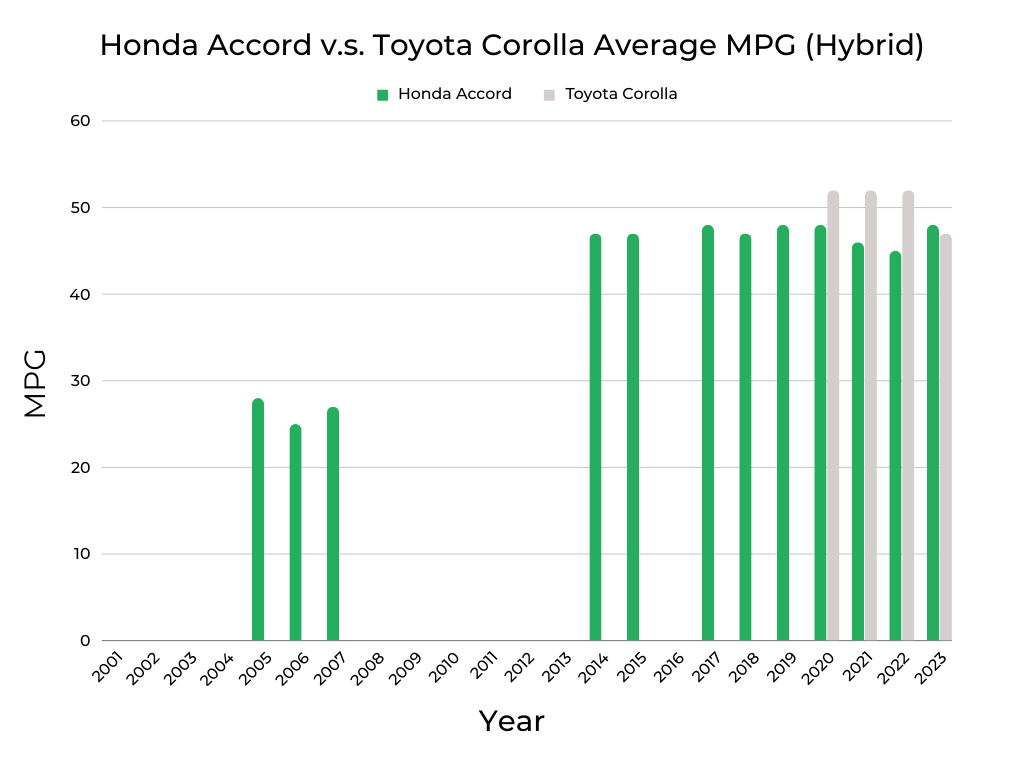
When comparing conventional (non-hybrid) power, the Corolla consistently beats the Accord in fuel economy. Its smaller engine and lower weight add to greater savings at the pump. Those looking to have reduced expenses and less environmental impact will find the Corolla compelling. The difference between 30 mpg and 25 mpg saves $350 annually for someone who drives 15,000 per year and spends $3.50 for a gallon of gas (the savings rise to $500 when gas is $5.00 per gallon).
The Corolla’s fuel economy advantage continues when there’s a model year match-up with hybrid versions. Achieving better than 50 mpg is an impressive example of Toyota’s hybrid technology mastery. That said, the 45 mpg (or better) achieved by newer (and larger) Accord Hybrids is also spectacular.

Dave Goldberg is an automotive journalist and lifelong car fanatic. He writes for numerous enthusiast and business outlets and is an ongoing contributor to HotCars.com, one of the most popular car culture websites. When he’s not writing or driving, Dave is either under a hood or asleep. His credentials include a BA in Journalism from The George Washington University.