Find the depreciation rate of your Subaru Forester in the graph below.
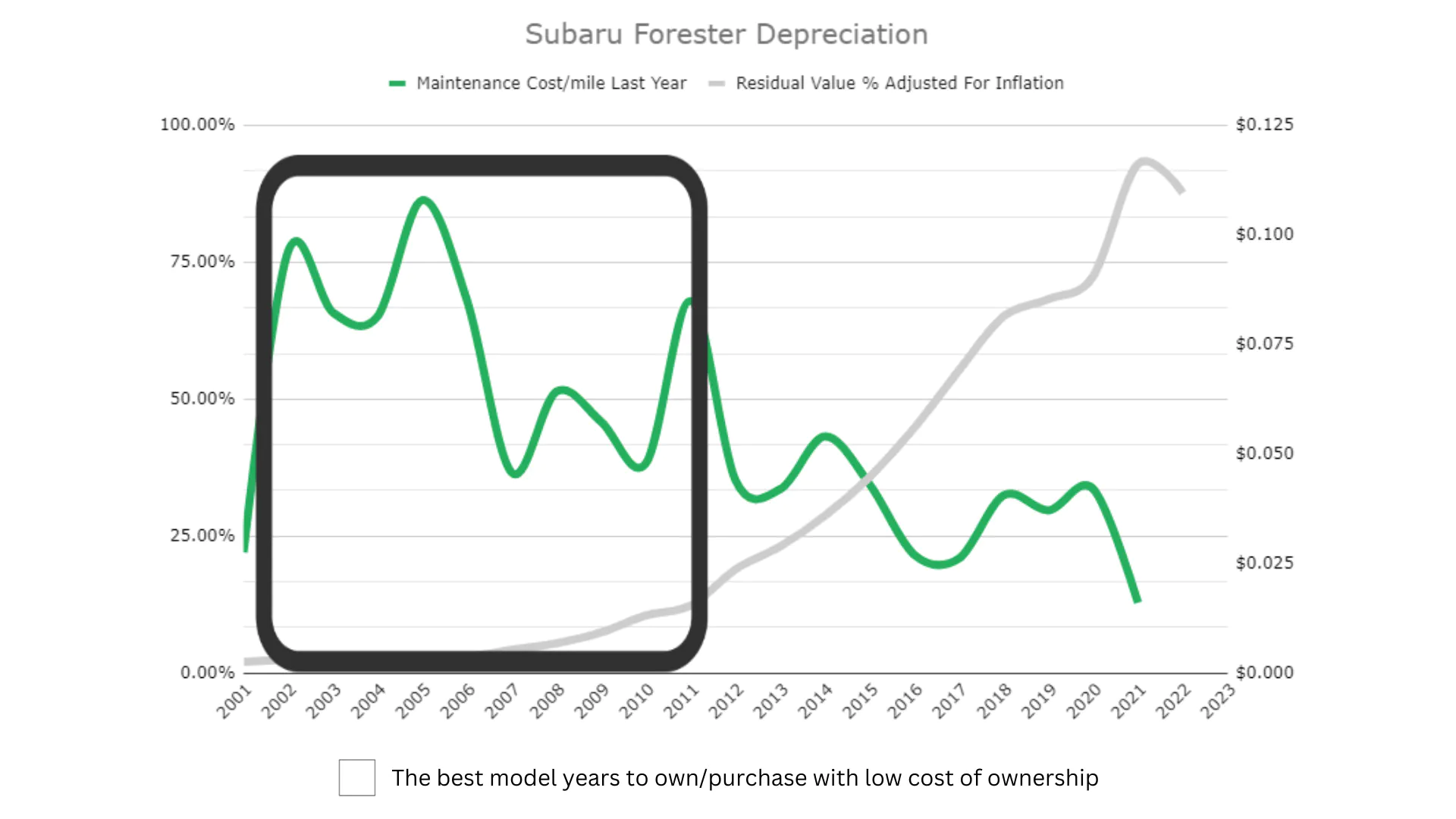
Though all vehicles depreciate, or lose value, over time, they don’t all depreciate at the same rate. Recognizing the factors that contribute to a vehicle’s depreciation rate can help you better understand its long-term value and the total cost of owning it. Typically, the first year marks the steepest drop in value, while the following years see gradually slowing depreciation. After the fifth year, the rate tends to normalize to a steady downtick. The Subaru Forester mostly follows the pattern except for a few years of slowed depreciation, particularly among model years 2016-2019 and 2021.
Keep in mind that just because the vehicle costs the least to own in the sweet spot we have outlined here, you still may not want to own the vehicle during these depreciation sweet spot years. Although vehicles depreciate less as they get older, they have more repairs. Duh right? However, keep in mind that repairs don’t just cost you money, they cost you time. Reliability is the difference between being able to make it to your destination on time or missing an opportunity because the car broke down.
Check out our article on the best and worst years of the Subaru Forester to see our reliability ratings for all years of the Forester between 2001-2022. We also cover MPG, safety ratings, and a number of other factors. We pulled data from Foresters registered in our app and surveyed owners to get you data-backed answers on just how good or bad each year of the Forester is.
If you want to know the depreciation and maintenance costs for your particular vehicle, use our free “Total Cost of Ownership” tool available in the FIXD App – Android or IOS.
If you like our online tools and articles consider purchasing our FIXD sensor for $19.99 (this is 67% OFF). It’s our flagship product. With it, you scan your car for common engine problems.
If our sensor detects any problems with the engine, our app will clearly explain:
- What could have caused it and
- How much the possible repairs may cost.
If you’d like, we’ll even show you trusted repair shops in your area where you can get your ride fixed through RepairPal. The total cost of ownership feature within the app totals your maintenance costs, repairs, and depreciation (Sensor + App). This is free on the app.
Subaru Forester Depreciation
| Model Years | Mileage | Amount Depreciated | Residual Value Percentage | Resale Value |
| 2001 | 264,000 | $24,930.49 | 2.0% | $502 |
| 2002 | 252,000 | $25,201.49 | 2.4% | $614 |
| 2003 | 240,000 | $26,200.65 | 2.7% | $728 |
| 2004 | 228,000 | $26,363.16 | 2.9% | $786 |
| 2005 | 216,000 | $27,103.04 | 2.1% | $589 |
| 2006 | 204,000 | $27,378.48 | 2.9% | $832 |
| 2007 | 192,000 | $26,525.43 | 4.2% | $1,176 |
| 2008 | 180,000 | $26,594.83 | 5.4% | $1,532 |
| 2009 | 168,000 | $24,318.64 | 7.4% | $1,936 |
| 2010 | 156,000 | $23,451.59 | 10.5% | $2,737 |
| 2011 | 144,000 | $22,567.83 | 12.3% | $3,156 |
| 2012 | 132,000 | $20,625.42 | 18.9% | $4,803 |
| 2013 | 120,000 | $19,995.92 | 23.1% | $6,017 |
| 2014 | 108,000 | $19,081.73 | 28.7% | $7,696 |
| 2015 | 96,000 | $17,237.25 | 35.8% | $9,626 |
| 2016 | 84,000 | $14,945.39 | 44.8% | $12,119 |
| 2017 | 72,000 | $12,238.94 | 55.3% | $15,135 |
| 2018 | 60,000 | $10,084.79 | 65.2% | $18,882 |
| 2019 | 48,000 | $9,327.22 | 68.3% | $20,138 |
| 2020 | 36,000 | $8,449.14 | 72.5% | $22,323 |
| 2021 | 24,000 | $2,053.95 | 93.0% | $27,404 |
| 2022 | 12,000 | $3,342.79 | 87.7% | $23,832 |
| 2023 | 0 | N/A | N/A | N/A |
The chart above conveys the approximate depreciation for a Subaru Forester. Based on Kelley Blue Book data since 2001, it assumes a vehicle in standard trim, a generic color such as black or white, and a mileage of 12,000 per year.
Keep in mind that the auto market was heavily affected in 2020 and beyond. Automakers selling new cars during the COVID pandemic raised prices which caused a spike in demand in the used car market as people tried to save money. Many automakers, however, did not drop prices after the pandemic, they kept them so they could make a larger profit.
This is why the most recent years of many vehicles have seemingly experienced less depreciation. Some, such as 2021, may have even appreciated due to the heightened levels of inflation created.
Factors That Impact the Subaru Forester Depreciation Rate
Brand reputation is probably the broadest category that informs a vehicle’s long-term value. The Subaru brand has a reputation for being “unpretentious, practical, and affordable,” and its vehicles tend to rank highly in reliability surveys. Each product model is a brand in its own right, too, and the Forester brand is well-regarded for being a “no-nonsense small SUV” that offers both practicality and a pleasant driving experience. These qualities together are key contributors to the Forester’s propensity for value retention.
Besides brand reputation, the following factors also impact a vehicle’s depreciation rate:

Age
A vehicle’s model year determines its age. As a designation, the model year specifies a particular version in the history of a model line. Often, automakers release a new model year in the previous calendar year. That was the case with the 2023 Subaru Forester, which hit dealerships in December of 2022.
Except in the world of classic automobiles, the current model year of a given model line is going to be the most valuable. This is because new vehicles have new features that increase their utility and market appeal. The notion of newness itself is also an attraction for consumers, suggesting that the vehicle will provide a longer useful life to the buyer.
Body Type
Body type is a classification that refers to a vehicle’s general size and shape. In the United States, the following body types are what you’re most likely to find at a dealership:
- Sedans
- Coupes
- Station wagons
- Hatchbacks
- Sports cars
- Sport utility vehicles (SUVs)
- Minivans
- Pickup trucks
The Subaru Forester is an SUV, which is like a station wagon built on a truck-like frame — a four-door vehicle larger than a passenger car, with a cabin that integrates the passenger and cargo areas. The SUV happens to be the most popular body type on the U.S. market, boasting a dominant market position in all but four states. This popularity may help SUVs better retain their value in the long run.
Mileage
Mileage is a measure of how far a vehicle has traveled. On average, American drivers put around 12,000 miles on their vehicles every year. To determine whether a vehicle has high or low mileage, divide its overall mileage by its age and weigh the result against the average.
Given that prolonged use correlates with increased wear and tear, vehicles with high mileage ordinarily attract lower prices on the secondhand market. Someone who buys a high-mileage vehicle probably understands that it has a comparably short useful life, and that they may have to pay for repairs or replacements sooner rather than later.
Some vehicle brands can accumulate around 200,000 miles before mechanical failure even becomes a possibility. Subaru tends to be one of those brands, which may also account for the Forester’s strong value retention.
Overall Condition
A vehicle’s overall condition relates to how it looks and runs. If your vehicle is free of dents and scratches, its upholstery and interior surfaces are intact, and it has no mechanical problems, you can confidently claim that it’s in good, great, or even excellent overall condition. Its value should be higher than comparable vehicles in lesser condition because the buyer is less likely to need repairs or restorations.
As a driver, you can maintain your vehicle’s overall condition both preventively and proactively. Avoid reckless driving so that you avoid collisions, keep your vehicle parked under shelter if possible, take it in for regular maintenance, and clean it regularly (inside and out).
Color
Color affects a vehicle’s value because of supply and demand. Attractive colors are in higher demand, and rare colors are in low supply. If you put those together, you have a car color that can fetch a higher price on the secondhand market.
To know which colors have the optimal supply-and-demand ratio for value retention, consider a 2023 study conducted by iSeeCars. Compared to an average three-year value loss of 22.5%, the study found that yellow, beige, orange, and green cars had significantly lower depreciation rates, ranging from 13.5% to 19.2%. On the other hand, common colors, such as blue, gray, and silver, had average depreciation rates, whereas less popular colors such as brown and gold had higher-than-average rates.
Other Costs of Subaru Forester Ownership
Depreciation aside, you should also factor in these other costs of ownership to figure out your vehicle’s long-term value:
Insurance
Some vehicles are cheaper to insure than others. When determining insurance rates, providers consider factors such as a vehicle’s safety features, ease of maneuverability, and potential to cause damage. Safe vehicles that are easy to drive and less likely to damage property tend to yield lower insurance rates because they present less risk to the insurer.
The Subaru Forester is an example of a safe vehicle. It has consistently been a Top Safety Pick by the Insurance Institute for Highway Safety since the 2007 model year, likely owing to its standard safety features and high outward visibility. As a result, it’s often one of the cheapest vehicles to insure in the United States. In Florida, for instance, the average cost of full-coverage insurance for a Forester is around 9 per year — much lower than the national average of “,630 for all vehicle models.
Maintenance
Regular maintenance entails routine services such as oil changes, fluid replenishment, tire pressure checks, and tire rotations. It also involves repairs and parts replacements as needed. Keeping up with your vehicle’s maintenance not only makes you a responsible driver but also helps ensure that you get as much life out of your vehicle as possible.
According to our data, the average cost of maintaining a Subaru Forester is $659 per year. That’s typical for compact SUVs and slightly lower than the $694 average for all vehicle types. Some model years are more expensive to maintain, however. Refer to our graph on the current market values and repair costs for the Forester from 2001 to 2021 to get a sense of the cost variations, and avoid the following model years if you want to keep your maintenance costs around or below the average:
- 2001
- 2003
- 2005-2008
- 2014
- 2018-2019
The Best Model Years To Buy a Subaru Forester
Based on factors including price and reliability (but not depreciation), our choice for the best Subaru Forester model years to buy are the 2002, 2004, 2009-2011, 2012-2013, 2015-2017, and 2020-2021, but check out our article on the best and worst years of the Forester to get the whole story.
The above model years boast high owner-reported reliability and strong safety scores. They’re also impressively affordable to maintain. The 2017 model year, for example, has an average maintenance cost of $386 per year, while the 2021 model is even lower at $250 per year.
Buying a Subaru Forester New vs. Used
| 20-Year Projection | ||
| Years Since Purchased | Depreciated Value | With Inflation |
| 1 | $23,236 | $25,651 |
| 2 | $24,640 | $28,794 |
| 3 | $19,209 | $22,564 |
| 4 | $18,096 | $21,336 |
| 5 | $17,275 | $20,270 |
| 6 | $14,652 | $17,150 |
| 7 | $11,870 | $13,914 |
| 8 | $9,485 | $11,184 |
| 9 | $7,604 | $8,997 |
| 10 | $6,120 | $7,319 |
| 11 | $5,008 | $6,087 |
| 12 | $3,259 | $4,073 |
| 13 | $2,782 | $3,538 |
| 14 | $1,961 | $2,520 |
| 15 | $1,431 | $1,811 |
| 16 | $1,113 | $1,395 |
| 17 | $768 | $961 |
| 18 | $556 | $700 |
| 19 | $768 | $961 |
| 20 | $715 | $881 |
A brand-new 2023 Subaru Forester has a starting MSRP of $26,495. Assuming an annual mileage of 12,000, we estimate this vehicle will have a value of $19,209 in three years. That amounts to an accumulated depreciation of $7,286. In comparison, a used 2020 Subaru Forester has a current value of $22,323, which means it has accumulated $8,449.14 in depreciation from an inflation-adjusted MSRP of $30,772.14.
The above figures are general. For a more accurate picture that accounts for the individual characteristics of your vehicle, we recommend using the My Car’s Value tool provided by Kelley Blue Book. For guidance when buying a used vehicle, consult our buying checklist to get the best value for your money.
Methodology
The basis for the data in this article is the base-level trim for every Subaru Forester from 2001 to 2023. Base-level trims are the most reliable reference point because they don’t offer any qualities that would inflate the value and skew the numbers. For example, the range-topping trim might have features such as leather seating and premium audio, which add costs and appeal that are separate from the vehicle itself. Specific resale values for the Subaru Forester may depend on factors such as vehicle condition, your mode of sale, and the COVID-era chip shortage.
Keep in mind, there are large economic factors at play here too and the sale of new cars has caused shifts in the used market too. There is a stark difference in the cost of vehicles due to car manufacturers seeking higher profit margins after COVID as detailed by CNN and posted by CBS channel 58:
“… (T)he auto industry saw sky-high profits even as sales plummeted. Domestic manufacturers of cars and car parts saw a profit of $32 billion through the third quarter of 2022 (the latest data available) — their largest profit since 2016. Car dealerships also reported record-breaking profits through Q3, according to auto-retail advisers Haig Partners.
That’s because pandemic-era pent-up consumer demand remained strong as supply shifted, allowing automakers to increase their prices and their profit margins. Cars and trucks were sold nearly as soon as they hit dealership lots, and the average price paid for a vehicle in December soared to a near-record high of $46,382, according to J.D. Power.
Data from the Labor Department’s November Consumer Price Index shows American consumers are paying about 20% more for cars than they were in 2019.
The trend could continue into next year — research website Edmunds expects new-car sales to hit 14.8 million in 2023, a marginal increase from last year but well below pre-pandemic levels.
The auto industry has entered a new era: Less choice, higher prices and larger profit margins. So far it seems to be working for them.”
This shift by car companies to create higher profit margins by taking advantage of the heavily-reported-on chip shortage panic of COVID has had rebounding effects upon the value of used cars.
Be aware that newer years (the latest 3-4 model years) may be inflated in price because of this and depending on how big this problem is for the model you are considering – it may even be inflating the price of the older model years.
Frequently Asked Questions About Vehicle Depreciation
Do Subaru Foresters Hold Their Value?
Based on our depreciation data, we’d say that Subaru Foresters hold their value quite well. If you consider that vehicles can lose around 60% of their value in five years, then the Forester’s 34.8% depreciation in the same time frame seems especially impressive. Remember, though, that an array of factors can affect the value of a specific Forester. We’ve discussed brand reputation, age, body type, overall condition, and color, but we should also consider how and where you sell a vehicle.
There are two primary ways of selling a used car: a dealer trade-in and a private sale. Using the My Car’s Value tool, we can calculate how much you can expect to get from selling a 2018 Forester by each method in different locations. Assuming a base trim, a common color, standard features, 12,000 miles a year, and good overall condition, we find you can get up to $15,968 in a dealer trade-in and $17,521 in a private sale in Topeka, Kansas. But if you move the sale to San Antonio, Texas, the value drops to $15,493 and $16,936, respectively.
What are the best years of the Subaru Forester to buy, and which ones should I avoid?
After accounting for depreciation and the other costs of ownership, we’d say that the 2009-2011, 2012-2013, 2015-2017, and 2020-2021 model years are the best Subaru Foresters to buy. With each, you get a reliable vehicle with strong safety ratings and affordable maintenance costs. With the 2009 and 2010 models, you also land in the ownership sweet spot.
On the other hand, we think you should avoid the following model years because of poor reliability and potentially high maintenance costs:
- 2001
- 2003
- 2005-2008
- 2014
- 2018-2019
What's high mileage for a Subaru Forester?
Because of the Forester’s reliability and longevity, its high-mileage mark is considerably higher than that of other vehicles. Our survey data shows that the average odometer reading for a Subaru Forester is 129,000 miles, but many have clocked up to 180,000 miles. With that in mind, we’d say that 200,000 miles would qualify as high mileage for this make and model.
How old of a Subaru Forester should you buy to avoid most of the depreciation?
If your priority is to avoid as much depreciation as possible, we would recommend a Subaru Forester in the 12-to-21-year-old range. That corresponds with model years 2002 to 2011. We reiterate, though, that many of those model years have low reliability ratings and high maintenance costs. Only the 2009 and 2010 Foresters meet our recommendation criteria.
References
(2023.) Subaru. Consumer Reports. Retrieved November 1, 2023, from https://www.consumerreports.org/cars/subaru
(2023.) Subaru Forester. Consumer Reports. Retrieved November 1, 2023, from https://www.consumerreports.org/cars/subaru/forester
(2023.) Which Vehicle Type Is the Most Popular in Each State? iSeeCars. Retrieved November 1, 2023, from https://www.iseecars.com/popular-vehicle-type-by-state-study
(2023.) The Best and Worst Car Colors for Resale Value. iSeeCars. Retrieved November 1, 2023, from https://www.iseecars.com/car-color-study

At FIXD, our mission is to make car ownership as simple, easy, and affordable as possible. Our research team utilizes the latest automotive data and insights to create tools and resources that help drivers get peace of mind and save money over the life of their car.