Vehicle Class & Body Style:
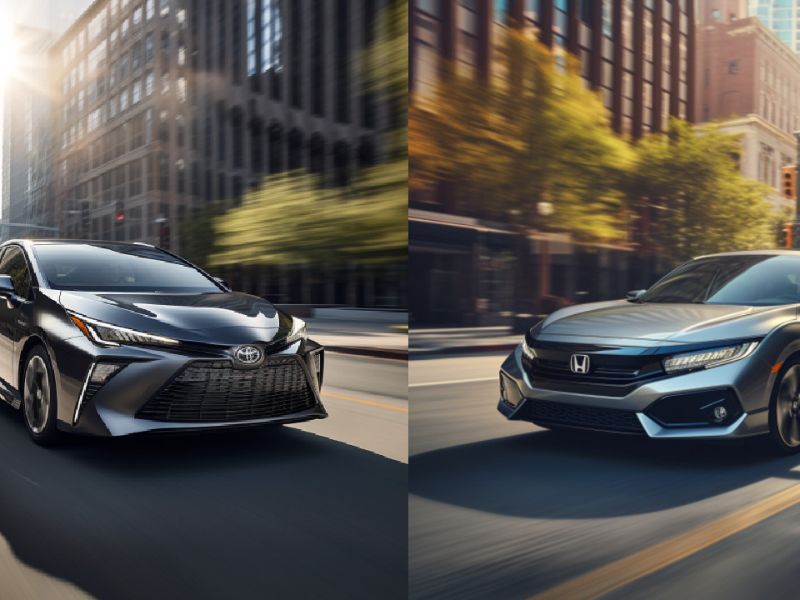
Quick Take: The Prius is strictly a hatchback, while the Civic offers sedan and hatchback body styles.
The Prius and Civic fall under the U.S. Environmental Protection Agency (EPA) mid-size label, a determination based on passenger volume. However, while both get lumped together, the Civic Sedan is noticeably larger inside, with as much as 99.0 cubic feet of cabin space (or 96.6 cubic feet in the Civic Hatchback). In contrast, the Prius has 91.2 cubic feet.
Later, I’ll cover how cubic feet translate into usable dimensions (like legroom). But don’t assume Civic passengers always have more space.
| 2023 Toyota Prius | 2023 Honda Civic | |
| Class | Hatchback | Mid-Size Sedan |
| 5-Door Hatchback | LE, LE AWD, XLE, XLE AWD, Limited, Limited AWD | LX, Sport, EX-L, Sport Touring |
| 4- Door Sedan | N/A | LX, Sport, EX, Touring, Si Sedan, Type R |
Powertrain:
Quick Take: The 2023 Prius is surprisingly quick and delivers stellar fuel economy. The Civic gets bonus points for offering a manual transmission.
Engine Options & Specifications:
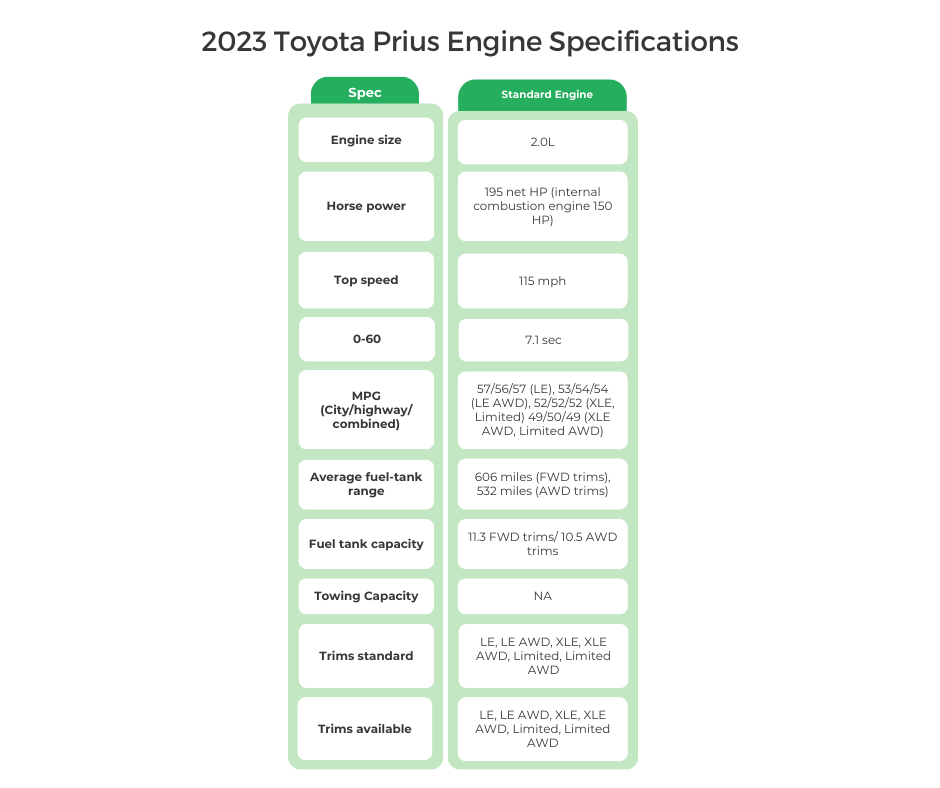
Previous Prii (“Prii” is the plural form of Prius, according to Toyota) had a reputation for being sluggish. However, this changed with the launch of the fifth-generation Prius. Thanks to Toyota’s engineering magic, the latest Prius accelerates from zero to 60 mph in a snappy 7.1 seconds. This accomplishment is thanks to a gas-hybrid 2.0-liter engine that makes a combined 195 horsepower.
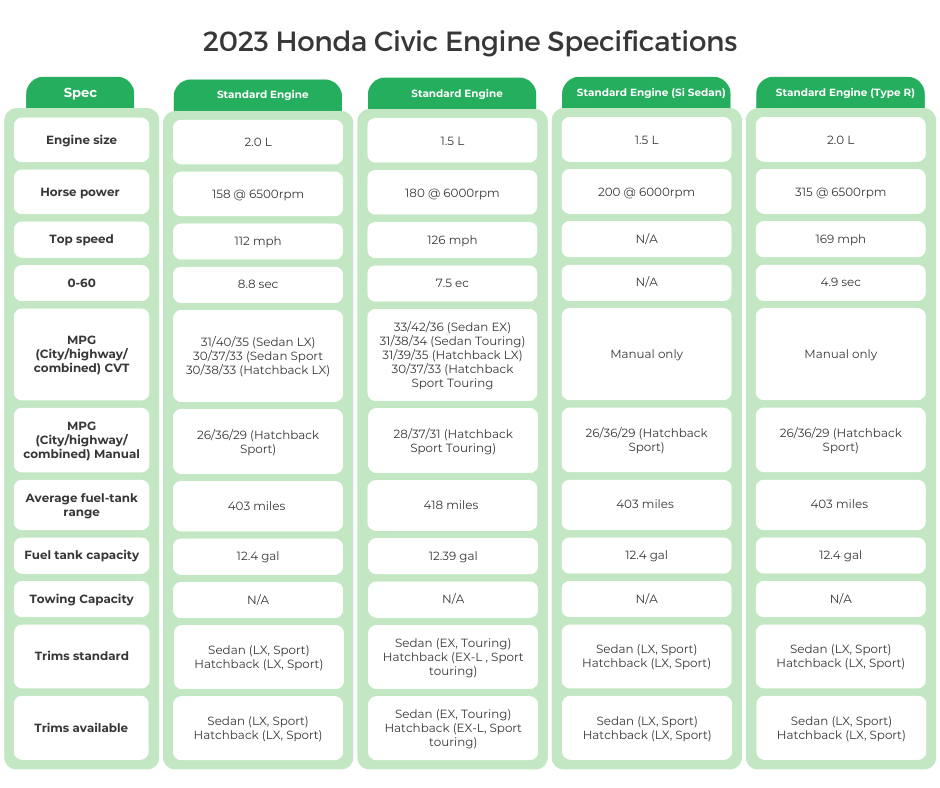
In comparison, the Civic’s 158-horsepower 2.0-liter four-cylinder is sluggish, with a 0-60 mph time of 8.8 seconds. Even stepping up to the 180-horsepower turbocharged 1.5-liter four-cylinder engine found in up-market Civic trims will still put the Prius ahead.
You’ll need the 200-horsepower Honda Civic Si sedan to keep pace with the Prius. However, there’s only one choice if stoplight challenge dominance is a must: the 315-horsepower Civic Type R—its 0-60 mph time of 4.9 seconds is quicker than most cars on the road.
Fuel Economy:
With an EPA-estimated fuel economy rating of up to 57 mpg (combined), the Prius is the undisputed mpg champ in this match-up. It’s among the most fuel-efficient conventionally powered vehicles on the road. Even as a loaded AWD edition, 49 mpg is still remarkable.
The Civic can’t hold a candle to the Prius regarding fuel economy. However, a combined mpg rating of 33-36 (varies by trim and engine) is commendable.
Some may choose the Prius because it uses less gas and makes an eco-friendly statement. Bottom-line savings don’t matter. Yet, some car shoppers count every dollar. Let’s see how the numbers add up when comparing fuel economy for the Prius and Civic.
For example, I’ve picked an FWD-equipped Prius LE with a combined MPG of 57 and a Civic Hatchback LX rated 33 mpg (combined). Someone who drives 15,000 miles per year and buys gas for $3.50 a gallon will spend about $920 annually at the pump with a Prius. The same factors lead to yearly fill-up costs of $1,590 for the Civic. Refueling is 42% ($670) cheaper each year with the Prius.
Wondering about fuel economy for an older Prius or Civic? Check out: Toyota Prius Vs. Honda Civic | The Best Model Year For Every Budget.
Transmission Options & Specifications:
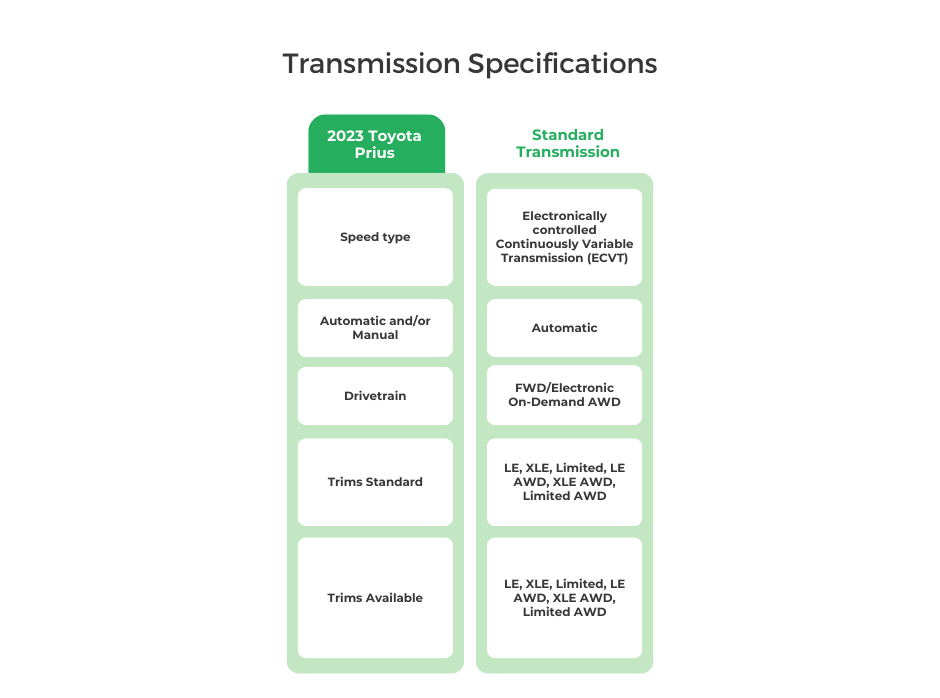
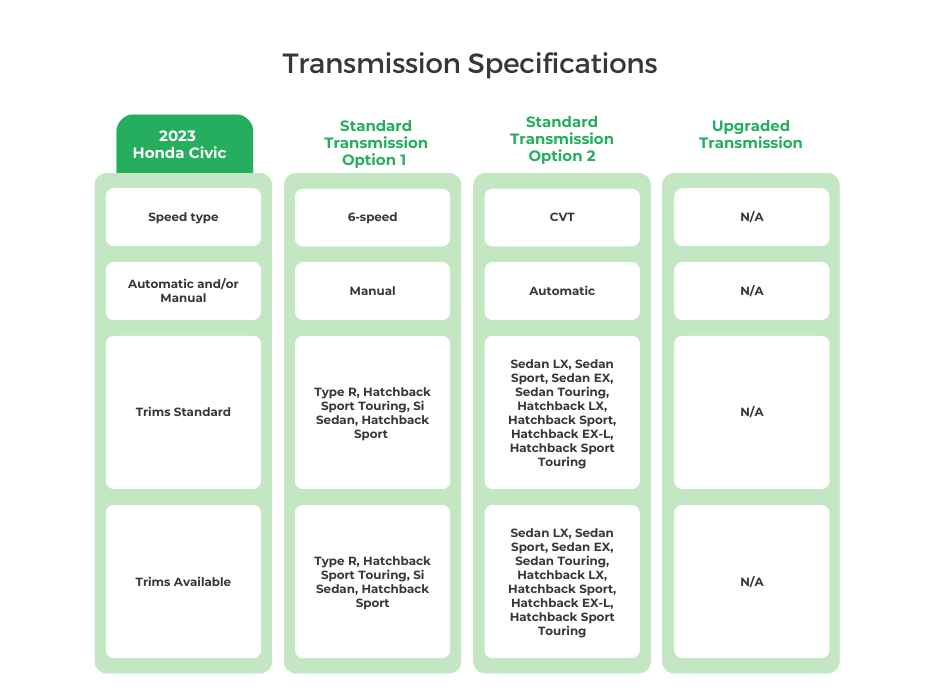
If you don’t know what a continuously variable transmission (CVT) is, you’ll likely get a better understanding if you buy a 2023 Prius or Civic. A CVT, which uses a belt and pulley system to manage engine power versus traditional gears, is the dominant transmission in this pairing. The Prius relies solely on an electronic CVT (eCVT), and most Civics use a CVT. CVTs are becoming more prevalent throughout the auto industry because they’re cheaper to manufacture and help improve fuel economy.
Purists will appreciate that select Civic trims are still available with a six-speed manual transmission. In fact, it’s the only shifter for the Si and Type R, while the Hatchback Sport and Sport Touring offer a choice of six-speed or CVT.
See the “Tech Talk” section below the charts to learn about CVTs and eCVTs.
TECH TALK: CVTs
A continuously variable transmission (CVT) does not use gears like a typical automatic transmission. Instead, it has two pulleys connected by a belt. One pulley connects to the engine, and the other connects to the wheels. The belt transfers the power between the pulleys. This setup allows the pulleys to continuously change positions as needed. The CVT automatically adjusts the pulleys as required, providing smooth and efficient power delivery.
An electronic continuously variable transmission (eCVT) uses electronic controls and electric motors to vary gear ratios instead of a belt and pulley system. Unlike a regular CVT, an eCVT has no physical pulleys or belts—the gear ratio is adjusted seamlessly by controlling the speeds of electric motors and generators. This electronic control allows faster, smoother gear ratio changes compared to a traditional CVT. An eCVT also provides more flexibility, needing less space and having fewer moving parts.
Drivetrain:
Usually, the drivetrain discussion for compact cars involves just front-wheel drive, but the Prius adds to the conversation by offering all-wheel drive as an option.
| 2023 Toyota Prius Wheel Drive | FWD | AWD (Electronic On-Demand AWD) | RWD |
| LE | S | ||
| LE AWD | S | ||
| XLE | S | ||
| XLE AWD | S | ||
| Limited | S | ||
| Limited AWD | S |
| 2023 Honda Civic Standard | FWD | AWD | RWD |
| Sedan LX | S | ||
| Sedan Sport | S | ||
| Sedan EX | S | ||
| Sedan Touring | S | ||
| Hatchback LX | S | ||
| Hatchback Sport | S | ||
| Hatchback EX-L | S | ||
| Hatchback Sport Touring | S | ||
| Si Sedan | S | ||
| Type R | S |
Safety:
Quick Take: NHTSA has yet to assess the latest Prius, but the Civic does very well in these tests. The Prius gets the gold from IIHS.
NHTSA Safety Ratings
The smaller the car, the more critical the crash test scores. Smaller vehicles like the Prius and Civic are much safer now than years ago, but today’s roads are filled with much larger vehicles.
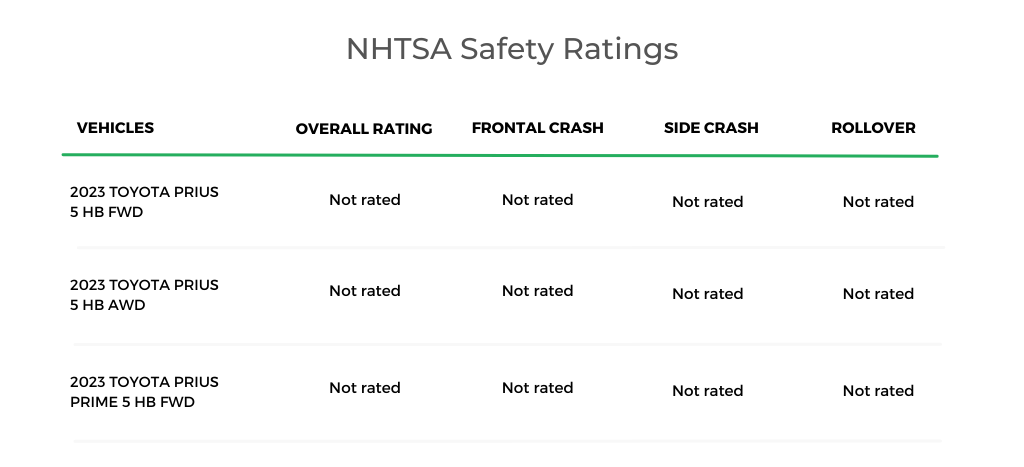
For now, there’s no complete word on Prius safety because the latest generation has not undergone testing by the National Highway Traffic Safety Administration (NHTSA). This isn’t unusual, as it can take another model year or two before an all-new vehicle undergoes a crash assessment. As of this writing, the 2024 Prius hasn’t been tested by NHTSA either.
Given Toyota’s extensive engineering experience, the fifth-gen Prius will likely perform well. However, this is just a guess. We’ll have to wait for the official results before comparing it with the Civic.
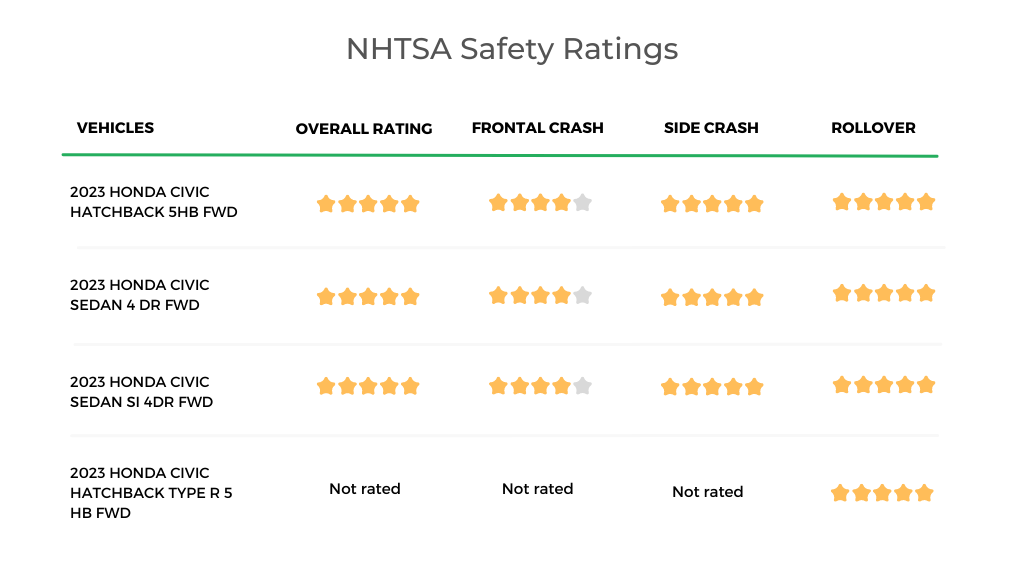
That said, the 2023 Civic does exceptionally well. Both body styles received a five-star (out of five) ranking for overall performance. An identical rating during the side crash test and rollover assessment is equally impressive. If the Civic has shortcomings in this area, it’s the four-star rating during the frontal crash test. Yet, this score (a four) is still a notable achievement.
IIHS Awards:
The Insurance Institute for Highway Safety (IIHS) takes a somewhat different approach to safety testing. In particular, it focuses on its small frontal overlap crash test, which the organization feels represents a more real-world scenario (a single car running into a fixed object). IIHS also looks at side impact crashes, roof strength, headlight effectiveness, and advanced driver safety technologies (like automatic emergency braking).
While tested vehicles receive a Good, Acceptable, Marginal, or Poor grade, the true measure comes if a car gets a Top Safety Pick or Top Safety Pick+ designation. If “Good” is a “B” grade, Top Safety Pick notches things up to an “A-,” and the Top Safety Pick+ signifies an “A+.”
The Prius beat out the Civic by receiving a Top Safety Pick+ designation from IIHS. Meanwhile, the Civic had to settle for second place with its Top Safety Pick award.
| IIHS Award | Tested Vehicle | ||
| 2023 Toyota Prius | Small Car/4-Door Hatchback | Top Safety Pick Plus | 2023 Toyota Prius LE 4-door |
| 2023 Honda Civic | SMALL CAR / 4-DOOR SEDAN | 2023 TOP SAFETY PICK | 2022 Honda Civic 1.5T Touring 4-door |
| SMALL CAR / 4-DOOR HATCHBACK | 2023 TOP SAFETY PICK | 2022 Honda Civic 1.5T Touring 4-door | |
Airbags & Head Restraints:
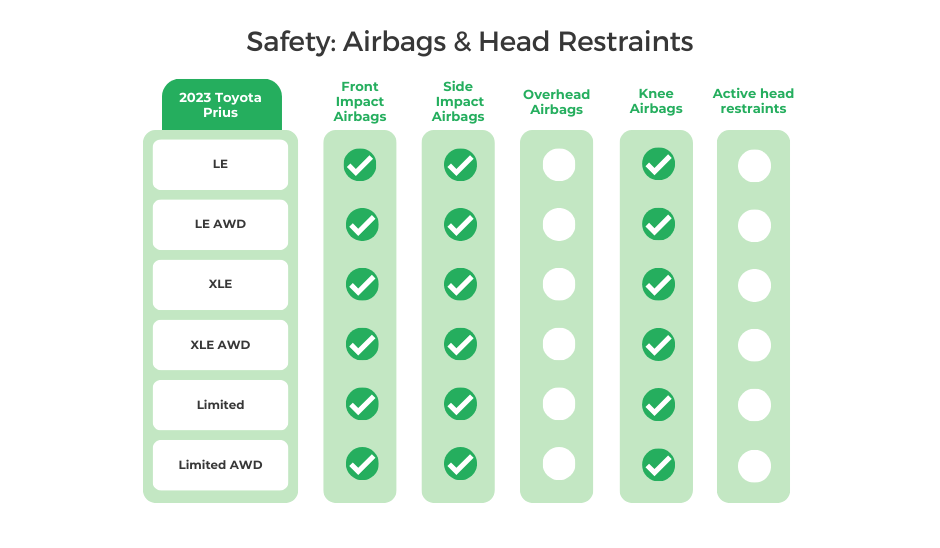
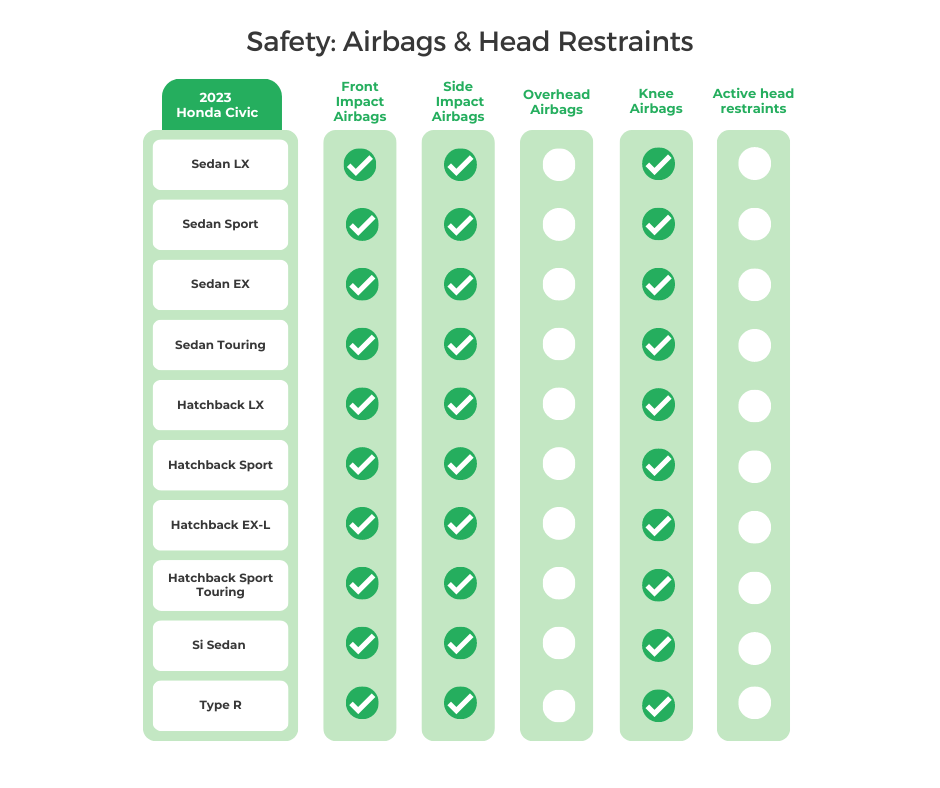
Like all modern cars, the Prius and Civic have numerous airbags to protect occupants. For the most part, the two models are evenly matched with front and side units for the first row and side curtain airbags that protect both rows in a collision or rollover. It’s especially commendable that both cars also have side airbags to protect the outboard passengers in the second row. This feature is becoming more commonplace; it’s nice to see Toyota and Honda help lead the charge.
However, the Civic gains an advantage by having knee airbags for the driver and the front seat passenger. These devices help position the body to minimize injury in a collision. Normally, most Toyotas have at least a knee airbag for the driver, but this isn’t the case with the 2023 Prius. It’s a curious omission.
Neither the Prius nor the Civic comes with overhead airbags. This newer technology replaces traditional front-row units (steering wheel and dashboard) with overhead devices. Active head restraints are usually found in specialty and high-end vehicles to minimize whiplash injuries. Mainstream cars like the Prius and Civic aren’t usually equipped with this feature.
 Driver-Focused Features and Equipment:
 Driver-Focused Features and Equipment:
Quick Take: The Prius and Civic share semi-autonomous driving technologies, but only the Prius gets blind-spot monitoring and rear cross-traffic alert on all trims.
Semi-Autonomous Driving:
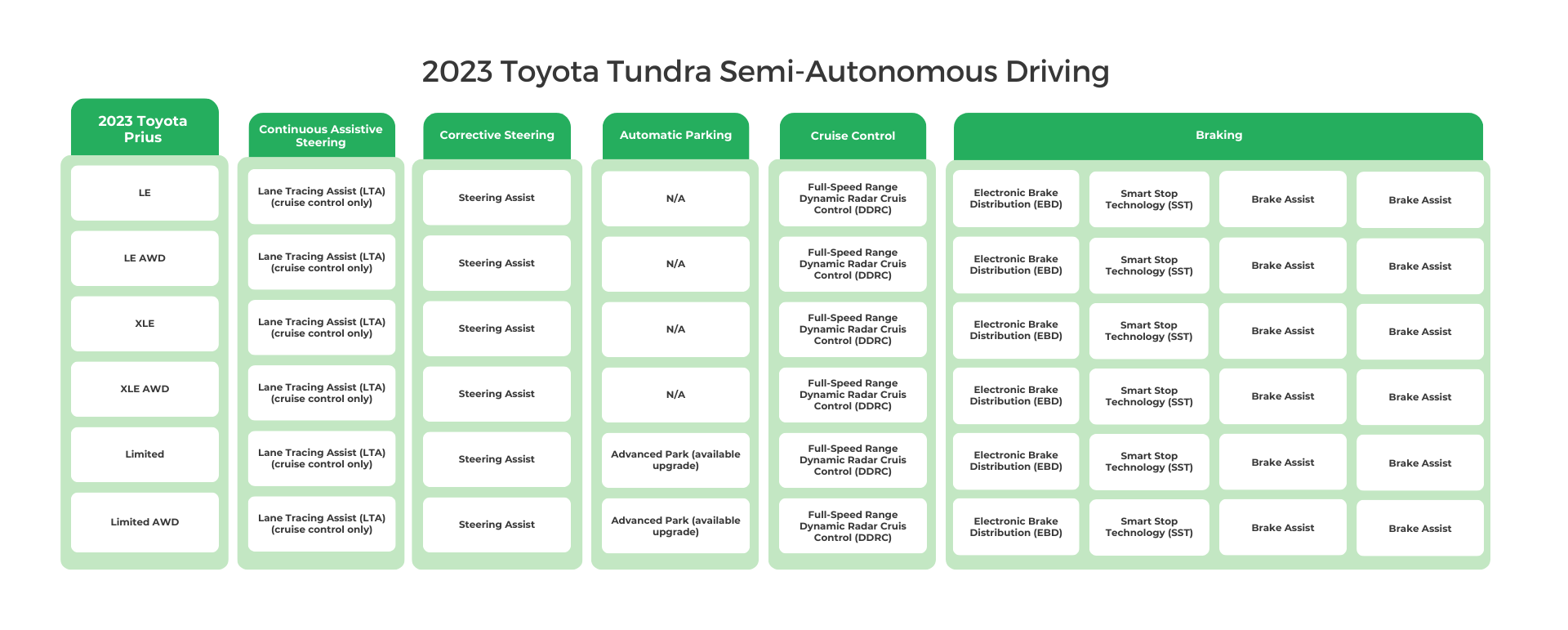
While some Prius and Civic trims sell for over $30,000, don’t expect these cars to have cutting-edge technology like hands-free driving. These are still entry-level cars, just at the higher end of the scale.
You’ll have to settle for semi-autonomous features like adaptive cruise control (Toyota calls it Dynamic Radar Cruise Control), which is standard on even the cheapest versions. Adaptive cruise control uses sensors to monitor the speed of vehicles ahead and automatically adjusts the car’s speed to maintain a safe distance.
Toyota and Honda also include lane-keeping systems to help the car stay in its lane through driver alerts and gentle steering corrections.
 Driver Warning Systems & Telematics:
 Driver Warning Systems & Telematics:
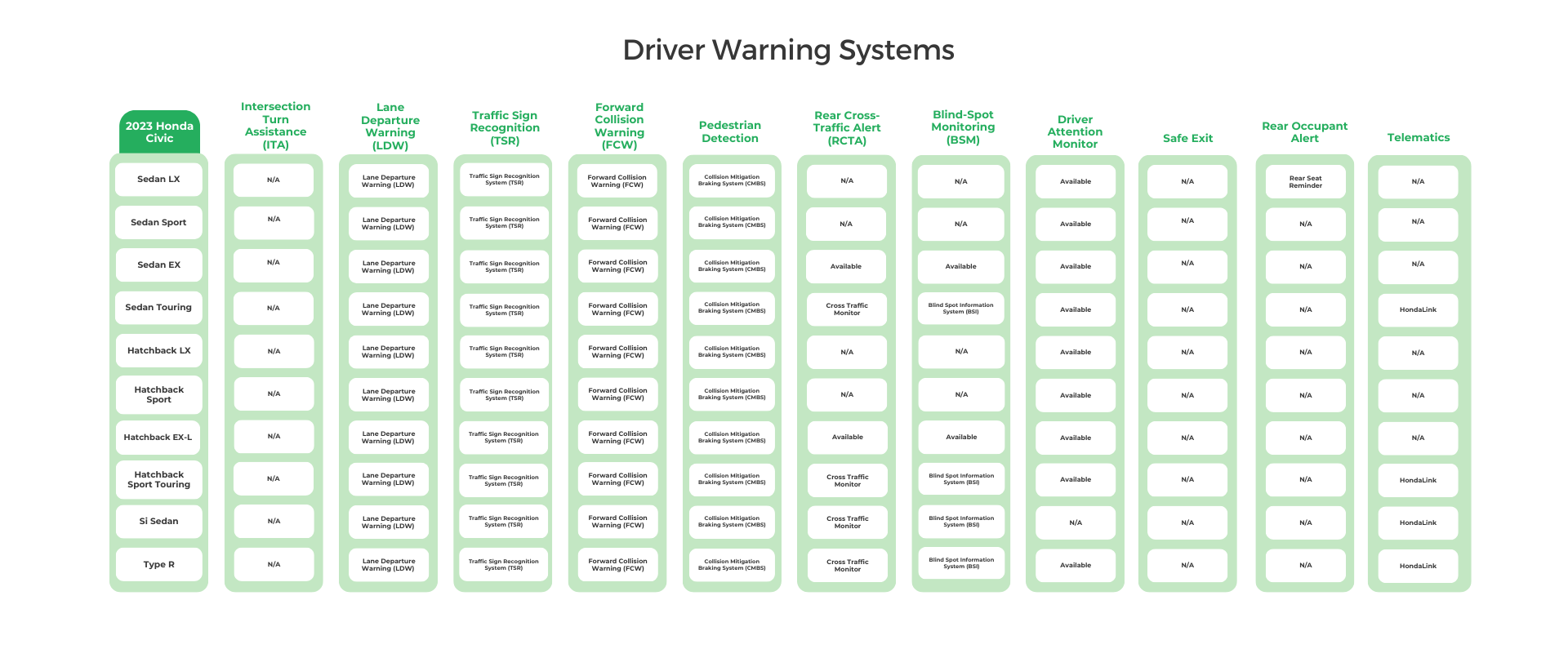
Even the cheapest 2023 Prius and Civic come with fundamental advanced driver assistance systems (ADAS) like forward collision warning (FCW) and automatic emergency braking (AEB) with pedestrian detection. Just about every new car sold today has these technologies. Lane departure warning (LDW) is also standard with the Prius and Civic.
However, it’s a different picture regarding blind-spot monitoring (BSM) and rear cross-traffic alert (RCTA). If you’ve ever had a close call (or worse) due to a restricted side or rear view, you know how crucial these technologies can be.
Toyota includes BSM and RCTA on all Prii, which helps justify a higher MSRP. Yet, this equipment is absent on the lower-end Civics and requires an upgrade on the mid-tier trims. Further, all Prius versions can access connected services (telematics) for emergency support and remote features. Yet, only the top-tier Civics have the Honda equivalent, HondaLink. Be sure to calculate these factors when comparing the Prius and Civic.
If ADAS technology appears like alphabet soup, check out an effort from AAA, Consumer Reports, J.D. Power, and other groups working to standardize the terminology for these systems.

 Road Visibility Features:
 Road Visibility Features:
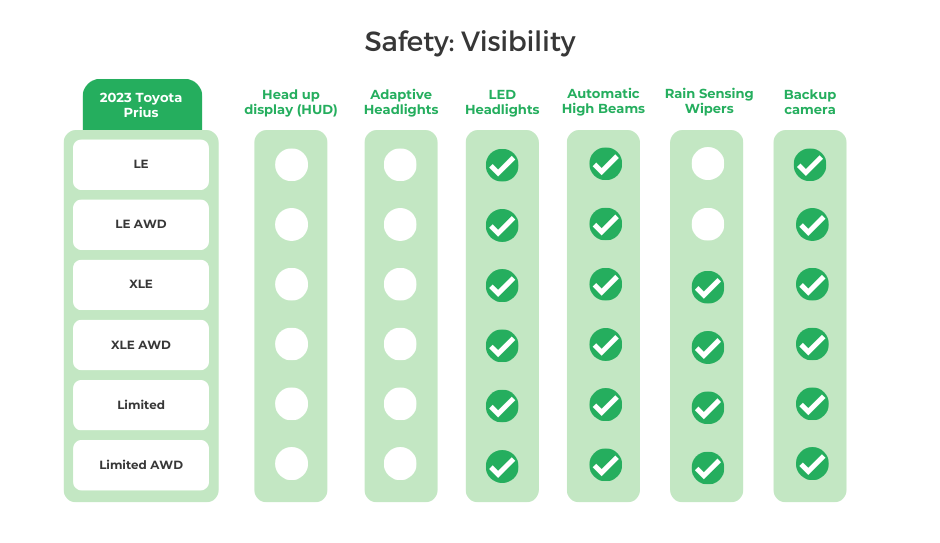
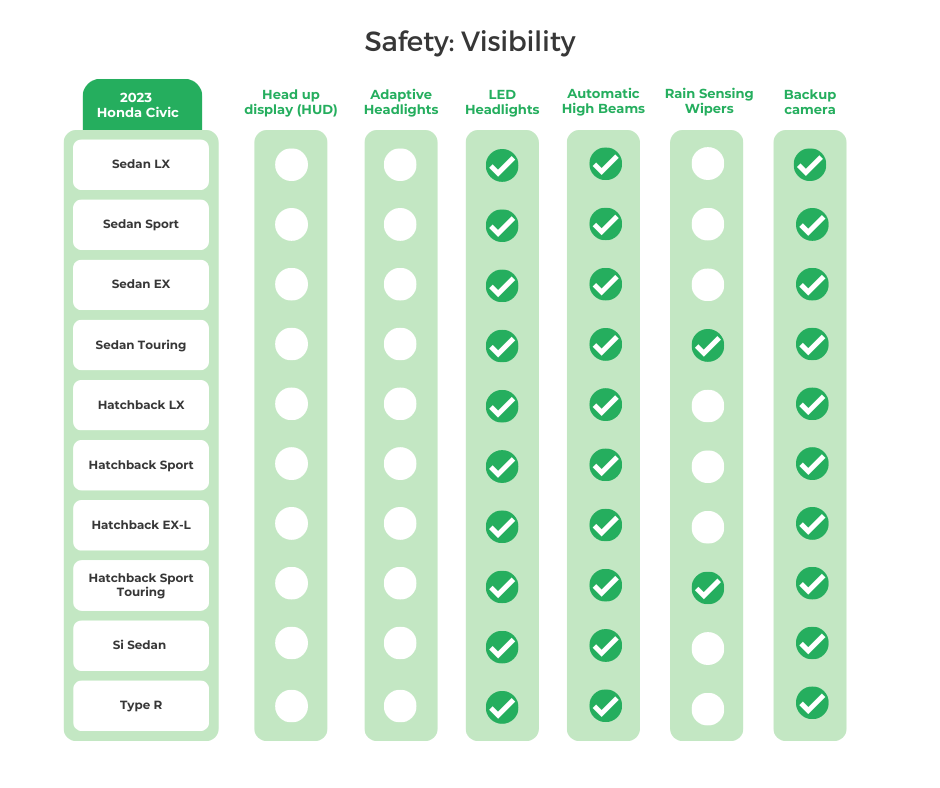
LED headlights and automatic high beams are steadily becoming as common as power windows and air conditioning (which were options years ago). Given the Prius and Civic aren’t ultra-low-cost economy cars, I expected to see LED headlights and automatic high beams as standard equipment.
Rain-sensing windshield wipers are more of a premium feature. So, it isn’t surprising that this equipment is reserved for higher-end trims. Toyota, however, appears to be more open-minded about which Prius editions qualify.
Interior:
Quick Take: Smartphone syncing is a breeze with the Prius and Civic, but not every trim has heated seats. The Civic generally offers more interior space, except the Prius has better front legroom.
Interior Features:
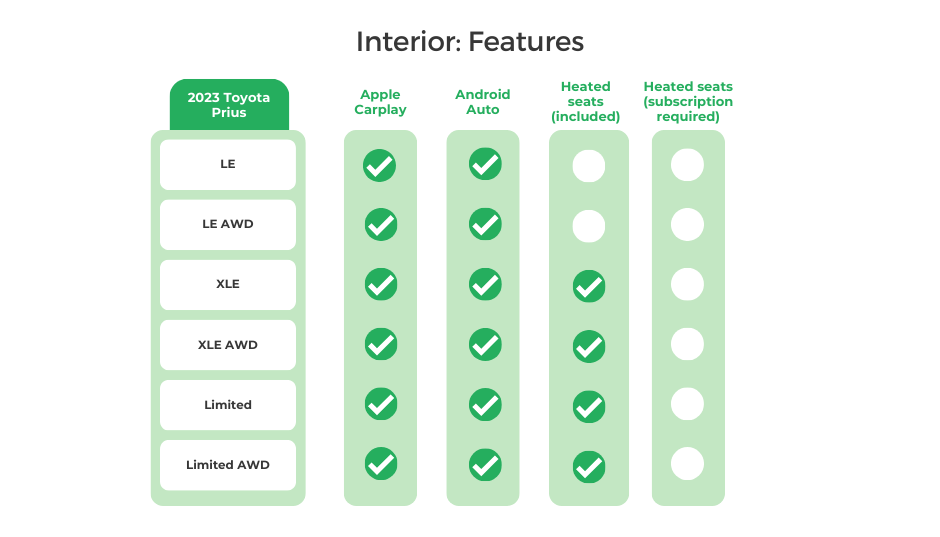
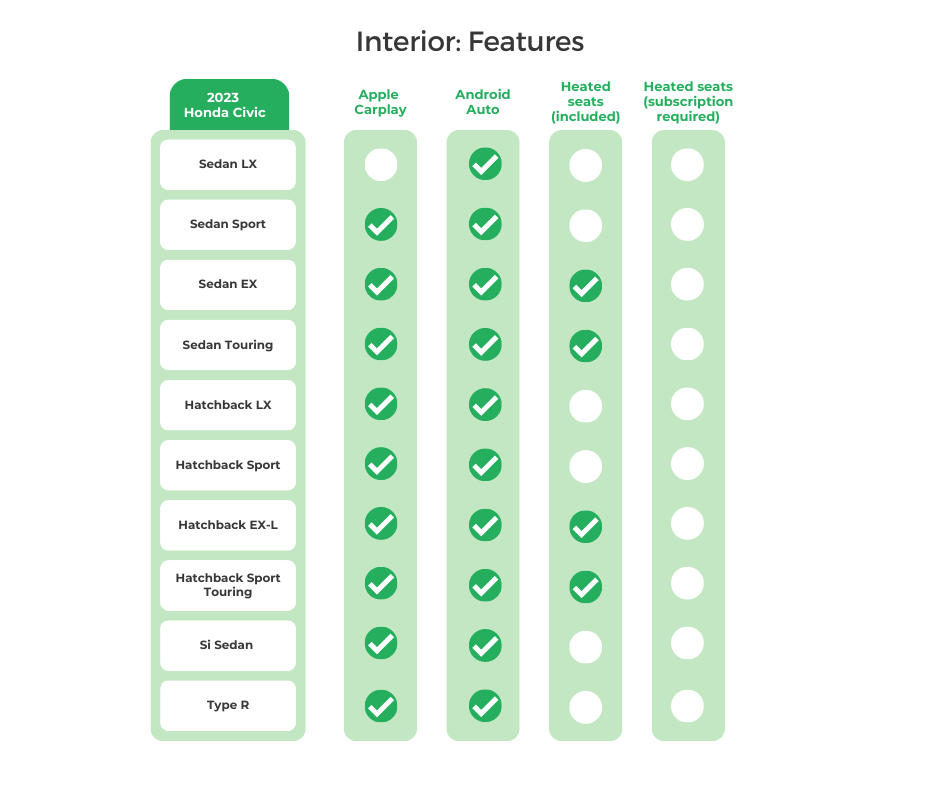
It’s hard to sell a car to cell phone-obsessed customers without Apple CarPlay and Android Auto. Toyota and Honda recognize this and make this technology standard in even the least expensive Prius and Civic.
Yet shoppers with heated front seats on their must-have lists will have to pay attention. All Prius trims except the base LE offer a warm and toasty front row, while the base (LX) and next-lowest (Sport) Civic trims are stripped of this feature. Heated front seats are also excluded from the Si and Type R.
And speaking of heated seats, some automakers offer this feature through a subscription service. This hasn’t yet happened in the U.S., but in certain countries, BMW offered heated seats for a monthly fee. The advantage is you can shut off the service during warm months, but you’ll need to keep paying (or pay a one-time upfront fee) to activate the heated seats. Recently, BMW announced it was backing away from this practice. Moving forward, the automaker will only charge a subscription for software-based services (like upgraded navigation). Hardware-based features will be part of the vehicle’s initial purchase price.
One industry study shows mixed results for consumer acceptance of features on demand (FoD), with about one-fifth not even being aware of the concept.
Interior Dimensions:
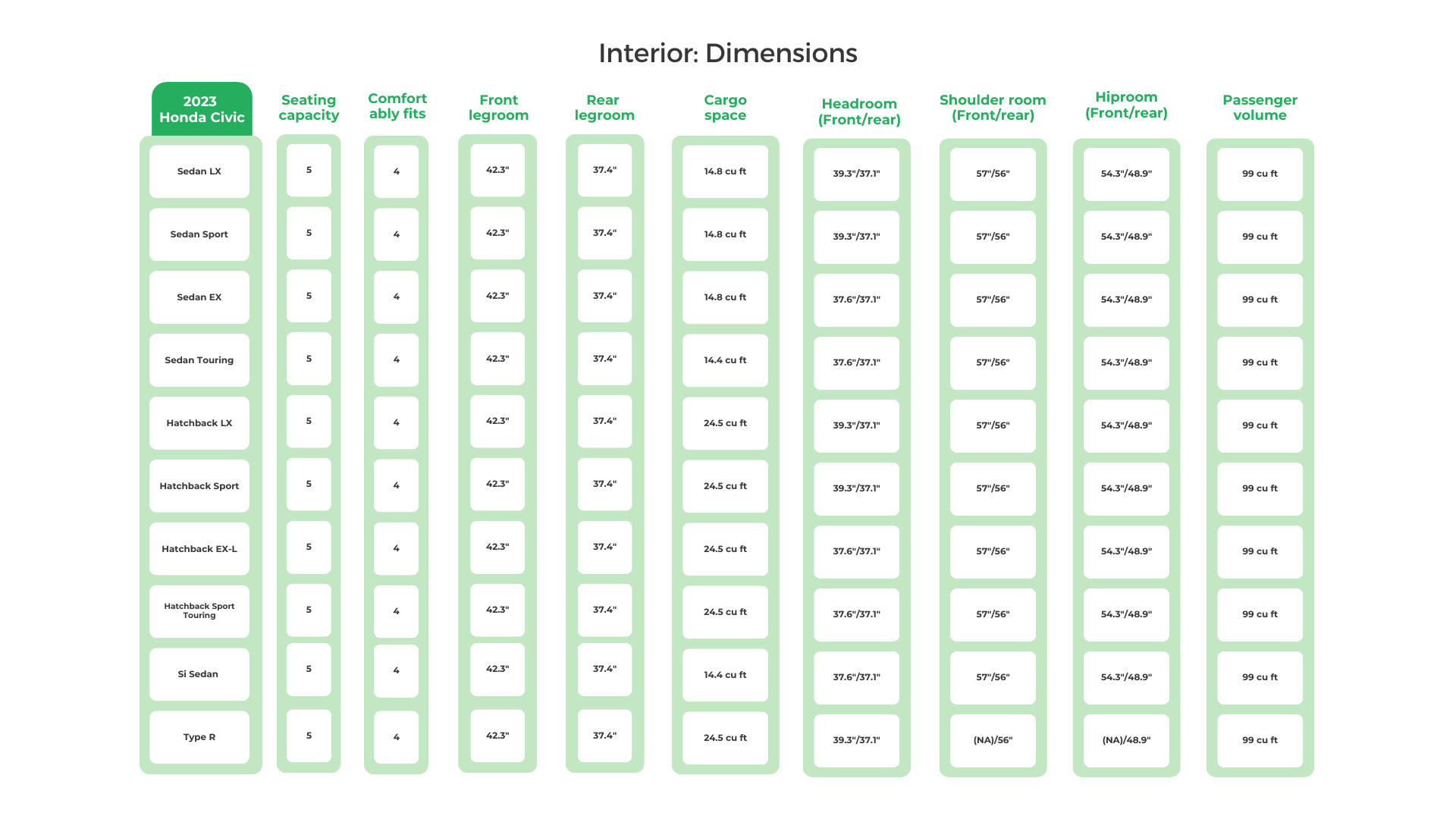
Don’t assume Civic’s bigger cabin means larger interior measurements across the board. In particular, the Prius boasts almost an extra inch of front legroom (43.2 inches versus 42.3 inches for the Civic). Any long-legged driver will tell you that extra space can create a more pleasant behind-the-wheel experience. The Prius can also claim bragging rights for greater hip room, especially in the second row.
Everywhere else, the Civic is more expansive. Its rear legroom of 37.4 inches is noticeably larger than the 34.8 inches in the second row of the Prius. In addition, the Civic’s front and rear shoulder room dimensions also beat what’s inside the Prius by a few inches.
Meanwhile, the Civic Sedan’s 14.4-14.8 cubic-foot trunk is on par with similar vehicles, while the Civic Hatchback’s 24.5 cubic feet of cargo space is slightly better than what the Prius can handle (23.8 cubic feet).

Exterior:
Quick Take: The Prius and Civic are available in many monotone shades, with some brighter colors available. The Prius is longer or shorter, depending on the Civic body style.
Exterior Features:
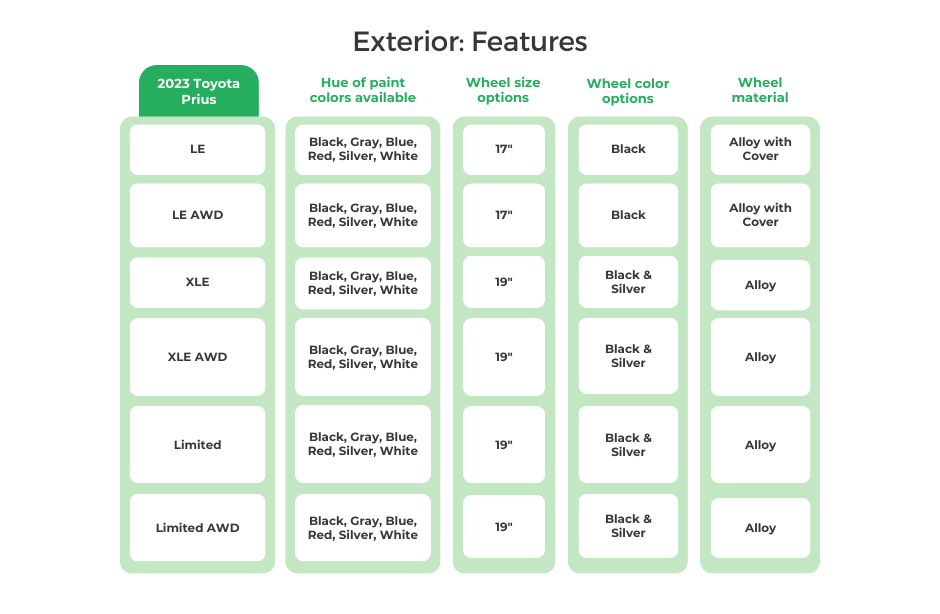
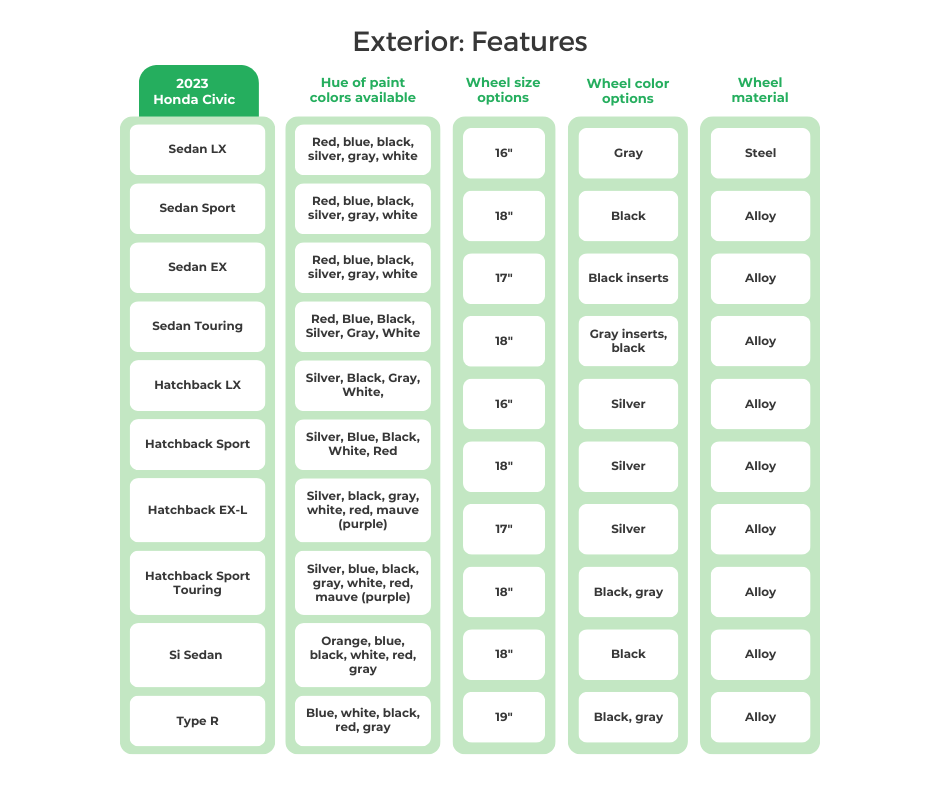
Wheels may also be an afterthought for many car buyers. But wheel size can impact ride quality. Larger rims can translate into better traction and cornering but may result in a bumpier ride. Bigger wheels also offer better aesthetics by filling out the wheel wells more completely. This is why the higher the trim, the larger the wheel. Different materials (steel or alloy) and finishes also help separate the wheels among the various trim levels.
If your car color preference leans toward monotone shades (white, black, gray, or silver), then Toyota and Honda are ready to meet your needs. But wilder options are limited to Supersonic Red for the Prius and Rallye Red or Aegean Blue Metallic for the Civic. In addition, a head-turning Boost Blue Pearl is available with the Type R.
Exterior Dimensions:
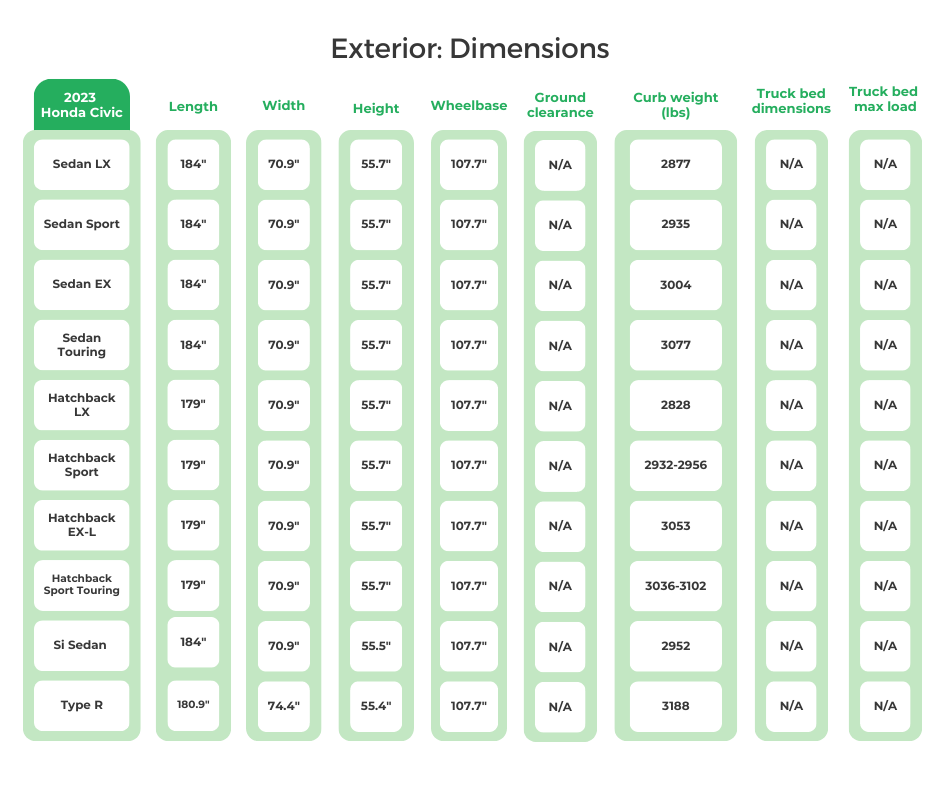
Exterior measurements aren’t usually a consideration for most car shoppers, but these details can make a difference with tight parking spaces and small garages.
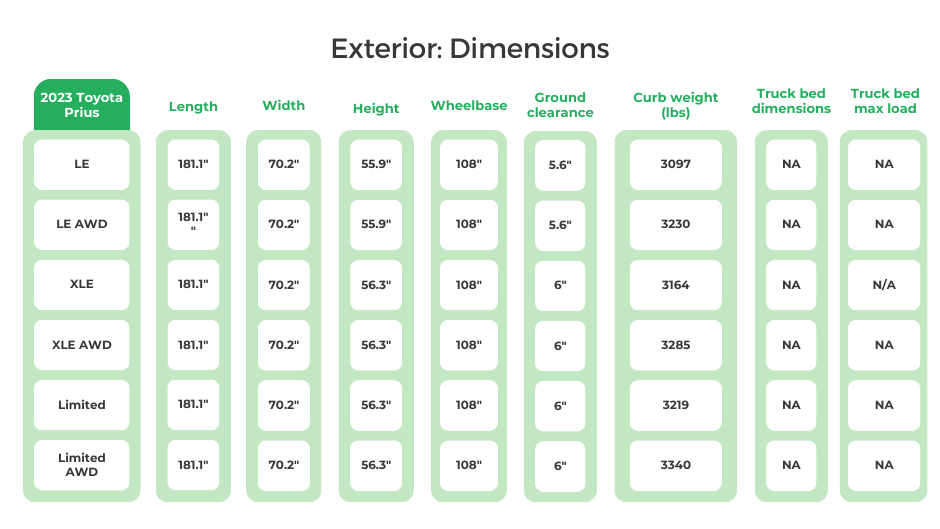
The Prius has a length of 181.1 inches, which sits in the middle of the Civic Sedan (184.0 inches) and the Civic Hatchback (179.0 inches). The width difference is less consequential: 70.2 inches for the Prius and 70.9 inches for the Civic.
A longer wheelbase often provides a more comfortable ride because the extra space between the axles smoothes out bumps and highway expansion strips. But this isn’t a factor in this comparison. The Prius has a 108-inch wheelbase versus 107.7 inches for the Civic.
Warranty:
Quick Take: Except for a few minor details, warranty coverage for the Toyota Prius and Honda Civic is identical.
You’ll need to look closely to see the daylight between the factory warranty for a Toyota Prius and a Honda Civic. Both have three years or 36,000 miles of bumper-to-bumper coverage and five years or 60,000 miles of powertrain protection.
Otherwise, the differences are more subtle. Honda covers the air conditioning refrigerant and offers roadside assistance for any extra year. Toyota offers extended protection (ten years or 150,000 miles) for the hybrid (traction) battery, but this doesn’t matter for Civic buyers because this Honda isn’t a hybrid.
Toyota and Honda also provide free scheduled maintenance for the first two years of ownership. However, this coverage ends after 25,000 miles for the Prius and 24,000 miles for the Civic, a difference that’s hardly worth mentioning.
| 2023 Toyota Prius Factory Warranty Coverage: | 2023 Honda Civic Factory Warranty Coverage: | |
| Basic warranty: | 36 months/36,000 miles | 36 months/36,000 miles |
| Powertrain warranty: | 60 months/60,000 miles | 60 months/60,000 miles |
| Corrosion perforation warranty: | 60 months/unlimited miles | 60 months/unlimited miles |
| Air conditioning warranty: | 12 month/12,000 miles | 24 months/24,000 miles |
| Battery warranty: | 36 months/36,000 miles | 36 months/36,000 miles |
| Hybrid (traction) battery warranty: | 120 months/150,000 miles (Hybrid Battery) | N/A |
| Emissions warranty: | Federal: 36 month/36,000 miles (defect), 24 months/24,000 miles (performance)California: 36 months/50,000 miles (performance) | 36 months/36,000 miles96 months/80,000 miles on some parts |
| Roadside assistance coverage: | 24 months/25,000 miles | 36 months/36,000 miles |
| Complimentary scheduled maintenance: | 24 months/25,000 miles | 24 months/24,000 miles |
| Total unique recalls: | 0 | 1 |

Dave Goldberg is an automotive journalist and lifelong car fanatic. He writes for numerous enthusiast and business outlets and is an ongoing contributor to HotCars.com, one of the most popular car culture websites. When he’s not writing or driving, Dave is either under a hood or asleep. His credentials include a BA in Journalism from The George Washington University.