
Comparing used editions of the Chevrolet Tahoe and the GMC Yukon may seem unnecessary. After all, these full-sized vehicles are essentially the same except for some badges and trim levels. Yet, matching underlying components doesn’t always lead to identical results in the real world.
Why? Despite being twins, there’s enough fluctuation in the assembly process to lead to different ownership experiences with the Tahoe and Yukon. Initially, these GM SUVs were built in two factories (in Wisconsin and Texas). Later, Tahoe and Yukon production shifted solely to Texas. However, the engines came from Michigan and Canada. Meanwhile, the transmissions originated in Ohio and Michigan.
Add in the thousands of parts from numerous suppliers, and there are enough variables to explain why Chevy Tahoes and GMC Yukons aren’t exactly alike. Problems can arise due to how these vehicles were put together or because of a failed component.
Nowhere is this more evident than when reviewing the engine reliability data generated by installed FIXD sensors. For example, the 2015 Tahoe has far more check engine lights than the 2015 Yukon. The differences in engine reliability are eye-opening and essential information for shoppers to be aware of. Here’s an interesting preview: Yukons have better engine reliability than Tahoes.
Other details can be used to buyers’ advantage. In particular, depreciation hits the Yukon harder than the Tahoe. This factor opens more purchasing opportunities and allows buyers to stretch their money further.
But don’t rush out in search of a Yukon. They can be more expensive to maintain and repair than their Tahoe doppelgangers. The key to effective shopping for a used Tahoe or Yukon is recognizing that each model is different, especially when comparing model years.
Keep reading to see how this Chevrolet Tahoe and GMC Yukon contest turns out. You can learn about resale values, depreciation, reliability, longevity, maintenance costs, and fuel economy—essentials to understand to make a more informed car-buying decision.
Other match-ups to review include Tahoe vs Expedition, Suburban vs. Tahoe, Jetta vs. Civic, Sentra vs. Corolla, Outback vs. Forester, 4Runner vs. Highlander, RAV4 vs. CR-V, Civic vs. Corolla, Pilot vs. Highlander, and Odyssey vs. Sienna.
| Income Bracket | Monthly Financing Cost Range | Cash Purchase Price Range | Chevrolet Tahoe | GMC Yukon | Best Model Year: | Why? |
| $5k – $10k | $83 – $125 | $3,000 – $4,500 | 2006 | 2005 | 2005 Yukon | Lower price |
| $10k – $15k | $125 – $187 | $4,500 – $6,750 | 2011 | 2009 | 2011 Tahoe | Very good engine reliability |
| $15k – $25k | $187 – $312 | $6,750 – $11,250 | 2013 | 2013 | 2013 Yukon | Very good engine reliability, lower price |
| $25k – $35k | $312 – $437 | $11,250 – $15,750 | N/A | 2014 | 2014 Yukon | Excellent engine reliability, very good safety score |
| $35k – $50k | $437 – $625 | $15,750 – $22,500 | 2016 | N/A | 2016 Tahoe | Above average engine reliability, very good safety score |
| $50k – $74k | $625 – $925 | $22,500 – $33,300 | 2019 | 2019 | 2019 Tahoe | Top engine reliability, lower price |
See the methodology for the table above.
Curious about other car pairings? Check these articles to explore:
Volkswagen Jetta vs. Honda Civic
Before you respond to the “For Sale” ad, check out this How to Buy a Used Car article for a step-by-step checklist.
Price History Comparison | Chevrolet Tahoe vs. GMC Yukon
Average Market Value – Based on Owners’ Self-Reported Mileages | Chevrolet Tahoe vs. GMC Yukon

Comparing vehicles like the Chevy Tahoe and GMC Yukon often starts with a look at prices. Based on private-party sales data from Kelley Blue Book (KBB), the Tahoe (green) and Yukon (gray) have very similar valuations for most model year pairs.
These numbers also incorporate real-world mileage based on owner responses to FIXD surveys. This information explains why a particular Tahoe model year may have a noticeably higher market value than a counterpart Yukon or vice versa. For instance, the 2020 Tahoe has a sharply lower average market value than the 2020 Yukon because these Chevy owners drove twice as much as their GMC peers.
Understanding how original selling prices (MSRPs) factor into these valuations is helpful. A base 2008 Chevy Tahoe LS stickered at $36,950 compared to $42,945 for an entry-level 2008 GMC Yukon SLE. Today, you can buy either vehicle for less than $5,000. In simple terms, depreciation takes a greater toll on the Yukon than the Tahoe.
Let’s review a more recent example. In 2018, a Chevrolet Tahoe LS had a starting price of $49,060, while the GMC Yukon had a minimum entry price of $53,395. In early 2024, this SUV’s market value hovered around $30,000. The 2018 Yukon’s slightly higher price (just over $30,000) can be explained by depreciation not yet bottoming out on this relatively new vehicle.
Declining residual value (the estimated worth of a vehicle after a specific time) adds up. CarEdge estimates that a new Tahoe will lose 33% of its value during its initial five years. Depreciation for a Yukon is worse at 35% over the same period.
As mentioned, the chart reflects private-party transactions. Expect to pay 30%- 50% more if your buying plans include shopping at a dealer. Higher retail prices can be reduced by targeting older model years or Tahoes and Yukons with higher miles or fewer features.
In the next section, you’ll learn how depreciation creates ideal buying opportunities.
Be sure to read our Best and Worst Years series of articles highlighting the Chevrolet Tahoe and GMC Yukon winners and losers.
Depreciation vs. Maintenance Expenses
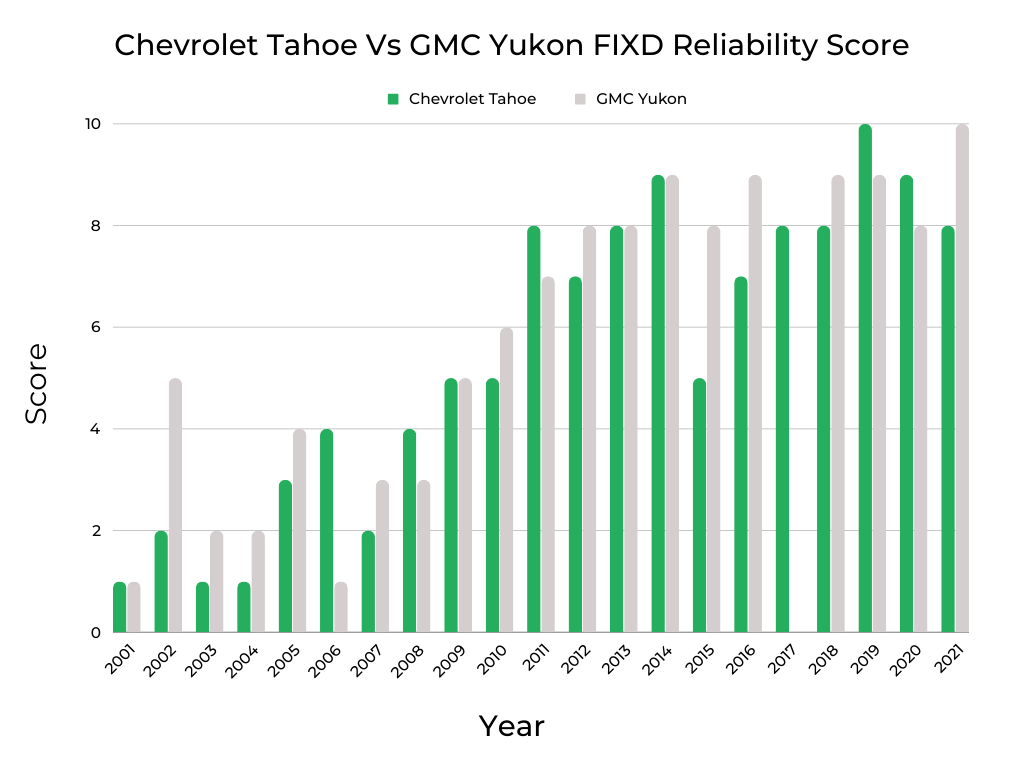
The idea that second-hand Chevrolet Tahoes and GMC Yukons are the same is crushed when looking at the FIXD Reliability Scores for these GM SUVs. Otherwise, you’d see matching engine reliability scores for each model-year pair.
Instead, there are only four Tahoe-Yukon pairs with the same rating. In addition, eleven model years have a score difference of one, and five years have a score gap of two or more. Getting further into the details shows that the Yukon comes out ahead for ten years compared to five years for the Tahoe.
There are a few model years worth talking about. The 2002, 2015, and 2016 Yukons noticeably outperform the equivalent Tahoes. Meanwhile, the Tahoe’s engine reliability is substantially better than the Yukon only for 2006.
In short, FIXD Reliability Scores show that used Yukons are the clear engine dependability champion.
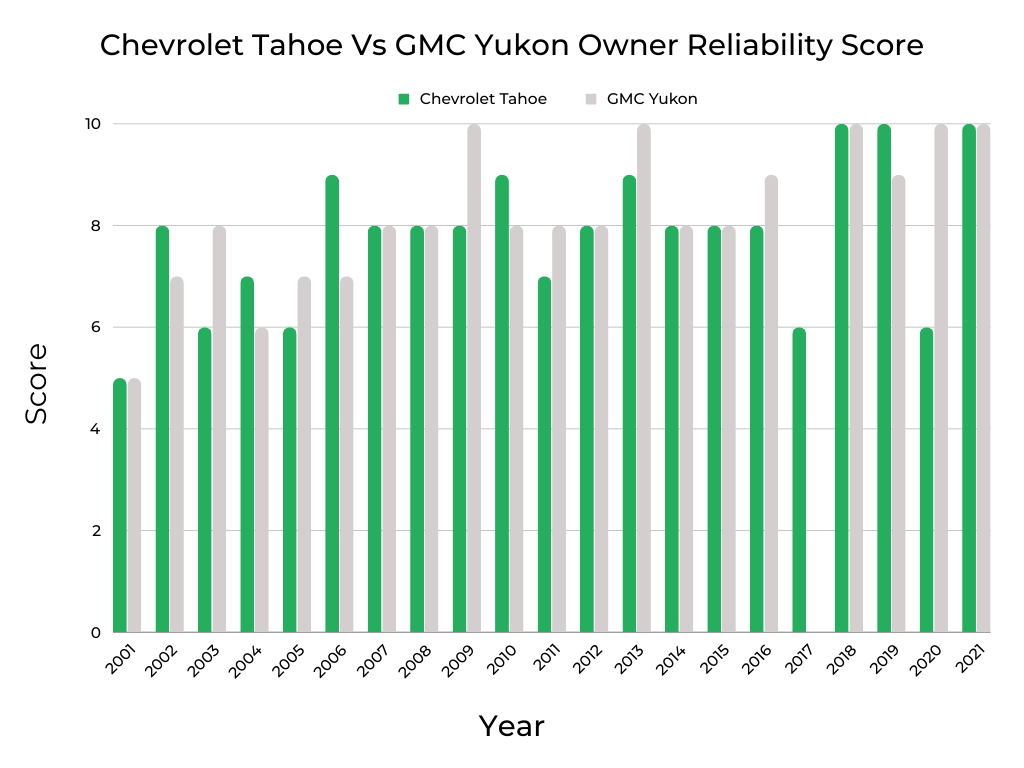
In contrast, owner perceptions about Tahoe and Yukon reliability are more closely aligned, no matter the frequency of check engine lights. Among the 20 model-year match-ups (2017 is excluded), the Tahoe and Yukon have tied owner reliability scores for eight years. The Yukon had top scores for seven years, but the Tahoe isn’t too far behind, with better rankings across five years.
Review the Best and Worst Years articles on the Chevrolet Tahoe and GMC Yukon to learn more about these vehicles’ FIXD Reliability and Owner Reliability Scores.
Longevity Comparison | Chevrolet Tahoe vs. GMC Yukon

FIXD owner surveys show that the Chevy Tahoe and GMC Yukon are equally capable of reaching 150,000-200,000 miles or more. Yet there doesn’t appear to be a clear winner in this category. Both models have numerous high-mileage model years. The 2002 GMC Yukon is the one outlier, with over 250,000 miles of average use. This doesn’t necessarily mean such a milestone isn’t reachable by a Tahoe, but it shows how capable this shared platform is.
A review of listings from autotrader.com (March 5, 2024) shows similar results for the Tahoe and Yukon. Among the 2001-2012 model years (examples most likely to have higher mileage), there are 855 Tahoes and 483 Yukons for sale. The greater number of Tahoes isn’t surprising, given that Tahoes generally have a lower MSRP than the more upscale Yukon.
This data reveals 328 (38.4%) Tahoes and 186 (38.5%) Yukons with 150,000-200,000 miles, practically identical results from a percentage perspective. The consistency continues with higher-mileage listings. There are 218 (25.5%) Tahoes and 113 (23.4%) with 200,000 miles or more. The percentages aren’t exactly even, but they are close enough to show that the Tahoe and Yukon are equally capable from a longevity standpoint.
It’s worth mentioning that extended vehicle lifespans are also dependent on use and upkeep, not just build quality. A Tahoe or Yukon with 150,000 miles, a good maintenance record, and mostly highway use is likely to have lots of life left. It’s a vehicle that stands in stark contrast to one with similar mileage but poor upkeep history and years of stop-and-go city use.
For a more thorough look at longevity, review the individual articles on the best and worst years of the Chevrolet Tahoe and GMC Yukon.
Who Should Buy These Cars: The Legacy of Chevrolet Tahoe vs. GMC Yukon
In many ways, the Chevrolet Tahoe and GMC Yukon are the Swiss Army knives of the automotive world; they’re a single tool for multiple purposes.
First and foremost, the GM SUVs are family haulers. According to FIXD surveys, 41% of Tahoe owners and 46% of Yukon owners use their vehicles for this purpose. “Lots of driving” (a combined activity of commuting and road trips) is another common task (29% for the Tahoe and 23% for the Yukon).
Although not a typical activity, 14% of Tahoe and Yukon owners report using their SUVs for hauling and towing duties—a more manageable task with a V8 or gutsy Diesel under the hood. A large engine, long wheelbase, and spacious cabin are the ingredients for “luxurious driving,” an activity that an average of 6.5% of Tahoe and Yukon owners participate in.
| Frequent Use Categories: | Chevrolet Tahoe | How Useful? (Out of 5 Stars) | GMC Yukon | How Useful? (Out of 5 Stars) |
| Family Vehicle | **** | *** |
| Lots of Driving (travel/long commute) | *** | **** |
| Hauling/Towing | ** | * |
| Office on Wheels | * | * |
| Sport/Fast Driving | * | * |
| Luxurious Driving | * | * |
| Outdoor/Off-Road | * | * |
Driver Experience | A Summary of The Top 10 Chevrolet Tahoe vs. GMC Yukon Posts:
SUV owners and shoppers will encounter numerous Reddit posts involving the Chevy Tahoe and GMC Yukon. Here’s an overview of some of the more recent conversations from Reddit: r/whatcarshouldIbuy.
Reliability and Maintenance
Redditors often highlight the reliability of the Chevrolet Tahoe and GMC Yukon, noting their ability to last well beyond 200,000 miles with proper maintenance. One commenter shared their experience with a 2001 Tahoe purchased with 130k miles, which had no problems since the acquisition, and mentioned family members having similar positive experiences with GM’s full-sized SUVs. Another user pointed out that these vehicles, if maintained well, could easily surpass 200k miles, citing personal and family experiences that portray these models as durable and reliable over time. The discussion also touched on the importance of inspecting for common issues like U Joints needing replacement around 130-150k miles and checking for rust in snow-prone states.
Performance and Comfort
In terms of performance, users did not differentiate much between the Tahoe and Yukon, as they share many mechanical components, including engines and drivetrains. The comfort level is generally praised, though one user, comparing the Tahoe to their 2019 F150, found the ride less impressive. This suggests that while these SUVs are reliable and capable, preferences for ride comfort can vary based on individual expectations and experiences with other vehicles.
Value and Cost
The conversation around value and cost often revolves around the initial purchase price and the cost of parts and maintenance. One Redditor mentioned the Tahoe and Yukon are practically identical, with the main difference being the branding. This similarity extends to their resale value, where both vehicles are noted for holding good value over time. However, users advised caution regarding the year and mileage when purchasing to avoid models with the potential for expensive repairs. The discussion also considered the cost-effectiveness of buying older models, with several users advocating for their value given the vehicles’ longevity and durability.
Functionality and Usability
Functionality, especially in terms of cargo space and towing capacity, was a key point of discussion. The Tahoe and Yukon are praised for their spacious interiors and ability to handle significant towing tasks, making them suitable for families and outdoor activities. However, one Redditor noted that cargo space becomes limited if the third row is in use, suggesting potential buyers consider how they plan to use the vehicle. Another user highlighted the vehicles’ off-road capabilities, albeit with a note on their mediocre gas mileage, suggesting that while they are versatile, potential owners should consider their specific needs and usage patterns.
Reddit Recap
The Chevrolet Tahoe and GMC Yukon are highly regarded among Redditors for their reliability, durability, and functionality. They are seen as nearly identical in many aspects, with differences mainly in branding and minor features. While they offer great value, especially for those needing spacious interiors and towing capacity, potential buyers are advised to consider maintenance history, common issues, and their specific needs when choosing between these models.
Year-by-Year Comparison | Chevrolet Tahoe vs. GMC Yukon
Best & Worst Years | Chevrolet Tahoe vs. GMC Yukon | 2001-2024

Bargain shoppers will want to zero in on a 2006 Tahoe or a 2005 Yukon. They’re far from perfect as almost 20-year-old vehicles but are cheap and readily available.
Stepping up to a third-generation Tahoe or Yukon comes at a price, but such a move creates more buying opportunities with a 2011-2012 Tahoe or 2009 or 2013-2014 Yukon. In fact, from everything already covered (market value, depreciation, maintenance costs, and engine reliability), the 2013 GMC Yukon is the smart purchase.
Buyers looking for something more modern will want to move up to fourth-generation editions. The 2016-2020 Tahoes and 2017-2019 Yukons all get green lights. The jury is still out on the fifth-generation Tahoe and Yukon (2021 and newer models). There’s just not enough data to pass judgment, and avoiding the first year of an all-new model (the 2021 Tahoe and Yukon) is always a good idea.
I’ll call attention to the undecided years (yellow) only because there isn’t enough information to give these editions a thumbs up or down.
Important Features Timeline | Chevrolet Tahoe vs. GMC Yukon

While the GMC Yukon is considered more high-end than the Chevy Tahoe, both vehicles received the most significant features at the same time. This approach makes sense as they’re near-identical and share almost every component.
However, there are a couple of curious exceptions. For the 2007 model year, the Yukon received parking sensors a year ahead of the Tahoe. Perhaps this had something to do with the roll-out of the third-generation Tahoe and Yukon and GM’s desire to help separate the two vehicles in the marketplace.
Another oddity is that Yukon got Apple CarPlay and Android Auto for the 2018 model, but the Tahoe had to wait until the following year. Again, the reasoning for this decision is uncertain, but it’s possibly another case of creating a distinction (even if shortlived) between the models.
Maintenance Costs (Year-by-Year Average) | Chevrolet Tahoe vs. GMC Yukon

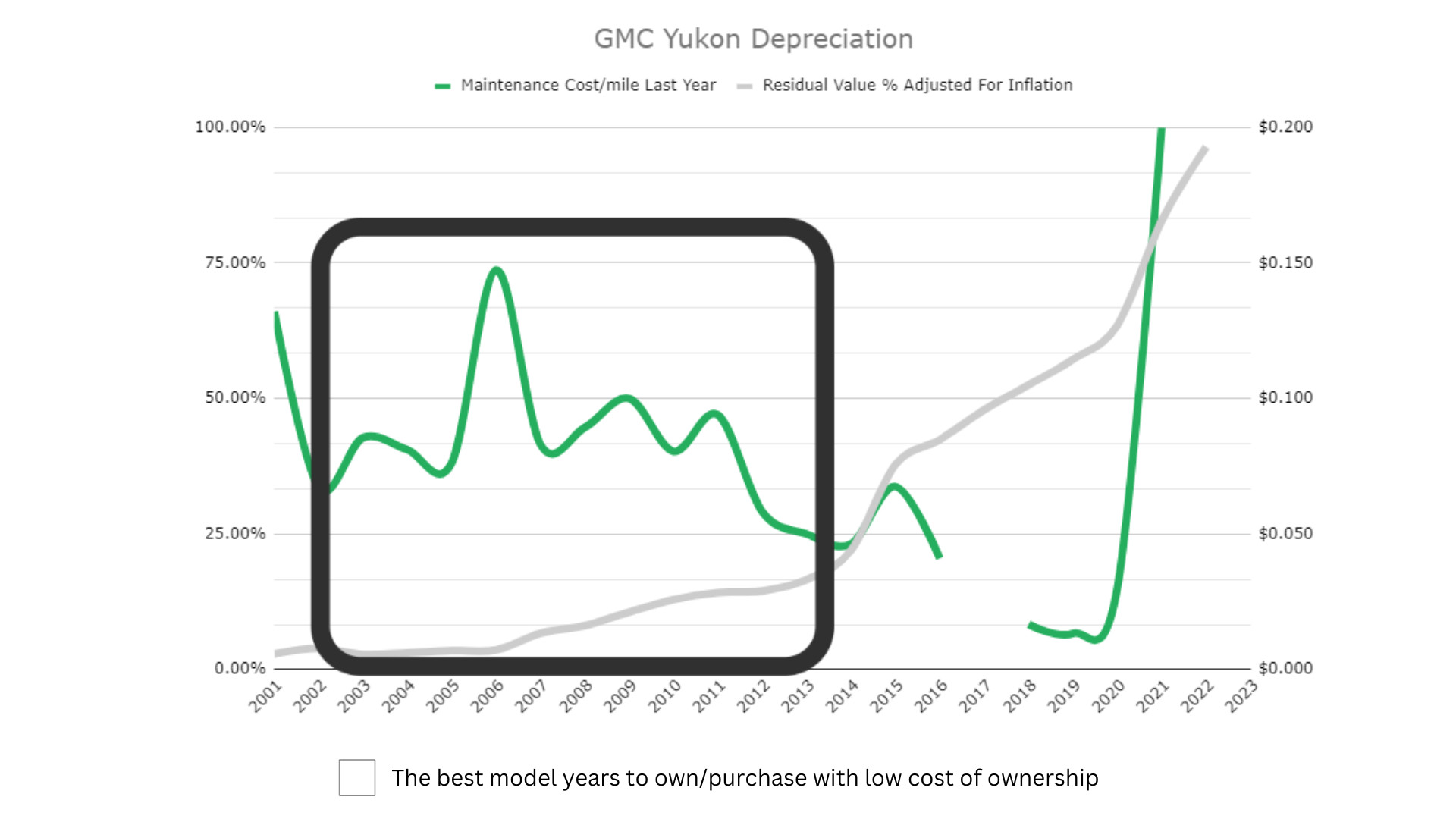
One undeniable aspect of large vehicles is that they cost more to keep on the road. All the essentials required to operate a plus-sized car are more expensive, from larger tires to more engine oil. For instance, RepairPal reports that annual maintenance for the compact Chevrolet Equinox costs $537, while the yearly upkeep tab for a midsize Chevy Traverse runs $656. You see where this is headed.
FIXD surveys reveal that the typical Tahoe owner spent $852 on maintenance and repairs in 2022, while their Yukon counterpart paid $971, 14% more.
Further, specific model years are especially expensive to maintain. Owners of Tahoes from 2002, 2005, 2006, 2009, 2011, 2013, and 2014 spent at least 20% above the $852 average. The same applies to the 2001, 2006, 2009, 2011, and 2021 Yukon, with upkeep exceeding the $971 average by 20% or more.
Review the best and worst years of the Chevrolet Tahoe and GMC Yukon to learn more about maintenance and repair costs for these vehicles.
Safety Rating Comparison | Chevrolet Tahoe vs. GMC Yukon

It shocks no one that the Tahoe and Yukon have virtually matching crash test scores from the National Highway Traffic Safety Administration (NHTSA). Remember, these jumbo SUVs are essentially the same vehicle. I’ll get to the 2011 Yukon momentarily.
Critically, I set 4.0 as the dividing line between good and underperforming NHTSA safety scores. This is a vital consideration if you’re shopping for an older Tahoe or Yukon, as the 2001-2006 model years didn’t produce the best results. Otherwise, models built since 2007 can be driven confidently, except for the odd-duck 2011 GMC Yukon.
The government instituted more stringent safety testing beginning with the 2011 model year. So, it’s not unusual to see a drop in safety performance for these models. However, what’s head-scratching is how much better the 2011 Tahoe did than the 2011 GMC. Short of digging through mounds of research data, we’ll need to leave this situation as a mystery and move on.
More details about crash test safety scores are covered in the Chevrolet Tahoe and GMC Yukon articles.
Fuel Efficiency Comparison | Chevrolet Tahoe vs. GMC Yukon

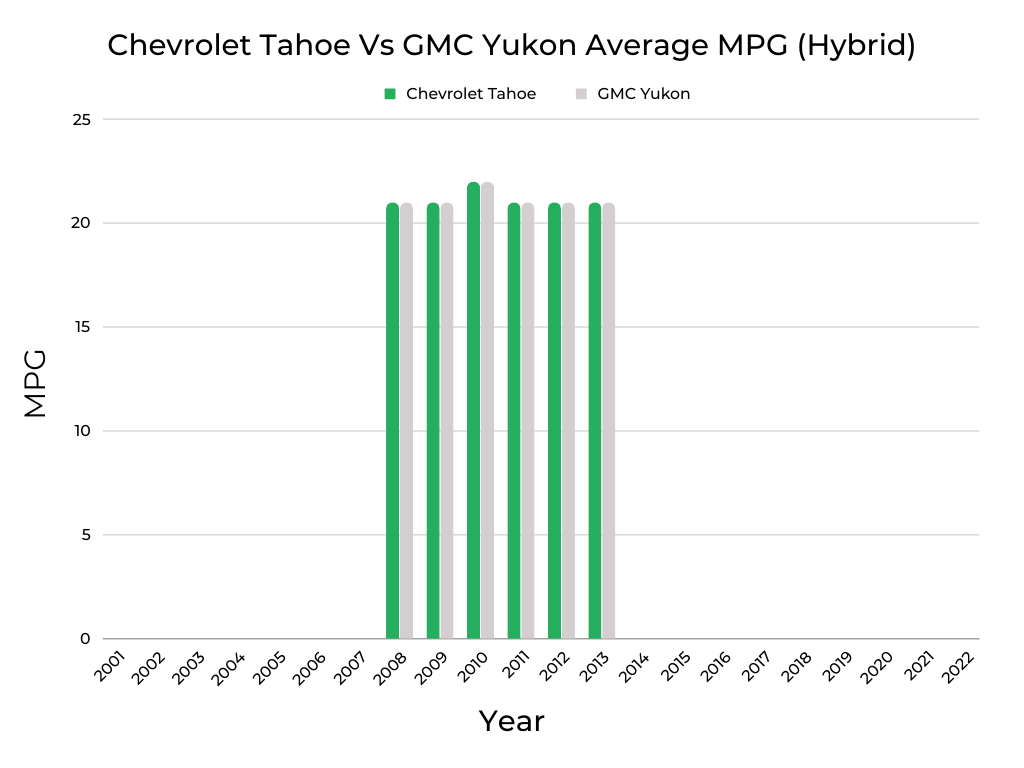
No one buys a full-size SUV to save on gas. While these large-scale people movers have many advantages, good fuel economy is not one of them. Fuel consumption ratings in the 15 mpg range are the norm. It’s just the price of admission to join the large vehicle club.
I was curious why the MPG ratings for some older Yukons were worse than their Tahoe equivalents. This is due to how these averages are calculated using information from fueleconomy.gov and isn’t a reflection of any differences in fuel economy ratings or performance.
Chevrolet and GMC introduced hybrid Tahoes and Yukons for the 2008-2013 model years to boost fuel economy past the 20 mpg threshold. While the effort was commendable, the extra expense of a hybrid powertrain was a consumer turn-off. Sales never met expectations, and GM dropped these hybrid-powered SUVs after 2013.

Dave Goldberg is an automotive journalist and lifelong car fanatic. He writes for numerous enthusiast and business outlets and is an ongoing contributor to HotCars.com, one of the most popular car culture websites. When he’s not writing or driving, Dave is either under a hood or asleep. His credentials include a BA in Journalism from The George Washington University.