
Not only are pickup trucks a big deal for Detroit, but they’re a significant part of the lives of millions of Americans. Of course, the Ford F-150 is the king of the hill as America’s best-selling truck for decades and more recently, the most popular vehicle. The GMC Sierra sometimes takes a back seat to its corporate twin, the Chevrolet Silverado, but remains a vital product for General Motors.
Growing up in a Ford family, I often saw an F-150 in the driveway. Meanwhile, friends and neighbors mostly drove Fords or Chevys, many of them Chevy C/K “Square Body” pickups. Once in a while, a GMC owner would appear, looking to be a little different from the crowd.
This same approach applies in modern times. Today’s GMC pickup buyers are looking for something more unique in the face of the millions of F-150s and Silverados on the road.
For used truck shoppers, adding Sierras to the mix opens opportunities. More choices are always a good thing when it comes to car buying, especially when shopping for second-hand examples. You’re more likely to find something with the desired features and at a better price.
At the same time, it’s hard to ignore the dominance of the Ford F-150—they’re everywhere. As I write this, over 51,000 used F-150s are for sale on Autotrader, compared to almost 19,000 GMC Sierras. It’s impossible to ignore Ford’s presence in the used truck market.
Comparing the F-150 and Sierra is only natural. So, read how these popular movers of people and things compare. To clarify, we’re only looking at the core F-150, not the larger members of the F-Series, like the F-250 and F-350 Super Duty trucks. Likewise, this match-up explores the essential GMC Sierra, the 1500, not its larger siblings such as the Sierra 2500 HD or Sierra 3500 HD.
Shoppers will find that choosing a Sierra 1500 over an F-150 comes at a price. Assuming equivalent factors like age, condition, and equipment, these GMCs usually cost more. But there’s a payoff—notably better engine reliability for the Sierra among older model years. Millions of aging F-150s may be roaming the roads, but they’re more vulnerable to check engine lights and the accompanying problems.
The Sierra also gets the nod for offering many advanced features, like Apple CarPlay and Android Auto, before the F-150. This could matter when comparing F-150s and Sierras of the same year.
One area where neither truck has the advantage is longevity. FIXD surveys and third-party data show the F-150 and Sierra have equal prospects of reaching high-mileage status. Both pickups also have near-identical maintenance and repair costs. However, specific model years from both brands have histories of above-average upkeep expenses, which is more likely to occur with the Sierra.
Lastly, poor fuel economy is the price of admission to the full-sized truck club. Few F-150 and Sierras model years prove this wrong. However, buyers looking to maximize every gallon will find that the most recent F-150s are better fuel sippers, especially if there’s a hybrid system under the hood.
Keep reading to see how this Ford F-150 and GMC Sierra contest turns out. You can learn about resale values, depreciation, reliability, longevity, maintenance costs, and fuel economy—essentials to understand to make a more informed car-buying decision.
Other match-ups to review include Tahoe vs Expedition, Suburban vs. Tahoe, Jetta vs. Civic, Sentra vs. Corolla, Outback vs. Forester, 4Runner vs. Highlander, RAV4 vs. CR-V, Civic vs. Corolla, Pilot vs. Highlander, and Odyssey vs. Sienna.
| Income Bracket | Monthly Financing Cost Range | Cash Purchase Price Range | Ford F-150 Years | GMC Sierra 1500 Years | Best Model Year: | Why? |
| $5k – $10k | $83 – $125 | $3,000 – $4,500 | N/A | 2004 | 2004 Sierra | Low price, good safety score |
| $10k – $15k | $125 – $187 | $4,500 – $6,750 | 2012 | N/A | 2012 F-150 | Good value, good safety score |
| $15k – $25k | $187 – $312 | $6,750 – $11,250 | 2012 | 2011 | 2011 Sierra | Above-average engine reliability, excellent safety score |
| $25k – $35k | $312 – $437 | $15,750 – $22,500 | 2017 | 2016 | 2017 F-150 | Above-average engine reliability, very good safety score |
| $35k – $50k | $437 – $625 | $15,750 – $22,500 | 2019 | 2018 | 2019 F-150 | Top engine reliability, very good safety score |
| $50k – $74k | $625 – $925 | $22,500 – $33,300 | 2020 | 2021 | 2021 Sierra | Top engine reliability, very good safety score |
See the methodology for the table above.
Curious about other car pairings? Check these articles to explore:
Volkswagen Jetta vs. Honda Civic
Before you respond to the “For Sale” ad, check out this How to Buy a Used Car article for a step-by-step checklist.
Price History Comparison | Ford F-150 vs. GMC Sierra
Average Market Value – Based on Owners’ Self-Reported Mileages | Ford F-150 vs. GMC Sierra
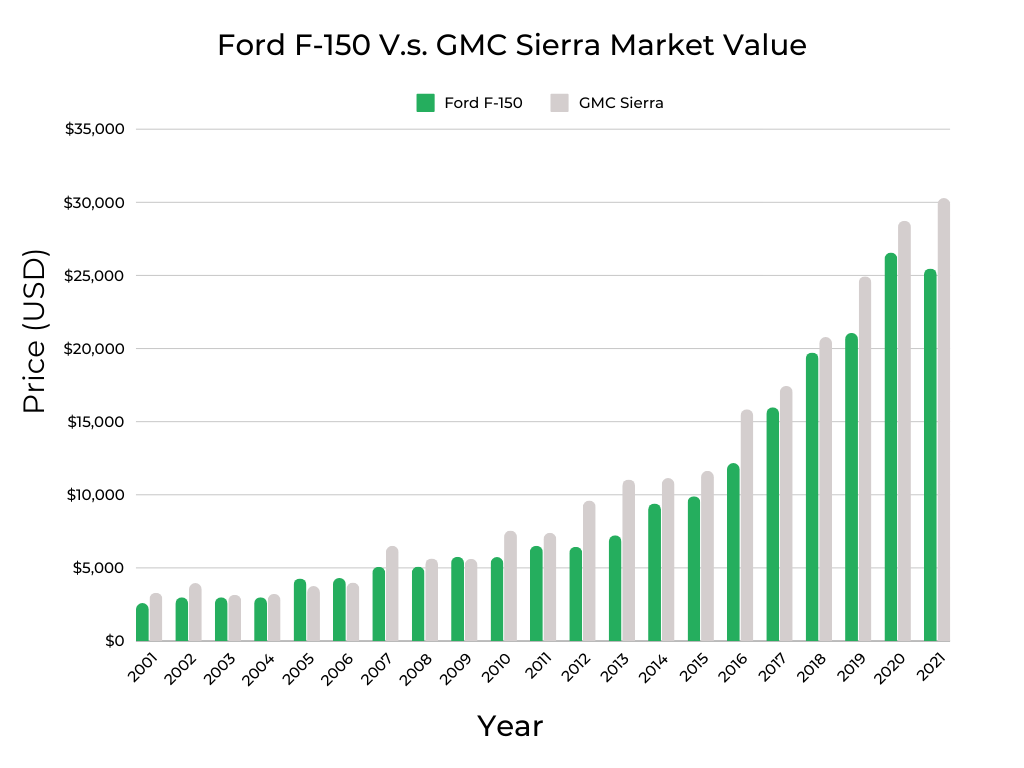
The market value chart shows that the Ford F-150s (green) and GMC Sierras (gray) have relatively consistent valuations across the 21st century. Older examples are worth less than newer ones. However, there are differences among several model-year pairs. Keep in mind that these prices are based on private-party sales, according to Kelley Blue Book (KBB).
In addition, the data reflects owner-reported mileage collected from FIXD surveys, making the values more true to life. As a result, some years show a modest imbalance. For example, owners of F-150s from 2012, 2013, 2016, and 2021 reported significantly higher mileage than their GMC counterparts. Hence, the Sierras from these years have higher valuations. The same applies to the 2001, 2004, 2005, and 2009 Sierra. Higher reported mileage for these trucks helps inflate the values of the corresponding F-150s.
Original sticker prices and depreciation are also part of the equation.
Overall, a Sierra costs more when new than a Ford, translating into higher vehicle prices. In 2014, a two-door GMC Sierra SLE with a 6.5-foot bed had an MSRP of $38,495, compared to a similar Ford F-150 XLT at $32,725. The margin is slimmer for the 2018 model year at $43,600 for the Sierra versus $42,320 for the F-150. Nonetheless, this is enough to make a difference later on, assuming equal factors like condition and equipment.
Building off the distinction in window stickers is depreciation, and the Sierra does a better job at this. CarEdge estimates that a new Sierra 1500 will lose 22% of its original value after five years. Meanwhile, a new F-150 takes a 24% hit over the same period. This 2% gap may seem minor, but the contrast adds up when applied to trucks in the $10,000 to $30,000 price range.
In short, used truck shoppers without a brand preference will find that an F-150 is usually the better bargain.
Because the chart reflects private-party purchases, buyers visiting dealers will find prices to be 30% to 50% higher. Looking for an older F-150 or Sierra or one with more miles will lessen the impact on your wallet.
Be sure to read our Best and Worst Years series of articles highlighting the Ford F-150 and GMC Sierra winners and losers.
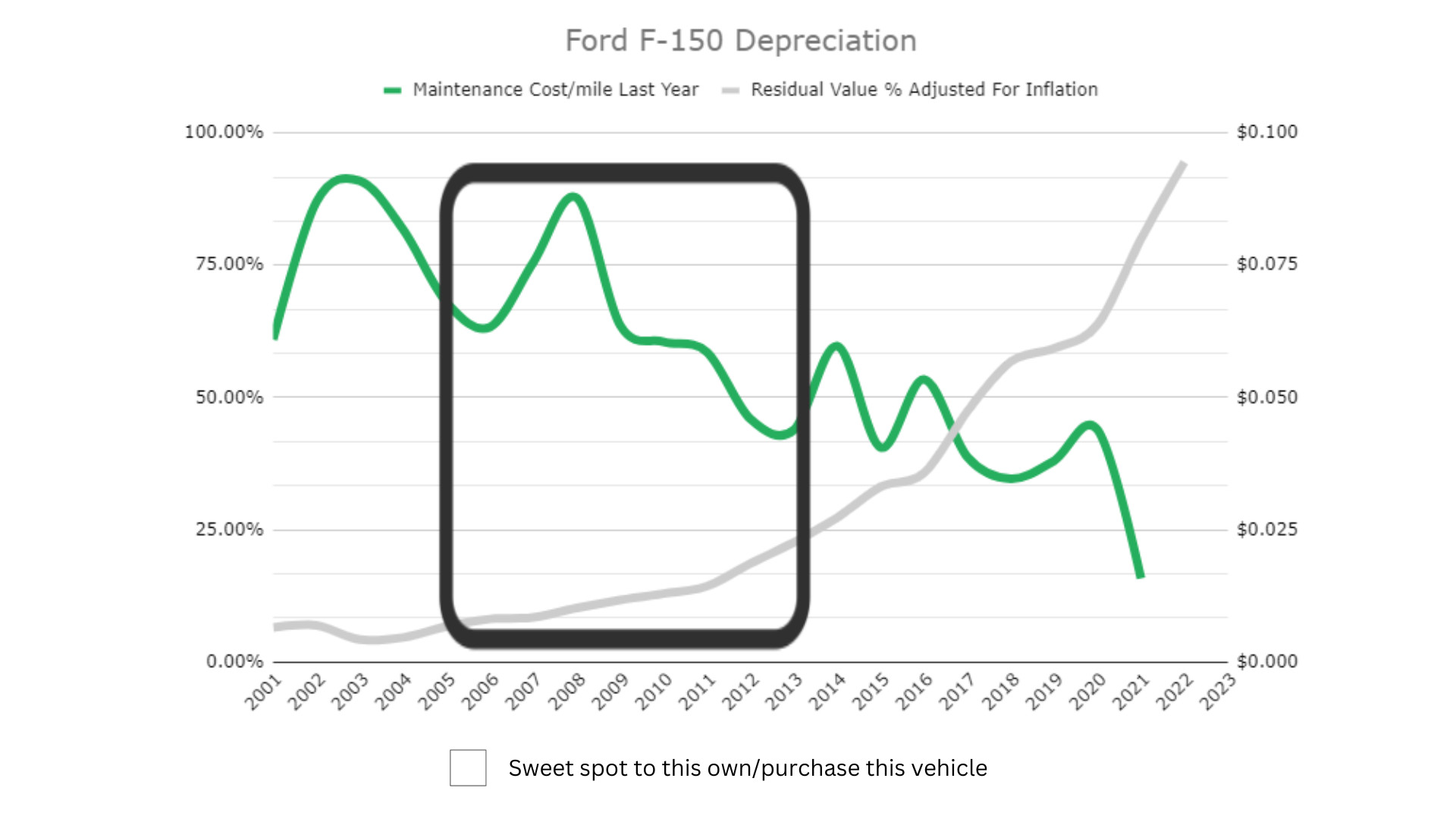
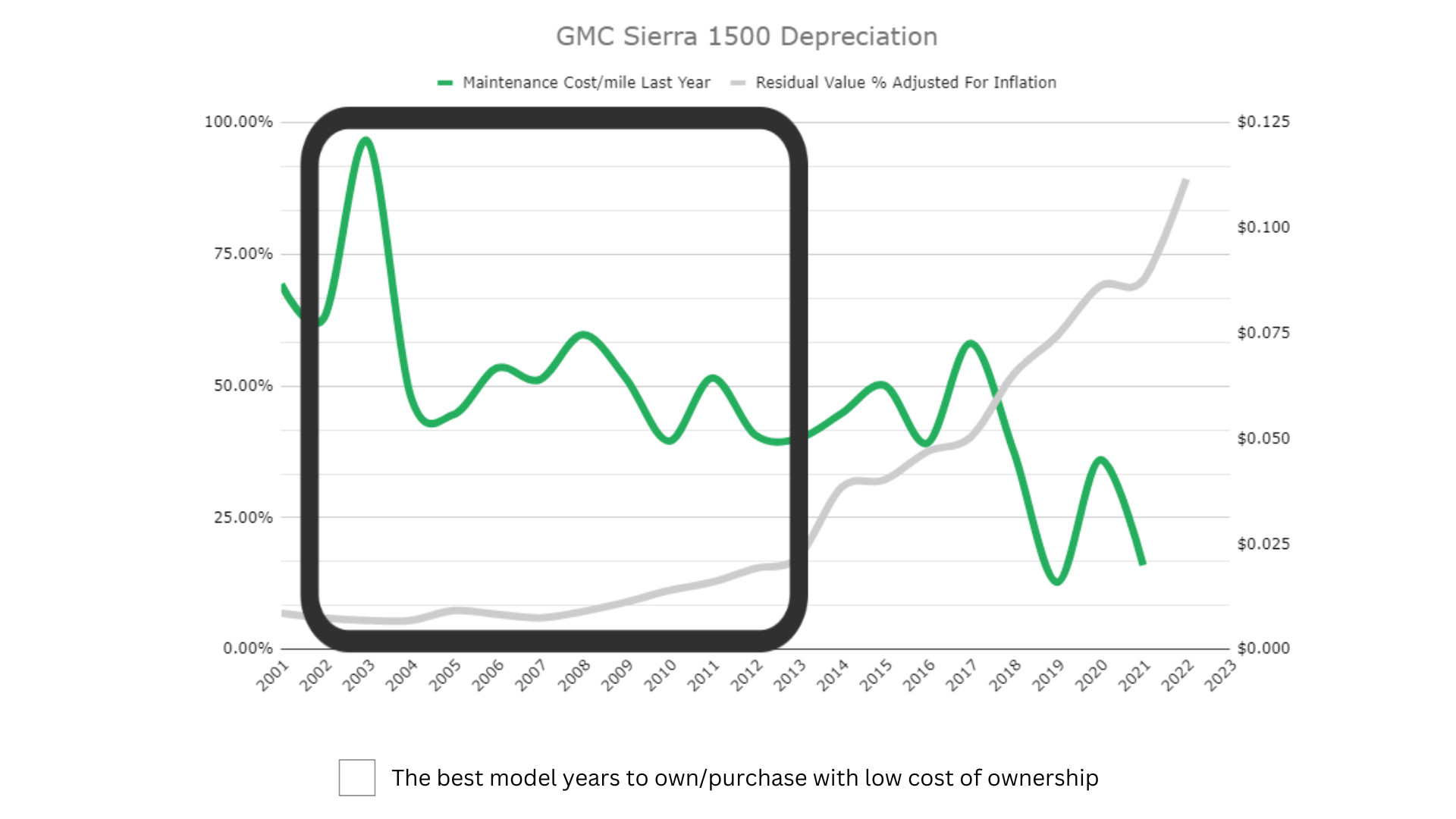
Depreciation vs. Maintenance Expenses
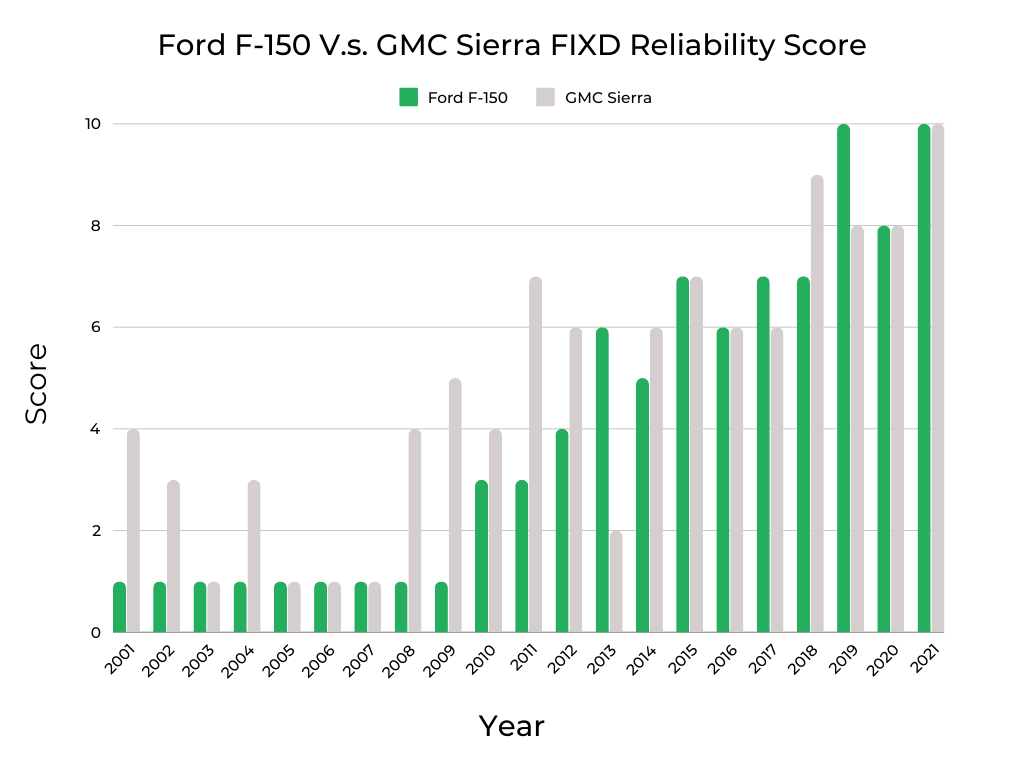
Overall, the Sierra trounces the F-150 with better engine reliability. The Sierra has better FIXD Reliability Scores for 10 of the 21 analyzed years, compared to 3 years for the F-150. The two trucks tied for eight years.
Those results are discouraging for Ford fans, but comparing more recent years, 2011-2021, puts the F-150 in a better light. In this breakdown, the Ford has higher FIXD Reliability Scores for 3 out of 11 years, while the GMC comes out ahead by 4. There’s a tie for 4 years. These results put more recent F-150s and Sierras on equal footing regarding engine reliability.
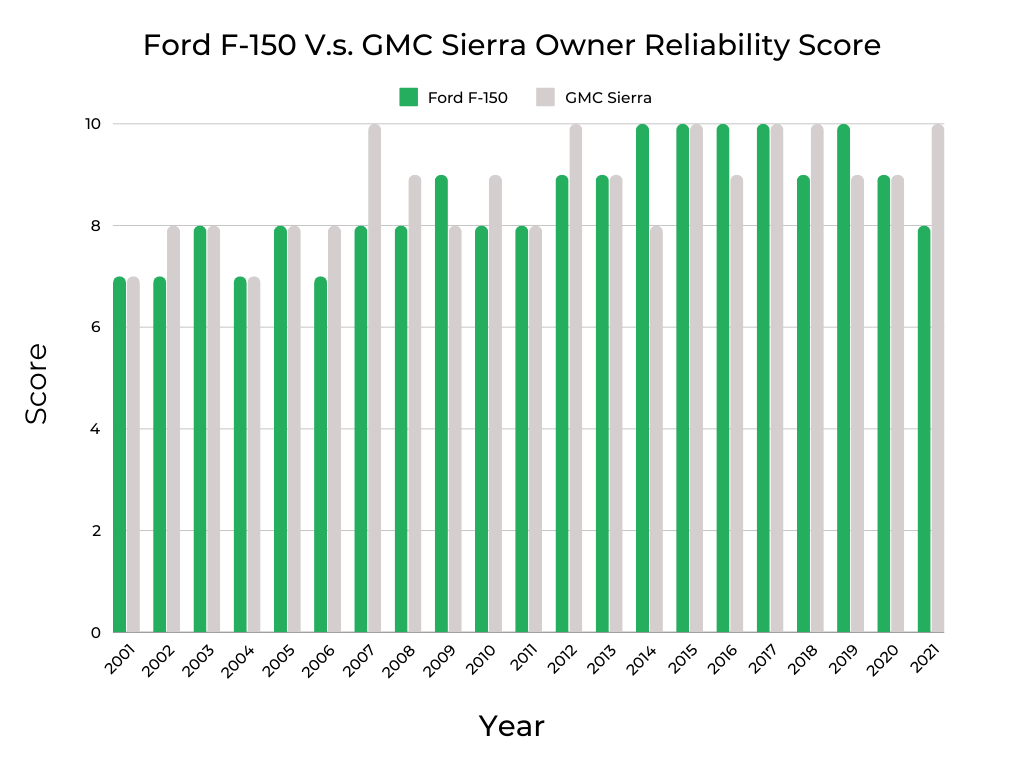
Regardless of the hard data and the reality of check engine lights, F-150 and Sierra owners overwhelmingly give their trucks high marks for perceived reliability. No year drops below a 7 (out of 10) for the Ford, and most are an 8 or better. Meanwhile, the Sierra does even better with a minimum Owner Reliability Score of 8.
So, no matter what’s happening under the hood, these owners feel their trucks are ready for the road and beyond.
Review the Best and Worst Years articles on the Ford F-150 and GMC Sierra to learn more about these vehicles’ FIXD Reliability and Owner Reliability Scores.
Longevity Comparison | Ford F-150 vs. GMC Sierra
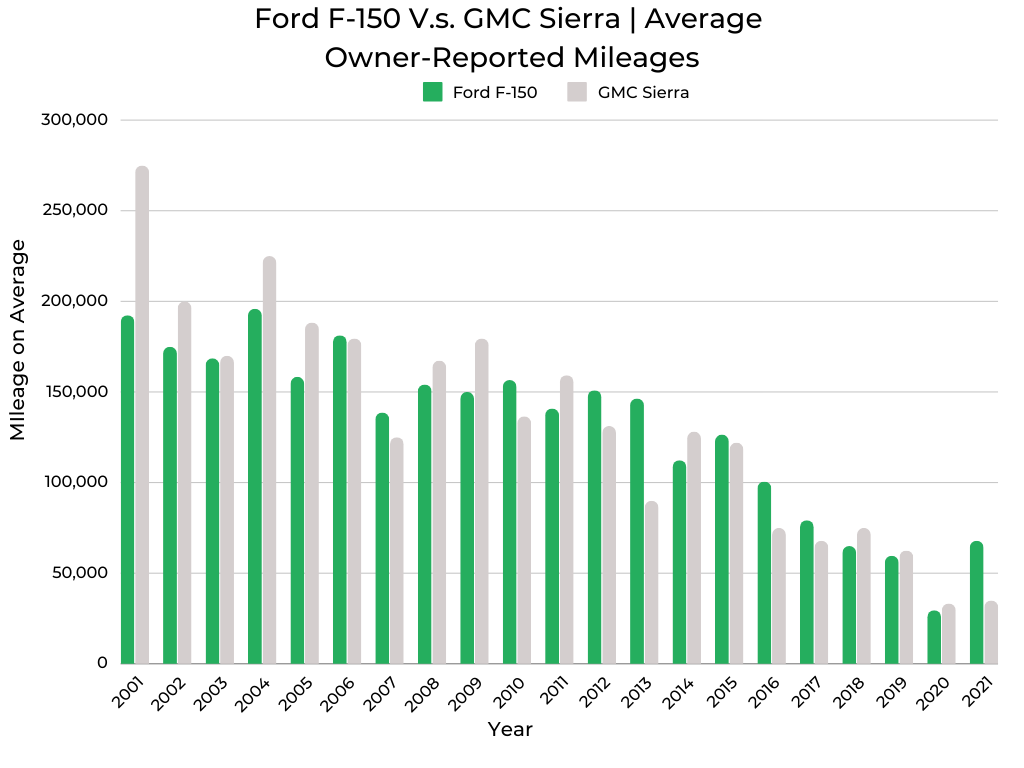
Most owners of older F-150s and Sierras report high mileage status for the trucks, with odometers readily reaching an average of 150,000 to 200,000 miles. This is unsurprising, as body-on-frame vehicles are more robust. Plus, larger engines and simpler drivetrains hold up well to the rigors of truck life. The Sierra also has a claim to fame for the 2001 and 2004 models, which went above and beyond 200,000 miles.
Let’s explore the longevity of the F-150 and Sierra further by examining used trucks in the marketplace. Autotrader.com listings from April 30, 2024, show 4,203 F-150s and 1,031 Sierra 1500s for sale from the 2001-2012 model years. These years were chosen because they typically have higher mileage than newer editions. The Autotrader data shows 1,401 (33.3%) of the F-150s and 309 (30.0%) Sierras have racked up 150,000 to 200,000 miles. A focus on the percentages shows these trucks have similar lifespan capabilities to this point.
The true test goes beyond 200,000 miles. Are the F-150 and Sierra equally capable of reaching this benchmark? The answer is a solid yes. The listings uncover 690 (16.4%) F-150s and 191 (18.5%) Sierras that have made it this far. Another case of comparable percentages demonstrates that the F-150 and Sierra have equal longevity potential.
For a more thorough look at longevity, review the individual articles on the best and worst years of the Ford F-150 and GMC Sierra.
Who Should Buy These Cars: The Legacy of Ford F-150 vs. GMC Sierra
It’s reasonable to assume similar uses of similar vehicles, which is true with the F-150 and the Sierra. Both are full-sized pickups with nearly identical capabilities. According to FIXD owner surveys, both trucks see similar usage as family transportation vehicles (29% for the F-150 and 24% for the Sierra).
Meanwhile, about one in five F-150 and Sierra owners use their vehicles for commuting and road-tripping, activities grouped together as “lots of driving.” In addition, an average of 28% of the surveyed owners report hauling and towing as another common task.
That said, these pickups aren’t all about work, as 12% of F-150 and 15% of Sierra owners enjoy the outdoors or head off-road behind the wheel of their trucks.
| Frequent Use Categories: | Ford F-150 | How Useful? (Out of 5 Stars) | GMC Sierra 1500 | How Useful? (Out of 5 Stars) |
| Family Vehicle | *** | *** |
| Lots of Driving (travel/long commute) | *** | *** |
| Hauling/Towing | * | * |
| Office on Wheels | * | * |
| Sport/Fast Driving | * | * |
| Luxurious Driving | * | * |
| Outdoor/Off-Road | ** | ** |
Driver Experience | A Summary of The Top 10 Ford F-150 vs GMC Sierra Posts:
Comparing the Ford F-150 and the GMC Sierra 1500 is a hot topic on Reddit. Here’s a recap of some of the top conversations from Reddit: r/whatcarshouldIbuy posts.
Reliability and Value
In discussions about the Ford F-150 versus the GMC Sierra, Redditors often focus on aspects like reliability and value for money. One commenter mentioned, “The Sierra should be easy to fix and reliable,” indicating a perception of good dependability. Comparatively, the F-150 is often praised for its robustness, with one user noting it as “better quality and a somewhat poor value compared to the F-150 we could get for the same price.” They elaborated that for about $44,000, the F-150 came with more features and superior quality compared to a similarly priced Sierra.
Performance and Comfort
Performance is a significant factor in the debate. Users argue that the F-150’s engine options, especially the 3.5 EcoBoost, offer a notable advantage in terms of power and efficiency over Sierra’s choices. A user stated, “Drive both and I think you’ll walk away wanting the Ford. That 3.5 EcoBoost will make all of the difference.” Regarding comfort, the opinions seem to reflect a preference for Ford’s interior and technological enhancements. Comments highlight that the F-150 provides “more power, adaptive cruise, lane assist, and easier to use tech” compared to the Sierra.
Functionality and Design
Functionality and design also come up, with users appreciating specific features like the F-150’s advanced tech and the Sierra’s aesthetic and utility updates, such as the Multi-Pro tailgate. Despite some being swayed by the GMC’s refreshed interior in the latest generation, the consensus leans towards the Ford for its overall utility and robust feature set. One Redditor detailed their decision-making process, balancing between the F-150’s engine and features against the Sierra’s design improvements.
Reddit Recap
The comparison between the Ford F-150 and GMC Sierra on Reddit paints a picture of two highly competitive vehicles, each with its own strengths. The F-150 is frequently lauded for its superior performance, technological features, and reliability, making it a favorite among those who value power and innovative technology in their trucks. Meanwhile, Sierra is praised for its aesthetic design and specific features, such as the Multi-Pro tailgate, which appeals to owners who prioritize design and utility. While both trucks have their supporters, the F-150 appears to edge out the Sierra in discussions focused on comprehensive value and performance.
Year-by-Year Comparison | Ford F-150 vs. GMC Sierra
Best & Worst Years | Ford F-150 vs. GMC Sierra | 2001-2024
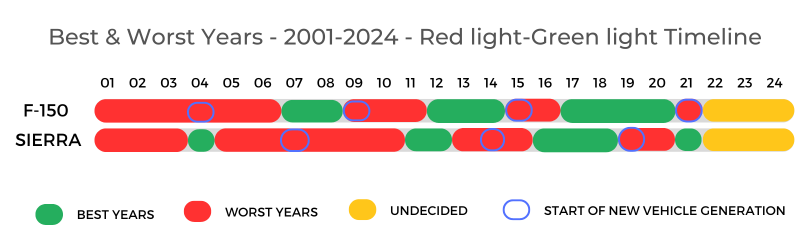
Poor engine reliability and other factors keep most older F-150s and Sierra off the best years list. One exception is the 2004 Sierra. Its FIXD Reliability Score of 3 (out of 10) is far from the best but sufficient to consider this truck if a low purchase price is a priority.
Moving up to middle-aged trucks opens buying opportunities, particularly with Ford. The 2007-2008 and 2012-2014 F-150s, along with the 2011-2012 Sierra, make the cut. Some examples offer above-average engine reliability, making them attractive options at reasonable prices.
If a newer Ford is the focus, then 2017-2020 F-150s get a thumbs up. In particular, the 2019 deserves special attention as only one of two 21st-century F-150s with a perfect engine reliability score. 2021 is the other, but staying away from the first year of an all-new generation of any vehicle is advisable.
More recent Sierras make the grade, too. Examples from 2016-2018 and 2021 are all worthwhile options.
I’ll call attention to the undecided years (yellow) only because there isn’t enough information to give these editions a thumbs up or down.
Important Features Timeline | Ford F-150 vs. GMC Sierra

Being the first to offer a feature in a vehicle gives an automaker short-term bragging rights over the competition and the opportunity to secure more customers. The Sierra can boast its first-mover status in several areas in this Ford versus GMC match.
For instance, the Sierra received Apple CarPlay and Android Auto in 2016, three years ahead of the F-150. This is also meaningful to used truck shoppers who require smartphone connectivity; they can buy an older and cheaper Sierra. The same applies to buyers looking for other must-have equipment.
The Sierra debuted lane departure warning and a rearview monitor before the F-150. To Ford’s credit, the F-150 was the first with blind-spot monitoring. Sierra-first conveniences include a power front passenger seat, a driver’s memory system, and remote start.
Maintenance Costs (Year-by-Year Average) | Ford F-150 vs. GMC Sierra
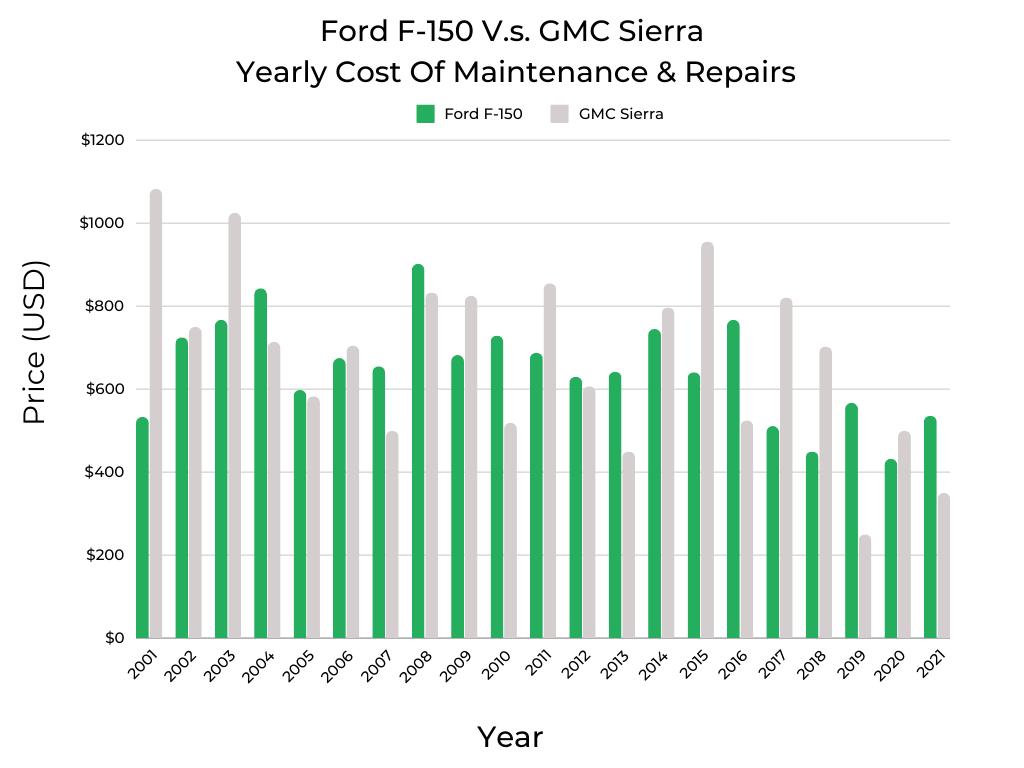
According to FIXD surveys, the typical F-150 owner spent $653 on repairs and maintenance in 2022. That’s about 4% less than the $683 average incurred by Sienna owners for the same year. It’s fair to call this a tie when looking at the overall numbers, but the picture changes somewhat when drilling into specific model years for each pickup.
The F-150 had only two years, 2004 and 2008, with upkeep expenses that exceeded its $653 average by 20% or more. Meanwhile, many Sierra owners aren’t so lucky, with the 2001, 2003, 2008, 2009, 2011, 2015, and 2017 model years having repairs bills at least 20% above the $683 average.
Review the best and worst years of the Ford F-150 and GMC Sierra to learn more about maintenance and repair costs for these vehicles.
Safety Rating Comparison | Ford F-150 vs. GMC Sierra
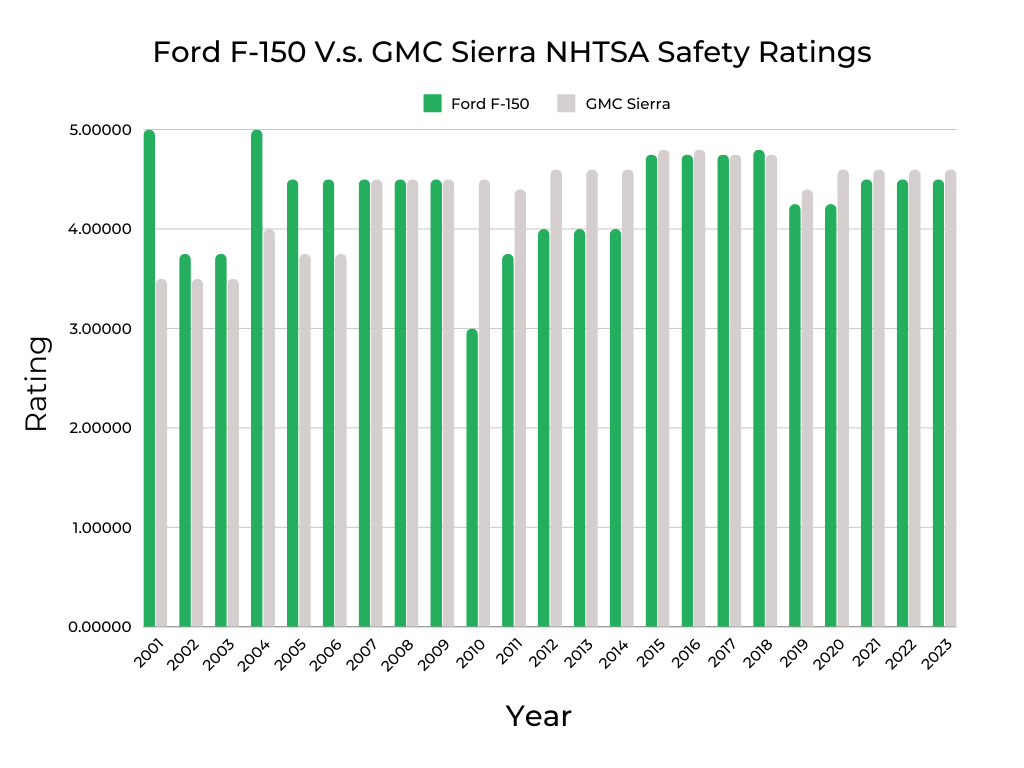
F-150 and Sierra shoppers can be comforted by most model years receiving good (4.0 out of 5) or better ratings in safety performance testing by the National Highway Traffic Safety Administration (NHTSA).
However, there are a few exceptions. Older Sierras from 2001 to 2003 and the 2002 and 2003 F-150 deliver subpar results.
The 2011 F-150’s mediocre performance is due to NHTSA’s implementation of more rigid safety standards. While this wasn’t an issue for GMC, it was for Ford. The Blue Oval made minor improvements in 2012, but notable progress wasn’t made until the eight-generation F-150 was introduced for 2015.
Another outlier is the 2010 F-150. At this point, the new requirements hadn’t kicked. However, the rear-wheel drive version of this truck did poorly in rollover testing, which brought the overall score down to 3.0. It’s something to consider if you’re shopping for a 2010 F-150.
More details about crash test safety scores are covered in the Ford F-150 and GMC Sierra articles.
Fuel Efficiency Comparison | Ford F-150 vs. GMC Sierra
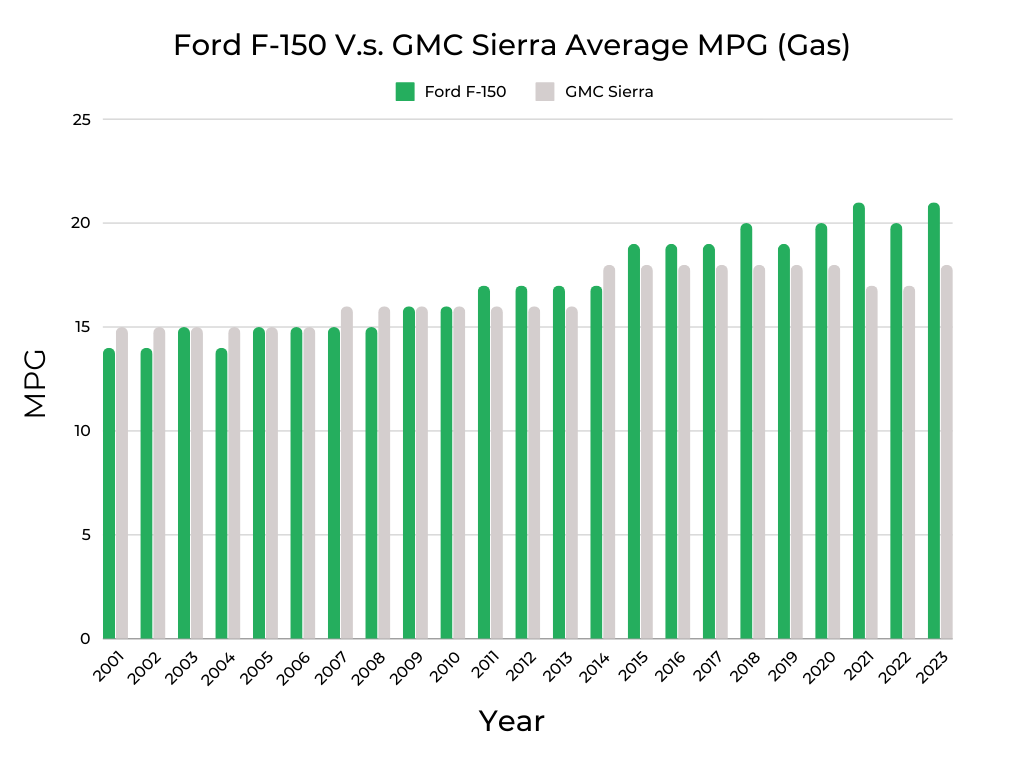
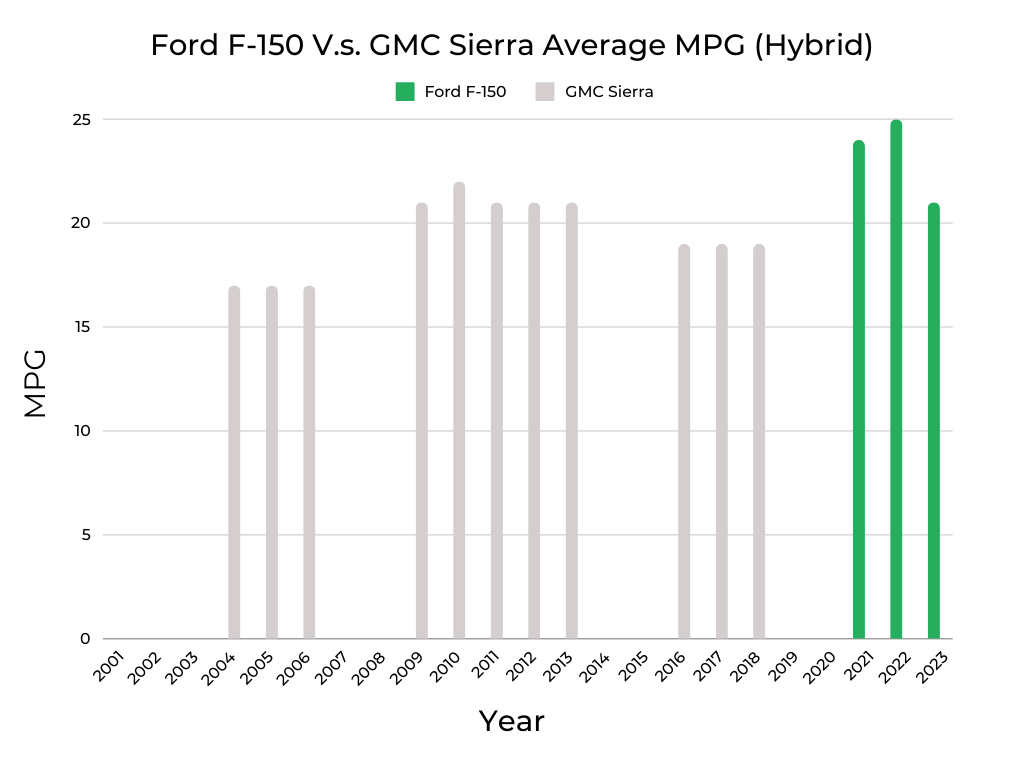
Lackluster fuel economy is the trade-off for buying a pickup truck because these vehicles have other benefits (like hauling, towing, and off-road capabilities). MPG ratings for the F-150 and Sierra are fairly matched through 2014, but the introduction of the eighth-generation F-150 in 2015 and its all-aluminum body helped Ford stay ahead of the Sierra.
The quest for a better pickup truck fuel economy led GMC to its on-again and off-again efforts with hybrid Sierra versions. Ultimately, increased cost and consumer skepticism doomed the attempts.
Ford’s hybrid efforts were more successful because these F-150s received V8 levels of horsepower and torque in addition to better fuel economy.

Dave Goldberg is an automotive journalist and lifelong car fanatic. He writes for numerous enthusiast and business outlets and is an ongoing contributor to HotCars.com, one of the most popular car culture websites. When he’s not writing or driving, Dave is either under a hood or asleep. His credentials include a BA in Journalism from The George Washington University.