
Although the Nissan Pathfinder was one of the first vehicles to popularize the SUV segment, it has suffered a bit of an identity crisis since debuting in America in 1987. Initially a rough-and-tumble utility with truck-based architecture, the Pathfinder took on more family-friendly characteristics and a third row with the 2005 model year (the launch of the third generation).
However, Nissan ditched the Pathfinder’s body-on-frame platform when introducing the fourth generation for 2013. This transformation moved the Pathfinder from the SUV camp to the world of crossovers. A crossover is a more car-like vehicle with a body and frame built as a single unit. Body-on-frame SUVs offer better off-road and towing capabilities, while unibody crossovers provide a smoother ride and greater fuel efficiency.
Understanding this difference is vital when comparing the Pathfinder with the Toyota Highlander, which has always been a crossover since hitting U.S. streets in 2001. If you need a vehicle with off-road ruggedness, then the path is clear: a Pathfinder built before 2013. The choice becomes less obvious if a crossover is on the shopping list.
As mentioned in an early comparison (Nissan Pathfinder versus Toyota 4Runner), the Pathfinder’s change from SUV to crossover has caused confusion in the marketplace. Some buyers don’t know what these Nissans are capable of. There are no such issues with the Highlander. As a result, many more Highlanders are on the road and in the used car market.
Nonetheless, matching up the Pathfinder and Highlander is worthwhile. For one, used Pathfinders are cheap, especially compared to pre-owned Highlanders. With careful shopping, $10,000 will get you a 2015 Pathfinder with top engine reliability, while the same money buys a 2010 Highlander with mediocre engine dependability.
Depreciation has a lot to do with Pathfinder pricing. This is great news if you’re buying a Pathfinder, but not so much if you have a Highlander mindset.
Another factor that plays to the Pathfinder’s advantage is good engine reliability. Toyota gets a lot of credit for this, but data from FIXD sensors shows that the Highlander isn’t as bulletproof as its reputation.
Yet, there are areas where the Highlander clearly excels. Not only are these Toyotas cheaper to maintain, but they’re also more fuel-efficient, especially when hybrid power plants are involved. Older Highlanders also outperform the Pathfinders in government crash tests.
Keep reading to see how this Nissan Pathfinder and Toyota Highlander contest turns out. You can learn about resale values, depreciation, reliability, longevity, maintenance costs, safety, and fuel economy—essentials to understand to make a more informed car-buying decision.
Other match-ups to review include Pathfinder versus 4Runner, Tahoe vs Expedition, Suburban vs. Tahoe, Jetta vs. Civic, Sentra vs. Corolla, Outback vs. Forester, 4Runner vs. Highlander, RAV4 vs. CR-V, Civic vs. Corolla, Pilot vs. Highlander, and Odyssey vs. Sienna.
| Income Bracket | Monthly Financing Cost Range | Cash Purchase Price Range | Nissan Pathfinder | Toyota Highlandere | Best Model Year: | Why? |
| $5k – $10k | $83 – $125 | $3,000 – $4,500 | 2007 | 2002 | 2007 Pathfindeer | Above-average engine reliability, good value |
| $10k – $15k | $125 – $187 | $4,500 – $6,750 | 2014 | 2007 | 2014 Pathfinder | Very good engine reliability, very good safety score |
| $15k – $25k | $187 – $312 | $6,750 – $11,250 | 2016 | 2010 | 2016 Pathfinder | Excellent engine reliability, very good safety score |
| $25k – $35k | $312 – $437 | $11,250 – $15,750 | 2017 | 2012 | 2012 Highlander | Above-average engine reliability, very good safety score, and very good value |
| $35k – $50k | $437 – $625 | $15,750 – $22,500 | 2019 | 2017 | 2017 Highlander | Excellent engine reliability, very good safety score |
| $50k – $74k | $625 – $925 | $22,500 – $33,300 | 2020 | 2019 | 2020 Pathfinder | Top engine reliability, very good safety score, and solid value |
See the methodology for the table above.
Before you respond to the “For Sale” ad, check out this How to Buy a Used Car article for a step-by-step checklist.
Price History Comparison | Nissan Pathfinder vs. Toyota Highlander
Average Market Value – Based on Owners’ Self-Reported Mileages | Nissan Pathfinder vs. Toyota Highlander

Looking at Pathfinder (green) and Highlander (gray) prices highlights the obvious: Highlanders cost more. Based on private sales reported by Kelley Blue Book (KBB), the chart shows that no matter the year, buyers will spend more on a Highlander than a Pathfinder. This also occurs among older model years (2001-2009), when depreciation usually evens out prices.
It’s important to mention that these values incorporate owner-reported mileage from FIXD surveys. These adjustments provide a more realistic look at used car prices but can also create a greater spread between the two models. For instance, owners of 2004, 2014, and 2018 Pathfinders reported adding significantly more miles than their Highlander peers, making these Nissans worth less. Similarly, 2003, 2008, 2009, and 2015 Highlanders have lower values because of excessive reported mileage.
But there’s more to greater Highlander valuations than mileage variances. Often, higher original prices can explain some of the difference. But that’s not really the case for most model years here. An entry-level 2007 Pathfinder S started at $28,250, while a base 2007 Highlander had a lower MSRP of $26,585. Pricing was more equivalent for the 2012 model: $32,115 for the Pathfinder and $32,533 for the Highlander.
However, pricing flips for the 2013 model year when the Pathfinder gets redesigned as a crossover and becomes a direct competitor to the Highlander. With a $29,510 starting price, the Pathfinder was substantially cheaper than a Highlander at $33,613. This significant pricing separation shows up in higher used car prices for Highlanders.
Depreciation is also part of the pricing equation for these vehicles. A 2007 Pathfinder has an average private-party transaction value of $3,647, compared to $5,458 for a 2007 Highlander. The difference increases significantly among newer examples. KBB reports that a typical 2012 Pathfinder is worth $5,930 against $11,647 for a 2012 Highlander. Even the transformation of the Pathfinder into a crossover doesn’t help. A 2013 Pathfinder is valued at $6,938, while a 2013 Highlander is worth twice as much: $13,652.
More recent Pathfinders still suffer at the hands of depreciation. CarEdge reports that a new Pathfinder loses 31% of its value over five years. In contrast, a Highlander only faces a 21% depreciation hit over half a decade.
No matter how you look at it, a Pathfinder is substantially cheaper than an equivalent Highlander.
Keep in mind that private-party sales determine these valuations. Buying from a dealer means paying 30% to 50% more. To navigate the higher retail prices, consider searching for an older model or a vehicle with higher mileage; these factors can help you find more affordable options.
Be sure to read our Best and Worst Years series of articles highlighting the Nissan Pathfinder and Toyota Highlander winners and losers.
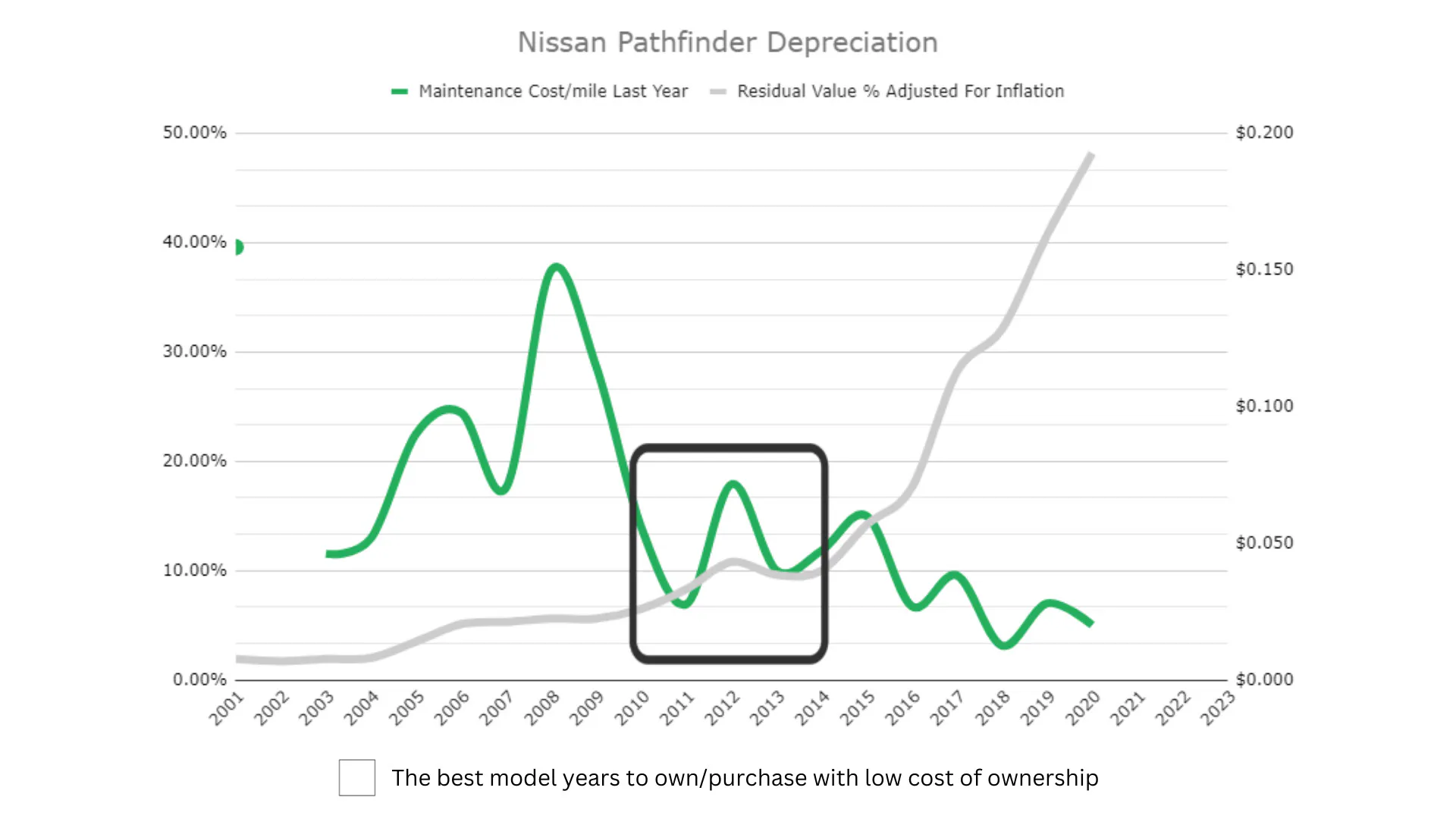
Depreciation vs. Maintenance Expenses
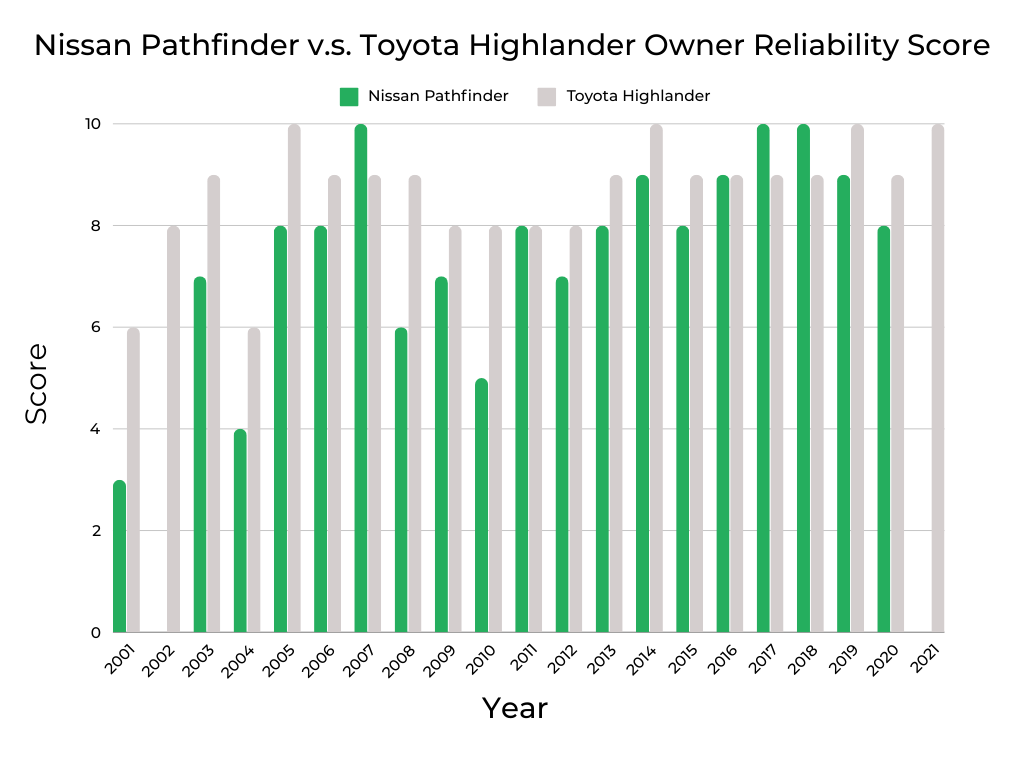
Low depreciation is often tied to reliability, which is why the Highlander holds its value so well. However, the Pathfinder doesn’t get all the credit it deserves, at least as far as engine reliability. Among the analyzed years (minus 2002 and 2021 due to insufficient Pathfinder data), the Pathfinder had higher FIXD Reliability Scores for 8 out of 19 years, compared to Highlander being on top for 7 years. Both vehicles are tied for 4 years.
Pathfinder engine reliability shines in more recent model years: 2010-2020. The Nissan has better FIXD Reliability Scores for 8 out of 11 years, while the Toyota has better results for only 2 years. The two crossovers tied for 2016.
To be fair, Highlander engine reliability is much better among the 2001-2009 model years. These older Highlanders had higher FIXD Reliability Scores for 5 out of 8 years, with the Pathfinder and Highlander tying for 3 years. The Pathfinder had no winning year among this group.
Regardless of check engine light frequency, Highlander owners greatly appreciate their cars more than Pathfinder owners. Owner Reliability Scores for the Highlander never drop below 6 (out of 10). Meanwhile, there are three Pathfinder years with sub-6 rankings.
On the high end, the Highlander received a 9 or 10 rating for 13 out of 19 years, compared to 6 years for the Pathfinder.
Review the Best and Worst Years articles on the Nissan Pathfinder and Toyota Highlander to learn more about these vehicles’ FIXD Reliability and Owner Reliability Scores.
Longevity Comparison | Nissan Pathfinder vs. Toyota Highlander
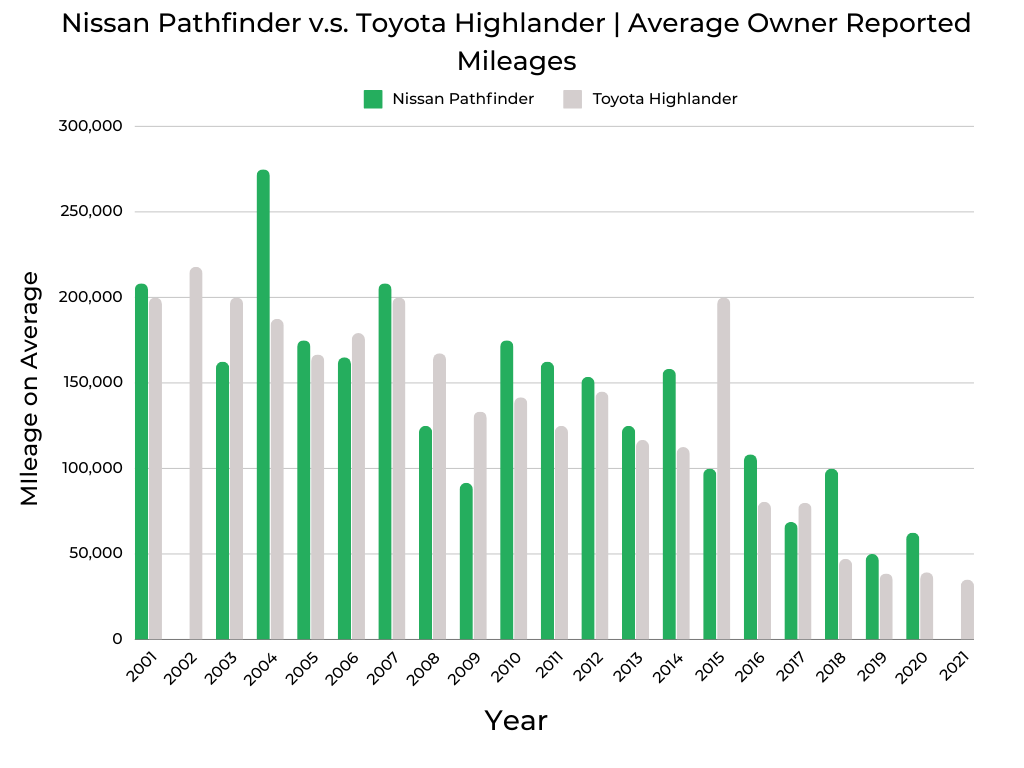
Data from FIXD owner surveys show that older Pathfinders and Highlanders have no problem reaching 150,000-200,000 miles. That’s typical for a modern automobile, according to Consumer Reports. But are the Pathfinder and Highlander capable of more?
Let’s use an unscientific review of autotrader.com (as of April 2, 2024) to find the answer. These marketplace listings show 225 Pathfinders and 1,040 Highlanders for sale, based on the 2001-2012 model years (examples most likely to have higher mileage).
Filtering for examples with 150,000-200,000 miles shows 90 (40%) Pathfinders and 379 (36.4%) Highlanders available. While the percentages don’t match, the results are close, indicating both models are equally capable of reaching this threshold.
Analyzing examples with 200,000 miles or more takes things in a different direction, with 31 (13.7%) Pathfinders and 225 (21.6%) Highlanders that qualify. The percentages show a clear longevity gap favoring the Highlander.
Keeping lifespan potential in mind is essential if you’re already starting with a used Pathfinder or Highlander that’s already got high mileage.
For a more thorough look at longevity, review the individual articles on the best and worst years of the Nissan Pathfinder and Toyota Highlander.
Who Should Buy These Cars: The Legacy of Nissan Pathfinder vs. Toyota Highlander
It restates the obvious that crossovers see the most duty as family haulers. Just glance at the vehicles in a school pickup line, and chances are there’s an overabundance of three-row cars waiting to transport the youngsters. 47% of Highlander owners say this is the predominant activity for their vehicles. Pathfinder owners aren’t far behind at 40%.
The Pathfinder is used slightly more for “lots of driving” (33% compared to 27% for the Highlander), a category that combines commuting and road trips.
Interestingly, even though older Pathfinders are more rugged SUVs (versus crossovers), these Nissans and Toyotas see similar action (11%) for hauling and towing. However, this difference in vehicle type explains why Pathfinders are tasked with outdoor and off-road use.
| Frequent Use Categories: | Nissan Pathfinder| How Useful? (Out of 5 Stars) |
Toyota Highlander | How Useful? (Out of 5 Stars) |
| Family Vehicle | * * * * * | * * * * * |
| Lots of Driving (travel/long commute) |
* * * * | * * * |
| Hauling/Towing | * * | * * |
| Office on Wheels | * | * |
| Sport/Fast Driving | * | * |
| Luxurious Driving | * | * |
| Outdoor/Off-Road | * | * |
Driver Experience | A Summary of The Top 10 Nissan Pathfinder vs. Toyota Highlander Posts:
There’s no shortage of Reddit conversations about the Nissan Pathfinder and Toyota Highlander. Here’s an overview of some of the most popular discussions from Reddit: r/whatcarshouldIbuy.
Reliability and Value
Redditors often discuss the reliability and value of the Nissan Pathfinder and Toyota Highlander. Many commenters acknowledge Toyota’s reputation for reliability and strong resale value, which makes the Highlander a preferred choice for some. However, the Nissan Pathfinder, particularly the 2022 model, receives praise for shedding its infamous continuously variable transmission (CVT) in favor of a more reliable 9-speed automatic. This change has positively impacted perceptions of the Pathfinder’s reliability. Despite this, there’s a lingering skepticism about Nissan’s overall reliability due to past issues, particularly with the CVT. The Pathfinder is noted for being feature-rich and offering more space, especially in the third row, compared to the Highlander.
Comfort and Functionality
In terms of comfort and functionality, the Pathfinder is praised for its spacious interior, especially with its larger third-row seating compared to the Highlander. One Redditor mentioned driving the Pathfinder across the country with a family of five, using all three rows, and found it comfortable. However, they noted the limited cargo space with the third row in use. On the other hand, the Highlander is criticized for its outdated technology and cramped third-row seating. Further, the interior quality of the Highlander, especially in higher trims, is still a point of contention, with some users finding it lacking compared to competitors.
Performance
Performance discussions focus on the latest-generation Pathfinder’s improved driving experience with the new 9-speed transmission. The Pathfinder’s V6 engine is also praised for its appropriateness for the vehicle’s size. While not as frequently discussed in terms of performance, the Highlander is generally regarded as a reliable, if somewhat uninspired, performer consistent with Toyota’s brand reputation.
Reddit Recap
The debate between the Nissan Pathfinder and Toyota Highlander on Reddit centers around reliability, value, comfort, and performance. The Pathfinder gains points for its spacious interior, improved transmission, and better feature set at a lower price point, while the Highlander maintains its stronghold on reliability and resale value.
Year-by-Year Comparison | Nissan Pathfinder vs. Toyota Highlander
Best & Worst Years | Nissan Pathfinder vs. Toyota Highlander | 2001-2024

Buyers looking for a really cheap Highlander have only one option: the 2002 model year. With more than 20 years on the road, it won’t be perfect, but that’s to be expected of vehicles in this price range.
The first green light for the Pathfinder starts in the 2007 model year, another thumbs-up year for the Highlander. Shoppers focused on Pathfinders will want to skip 2008 and 2009, but choices expand greatly as the 2010-2020 model years all fall into the best years category. In particular, the 2010-2012 Pathfinders are must-shop years thanks to a blend of low prices and strong engine reliability.
Highlander buyers will need to be more selective. Due to inconsistent engine reliability and other factors, subsequent Highlander model years are hit or miss. The ones to target are from 2009, 2010, 2012, 2015, 2017, 2019, and 2021.
I’ll call attention to the undecided years (yellow) only because there isn’t enough information to give these editions a thumbs-up or thumbs-down.
Important Features Timeline | Nissan Pathfinder vs. Toyota Highlander

The Highlander plays a more important role in Toyota’s lineup and profitability than the Pathfinder does for Nissan. According to GoodCarBadCar.net, the best sales year for the Highlander was 2021, with Toyota producing over 264,000 units. Nissan sold 41,000 Pathfinders that same year. The best sales year for the Pathfinder was 2013, with 88,000 examples sold.
Why does this matter? Because automakers dedicate resources (money and attention) to models that help most with the bottom line. So, it’s only natural that the Highlander got safety equipment like blind-spot monitoring, lane departure warning, a rearview camera, and parking sensors before the Pathfinder. The same applies to the availability of Apple CarPlay, Android Auto, and remote start.
One odd exception is that the Pathfinder was available with a power front passenger seat a year before the Highlander. The Pathfinder also was the first to receive ventilated front seats, an upgrade due to the 2013 rollout of the first crossover-based generation. A new Highlander, with cooled seats, debuted a year later.
Maintenance Costs (Year-by-Year Average) | Nissan Pathfinder vs. Toyota Highlander

Buyers of used Pathfinders should be prepared for moderately higher maintenance and repair bills. FIXD surveys show that Pathfinder owners had an average repair shop bill of $708 in 2022, about 10% higher than the $646 the typical Highlander owner spent.
Some Pathfinder years are costly to own. Owners with 2001, 2005-2008, and 2012 models spent at least 20% above the $708 average to keep their vehicles on the road. Annual repair bills for 2001, 2008, and 2012 Pathfinders averaged $1,000 or more.
There are offending years for the Highlander, too. Owners of the 2005, 2009, 2010, 2012, 2013, and 2015 model years had maintenance and repair expenses that exceeded the $646 average by at least 20%. These costs averaged $1,050 for the 2012 Highlander.
Review the best and worst years of the Nissan Pathfinder and Toyota Highlander to learn more about maintenance and repair costs for these vehicles.
Safety Rating Comparison | Nissan Pathfinder vs. Toyota Highlander

A crucial advantage of unibody vehicle architecture is good performance in crash tests. The one-piece design does a better job of absorbing crash energy. This is evident in comparing safety scores for pre-2013 Pathfinders to the Highlander. For the most part, the Pathfinder’s safety performance didn’t match the Highlander until Nissan switched the model to a unibody design for 2013. Safety-focused shoppers looking at an older three-row vehicle will want to give the nod to the Highlander.
For the 2011 model year, the National Highway Traffic Safety Administration (NHTSA) introduced more rigorous testing standards, causing the Pathfinder’s scores to plunge to a sub-par 3.0 out of 5. I consider a 4.0 to be a reasonable “B” grade.
Automakers knew of these changes years in advance. So, either the Highlander met the new standard all along, or Toyota made incremental engineering changes to ensure the Highlander’s solid safety scores wouldn’t drop.
In contrast, the Pathfinder suffered through the new testing while Nissan put its compliance efforts into the 2013 release of the new generation, a unibody crossover.
More details about crash test safety scores are covered in the Nissan Pathfinder and Toyota Highlander articles.
Fuel Efficiency Comparison | Nissan Pathfinder vs. Toyota Highlander


The mileage penalty paid by the pre-crossover Pathfinder (2001-2012) is evident. Some of these Nissans even came with fuel-hungry V8s. Meanwhile, the Highlander has always been about four- and six-cylinder engines, the benefit of lighter construction.
Buy an older Pathfinder, and you’ll pay in the form of worse mileage, 3-5 MPGs less than the Highlander. Fuel economy didn’t reach parity until 2013, again because the Pathfinder switched to a crossover platform and a continuously variable transmission (CVT).
While a hybrid powertrain was an unsuccessful two-year experiment for the Pathfinder, it’s been a fundamental element of the Highlander since 2006. Fuel economy of 25 MPG was impressive over a decade ago, but today’s Highlander, with mileage of 35 MPG for a large three-row vehicle, is astounding. Toyota continues to flex its hybrid muscles with these editions of the Highlander.

Dave Goldberg is an automotive journalist and lifelong car fanatic. He writes for numerous enthusiast and business outlets and is an ongoing contributor to HotCars.com, one of the most popular car culture websites. When he’s not writing or driving, Dave is either under a hood or asleep. His credentials include a BA in Journalism from The George Washington University.