
Comparing a Tacoma and a Tundra makes sense. Toyota fans want to stay loyal but are unsure which pickup best meets their needs. There are also truck buyers new to the brand who want to see if a Toyota is all it’s cracked up to be.
The automaker’s basic approach to making vehicles relies on proven engineering rather than bleeding-edge technology. It’s a formula that some critics say makes for uninspired products, but the trade-off is a perception of better reliability.
This methodology is front and center with the Toyota Tacoma; its four- and six-cylinder engines are nothing fancy (no turbos or hybrids), nor are the six-speed manual and automatic transmissions. Nonetheless, the Tacoma is the best-selling pickup in its class, with enviable resale value.
Until the launch of the third-generation Tundra for the 2022 model year, Toyota’s largest pickup followed the same course, just in bigger form and with six or eight cylinders. The third-gen Tundra turned Toyota’s tried-and-true process on its head with twin-turbocharged engines, a hybrid system, and a high-tech ten-speed automatic transmission.
The all-new fourth-generation Tacoma will hit the streets for the 2024 model year and borrow from the Toyota Tundra playbook with turbos and hybrids. Only time will tell if Toyota’s strategy changes will affect how its trucks are perceived.
Although I’ve never owned a pickup, I’ve been around them for as long as I can remember. I learned to drive in a Ford Courier (a rebadged compact Mazda truck from the 1970s) and a Ford F-150. Pickups aren’t everyone’s cup of tea, but I certainly understand the reasons why they’re the only choice for so many.
Examining this Tacoma versus Tundra matchup shattered some myths. Like many, I assumed these Toyota trucks were bulletproof, with problem years being more isolated. In some way, my assumptions are true if you consider “Tacos” and Tundras built since 2011. However, it’s a very different story with the 2001-2010 model years. Finding examples worthy of a green light is challenging but not impossible.
What I found especially fascinating is how the Tacoma’s ultra-low depreciation affects resale value. Buyers will be able to find used Tundras for less than comparable Tacomas. But this is about the only time the Tundra saves money over a Tacoma.
New Tundras sell for substantially more than comparable Tacomas. In addition, the Tundra (new or used) costs more at the pump and has higher maintenance and repair bills. Yet, there’s no substituting the Tundra if there’s a need for heavy hauling or towing or if the second row gets used a lot.
Dive in to learn more about this Toyota Tacoma and Toyota Tundra match-up. Other comparisons include Accord vs. Civic, Outback vs. Forester, RAV4 vs. CR-V, Civic vs. Corolla, Pilot vs. Highlander, and Odyssey vs. Sienna.
| Income Bracket | Monthly Financing Cost Range | Cash Purchase Price Range | Toyota Tacoma Years | Toyota Tundra Years | Best Model Year: | Why? |
| $5k-$10k | $83 – $125 | $3,000-$4,500 | N/A | 2003 | 2003 Tundra | Acceptable engine reliability, decent safety score, low price |
| $10k-$15k | $125 – $187 | $4,500-$6,750 | 2002 | 2008 | 2008 Tundra | Better engine reliability and safety score |
| $15k-$25k | $187 – $312 | $6,750-$11,250 | N/A | 2011 | 2011 Tundra | Acceptable engine reliability and safety scores, reasonable price |
| $25k-$35k | $312 – $437 | $11,250-$15,750 | 2014 | 2014 | 2014 Tacoma | Above-average engine reliability and safety score |
| $35k-$50k | $437 – $625 | $15,750-$22,500 | 2017 | 2016 | 2016 Tundra | Above-average engine reliability, lower market value |
| $50k-$74k | $625 – $925 | $22,500-$28,000 | 2019 | 2018 | 2018 Tundra | Near-perfect engine reliability, solid safety score |
| $75k-$99k | $925-$1,238 | $28,000-$44,550 | 2021 | 2021 | 2021 Tacoma | Perfect engine reliability, excellent safety score |
See the methodology for the table above.
Before you respond to the “For Sale” ad, check out this How to Buy a Used Car article for a step-by-step checklist.
Price History Comparison | Toyota Tacoma Vs. Toyota Tundra
Average Market Value – Based on Owners’ Self-Reported Mileages | Toyota Tacoma Vs. Toyota Tundra

Price is a driving factor for most car buyers, so getting a handle on market values for the Toyota Tacoma (green) and Toyota Tundra (gray) is essential. The graph highlights data from Kelley Blue Book (KBB). However, it’s important to note that these figures reflect private-party sales. Prices at dealers can be 50% higher. One way around retail prices is to shop for an older truck or one with more miles or less equipment.
Ordinarily, you’d expect greater market values for a vehicle with a higher original MSRP (the Tundra), but the Tacoma flips the script. The Tacoma consistently ranks as one of the best vehicles of any type for low depreciation. Marketplace site iseecars.com estimates that a Toyota Tacoma retains an incredible 86.2% of its value after five years, compared to the typical car lucky to keep half its value.
The Tundra is no slouch in the depreciation department, as iseecars.com forecasts it will be worth 80.5% of its original value after five years. As I’ll cover in the next section, you’ll see that the Tacoma’s market value is stronger than the Tundra’s among earlier examples. This explains why older Tacoma’s cost more than their Tundra counterparts.
The Tundra has a modest market value lead for the 2014 model year with no rhyme or reason. Neither vehicle (based on FIXD survey data) reported abnormal mileage or other oddity. I’ll just chalk it up to being an anomaly. It’s easier to explain why the Tundra has a higher market value for the 2018-2021 model years. The Tundra’s higher sticker price hasn’t yet been offset by depreciation. The dip in value for the 2020 Tacoma is due to above-average mileage among the surveyed examples.
Be sure to read our Best and Worst Years series of articles highlighting the Toyota Tacoma and Toyota Tundra winners and losers.
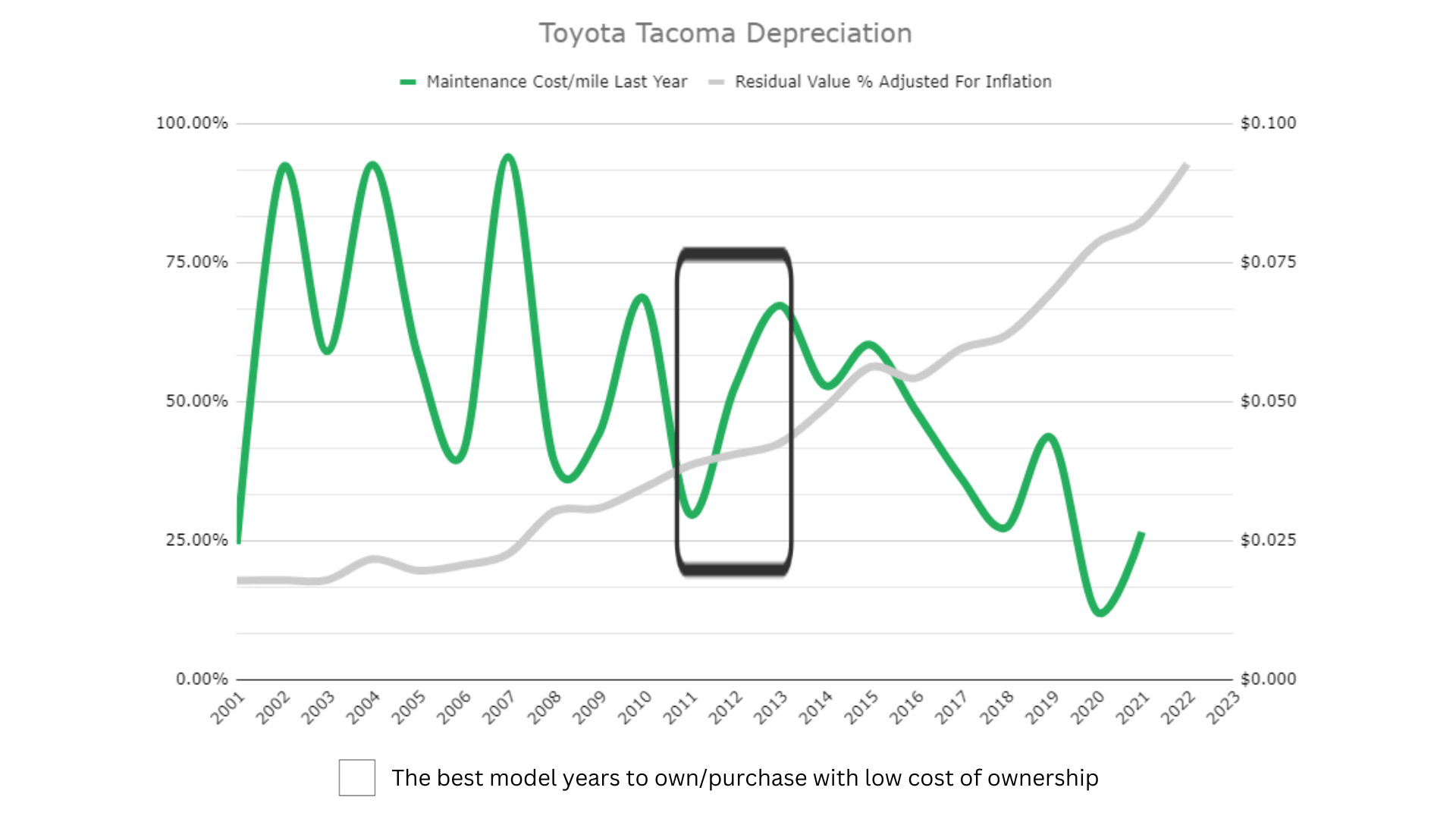
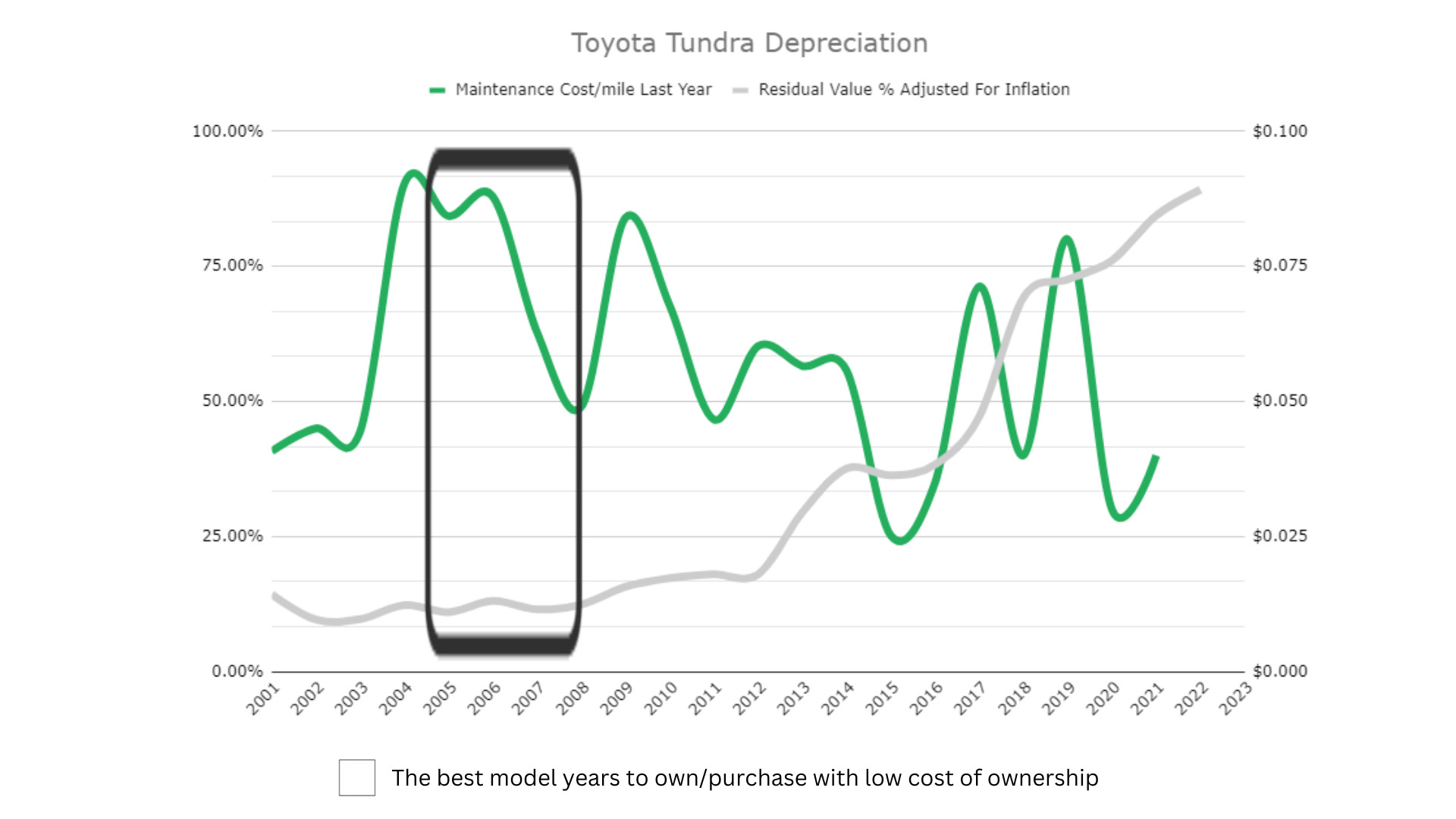
Depreciation vs. Maintenance Expenses
We’ll also point out that both scores seldom align. The FIXD Reliability Score is determined by a definitive number, the frequency of check engine lights. On the other hand, the Owner Reliability Score is opinion-based. Owners tend to have pride in their automobiles, with higher ratings as a result. At a minimum, those with older vehicles are more accepting of check engine lights. For many, it’s the price of owning an aging car.
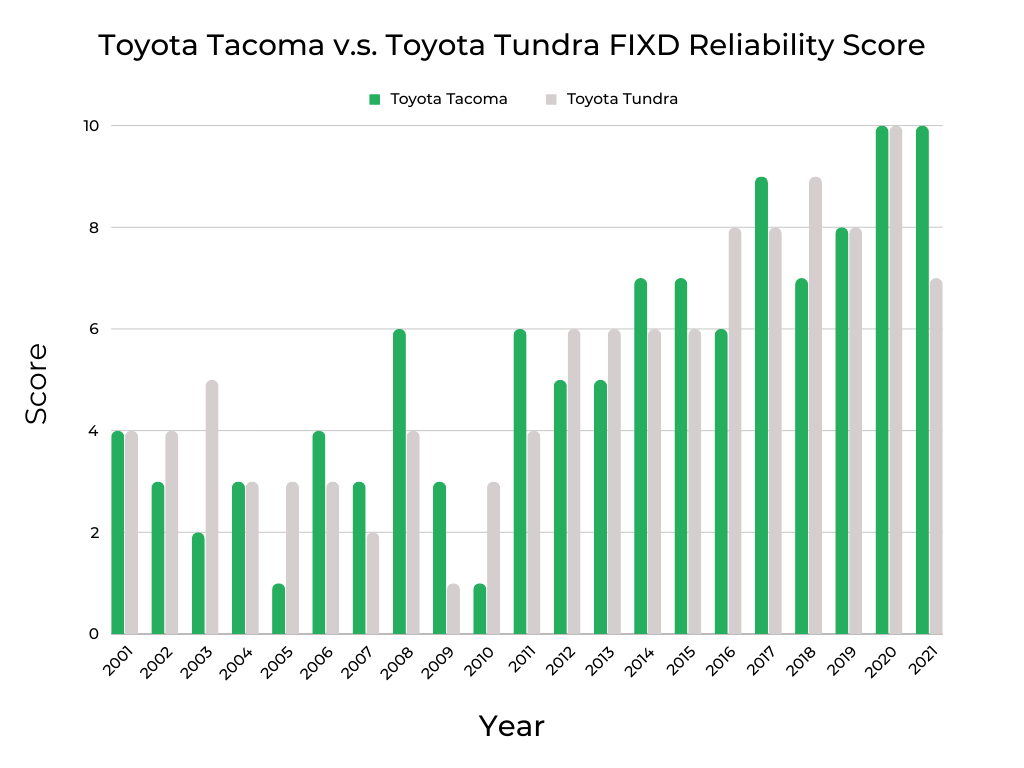
It’s commonplace to come across praise for the Tacoma’s and Tundra’s reliability. This reputation helps fuel strong resale value. But, a dive into FIXD Reliability Scores caused me to double-check the data. Frankly, I couldn’t believe how low engine reliability was for these trucks.
No Tacoma or Tundra scored above a 6 (out of 10) until 2014. And for most of the years before 2011, both trucks scored a sub-par 4 or worse. Only the 2003 Tundra and 2008 rose above the fray with mid-tier rankings. Top-notch engine reliability (what I rank as an 8 or better) didn’t even kick in until 2016 for the Tundra and 2017 for the Tacoma.
What does this mean in practical terms? Buying an older Tacoma or Tundra (or any used vehicle, for that matter) should include a thorough inspection, especially of the engine.
Admittedly, check engine lights are caused by many problems. Some serious, some not. While a defective gas cap seal or loose hose can trigger a dashboard warning, so can more complex issues. Both the Tacoma and Tundra are prone to engine misfires (diagnostic trouble code P0300, for example). The fix can be cheap (like new spark plugs) or more elaborate; repairing cylinder heads can run into thousands of dollars.
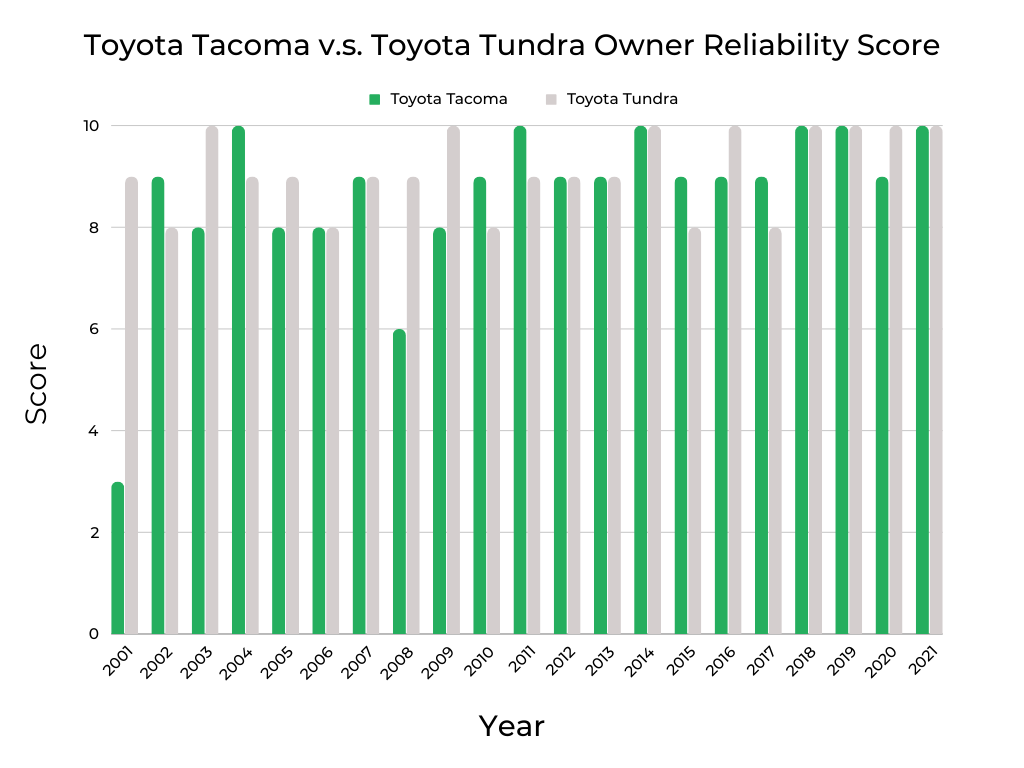
Yet, CELs don’t appear to be a turnoff for Tacoma and Tundra owners. Except for the 2001 and 2008 Tacoma, no surveyed owner of a 21st-century Toyota truck ranked their vehicle below an 8 (out of 10).
These are polar opposite results compared to the FIXD Reliability Scores, especially among earlier model years. Equally as striking is how many owners gave their Toyota trucks a 10 for reliability. Saying Toyota truck owners love their vehicles despite CEL frequency is an understatement.
Review the Best and Worst Years articles on the Toyota Tacoma and Toyota Tundra to learn more about these vehicles’ FIXD Reliability and Owner Reliability Scores.
Longevity Comparison | Toyota Tacoma Vs. Toyota Tundra
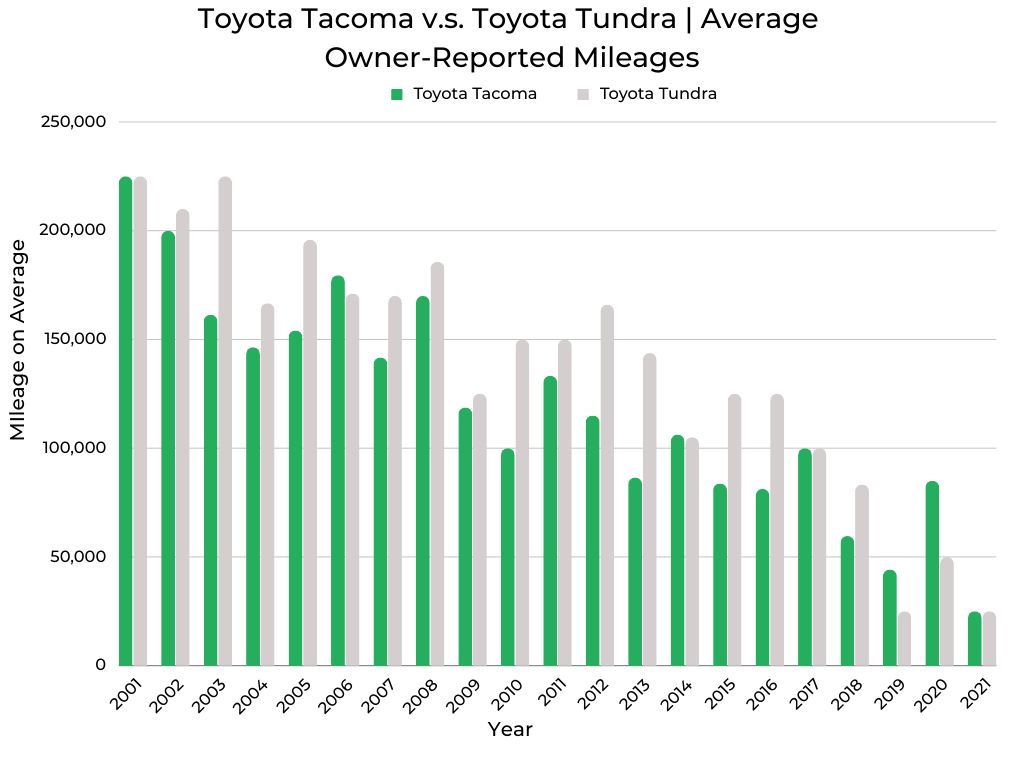
Despite low FIXD Reliability Scores, older Tacomas and Tundras can pack on the miles. FIXD owner surveys show reaching or crossing the 150,000-mile mark is common, especially for the Tundra. Further, achieving 200,000 miles isn’t out of the question either.
Examining for-sale listings provides further insight into the Tacoma’s and Tundra’s longevity. As of November 5, 2023, there are 991 Tacomas and 859 Tundras for sale on autotrader.com for the 2001-2010 model years. Of these, 232 Tacomas (23.4%) and 237 Tundras (27.5%) had 200,000 miles or more.
Simply put, one in four of these older Toyota trucks has crossed a high-mileage benchmark. I don’t usually see this in passenger cars, where the 200,000-mile mark is generally in the 10%–15% range.
The Tacoma and Tundra are excellent candidates for high-mileage longevity, but neither truck appears to have a lifespan edge. Of course, regular maintenance and accident-free driving are also contributing factors.
Review the individual articles on the best and worst years of the Toyota Tacoma and Toyota Tundra for a more thorough look at longevity.
2023 Toyota Tacoma Vs. Toyota Tundra | A Guide to Trim Levels & Optional Features
Trim Levels: Starting Prices
To no one’s surprise, there’s no getting around the fact that the 2023 Tacoma and Tundra are at different price levels and positions within Toyota’s lineup. While the cheapest Tacoma, the SR trim, starts at $28,600, the entry-level Tacoma (also the SR) adds more than $10,000 to the window sticker. In realistic terms, that extra $10,365 adds $202 to the monthly payment for a five-year loan at 6.5%.
Stepping up to the popular SR5 trim creates a greater separation ($14,080) between the Tacoma and Tundra. The smallest gap between equivalent trims is the $9,210 difference between the Tacoma Limited ($41,355) and Tundra Limited ($50,565). This starkly contrasts the $22,885 gulf between the Tacoma TRD Pro ($48,035) and the Tundra TRD Pro ($70,920).
Given that the Tundra serves as Toyota’s truck flagship, it’s not unexpected to see top-level trims with no equal in the Tacoma range. The Tundra Platinum adds more premium features to justify a $60,775 starting price. At the same time, the Capstone takes an over-the-top approach to the Tundra, explained by an eye-popping $77,645 price tag, about 275% higher than the base Tacoma SR.
Meanwhile, Toyota emphasizes the Tacoma’s extra capabilities with exclusive trims that won’t break the bank. The TRD Sport ($35,510) and TRD Off-Road ($36,79) sit squarely between the base trims and the Tacoma’s pricier offerings, including the Limited and TRD Pro.
| 2023 Toyota Tacoma Model | Starting Price |
| SR | $28,600 |
| SR5 | $30,390 |
| TRD Sport | $35,510 |
| TRD Off-Road | $36,790 |
| Limited | $41,355 |
| Trail Special Edition | $41,820 |
| TRD Pro | $48,035 |
| 2023 Toyota Tundra Model | Starting Price |
| SR | $38,965 |
| SR5 | $44,470 |
| Limited | $50,565 |
| Platinum | $60,775 |
| 1794 Edition | $61,460 |
| TRD Pro | $70,920 |
| Capstone | $77,645 |
2023 | Toyota Tacoma Vs. Toyota Tundra | Specifications | Safety, Interior, and Exterior Features
Sizing up the Toyota Tacoma and Toyota Tundra involves a look at each vehicle’s specifications. Here’s what you need to know.
Vehicle Class & Body Style:
While the U.S. Environmental Protection Agency (EPA) classifies the Tacoma and Tundra as pickup trucks, that’s about where the similarities end. The Tundra is substantially larger, so its capabilities are more robust than the Tacoma.
However, not everyone wants or needs such bulk. The Tacoma outsells the Tundra two-to-one, according to carsalesbase.com. In addition, the Tacoma is available with an Access Cab (two standard front doors with two smaller rear access doors) or the Double Cab (four standard doors), while the Tundra takes a somewhat different approach.
The Tundra offers a Double Cab with four standard-opening doors, but the back doors are smaller and have exterior handles. On the contrary, the doors in the Tacoma Access Cab have a clamshell opening and are without outside handles for the back doors (the front door has to be open to operate the back door). There’s also the Tundra CrewMax, with four standard doors.
I’ll look closer at payload, towing, cargo bed length, and other measurement comparisons later.
| 2023 Toyota Tacoma | 2023 Toyota Tundra | |
| Class | Pickup Truck | Pickup Truck |
| 2-Door Truck | SR, SR5, TRD Sport, TRD Off-Road | N/A |
| 4-Door Truck | SR, SR5, Trail Special Edition, TRD Sport, TRD Off-Road, Limited, TRD Pro | SR, SR5, Limited, Platinum, 1794 Edition, TRD Pro, Capstone |
Powertrain:
Engine Options & Specifications:
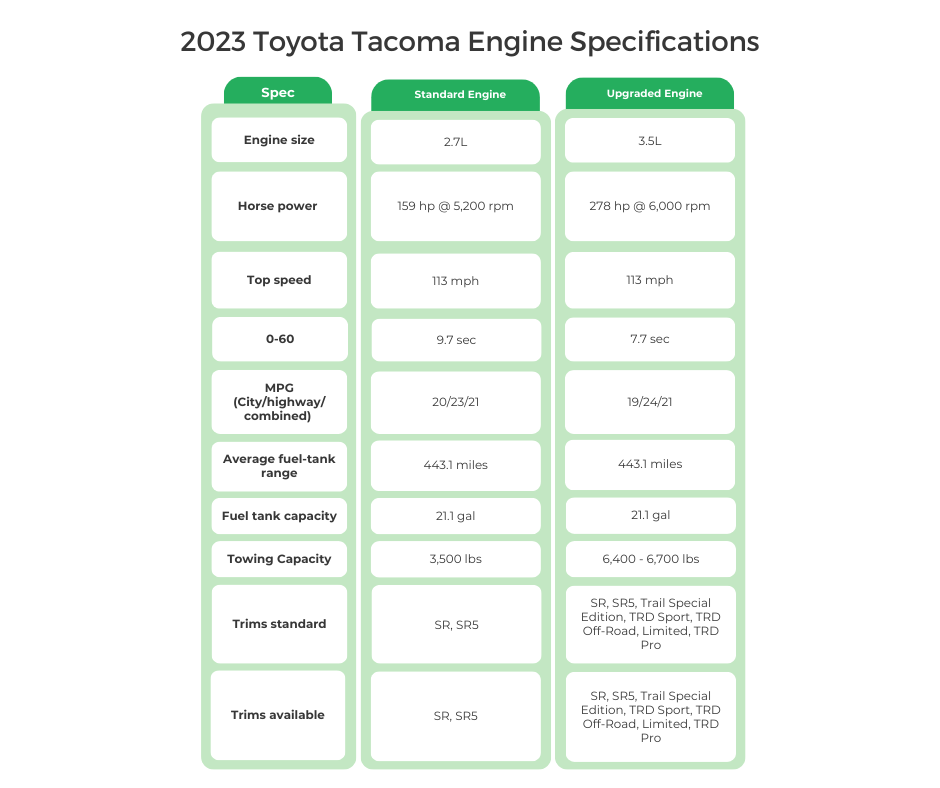
Some of the price discrepancies between the 2023 Tacoma and Tundra can be explained by what’s under the hood. The base engine for the Tacoma is a 2.7-liter four-cylinder engine. Its 159 horsepower output leaves much to be desired in terms of performance, but there are buyers more focused on the bottom line than acceleration. Choosing the 278-horsepower 3.5-liter V6 substantially improves the Tacoma’s capabilities.
Towing for the four-cylinder Tacoma is limited to 3,500 pounds, while the V6 can almost double the towing limits to as much as 6,700 pounds. Despite the differences in horsepower, there’s not much separating the fuel economy for the 2023 Tacoma. The base engine is rated for 20 mpg in the city and 23 mpg on the highway, while the upgraded engine delivers 19 mpg around town and 24 mpg on the open road.
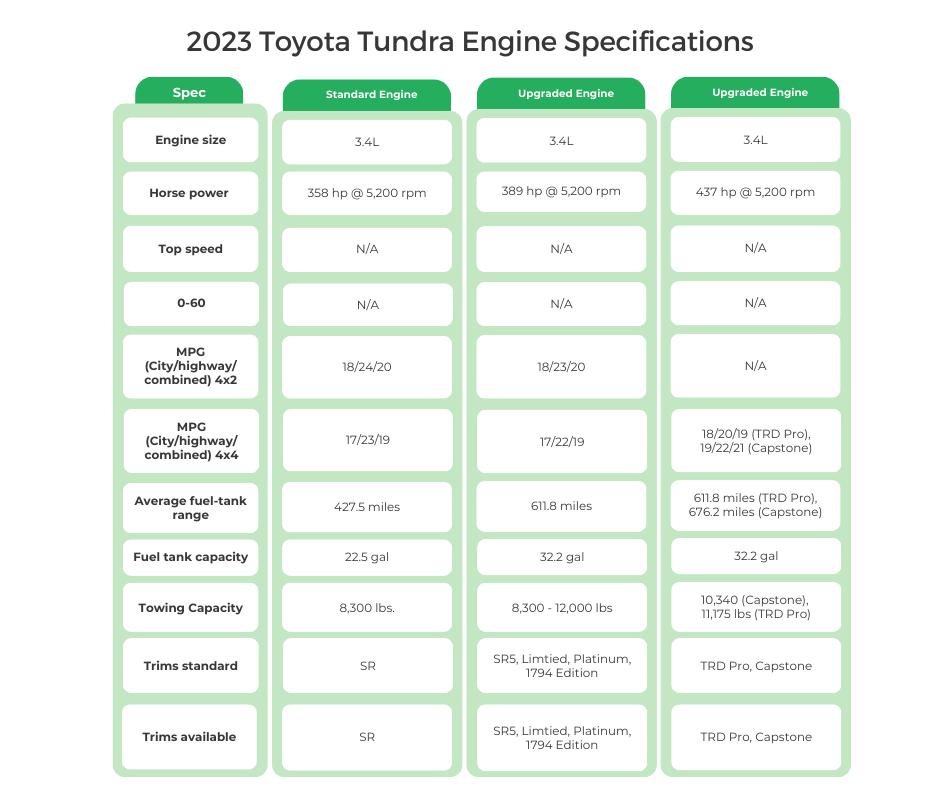
The three engine options for the Tundra are a whole different story. All rely on a 3.4-liter V6 with twin turbochargers. The standard arrangement makes a hefty 358 horsepower. Thanks to some engineering tweaks, the mid-tier Tundra powerplant produces 389 horsepower. The top-dog engine includes a hybrid system that cranks output to a potent 437 horsepower.
Toyota dropped the Tundra’s V8 with the introduction of the third generation for the 2022 model year. So, the replacement engine had to deliver V8-like power. Toyota met the challenge while enabling the Tundra to offer 20% better fuel economy.
Transmission Options & Specifications:
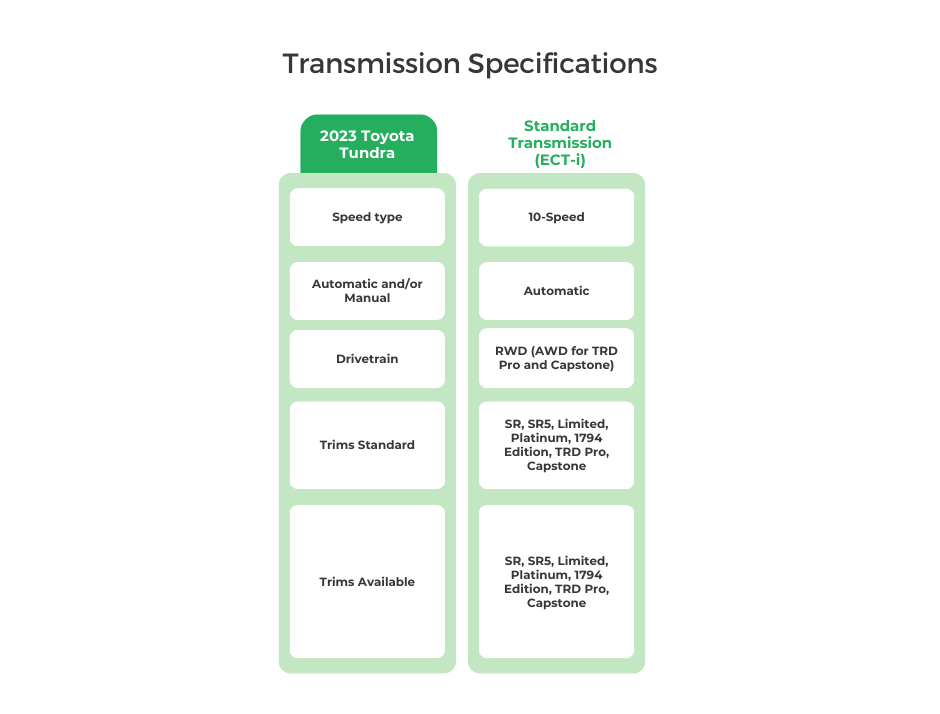
Pickups require rugged transmissions to better handle the rigors of hauling and towing. As a result, you won’t find a continuously variable transmission (CVT) in the Tacoma or Tundra. A CVT is best left to passenger cars and crossovers more focused on moving people than things.
See the “Tech Talk” section below the charts to learn about CVTs.
Purists will appreciate that the Tacoma is available with a manual gearbox on a few trims. It’s a rarity as more and more pickups drop do-it-yourself shifting (the Tundra, Ford F-150, and Chevrolet Silverado, included). Otherwise, buyers can choose a six-speed automatic for the Tacoma (standard on some trims).
As mentioned, the 2023 Tundra is strictly an automatic transmission affair. However, it gets a sophisticated ten-speed unit that maximizes power delivery and fuel economy.

TECH TALK: CVTs
A continuously variable transmission (CVT) does not use gears like a typical automatic transmission. Instead, it has two pulleys connected by a belt. One pulley connects to the engine, and the other connects to the wheels. The belt transfers the power between the pulleys. This setup allows the pulleys to continuously change positions as needed. The CVT automatically adjusts the pulleys as required, providing smooth and efficient power delivery.
Drivetrain:
Toyota wisely recognizes that not everyone needs a truck with four-wheel drive (4WD), so most Tacoma and Tundra trims come with rear-wheel drive (RWD) as standard equipment. A RWD truck uses less gas and requires less long-term maintenance.
However, some editions (Trail Special Edition and TRO Pro for the Tacoma and TRD Pro and Capstone for the Tundra) come with 4WD from the factory.
| 2023 Toyota Tacoma Wheel Drive | FWD | 4WD | RWD |
| SR | U | S | |
| SR5 | U | S | |
| Trail Special Edition | S | ||
| TRD Sport | U | S | |
| TRD Off-Road | U | S | |
| Limited | U | S | |
| TRD Pro | S |
| 2023 Toyota Tundra Wheel Drive | FWD | 4WD | RWD |
| SR | U | S | |
| SR5 | U | S | |
| Limited | U | S | |
| Platinum | U | S | |
| 1794 Edition | U | S | |
| TRD Pro | S | ||
| Capstone | S |
U = Available in upgrade
Safety:
NHTSA Safety Ratings
While the Tacoma and Tundra get used frequently for hauling/towing and off-road adventures, they also see duty as family transportation and for commuting and long-distance travel. FIXD surveys show that about one-fourth of owners use their Tacomas and Tundras for these non-truck-like activities. This usage puts a spotlight on safety.
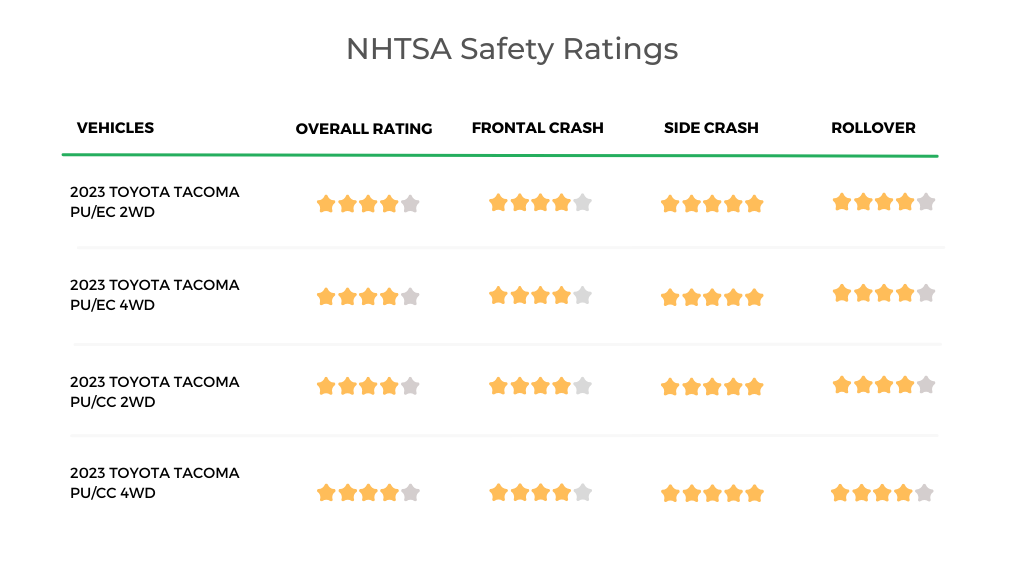
Crash testing by the National Highway Traffic Safety Administration (NHTSA) shows that the Tacoma gets a four-star (out of five) rating for overall safety performance, frontal crashes, and five stars for side crashes.
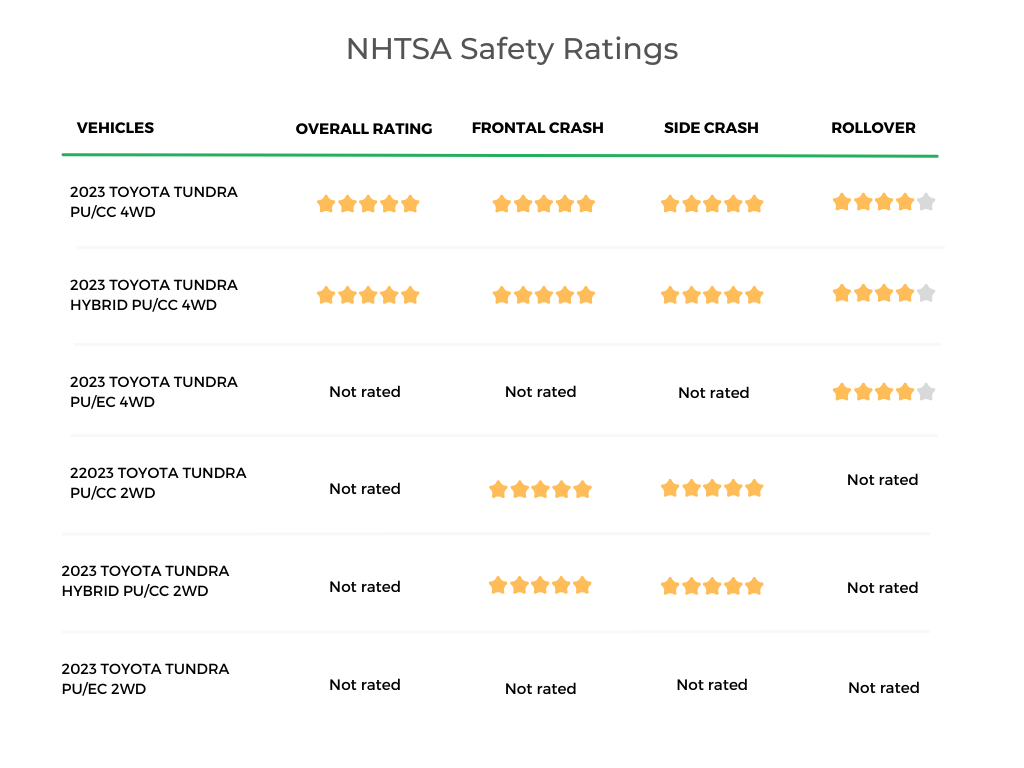
On the other hand, the Tundra aces its NHTSA testing with five-star performance across the board. These results are attributable to the Tundra being a newer design (the third-generation Tacoma’s design dates back to 2016) and the Tundra’s larger size. In truth, a four-star ranking in NHTSA testing is still commendable, but those seeking top safety results will want to consider the Tundra’s performance.
Both trucks get four stars in the government’s rollover assessments, typical for vehicles (pickups and SUVs) with elevated ground clearance.
IIHS Awards:
The Insurance Institute for Highway Safety (IIHS) takes a somewhat different approach to safety testing. In particular, it focuses on its small frontal overlap crash test, which the organization feels represents a more real-world scenario (a single car running into a fixed object). IIHS also looks at side impact crashes, roof strength, headlight effectiveness, and advanced driver safety technologies (like automatic emergency braking).
While tested vehicles receive a Good, Acceptable, Marginal, or Poor grade, the true measure comes if a car gets a Top Safety Pick or Top Safety Pick+ designation. If “Good” is a “B” grade, Top Safety Pick notches things up to an “A-,” and the Top Safety Pick+ signifies an “A+.”
Although IIHS tested the Toyota Tacoma, its performance yielded no Top Safety Pick awards.
In comparison, the 2023 Tundra received a Top Safety Pick+ designation. Like with NHTSA testing, the Tundra’s stellar achievement with IIHS comes from being newer and larger than the Tacoma.
| 2023 Toyota Tacoma | Large Pickup/Extended Cab Pickup | None | 2017 and 2022 Toyota Tacoma SR5 |
| 2023 Toyota Tundra | Large Pickup/Extended Cab Pickup | 2023 TOP SAFETY PICK + | 2022 Toyota Tundra Double Cab 2WD |
| 2022 Toyota Tundra SR5 Double Cab 4WD |
Airbags & Head Restraints:
The federal government estimates that airbags have saved over 50,000 lives. It’s a proven safety technology that is present in the 2023 Tacoma and Tundra.
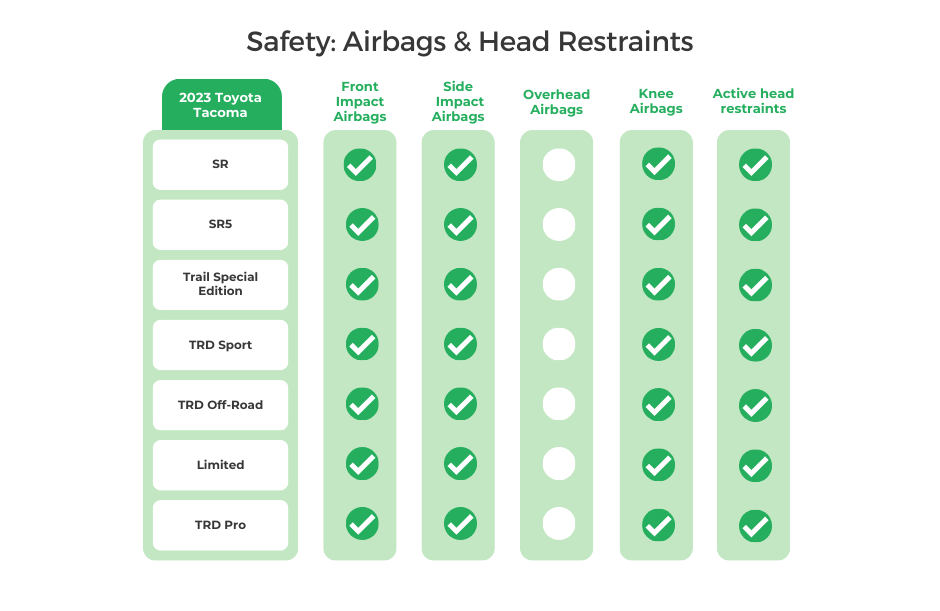
Airbags for the front row protect Tacoma and Tundra occupants against front and side collisions. There are also knee airbags that better position the driver and front passenger to minimize injuries in a frontal accident. These trucks also get side curtain airbags to protect both rows during a rollover or side impact.
Neither the Tacoma nor the Tundra comes with overhead airbags. This newer technology replaces traditional front-row units (steering wheel and dashboard) with overhead devices. Active head restraints are usually found in specialty and high-end vehicles to minimize whiplash injuries. Mainstream vehicles like the Tacoma and Tundra aren’t usually equipped with this feature.

 Semi-Autonomous Driving:
 Semi-Autonomous Driving:
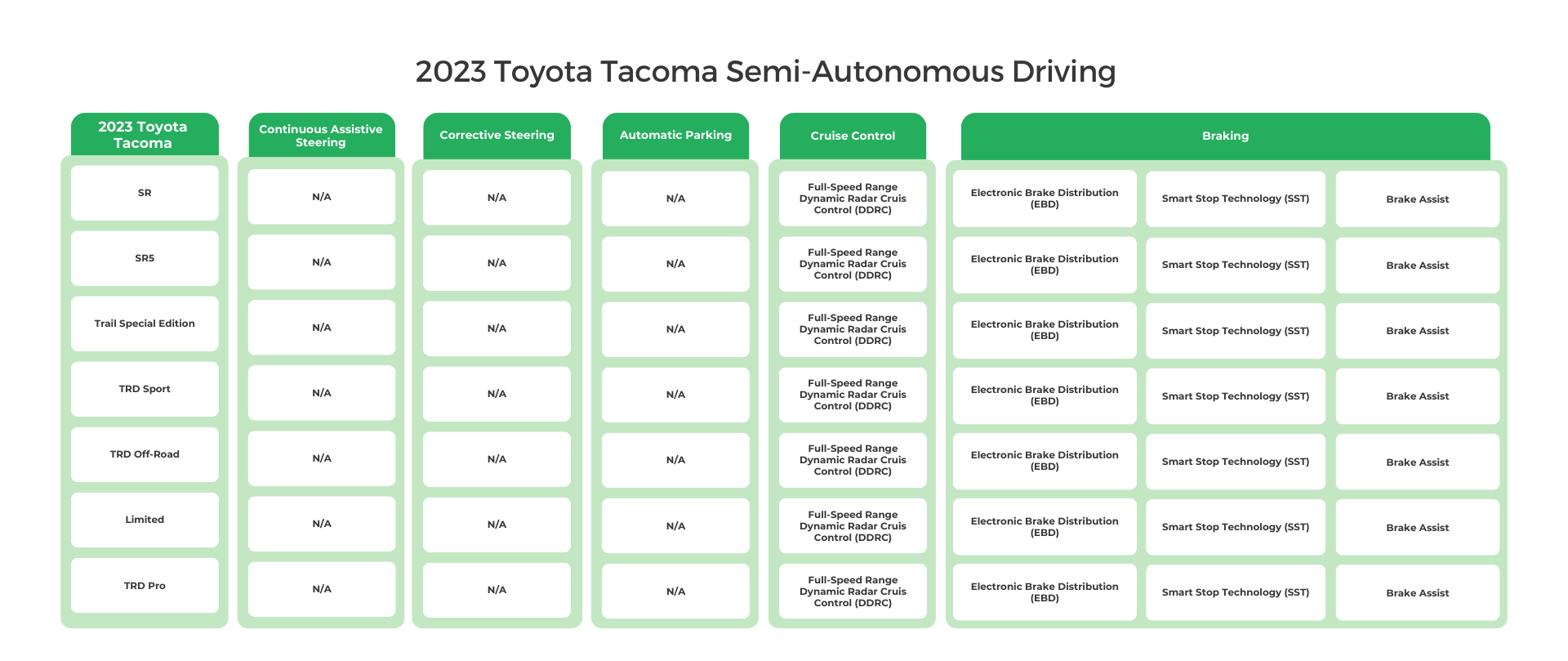
While the Ford F-150 and Chevrolet Silverado are available with hands-free driving technology, the Tacoma and Tundra fall far short. Adaptive cruise control (ACC), which Toyota calls Dynamic Radar Cruise Control, is about as high-tech as it gets for the Tacoma (all trims come with ACC). The Tundra also has ACC as standard equipment.
Given that the Tundra is more modern, it comes with steering support technology that’s missing in the Tacoma. Lane departure alert with steering assist warns the driver if a Tundra is veering out of its lane and provides gentle steering correction to center the vehicle. See the next section to learn about lane departure warning with the Tacoma.

 Driver Warning Systems & Telematics:
 Driver Warning Systems & Telematics:
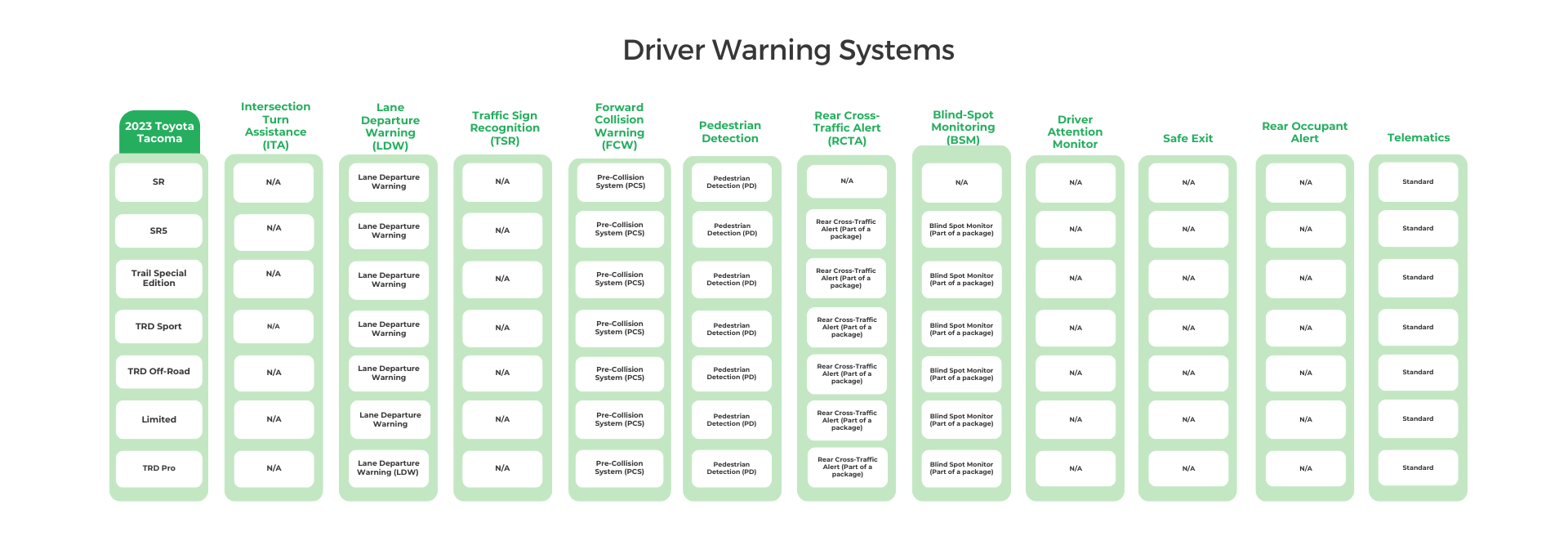
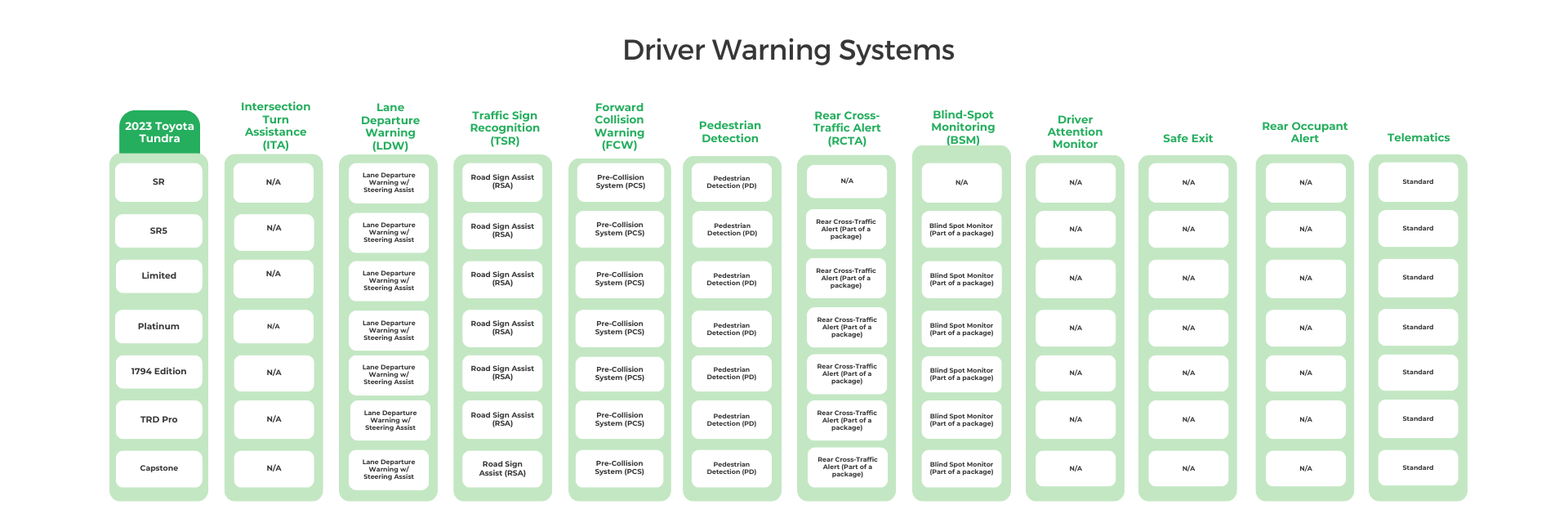
Driver warning technology, part of advanced driver assistance systems (ADAS), helps prevent accidents before they happen (or at least lessen the severity). Under its Safety Sense label, Toyota includes several ADAS features with the Tacoma and Tundra. Both trucks have lane departure warning (LDW), which alerts the driver if the vehicle drifts out of the lane. There’s also forward collision warning (FCW) and automatic emergency braking (AEB) with pedestrian detection,
Blind-spot monitoring (BSM) and rear cross-traffic alert (RCTA) aren’t available with the base (SR) trim of either truck, while optional on the SR5 versions. BSM and RCTA are optional on mid-tier Tacomas and standard on the higher-end editions. These technologies are standard on the remaining Tundra trims.
If ADAS technology appears like alphabet soup, check out an effort from AAA, Consumer Reports, J.D. Power, and other groups working to standardize the terminology for these systems.
 Road Visibility Features:
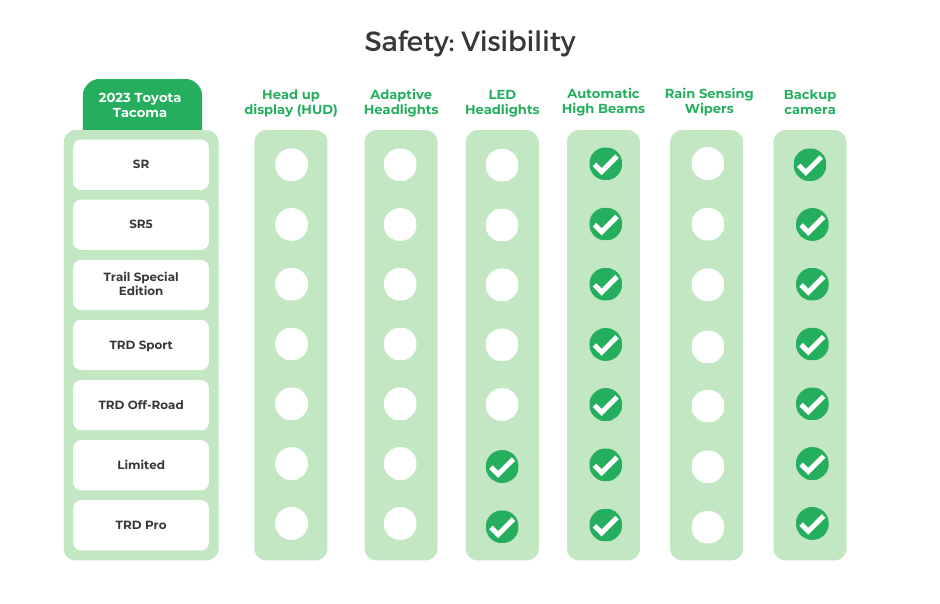
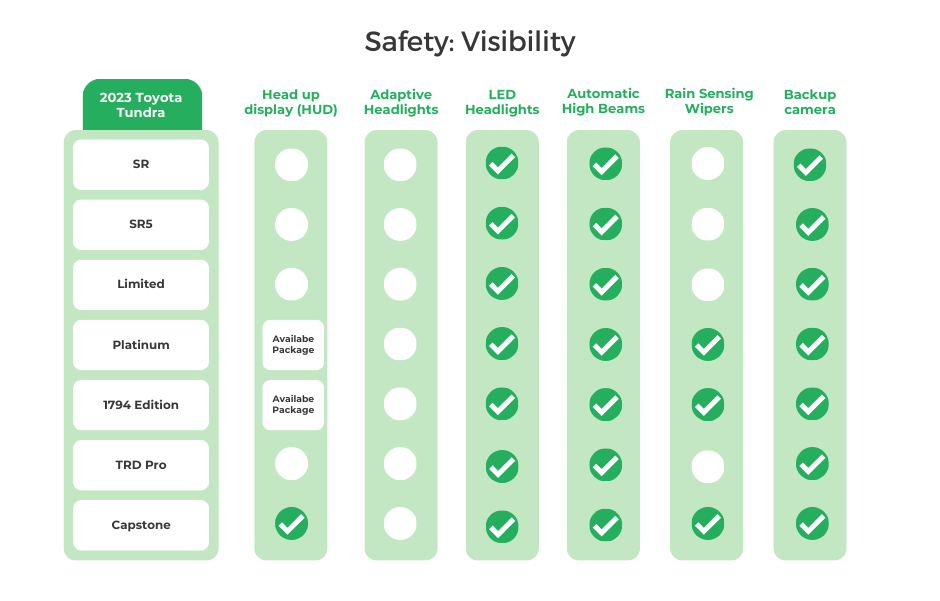
One way the 2023 Tacoma shows its age is its road visibility features (or lack thereof). Only higher-end trims get LED headlights, while all Tundras get this equipment. More and more vehicles are getting LED headlights as standard equipment, so it’s reasonable to think that the fourth-generation Tacoma will have this feature when it arrives for 2024.
Other visibility equipment like rain-sensing windshield wipers and a head-up display are the sole domain of higher-end Tundras as a standard feature or option. However, both trucks have automatic high beams and a rearview monitor.
Interior:
Interior Features:
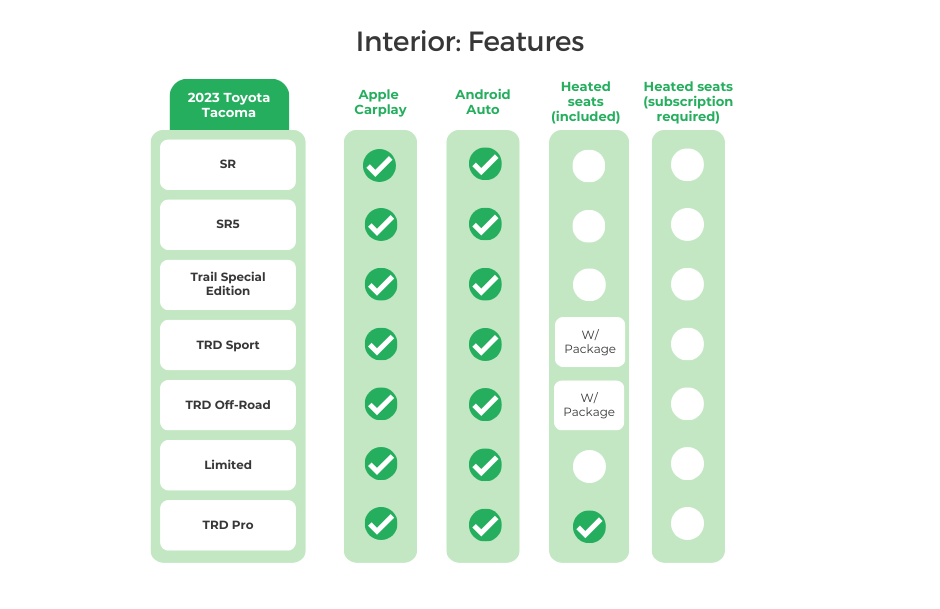
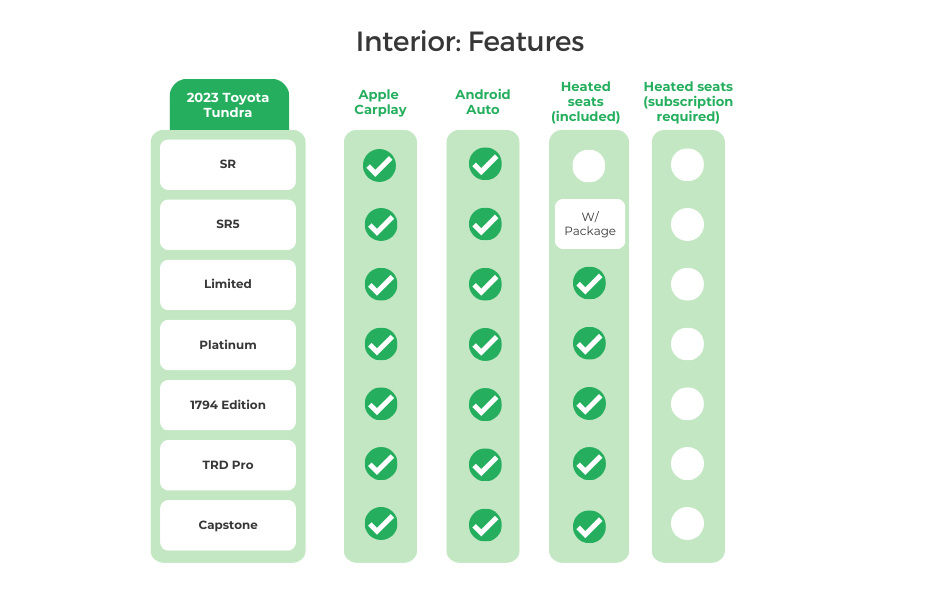
If your primary concern in choosing a Toyota truck is Apple CarPlay or Android Auto, then you can move on to other requirements; the 2023 Tacoma and Tundra have these technologies. Nonetheless, you’ll need to be more selective if heated front seats are a priority.
Only the Tacoma TRD trims (Sport, Off-Road, and PRO) come with a heated front row as an upgrade or standard. In contrast, most Tundra trims come standard with heated front seats. The feature is only unavailable with the SR trim, while the SR5 requires an optional package.
And speaking of heated seats, some automakers offer this feature through a subscription service. This hasn’t yet happened in the U.S., but in certain countries, BMW offered heated seats for a monthly fee. The advantage is you can shut off the service during warm months, but you’ll need to keep paying (or pay a one-time upfront fee) to activate the heated seats. Recently, BMW announced it was backing away from this practice. Moving forward, the automaker will only charge a subscription for software-based services (like upgraded navigation). Hardware-based features will be part of the vehicle’s initial purchase price.
One industry study shows mixed results for consumer acceptance of features on demand (FoD), with about one-fifth not even being aware of the concept.
Interior Dimensions:
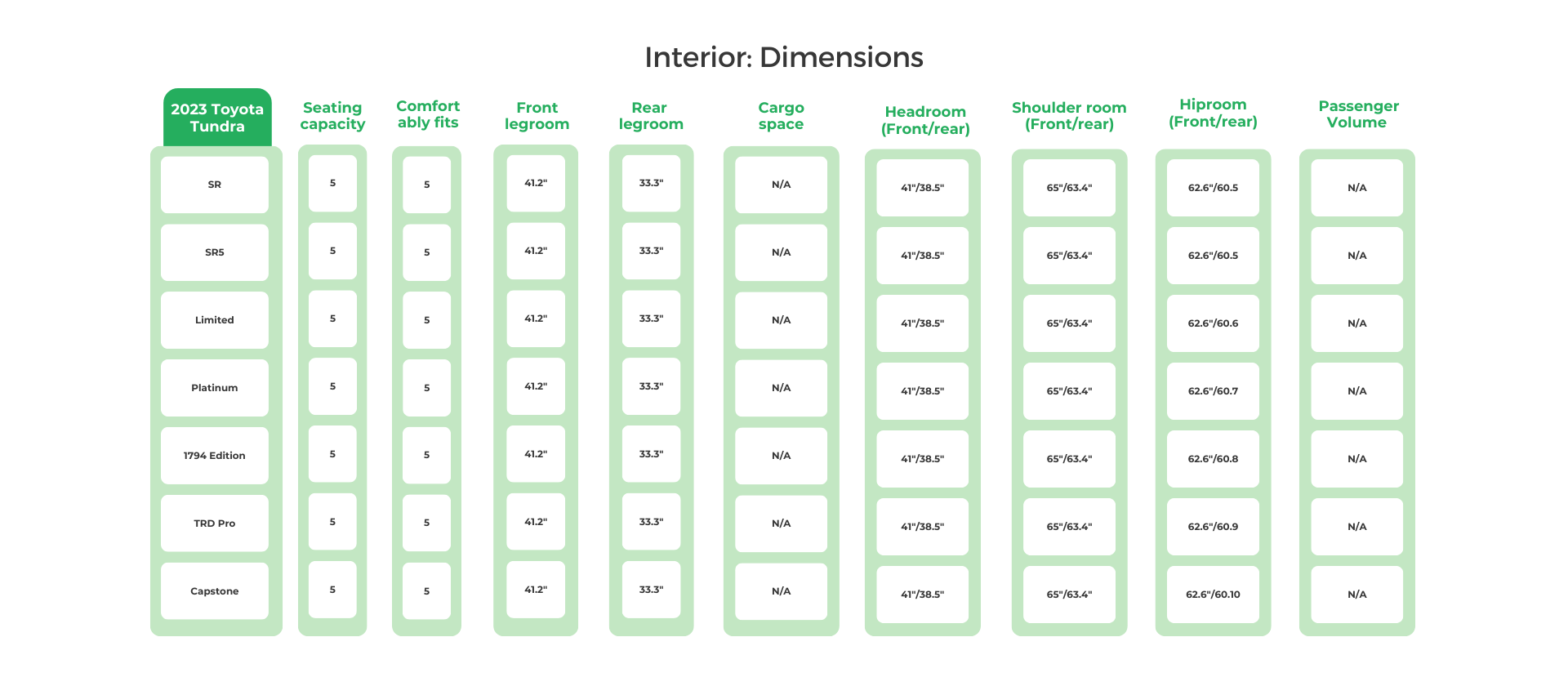
The size difference between the Tacoma and Tundra comes to light when looking at interior dimensions. Just don’t assume that the Tundra is bigger across the board.
Interestingly, the Tacoma has more front legroom than the Tundra (42.9 inches vs. 41.2 inches). However, the Tundra comes out on top in other key measurements. Notably, the Tundra has substantially more rear shoulder (65.0 inches vs. 58.3 inches) and hip (62.6 inches vs. 56.3 inches) room. The Tundra will be noticeably more comfortable if you regularly seat three people in the second row.

Exterior:
Exterior Features:
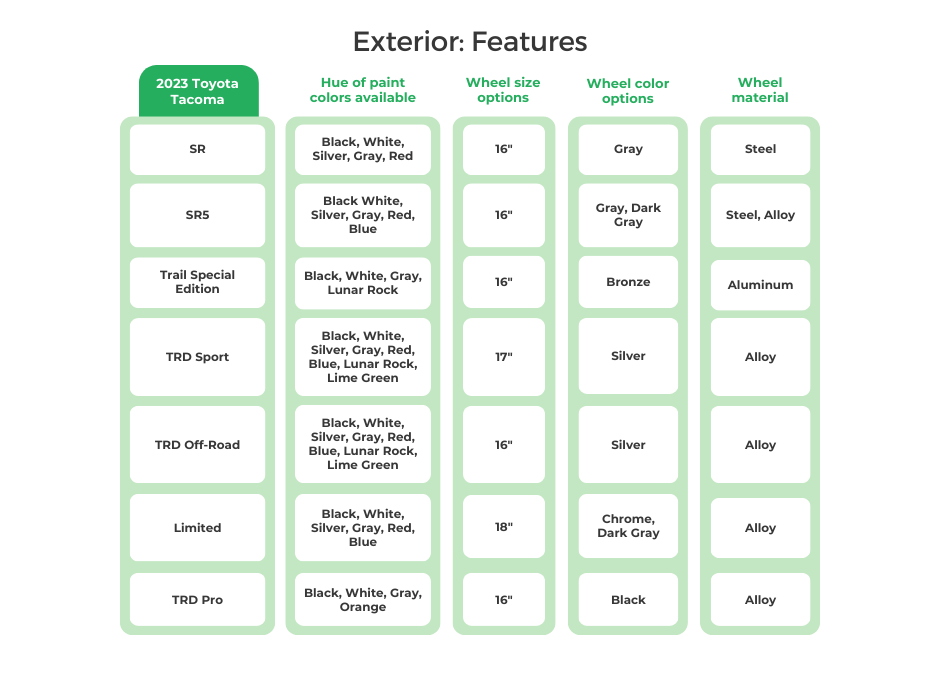
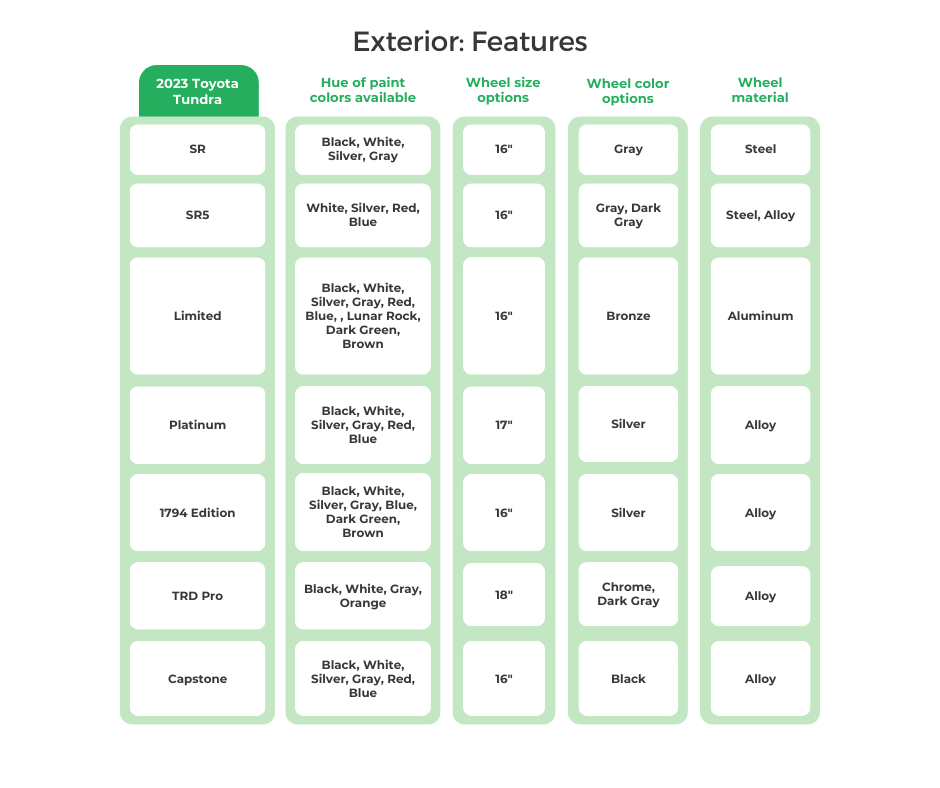
Wheels may also be an afterthought for many car buyers. But wheel size can impact ride quality. Larger rims can translate into better traction and cornering but may result in a bumpier ride. Bigger wheels also offer better aesthetics by filling out the wheel wells more completely. This is why the higher the trim, the larger the wheel. Different materials (steel or alloy) and finishes also help separate the wheels among the various trim levels.
Those looking for a subtle exterior for their Toyota truck will have no problem finding an acceptable white, black, silver, or gray shade. There are also options for red and blue if a splash of color is preferred. The Tundra is even available in Army Green. Toyota also offers a hard-to-miss Solar Octane orange with either truck. Yet, the most distinctive exterior color certainly belongs to the Tacoma: Electric Lime Metallic.
Exterior Dimensions:
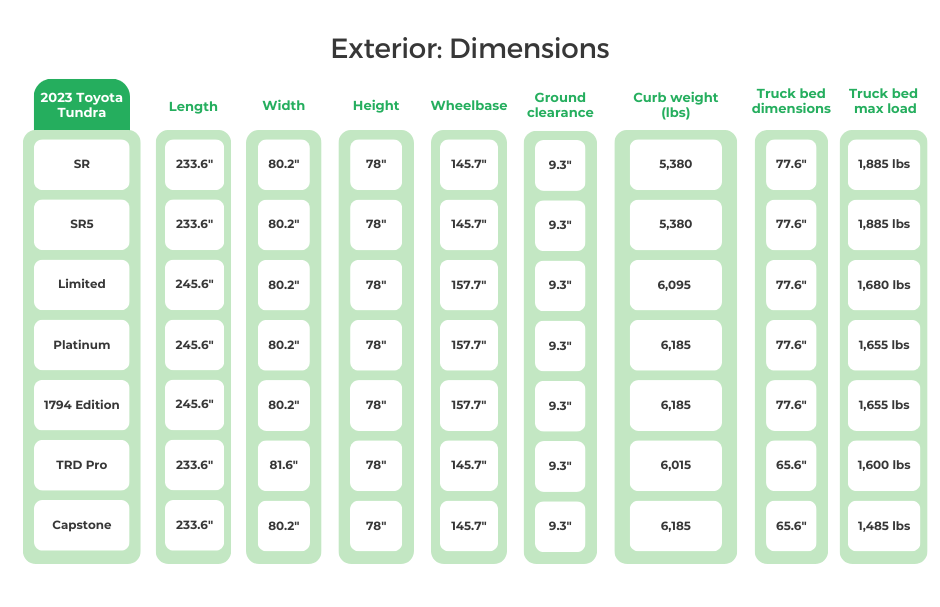
The Tundra is the obvious winner in exterior size—it’s nearly two feet longer than its smaller stablemate. The Tundra also has five inches of width and almost seven inches of height on the Tacoma. Naturally, the Tundra weighs more, tipping the scales by as much as three-quarters of a ton over the Tacoma.
But let’s look at the practical differences. The Tundra’s cargo bed is 5-17 inches longer (depending on the trim) than the Tacoma’s back end. This extra capacity means the Tundra can handle a maximum bed load of up to 1,885 pounds, compared to 1,155 pounds for the Tacoma.
The contrast also extends to the wheelbase, with the Tundra’s wheel-to-wheel measurement of 145.7 or 157.7 inches far surpassing the Tacoma’s 127.4 inches. A vehicle with a longer wheelbase delivers a smoother ride because it’s better able to even out rough road surfaces and highway expansion strips.

Warranty:
Since the Tacoma and Tundra are from the same manufacturer, they also have the same warranty coverage. Both trucks have a three-year or 36,000-mile bumper-to-bumper warranty and powertrain coverage for five years or 60,000 miles. Toyota also includes 24 months of roadside assistance with no mileage restrictions.
The only difference in protection is the extra coverage for the Tundra when it’s equipped with a hybrid powerplant. Toyota warranties this system for 120 months or 150,000 miles.
| 2023 Toyota Tacoma Factory Warranty Coverage: | 2023 Toyota Tundra Factory Warranty Coverage: | |
| Basic warranty: | 36 months/36,000 miles | 36 months/36,000 miles |
| Powertrain warranty: | 60 months/60,000 miles | 60/months/60,000 miles |
| Corrosion perforation warranty: | 60 months/Unlimited miles | 60 months/Unlimited miles |
| Air conditioning warranty: | 12 months/12,000 miles | 12 months/12,000 miles |
| Battery warranty: | 24 months/Unlimited Miles | (Hybrid) 120 months/150,000 miles |
| Emissions warranty (Federal): | Defect: 36 months/36,000 miles Performance: 24 months/24,000 miles | Defect: 36 months/36,000 miles Performance: 24 months/24,000 miles |
| Emissions warranty (California): | Defect: 36-84 months/50,000-70,000 miles Performance: 36 months/50,000 miles | Defect: 36-84 months/50,000-70,000 miles Performance: 36 months/50,000 miles |
| Roadside assistance coverage: | 24 months/Unlimited miles (With Toyota Care) | 24 months/Unlimited miles (With Toyota Care) |
| Total unique recalls: | 2 recalls | 6 recalls (5 recalls for hybrid) |
Driver Experience | A Summary of The Top Toyota Tacoma Vs. Toyota Tundra Reddit Posts:
There’s no shortage of conversations on Reddit comparing the Tacoma and Tundra. Here are some of the highlights from r/whatcarshouldIbuy.
Size and Comfort: The Tacoma is often seen as more suitable for individuals or small families. One Redditor, discussing family use, mentioned, “The Tacoma rear feels like it is the smallest out of the mid-sized pickup trucks.” Another user highlighted the Tundra’s size, saying, “The Tundra is a big, reliable pig. Expensive to buy, but even more expensive to run.” This suggests that while the Tundra offers more space, it costs more.
Performance and Utility: Users noted differences in performance and utility. A comment from a user comparing older models (2006 Tundra vs. 2012 Tacoma) pointed out that “Those old Tundras are about the same size as a modern Tacoma.” Another Redditor, focusing on off-roading, said, “I do some off-roading but plan on doing a lot more, sometimes pretty rough stuff so off-roading capability is definitely necessary.” It’s feedback that indicates a preference for the Tacoma in off-road conditions.
Price and Value: Price is a significant factor in the decision-making process. One Reddit user mentioned, “The Tacoma is going for 28k and the Tundra is going for 10k.” This reflects the general sentiment that Tundras are more expensive, both in purchase price and running costs. However, another Redditor suggested, “Get the Tundra if you have to choose between the two, and the size won’t be a pain.”
The Tacoma is favored for its off-roading capabilities and suitability for smaller families or individual use. At the same time, the Tundra is recognized for its larger size and power, albeit with higher costs. Redditors suggest considering factors like family size, intended use (especially off-roading), and budget.
Who Should Buy These Cars: The Legacy of The Toyota Tacoma and Toyota Tundra
Trucks are all about utility, while a second row makes them more suitable for daily driving. The Tundra’s size gives it capabilities beyond the Tacoma, but the Tacoma is still ready to handle a half-ton load or tow several thousand pounds. At the same time, the Tacoma shines for its off-road prowess. A Toyota truck buyer has options that best meet their needs.
Further, owner reports and online research indicates that either truck can reach 150,000-200,000 miles, with the possibility for even greater longevity.
| Frequent Use Categories: | Toyota Tacoma | How Useful? (Out of 5 Stars) | Toyota Tundra | How Useful? (Out of 5 Stars) |
| Family Vehicle | * * * | * * * |
| Lots of Driving (travel/long commute) | * * * | * * * |
| Hauling/Towing | * * * | * * * |
| Office on Wheels | * * | * |
| Sport/Fast Driving | * | * |
| Luxurious Driving | * | * |
| Outdoor/Off-Road | * | * * * |
Best & Worst Years | Toyota Tacoma Vs. Toyota Tundra | 2001-2024
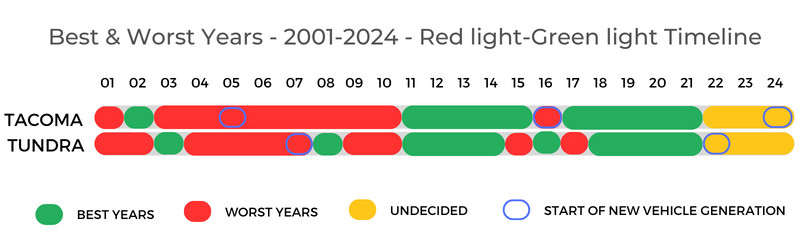
Toyota truck buyers looking for an older example (pre-2011) will need to exercise caution, as most model years don’t muster. This means focusing on 2002 for the Tacoma, while options expand slightly with the 2003 and 2008 Tundra.
If the budget permits, start with the 2011 model year, as both trucks turn the corner for reliability and other critical factors. You just need to avoid the 2016 Tacoma and the 2015 and 2017 Tundra. More “green light” years make for more choices in the marketplace—always a good thing, especially with today’s inflated prices for used vehicles.
I’ll also call attention to the undecided years (yellow) only because there isn’t enough information to give these editions a thumbs up or down.
Important Features Timeline | Toyota Tacoma Vs. Toyota Tundra
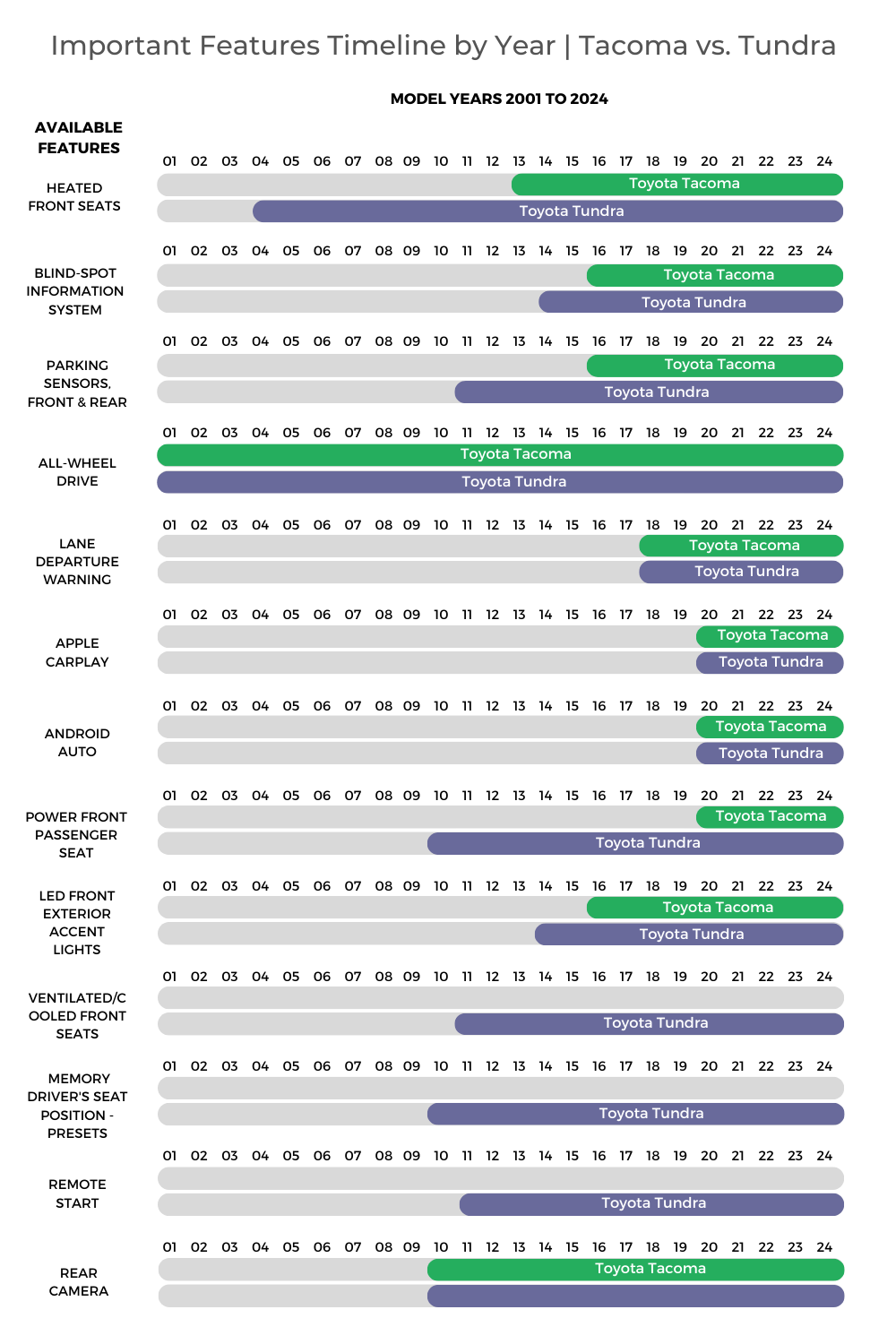
Rank has its privileges, which is why the Tundra usually gets comfort and convenience features before the Tacoma. For instance, the Tundra first got heated front seats in 2004, while the Tacoma didn’t see this feature until 2013. It’s a similar story with a power front passenger seat. Some equipment, like a driver’s memory system and ventilated front seats, have yet to appear in the Tacoma.
Yet, things even out in the technology area. There’s only a two-year gap for blind-spot monitoring. Further, the Tacoma and Tundra received lane departure warning, Apple CarPlay, and Android Auto at the same time. Sometimes, keeping the Tacoma competitive against other brands is more important than maintaining Toyota’s pecking order.
Maintenance Costs (Year-by-Year Average) | Toyota Tacoma Vs. Toyota Tundra
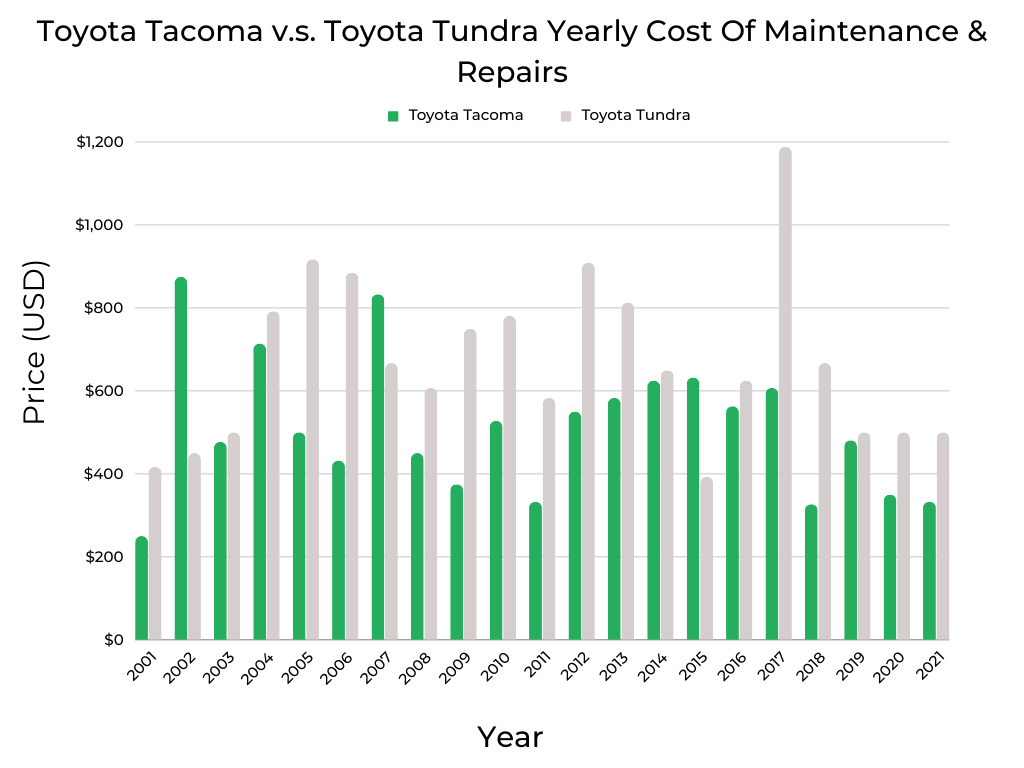
It’s good for a car shopper to remember that the bigger the vehicle, the greater the costs. Nowhere is this more evident than with maintenance and repair costs for the Tacoma and Tundra. FIXD surveys reveal that Tundra owners spent an average of $671 in 2022 to keep their trucks running. This amount is 30% more than what Tacoma owners shelled out ($515).
Examining individual model year data shows that each truck had five years where owners encountered upkeep costs that exceeded average maintenance bills by at least 20%. But given the Tundra’s higher average to start with, these expenses were often hundreds more than the Tacoma.
The $1,188 average for the 2017 Tundra looks particularly bad. But to be fair, the survey results don’t reveal any significant repairs for these trucks. Instead, the high costs are likely due to tire and brake replacements, work that’s eventually required for every vehicle.
Review the best and worst years of the Toyota Tacoma and Toyota Tundra to learn more about these vehicles’ maintenance and repair costs.
Safety Rating Comparison | Toyota Tacoma Vs. Toyota Tundra
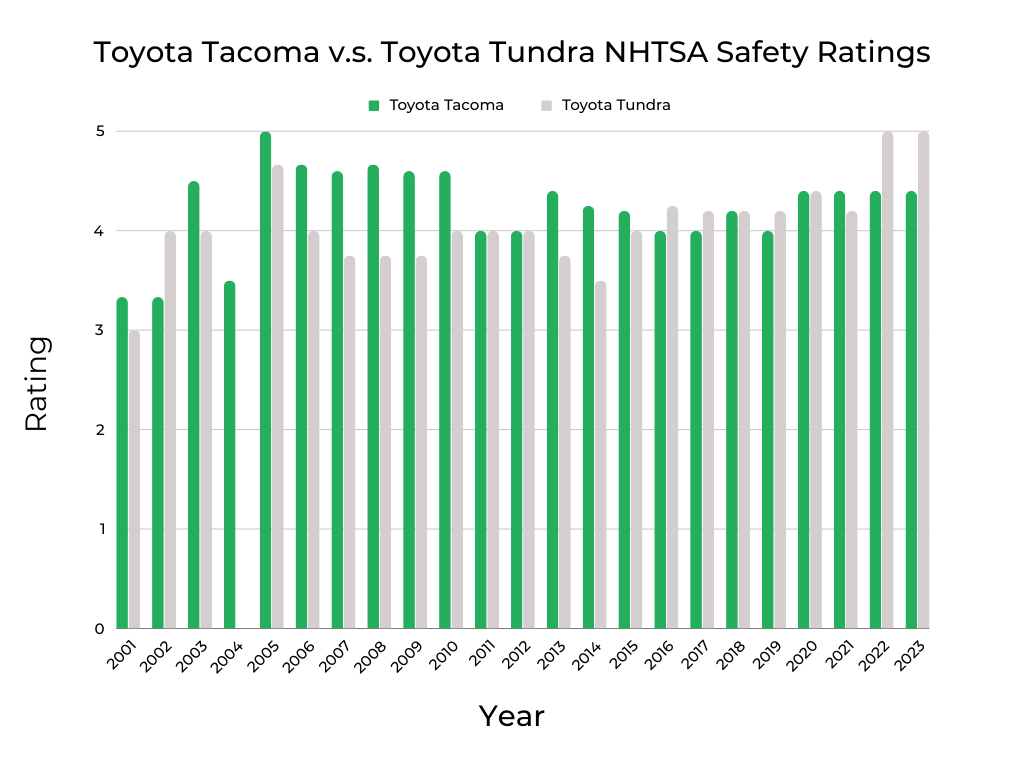 As evident in the graph, it wasn’t too long ago that truckmakers didn’t prioritize crash test safety. Some older Tacomas are sub-par (below 4 out of 5 in NHTSA testing), and it was rare for the Tundra to achieve decent (better than 4) test scores until recently (2016).
However, at some point, Toyota (and other car makers) realized that pickups are also family vehicles, not just work trucks. So, improving test safety performance is good for business. Hence, the perfect test scores for the third-generation Tundra (starting in 2022).
Older Tacomas (2005-2010) also did well, but NHTSA instituted more rigorous testing standards starting with the 2011 model. A change that the Tacoma never entirely overcame. I suspect the all-new 2024 Tacoma will do much better with crash tests.
That said, if safety is an emphasis, you’ll want to pick and choose the model years carefully if you’re looking at a Tacoma or Tundra built before 2015.
More details about crash test safety scores are covered in articles about the Toyota Tacoma and Toyota Tundra.
Fuel Efficiency Comparison | Toyota Tacoma Vs. Toyota Tundra
Fuel Efficiency Comparison | Toyota Tacoma Vs. Toyota Tundra
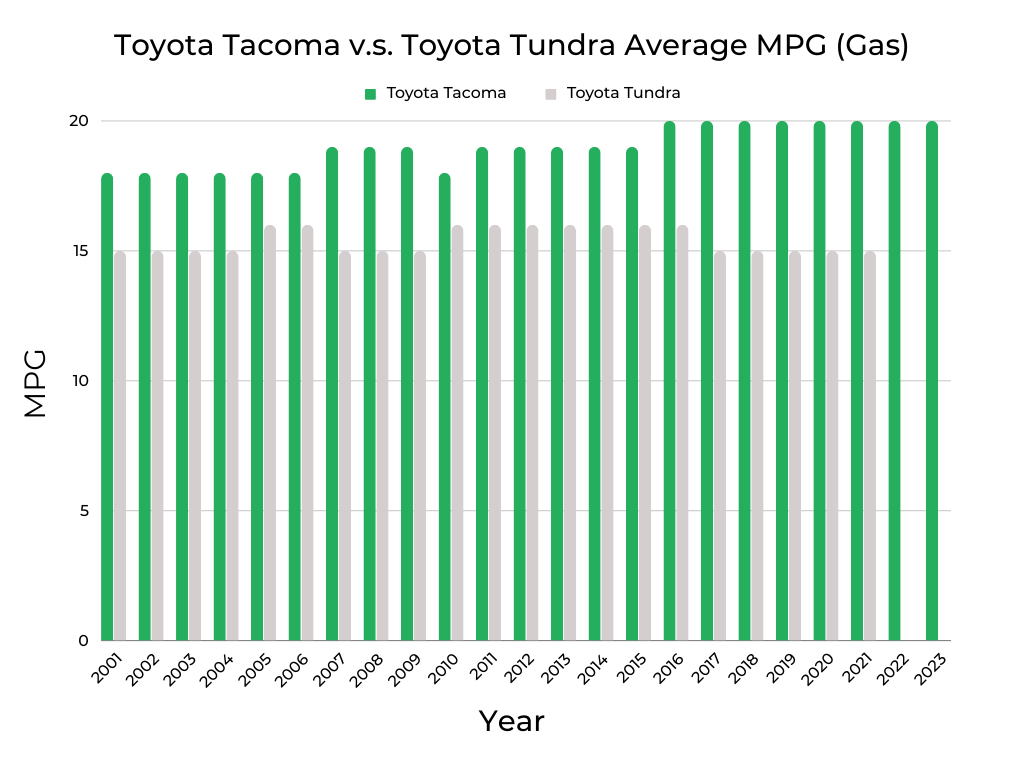

No one buys a mid-sized or larger pickup to save on gas. The ability to haul large loads comes at the expense of fuel economy. Yet, for those who don’t need the Tundra’s extra capabilities, the Tacoma can keep more money in your pocket. Let’s use the 2017 model year as an example.
The Tundra’s average 20 mpg rating is 33% better than the Tundra’s 15 mpg. For someone who drives 15,000 miles a year and pays $3.50 for a gallon of gas, the difference adds to the Tacoma being $875 cheaper to refuel annually.
Toyota added a hybrid option to the Tundra’s engine bay as part of the third-generation rollout but dropped the V8. While hybrids are usually associated with reducing fuel consumption, the automaker engineered the Tundra’s i-FORCE MAX hybrid engine to compensate for the loss of two cylinders. Sure, 20 mpg is a significant improvement over previous years, but the true benefit is more power.

Dave Goldberg is an automotive journalist and lifelong car fanatic. He writes for numerous enthusiast and business outlets and is an ongoing contributor to HotCars.com, one of the most popular car culture websites. When he’s not writing or driving, Dave is either under a hood or asleep. His credentials include a BA in Journalism from The George Washington University.