
Car shopping is no easy task. There are all sorts of considerations, from brand to price to features. The task is even more complicated when looking at used cars because the reliability factor comes into play. At least by sticking to Toyota, you’ve removed the brand element from the equation. Yet, deciding between the RAV4 and Highlander can be equally challenging because while these crossovers share a badge, each offers something different.
One advantage of going the RAV4 or Highlander route is popularity. These are Toyota’s most popular SUVs (the RAV4 taking the top spot), which means ample supply in the used car market. You won’t have any trouble finding one, and choice always works in favor of the buyer.
The RAV4 is ideal for buyers wanting a maneuverable, fuel-sipping crossover with decent cargo space. Its smaller size makes it easy to drive and park, though rear seat room and maximum cargo capacity trail the more accommodating Highlander.
There’s no contest if you need to fit more than five people in a car; the Highlander is the winner. For the record, the third-generation RAV4 (2005-2012) had an optional third row, but these seats weren’t adult-friendly. Plus, three-row RAV4s are hard to find. The Highlander also scores points for having a much greater cargo capacity.
So, why not just go for a Highlander? For some, this makes sense. Yet, the trade-off is lower fuel economy, higher maintenance and repair costs, and a larger vehicle. In addition, all things being equal (age, mileage, equipment, etc.), the Highlander costs more upfront.
One aspect I found intriguing during my research is that the data points to the Highlander having greater longevity (200,000 miles or more) than the RAV4. It’s a notable consideration if your shopping includes examples that have already crossed the 100,000-mile mark. The findings are detailed later in the article.
Yet, the decision ultimately comes down to a desire for space. I’ve owned several two-row SUVs over the years (although no RAV4s), and they always did an adequate or better job of meeting my needs.
But transition is a part of life. The third row changes from convenience to necessity, and extra legroom makes for easier journeys. Eventually, I joined the three-row club (no Highlander, either). An informal look around my neighborhood shows that others have signed up, too. Of those with an SUV in the immediate vicinity, about two-thirds have models with three rows.
I mention my experience with the two-row versus three-row dilemma because it’s at the heart of deciding between the RAV4 and Highlander. You’ll want to take stock of your needs today and consider what the future might bring.
Keep reading to see how the RAV4 and Highlander compare in cost, engine reliability, safety, fuel economy, upkeep, and other vital factors—things you’ll want to know before making a purchase.
Looking for the latest model? Explore: Toyota RAV4 Vs. Toyota Highlander | 2023 Comparison.
Keep reading to see how this Toyota RAV4 and Toyota Highlander contest turns out. Other match-ups to review include Outback vs. Forester, RAV4 vs. CR-V, Civic vs. Corolla, Pilot vs. Highlander, 4Runner vs. Highlander, and Odyssey vs. Sienna.
| Income Bracket | Monthly Financing Cost Range | Cash Purchase Price Range | Toyota RAV4 Years | Toyota Highlander Years | Best Model Year: | Why? |
| $5k-$10k | $83-$125 | $3,000-$4,500 | 2002 | 2002 | 2002 RAV4 | Better engine reliability and safety score |
| $10k-$15k | $125-$187 | $4,500-$6,750 | N/A | 2007 | 2007 Highlander | Good value, strong safety score, and above-average engine reliability |
| $15k-$25k | $187-$312 | $6,750-$11,250 | 2009 | 2010 | 2010 Highlander | Better engine reliability |
| $25k-$35k | $312-$437 | $11,250-$15,750 | 2015 | 2015 | 2015 Highlander | Top engine reliability score, better safety score |
| $35k-$50k | $437-$625 | $15,750-$22,500 | 2018 | 2017 | 2018 RAV4 | Better value and fuel economy |
| $50k-$74k | $625-$925 | $22,500-$33,300 | 2021 | 2019 | 2019 RAV4 | Top engine reliability score, strong value, and better fuel economy |
| $75k-$99k | $925-$1,238 | $33,300-$44,550 | N/A | 2021 | 2021 Highlander | Top engine reliability score, very good safety score, |
See the methodology for the table above.
Before you respond to the “For Sale” ad, check out this How to Buy a Used Car article for a step-by-step checklist.
Price History Comparison | Toyota RAV4 vs. Toyota Highlander
Average Market Value – Based on Owners’ Self-Reported Mileages | Toyota RAV4 vs. Toyota Highlander

Price is often the starting point for used car shoppers. A look at private-party transactions for the RAV4 (green) and Highlander (gray) shows that prices ranged from below $5,000 to over $30,000. These numbers are also adjusted for owner-reported mileage from FIXD surveys.
As is usually the case, newer model years are worth more than older ones. Regarding RAV4 versus Highlander values, you’ll notice that starting with the 2010 model year, the Highlander generally is worth more than the RAV4. This is due to the Highlander having a higher selling price when new.
Both vehicles have near identical depreciation rates when new, according to CarEdge. Over five years, the RAV4 loses 22% of its value compared to 21% for the Highlander. So, other factors are involved, like MSRPs.
The higher values of older RAV4 (2003-2009) are due to Highlanders from these years having high mileage. Lots of driving also explains the depressed values for the 2015 RAV4 and Highlander.
What does this all mean? A used Highlander will cost more than an equivalent RAV4. If you have a Highlander mindset but a RAV4 budget, look for an older Highlander, that has higher mileage, or less equipment as a workaround.
You’ll want to use this same approach if dealer prices (usually 33%-50% more than private sales) are out of reach.
Be sure to read our Best and Worst Years series of articles highlighting the Toyota RAV4 and Toyota Highlander winners and losers.
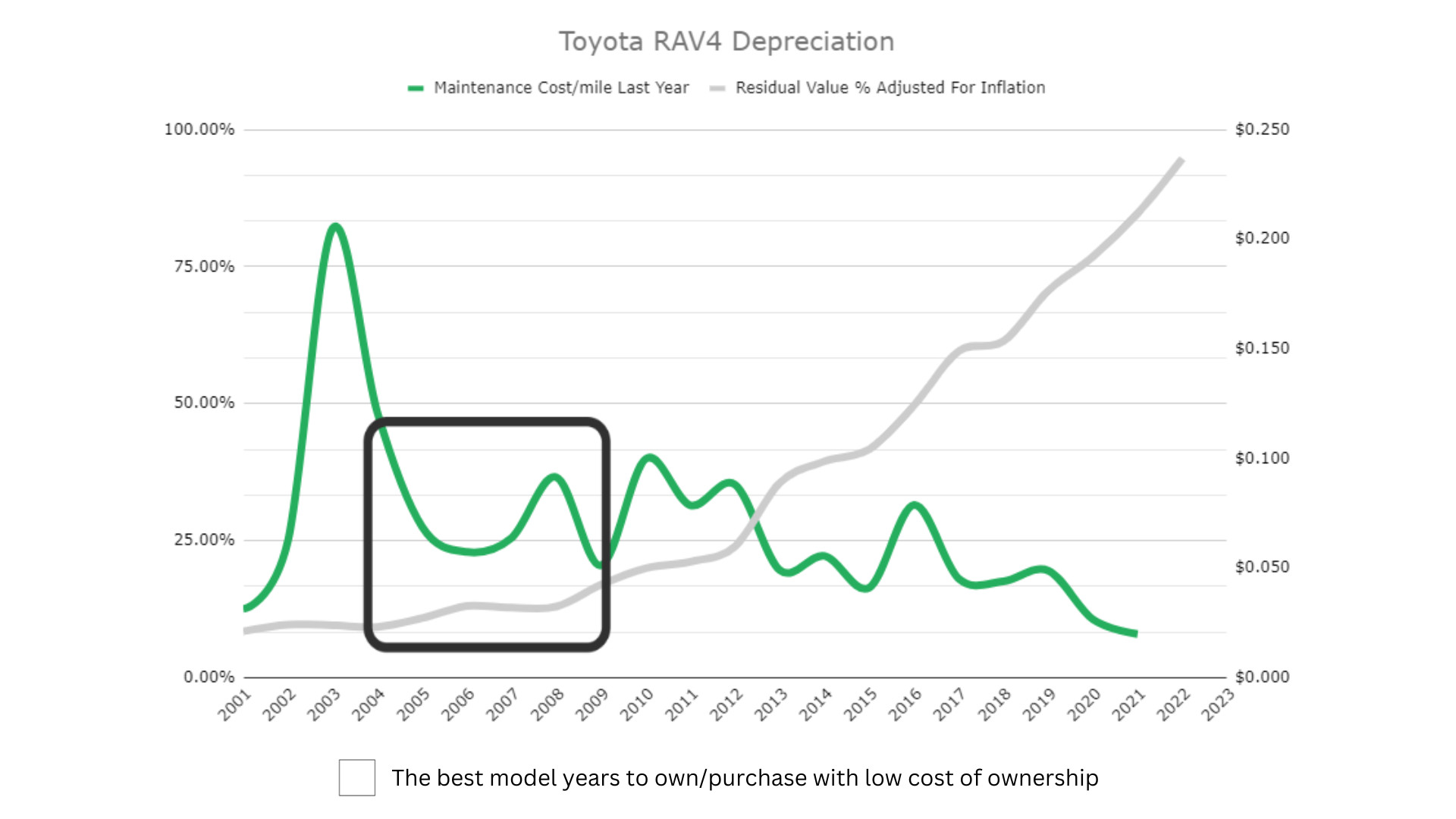
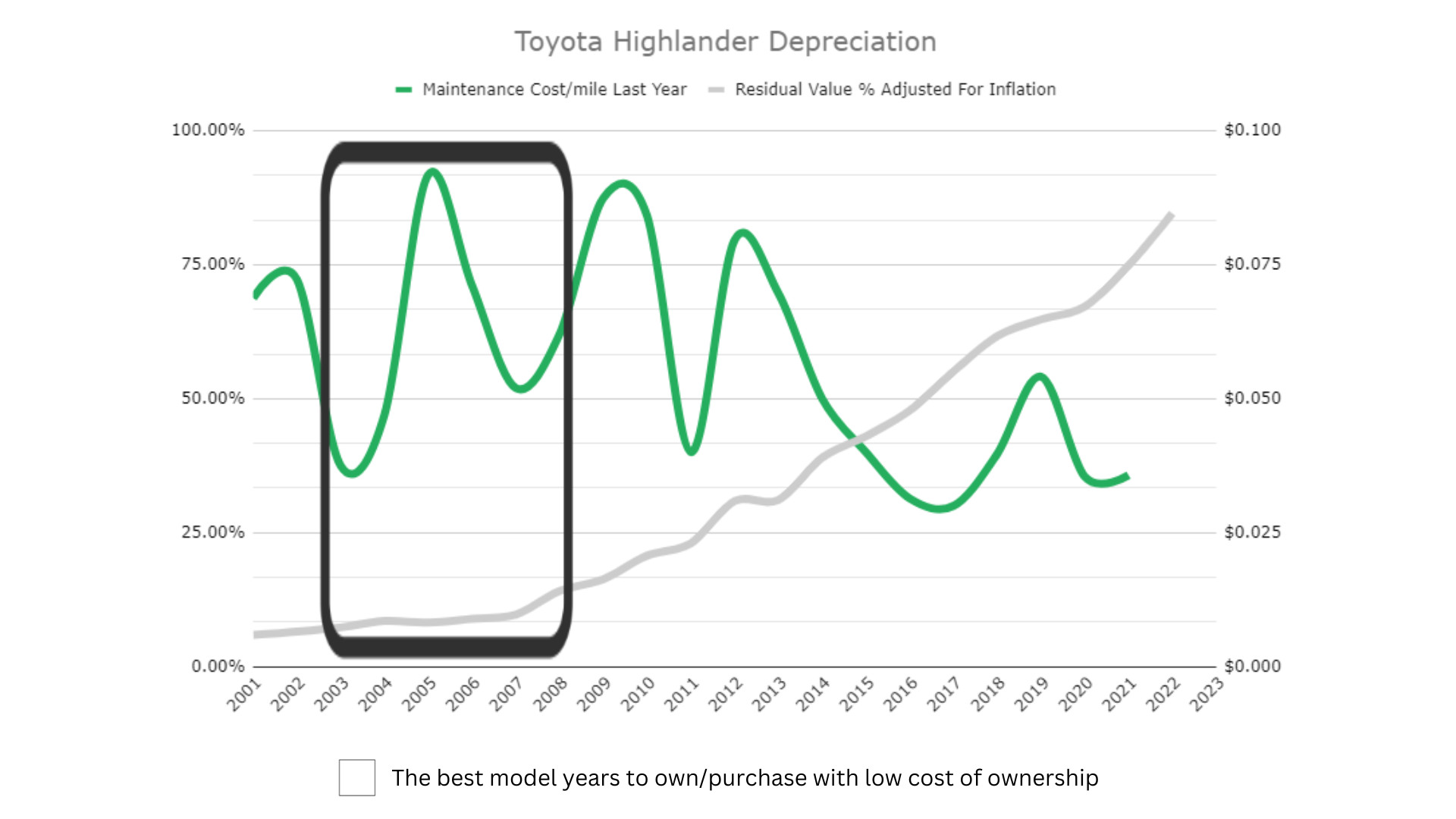
Depreciation vs. Maintenance Expenses
Just because the RAV4 and Highlander wear a Toyota badge doesn’t mean they have the same engine reliability. You can make a case that because they don’t share engines, then, of course, dependability could be different. Nonetheless, the contrast in FIXD Reliability Scores for pre-2009 models is startling.
Most RAV4s from this period received a bottom-of-the-barrel rating of 1 (out of 10). In contrast, most Highlanders from 2001-2008 scored at least a 3. I certainly wouldn’t call a 3 a benchmark for reliability (remember, 5 is average), but I’ll take it over a 1 any day.
Moving on, check engine lights (CELs) became less common with the 2013 model year. These newer Highlanders never dropped below a 6. Other than the 2016 RAV4 getting a FIXD Reliability Score of 4, the same thing can be said about this smaller Toyota.
I’ll also note that not every CEL translates into a high-dollar repair bill. Sometimes, all it takes is a loose gas cap or cracked hose to trigger a dashboard warning. Yet, there’s no getting around the fact that older RAV4s have more CELs than their Highlander equivalents.
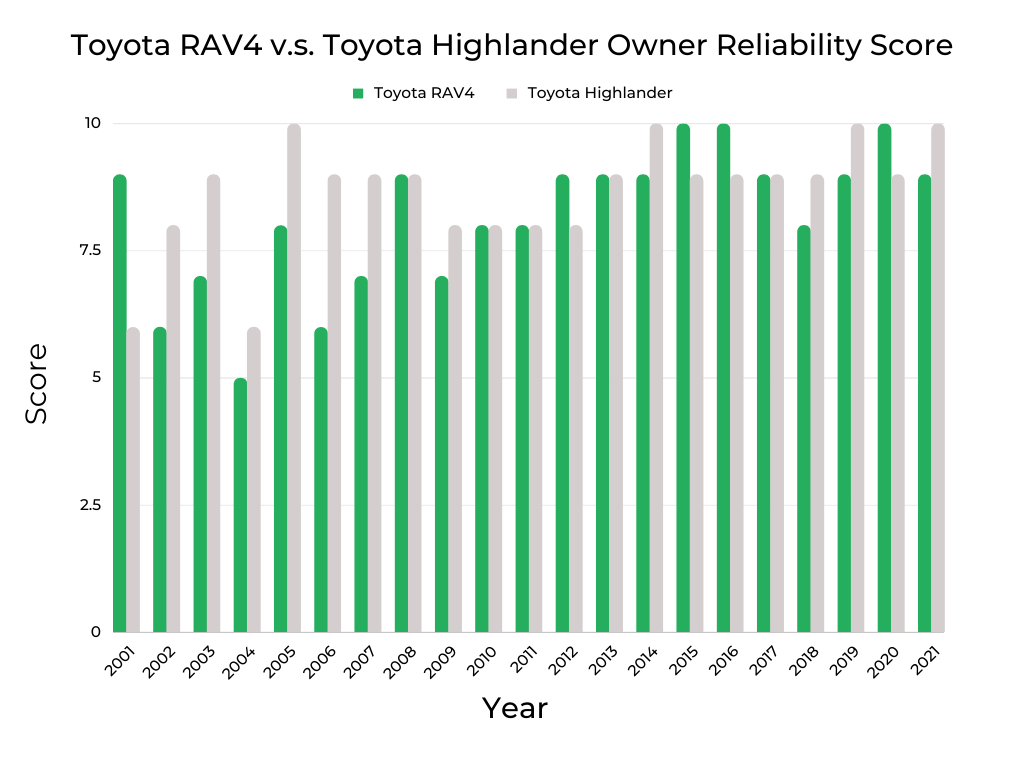
But check engine light frequency doesn’t appear to impact what owners think of their RAV4 and Highlanders (Owner Reliability Scores). Even among older model years, neither Toyota ranked below a five. Further, seeing almost all of these 20-year-old (or older) vehicles receiving a 6 or better tells me that owners don’t consider CELs much of a nuisance.
Review the Best and Worst Years articles on the Toyota RAV4 and Toyota Highlander to learn more about these vehicles’ FIXD Reliability and Owner Reliability Scores.
Longevity Comparison | Toyota RAV4 vs. Toyota Highlander
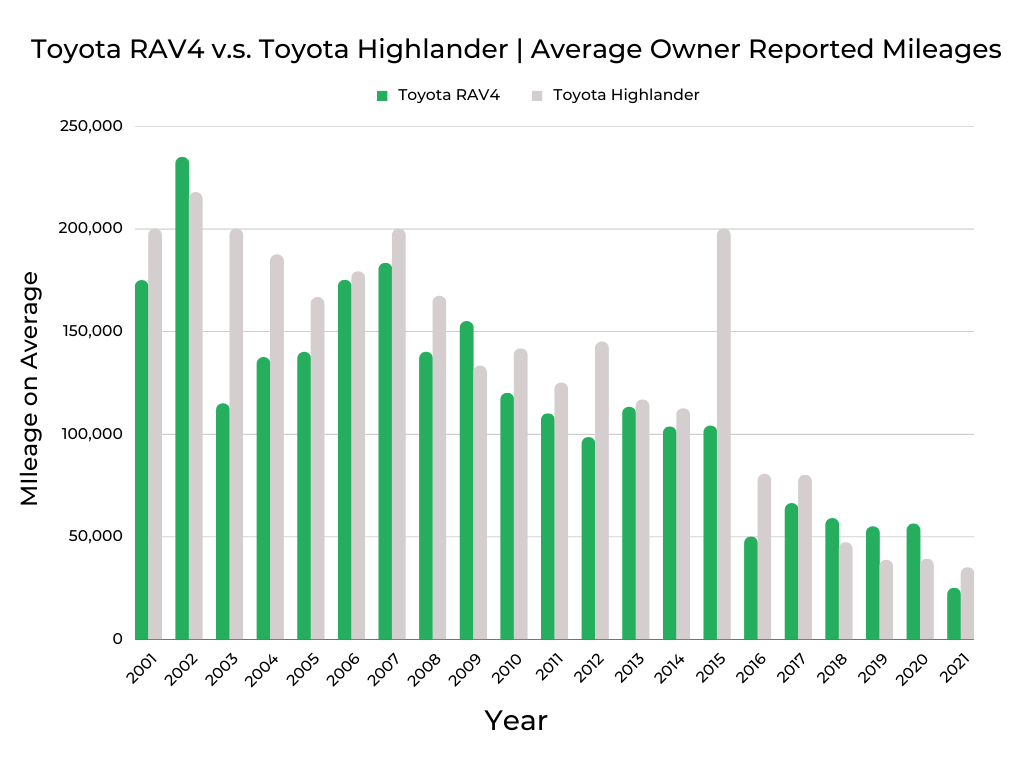
It wasn’t that long ago that a car with 100,000 miles was considered high mileage and approaching its end of life. But Japanese automakers, including Toyota, have helped to move the bar. Today, 150,000 miles is a doable achievement for most automobiles.
FIXD owner surveys show that the RAV4 and Highlander can reach this milestone. Yet what’s even more encouraging is how many of these Toyotas are approaching or have already reached the 200,000-mile mark. The surveys show that five RAV4 model years have 150,000 miles or more, compared to nine model years for the Highlander.
Let’s expand on this data by looking at for-sale listings from autotrader.com (January 8, 2024). Looking at marketplace data will help compare what owners say about longevity against another source.
This unscientific review shows 1,241 RAV4s and 1,136 Highlanders from 2001-2012 are available for sale. Why these particular model years? Because these examples are more likely to have higher mileage.
Among these listings, 113 (9.1%) RAV4s and 225 Highlanders (19.8%) had 200,000 miles or more. Twice as many Highlanders with ultra-high-mileage hints at the RAV4’s longevity (or lack thereof).
Let’s dive into the listings further. When looking at examples with 150,000-200,000 miles, 384 (30.9%) RAV4s and 434 (38.2%) Highlanders qualified. The numbers still don’t align from a percentage standpoint, but at least they’re closer.
Combine what owners say about mileage with for-sale listings, and it’s fair to say that the Highlander is more likely to cross the 200,000-mile threshold than the RAV4.
Review the individual articles on the best and worst years of the Toyota RAV4 and Toyota Highlander for a more thorough look at longevity.
Who Should Buy These Cars: The Legacy of Toyota RAV4 vs. Toyota Highlander
While Toyota (and any automaker, for that matter) attempts to make crossovers look like they can tackle all terrains, their primary purpose is to transport families. Owners report this task takes top priority: 54% for the RAV4 and 47% for the Highlander. Long commutes and road trips (bundled under the “lots of driving” category) account for an average of 28% of use between these two vehicles.
Hauling and towing only get cited as a frequent task by 4% of RAV4 owners. However, almost three times as many Highlander owners (11%) take advantage of their Toyota’s extra space and trailering ability.
| Frequent Use Categories: | Toyota RAV4 | How Useful? (Out of 5 Stars) | Toyota Highlander | How Useful? (Out of 5 Stars) |
| Family Vehicle | * * * * * | * * * * * |
| Lots of Driving (travel/long commute) | * * * | * * * |
| Hauling/Towing | * | * * |
| Office on Wheels | * | * |
| Sport/Fast Driving | * | * |
| Luxurious Driving | * | * |
| Outdoor/Off-Road | * | * |
Driver Experience | A Summary of The Top 10 Toyota RAV4 vs. Toyota Highlander Reddit Posts:
There’s no shortage of Reddit posts about the Toyota RAV4 and Highlander. Here are some of the conversation highlights from Reddit: r/whatcarshouldIbuy.
The RAV4 is seen as a smaller, more fuel-efficient vehicle that is better for driving around the city and doing everyday errands. One Redditor remarked, “The RAV4 will have better fuel economy and be easier to drive and park on a day-to-day basis.”
Several users pointed out the better gas mileage of the RAV4 Hybrid compared to the Highlander Hybrid. The RAV4 Prime, with its electric range, was also favorably compared against the Highlander Hybrid.
In contrast, the Highlander is considered the better family vehicle with more passenger and cargo space. As one user said, “The Highlander will have more room for car seats, dogs, luggage, etc if that’s a concern.” The third-row seating and larger cargo area make it better for trips and family activities. One commenter said, “I’d only go for the Highlander if you really need the third row or extra cargo space.”
Several posts debated the merits of the hybrid models. Some felt the improved gas mileage of the RAV4 hybrid was worth the smaller size, with one saying, “I prefer the RAV4 due to its superior fuel efficiency.”
However, a few users felt the Highlander Hybrid offered a nice balance, with more space than the RAV4 Hybrid but close to the same fuel economy. As one commenter put it, “I would choose the Highlander hybrid since it gets almost the same MPG as the RAV4 hybrid but a lot more usable room for people and things.”
These comments echo what’s already been discussed. The choice often came down to priorities: fuel efficiency and maneuverability of the RAV4 versus the passenger and cargo space of the larger Highlander.
Best & Worst Years | Toyota RAV4 Vs. Toyota Highlander | 2001-2024
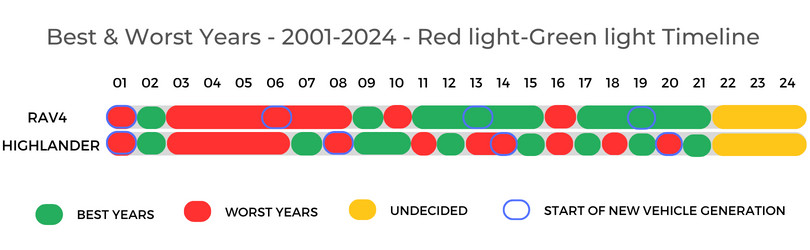
Choices are limited for buying a cheap RAV4 or Highlander. The 2002 model year for both vehicles gets a green light, while the 2007 Highlander offers another affordable option. None of these are perfect, but they’re better than any other year before 2009.
With a larger budget, you can step up to a 2009 or 2011-2012 RAV4 or a Highlander from 2009-2010 or 2012. Ideally, shopping should focus on the 2013-2021 RAV4 (excluding 2016) and 2015, 2017, 2019, and 2021 Highlander. These newer models have substantially higher engine reliability scores, an underlying factor with these green light-red light recommendations.
I’ll call attention to the undecided years (yellow) only because there isn’t enough information to give these editions a thumbs up or down.
Important Features Timeline | Toyota RAV4 vs. Toyota Highlander
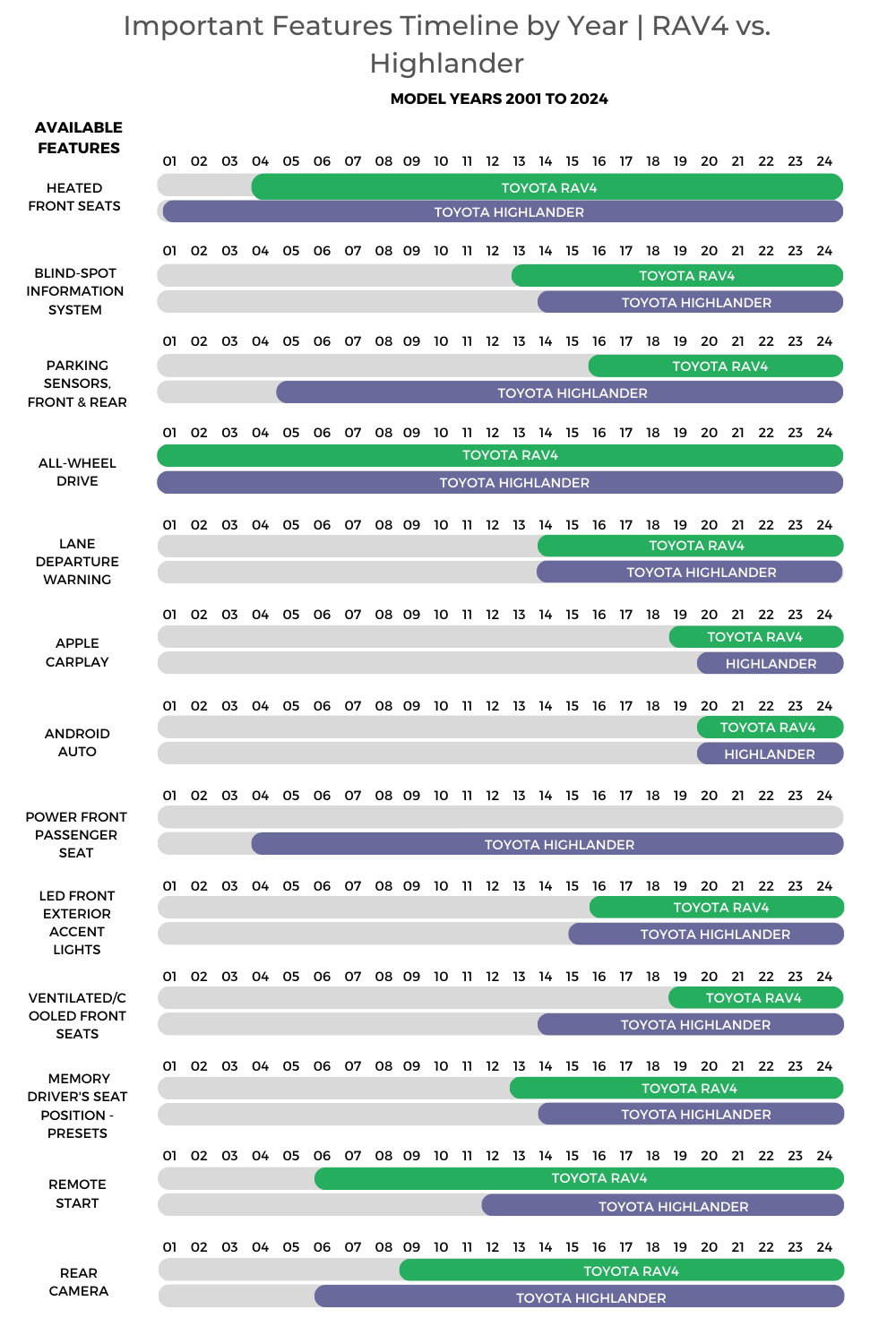
In Toyota’s crossover lineup, the Highlander sits atop the RAV4. This explains why the Highlander got numerous features before its stablemate.
For instance, comfort and convenience equipment like heated front seats and ventilated front seats came to the Highlander several years before the RAV4. Similarly, the Highlander was first in line for certain safety tech, such as a rearview camera and parking sensors.
When the RAV4 beat the Highlander to the feature punch in some areas (blind-spot monitoring, Apple CarPlay, and a driver’s memory system), it was usually connected with the launch of a new generation (2013 and 2019). The equipment then shows up on the Highlander the following model year.
Of course, some equipment arrives simultaneously to both vehicles (Android Auto and lane departure warning).
Maintenance Costs (Year-by-Year Average) | Toyota RAV4 vs. Toyota Highlander
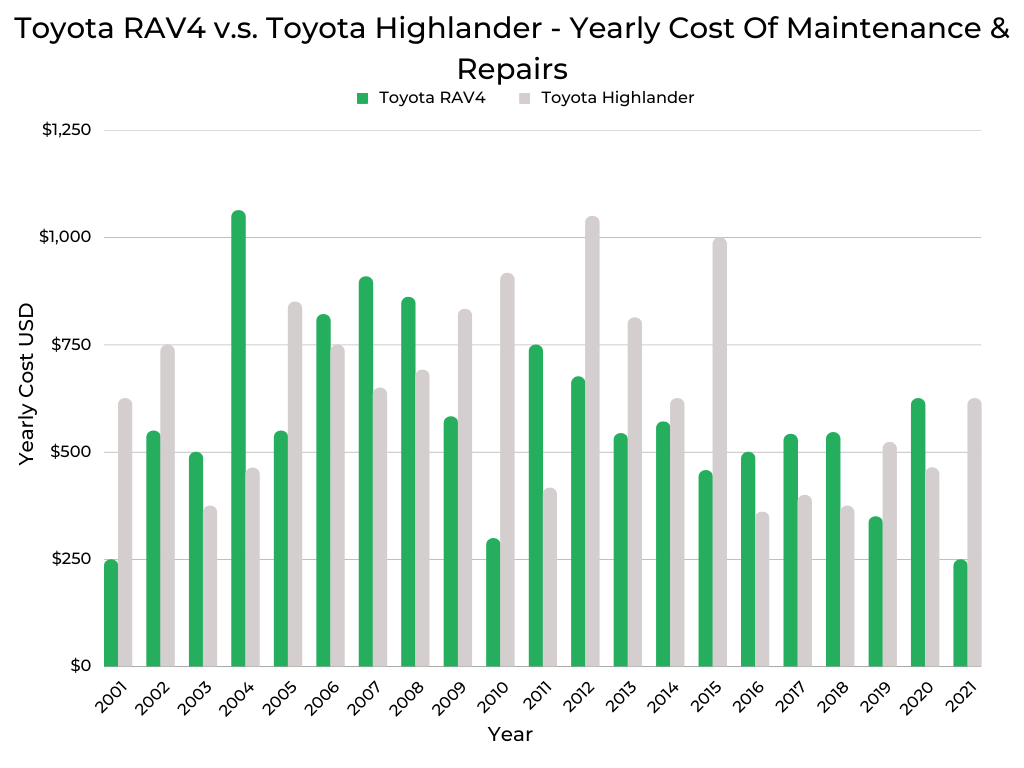
Looking at the maintenance and repair expenses for these Toyotas proves that the larger the vehicle, the greater the cost to own. The chart reflects what surveyed owners reported spending in 2022 to keep their cars running. The amounts add to an average of $581 for the RAV4 and $646 for the Highlander.
These averages serve as a benchmark to identify model years associated with higher repair bills. For the RAV4, owners of the 2004, 2006-2008, and 2011 editions reported spending at least 20% above average for service work. Owners with a Highlander from 2005, 2009, 2010, 2012, 2013, and 2015 experienced the same.
You’ll notice that these offenders are one to two decades old, indicating that age plays a role in upkeep expenses. No matter how good Toyota’s build quality is, eventually, components wear out. High mileage also accelerates the process.
Review the best and worst years of the Toyota RAV4 and Toyota Highlander to learn more about maintenance and repair costs for these vehicles.
Safety Rating Comparison | Toyota RAV4 vs. Toyota Highlander
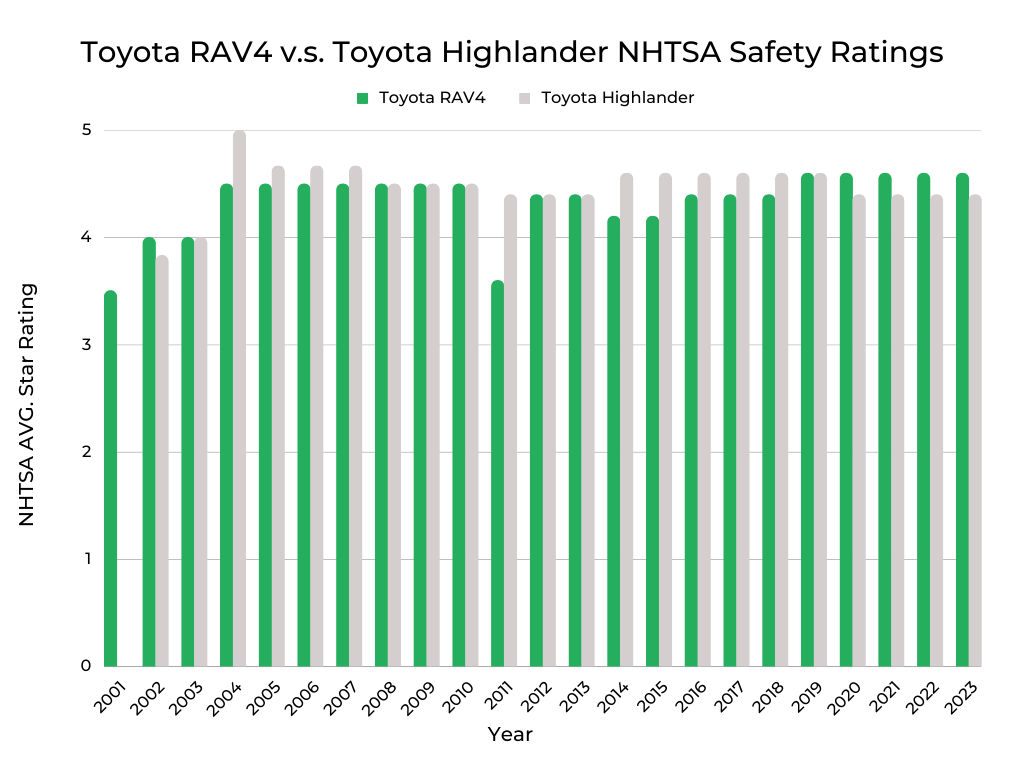
Strong safety is mandatory for family vehicles. Without stellar scores, buyers will look elsewhere. This isn’t an issue with the RAV4 and Highlander, as both cars deliver solid results in National Highway Traffic Safety Administration (NHTSA) testing.
With 4.0 (out of 5.0) as a minimum “good” rating, almost every model year offers substantial passenger protection. The only versions to worry about are the 2001 RAV4 and 2002 Highlander (I’ll cover the 2011 RAV4 separately).
Should the 2011 RAV4 be avoided due to a subpar safety score? That’s a matter of opinion. Starting for the 2011 model year, NHTSA instituted more stringent testing standards. Some vehicles, like the 2011 RAV4, didn’t meet the new requirements, but Toyota turned things around for the following year.
So, if you go by the old, less rigorous standards, the 2011 RAV4 does quite well. However, judging this Toyota by current criteria puts it well behind the pack.
More details about crash test safety scores are covered in articles about the Toyota RAV4 and Toyota Highlander.
Fuel Efficiency Comparison | Toyota RAV4 vs. Toyota Highlander
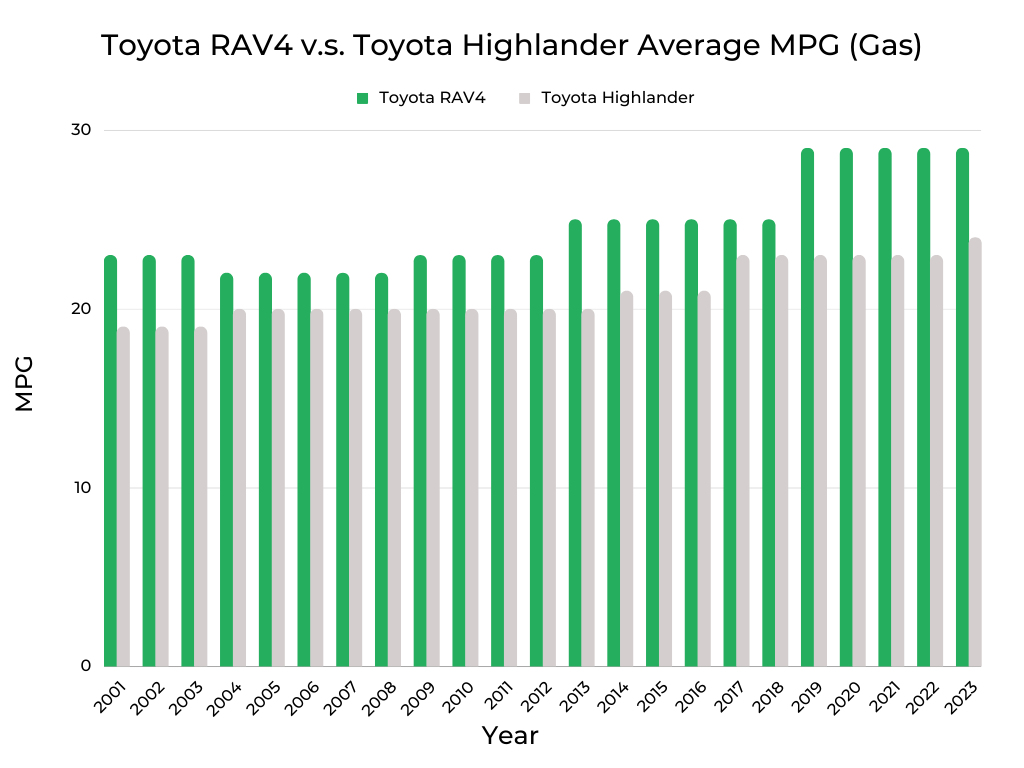
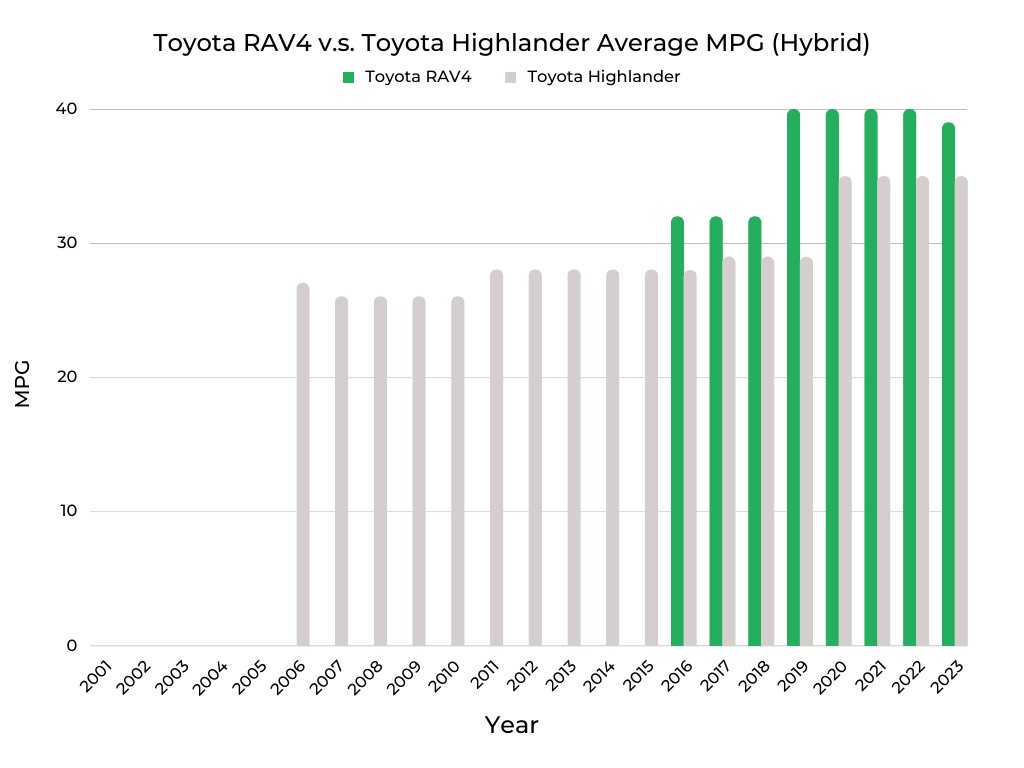
There’s no question that the RAV4 is the mpg champ over the Highlander. With only gasoline power, the RAV4’s four-cylinder engine sips fuel much more slowly than the four- and six-cylinder engines used in the Highlander. Here’s where the RAV4’s smaller size and weight shines.
The same holds true when looking at the hybrid editions. The 30+ mpg performance of the 2016-2018 RAV4 doesn’t get beaten by the Highlander until 2020. By then, the RAV4 is delivering 40 mpg.
If you’re still undecided about choosing between these SUVs and don’t need the Highlander’s extra space, then picking the RAV4 for its better fuel economy is logical.

Dave Goldberg is an automotive journalist and lifelong car fanatic. He writes for numerous enthusiast and business outlets and is an ongoing contributor to HotCars.com, one of the most popular car culture websites. When he’s not writing or driving, Dave is either under a hood or asleep. His credentials include a BA in Journalism from The George Washington University.