

Vehicle Class & Body Style:
Quick Take: The Highlander has significantly more interior space than the RAV4.
The U.S. Environmental Protection Agency (EPA) categorizes the RAV4 as a crossover SUV, while the Highlander gets a midsize SUV designation. Although both vehicles share a body style, passenger volume is the reason for the different categories.
At 99 cubic feet, the RAV4’s interior space falls far short of the 136-142 cubic feet available inside the Highlander. Later, I detail how passenger volume translates into usable space for each vehicle.
|
2023 Toyota Rav4 |
2023 Toyota Highlander | |
| Vehicle Class | Crossover SUV | Midsize SUV |
| 4-Door SUV | Hybrid LE, Hybrid XLE, Hybrid Woodland Edition, Hybrid XLE Premium, Hybrid SE, Hybrid XSE, Hybrid Limited LE, XLE, XLE Premium, Adventure, TRD Off-Road, Limited, LE, XLE, XLE Premium, Adventure, TRD Off-Road, Limited | L, LE, XLE, XSE, Limited, Platinum, Hybrid LE, Hybrid XLE, Hybrid Bronze Edition, Hybrid Limited, Hybrid Platinum |
Powertrain:
Engine Options & Specifications:
Quick Take: The RAV4 and Highlander share a hybrid engine but have different base powerplants. The RAV4 Prime PHEV is speedy.
Before 2023, the RAV4 and Highlander didn’t share much under the hood. However, the 2023 model year saw the introduction of a four-cylinder engine as standard power for the Highlander. Toyota dropped the V6.
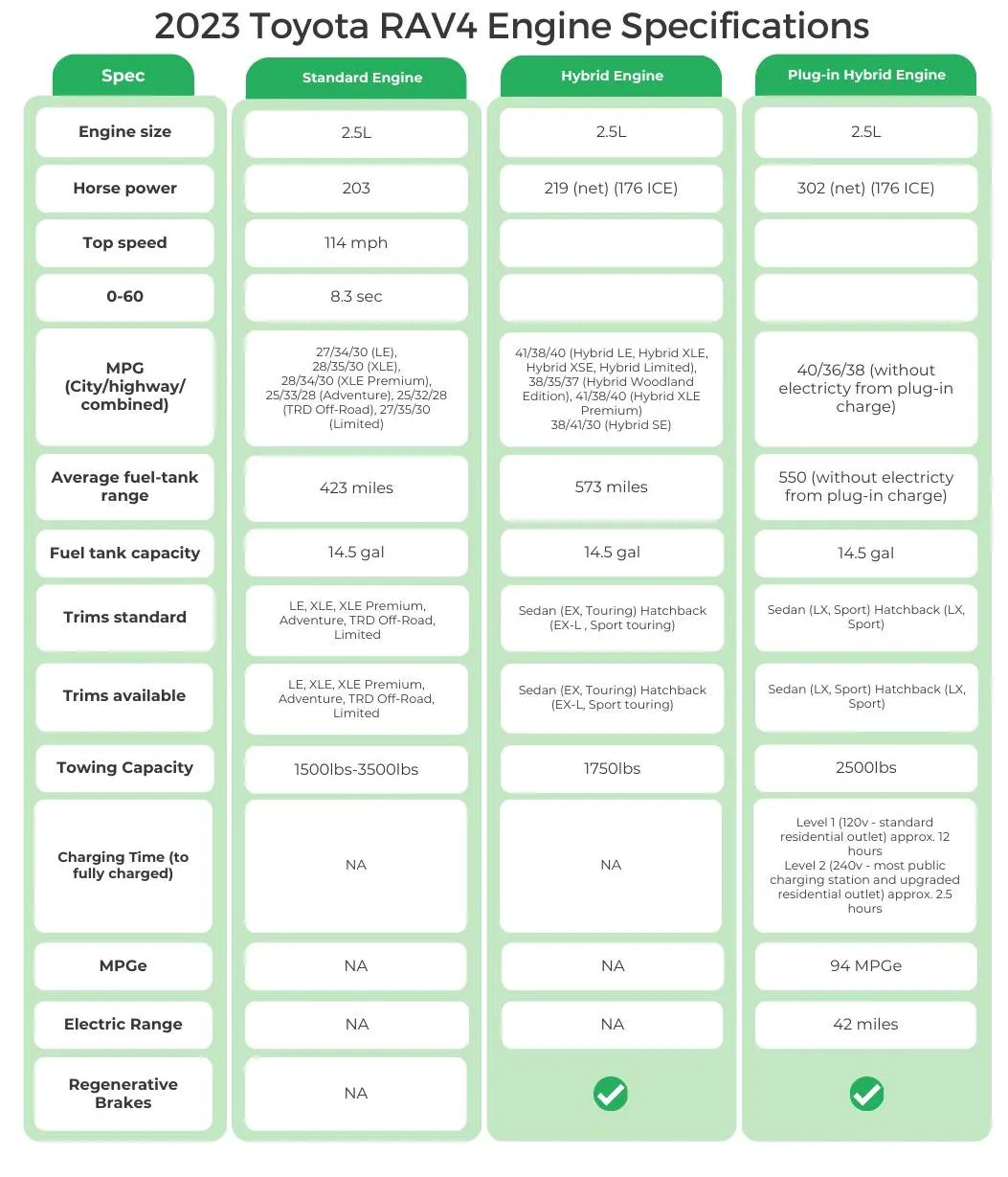
The RAV4 relies on different versions of the venerable 2.5-liter four-cylinder engine. One offers 203 horsepower of conventional power for a somewhat pokey 0-60 mph time of 8,3 seconds. The same engine gets used for hybrid and plug-in hybrid duties, with the RAV4 Prime (PHEV) offering a performance punch.
The Prime’s 302 horsepower far exceeds what’s available with the Highlander and can accomplish the 0-60 dash in a spritely 5.7 seconds. Believe it or not, the RAV4 Prime is one of the quickest cars in Toyota’s 2023 lineup. The Prime’s 42-mile all-electric range also makes this RAV4 ideal for gasless local driving and modest commuting while having gas power as a backup for longer distances.
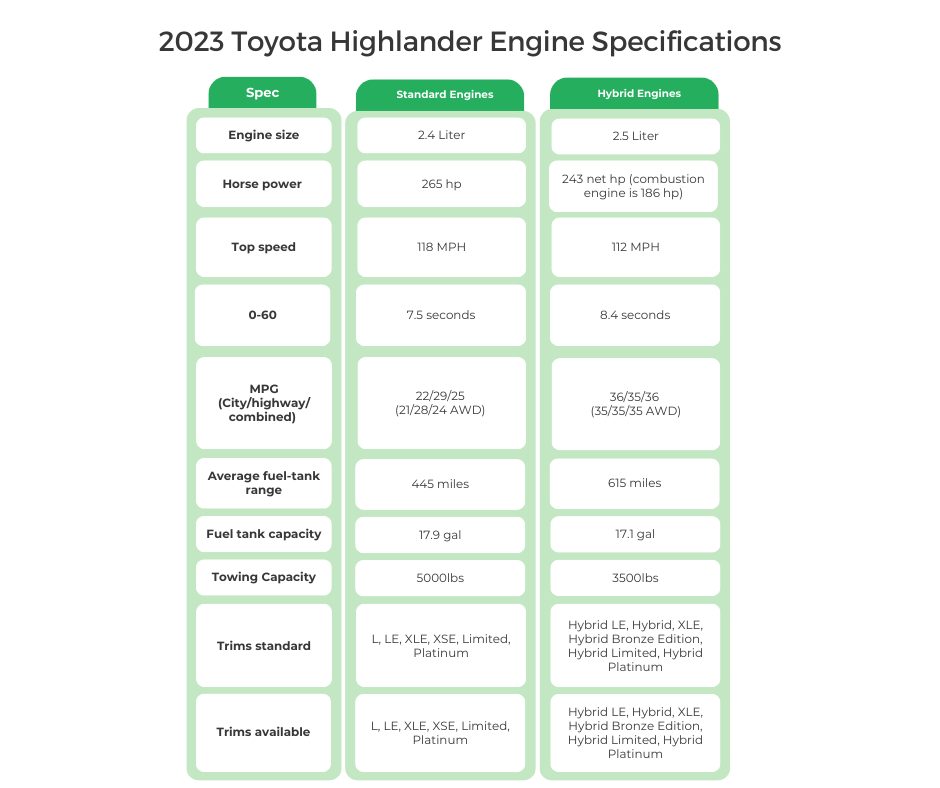
Four-cylinders serve as the base engine for the Highlander, but this Toyota gets a slightly smaller 2.4-liter unit that includes a turbocharger. Its 265 horsepower falls short of some of the competition, but being able to complete a 0-60 run in 7.5 seconds is quick enough for most.
The Highlander Hybrid has the familiar 2.5-liter setup under the hood. However, Toyota engineers have squeezed out more combined horsepower (243 versus 219 for the RAV4 Hybrid) to differentiate from the RAV4 and help handle the extra bulk.
Fuel Economy:
Thanks to its smaller and less powerful engine, a RAV4 gets 3-6 mpg better fuel economy than the Highlander. This can save hundreds yearly, but it doesn’t matter if you need the Highlander’s third row and extra cargo capacity.
No matter if you pick a RAV4 Hybrid or Highlander Hybrid, fuel economy is impressive. With driving at up to 41 mpg, the RAV4 Hybrid sips gas like an economy car. The Highlander Hybrid’s 35-36 mpg is equally outstanding, considering this a sizeable three-row SUV.
Towing:
Towing capacity may not be the main reason for buying an SUV, but knowing what the RAV4 and Highlander can handle may help with the decision process.
Towing limits for the RAV4 vary greatly, depending on trim. Most RAV4s can tow up to 1,500 pounds with conventional power, while the Adventure and TRD Off-Road editions are rated for 3,500 pounds. The RAV4 Hybrid can tow 1,750 pounds and the Prime has a 2,500 pounds maximum.
The Highlander can tow up to 5,000 pounds (regardless of trim or equipment), and the Highlander Hybrid can pull a maximum of 3,500 pounds.
Wondering about fuel economy for an older RAV4 or Highlander? Check out: Toyota RAV4 Vs. Toyota Highlander | The Best Model Year For Every Budget.
Transmission Options & Specifications:
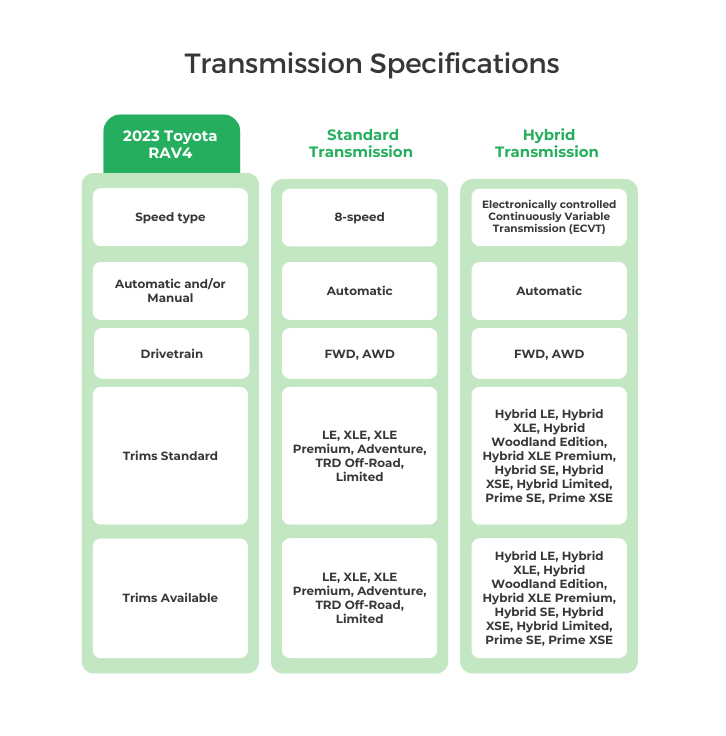
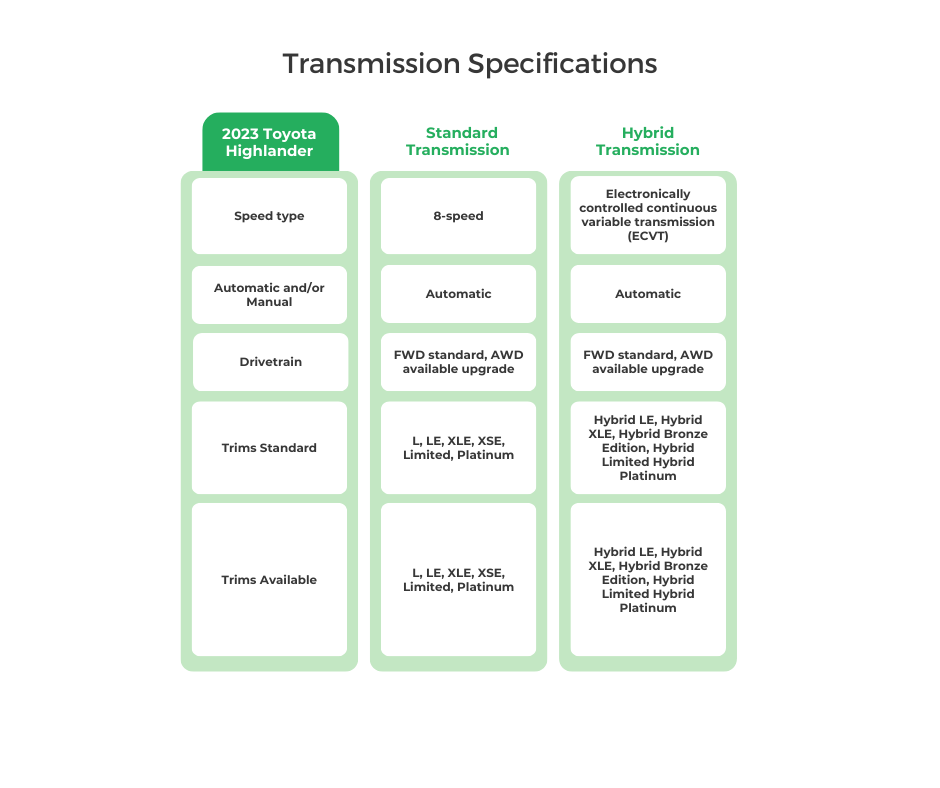
One thing (or things) that the RAV4 and Highlander have in common is the same transmission. Both vehicles have an eight-speed automatic transmission with conventional power—a gearbox well-suited to the extra strain of a full load of people or a trailer.
With hybrid power, fuel economy is the name of the game. RAV4s and Highlanders so equipped have a continuously variable transmission (CVT) to manage the drivetrain. In particular, these Toyotas get an electronic CVT (eCVT) to maximize fuel economy further.
See the “Tech Talk” section below the charts to learn about CVTs and eCVTs.
TECH TALK: CVTs
A continuously variable transmission (CVT) does not use gears like a typical automatic transmission. Instead, it has two pulleys connected by a belt. One pulley connects to the engine, and the other connects to the wheels. The belt transfers the power between the pulleys. This setup allows the pulleys to continuously change positions as needed. The CVT automatically adjusts the pulleys as required, providing smooth and efficient power delivery.
An electronic continuously variable transmission (eCVT) uses electronic controls and electric motors to vary gear ratios instead of a belt and pulley system. Unlike a regular CVT, an eCVT has no physical pulleys or belts—the gear ratio is adjusted seamlessly by controlling the speeds of electric motors and generators. This electronic control allows faster, smoother gear ratio changes compared to a traditional CVT. An eCVT also provides more flexibility, needing less space and having fewer moving parts.
Drivetrain:
Like most non-truck vehicles sold today, the RAV4 and Highlander are built around front-wheel drive architecture. These systems are cheaper to manufacture and are more efficient. Both come with all-wheel drive (AWD) as an option (or are standard with some RAV4 trims).
All RAV4 Hybrids and PHEVs include electronic AWD (an electric motor is used to spin the axle instead of a conventional mechanical connection).
The RAV4 Adventure and TRD Off-Road trims come standard with an advanced AWD system that better manages grip and can disconnect the rear wheels for improved fuel economy (the Limited can be upgraded to this system).
The drivetrain is more straightforward with the non-hybrid Highlanders. All trims come standard with front-wheel drive, while a more conventional AWD system is optional on all trims.
| 2023 Toyota RAV4 Wheel Drive | FWD | AWD | RWD |
| LE | S | U | |
| XLE | S | U | |
| XLE Premium | S | U | |
| Adventure | D | ||
| TRD Off-Road | D | ||
| Limited | S | U(D) | |
| Hybrid LE | E | ||
| Hybrid XLE | E | ||
| Hybrid Woodland Edition | E | ||
| Hybrid XLE Premium | E | ||
| Hybrid SE | E | ||
| Hybrid XSE | E | ||
| Hybrid Limited | E | ||
| Prime SE | E | ||
| Prime XSE | E |
U = Available in upgrade
E = electric on-demand AWD
D = AWD with rear driveline disconnect
| 2023 Toyota Highlander Wheel Drive | FWD | AWD | RWD |
| L | S | U | |
| LE | S | U | |
| XLE | S | U | |
| XSE | S | U | |
| Limited | S | U | |
| Platinum | S | U | |
| Hybrid LE | S | U | |
| Hybrid XLE | S | U | |
| Hybrid Bronze Edition | S | U | |
| Hybrid Limited | S | U | |
| Hybrid Platinum | S | U |
U = Available in upgrade
E = electric on-demand AWD
D = AWD with rear driveline disconnect
Safety:
Quick Take: The RAV4 and Highlander perform equally well in NHTSA testing, but the Highlander gets a better grade from IIHS.
NHTSA Safety Ratings
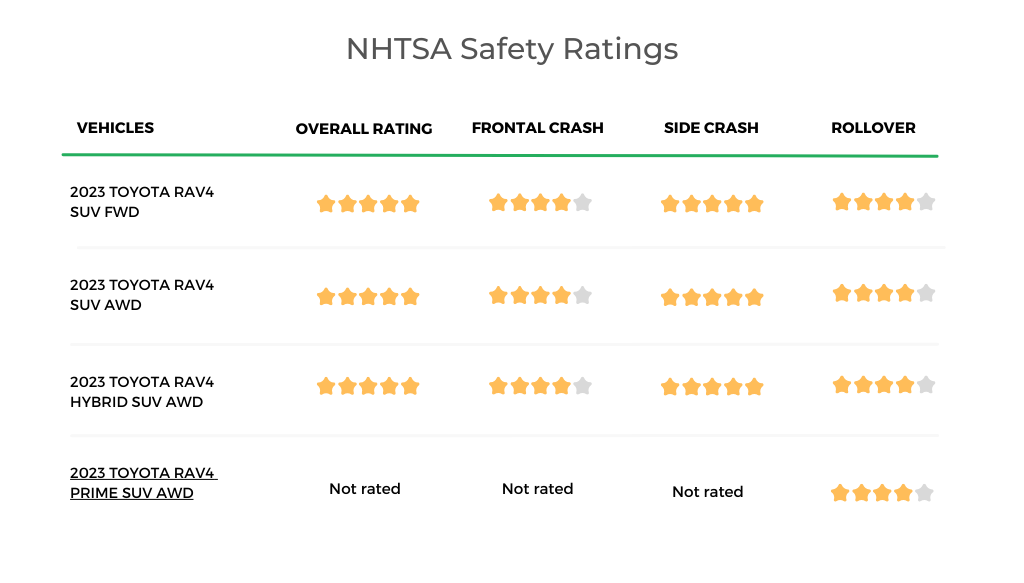
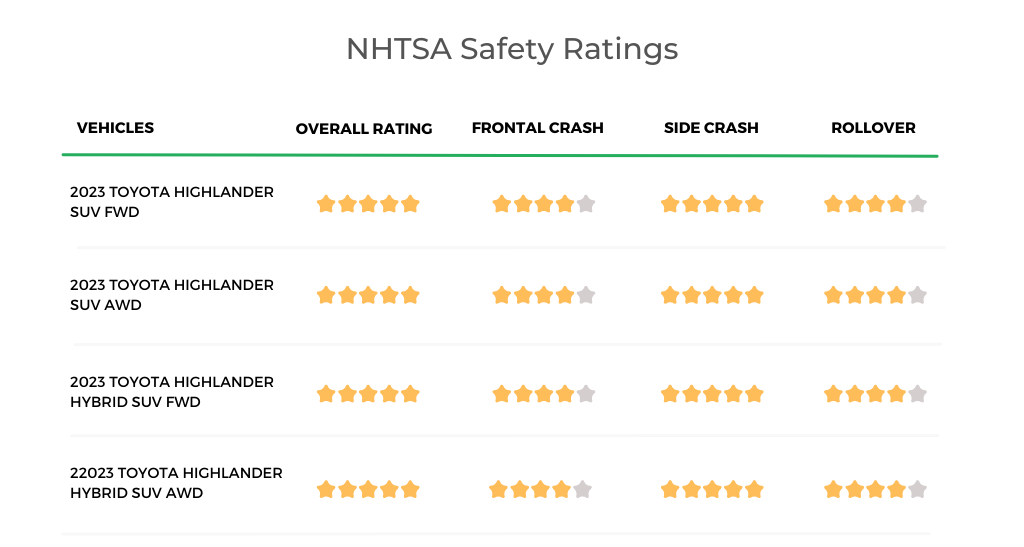
It’s hard to sell cars without strong safety records nowadays. There’s so much competition that buyers can readily find other choices with better crash test scores. Toyota recognized this, ensuring the RAV4 and Highlander did well in evaluations by the National Highway Traffic Safety Administration (NHTSA).
Both vehicles received a five-star rating from NHTSA for overall and side crash performance. These Toyotas also matched with a four-star frontal crash rating; not perfect, but still acceptable. A four-star rollover score is typical of taller vehicles, like crossovers.
Because NHTSA safety scores are identical, you’ll need to look at different factors if you need a reason to choose the RAV4 over the Highlander or vice versa.
IIHS Awards:
The Insurance Institute for Highway Safety (IIHS) takes a somewhat different approach to safety testing. In particular, it focuses on its small frontal overlap crash test, which the organization feels represents a more real-world scenario (a single car running into a fixed object). IIHS also looks at side impact crashes, roof strength, headlight effectiveness, and advanced driver safety technologies (like automatic emergency braking).
While tested vehicles receive a Good, Acceptable, Marginal, or Poor grade, the true measure comes if a car gets a Top Safety Pick or Top Safety Pick+ designation. If “Good” is a “B” grade, Top Safety Pick notches things up to an “A-,” and the Top Safety Pick+ signifies an “A+.”
While there’s nothing wrong with the RAV4’s Top Safety Pick designation, the Highland gets the gold thanks to being chosen as a Top Safety Pick+ vehicle for 2023.
| IIHS Award | Tested Vehicle | ||
| 2023 Toyota RAV4 | SMALL SUV/4-DOOR SUV | TOP SAFETY PICK | 2019 Toyota RAV4 XLE 4-door 4wd |
| 2023 Toyota Highlander | Midsize SUV/4-Door SUV | 2023 TOP SAFETY PICK + | 2020 Toyota Highlander LE 4-door AWD |
Airbags & Head Restraints:
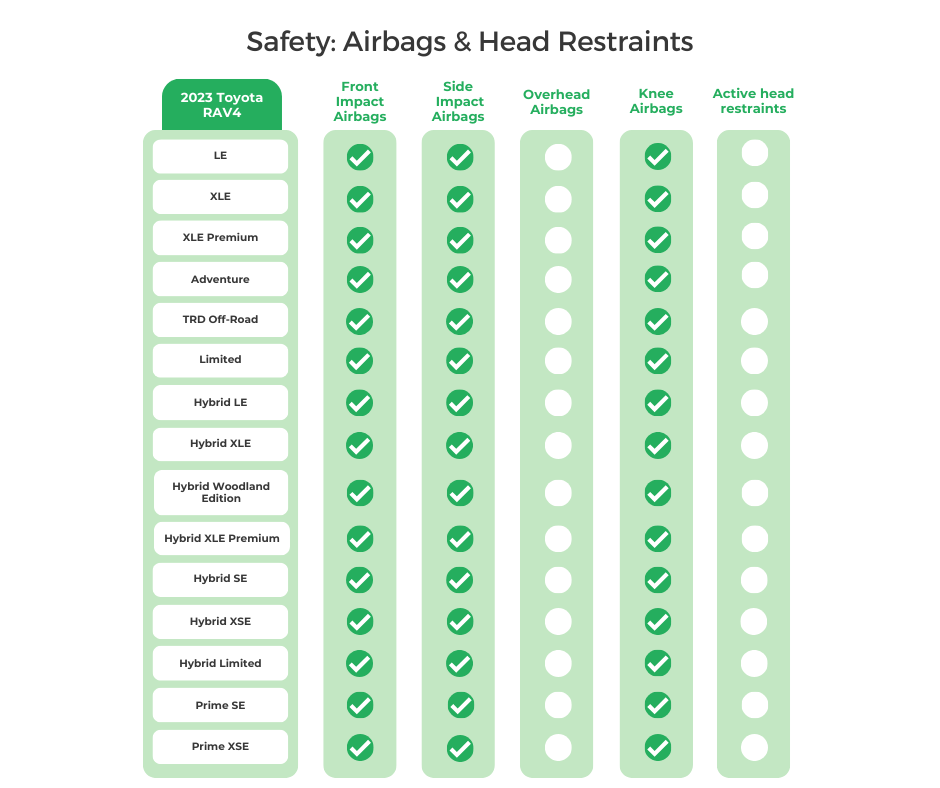
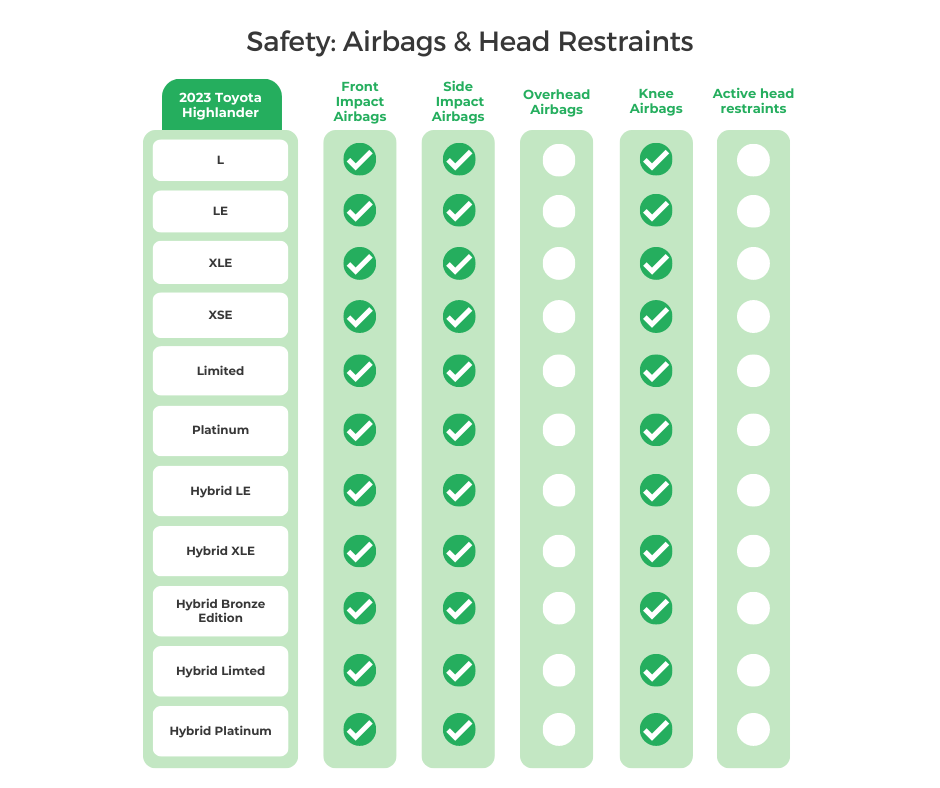
The RAV4 and Highlander are equally aligned in the airbag department. Both have multiple front-row airbags and units that protect all rows in a collision or rollover. There’s also a knee airbag for both drivers to help better position the body during a front-end accident to minimize injury.
Neither the RAV4 nor the Highlander comes with overhead airbags. This newer technology replaces traditional front-row units (steering wheel and dashboard) with overhead devices. Active head restraints are usually found in specialty and high-end vehicles to minimize whiplash injuries. Mainstream cars like the RAV4 and Highlander aren’t usually equipped with this feature.
Driver-Focused Features and Equipment:
Quick Take: The RAV4 and Highlander share essential driver-assist technologies, but more advanced features may be absent or optional, depending on the model and trim.
Semi-Autonomous Driving:
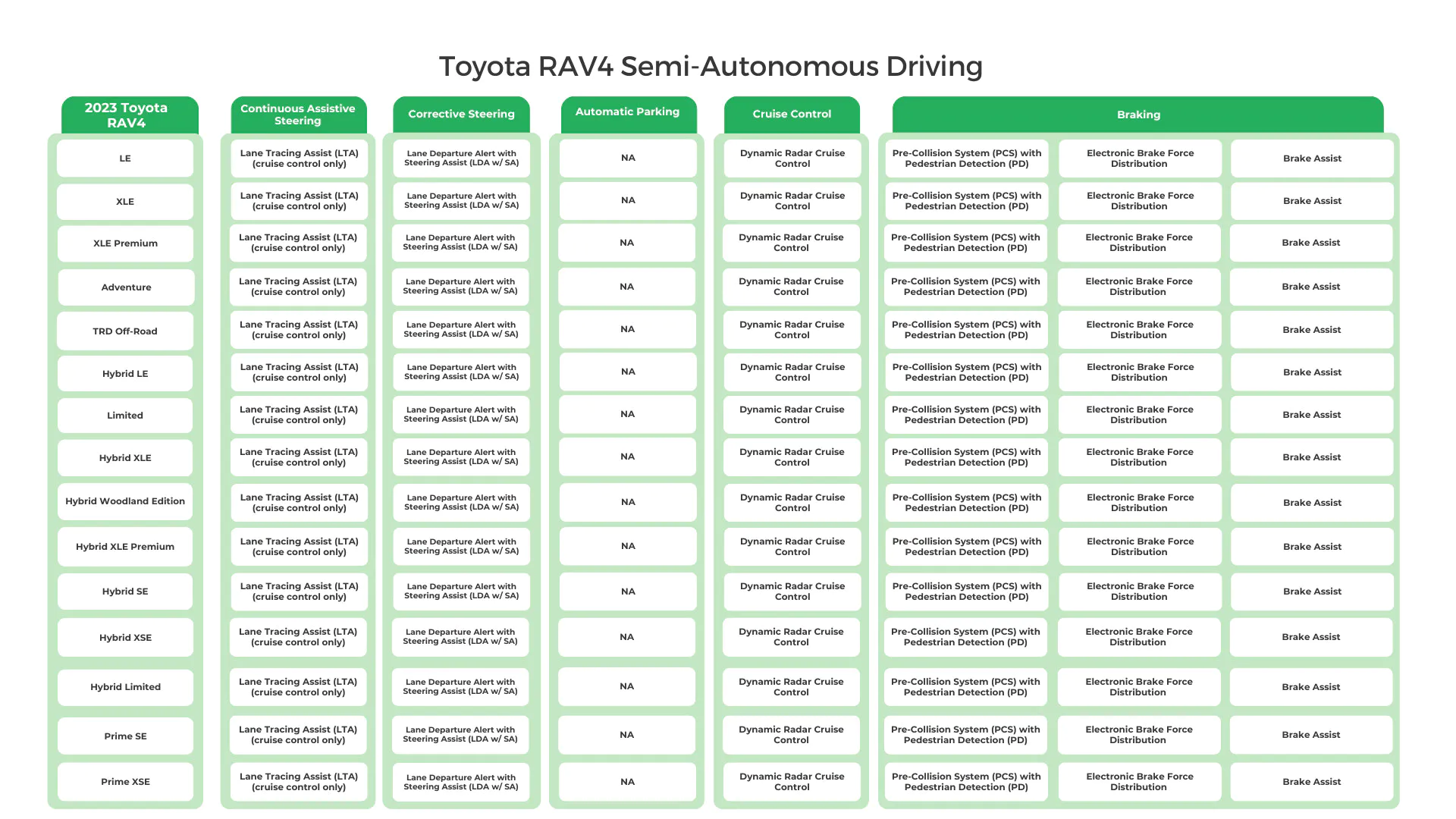
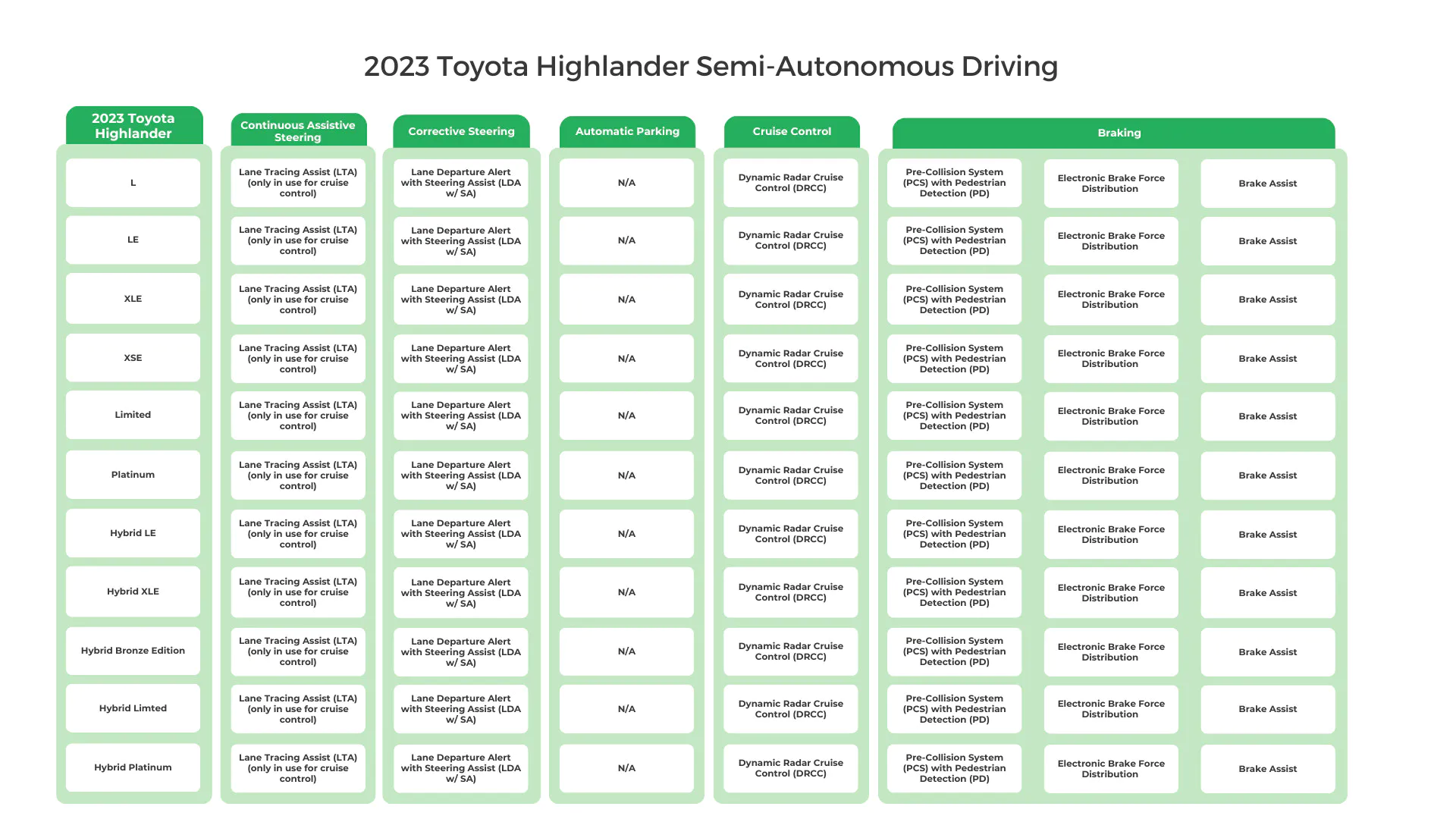
A RAV4 or Highlander isn’t the car to buy if you’re looking for cutting-edge tech like hands-free driving. Adaptive cruise control (Toyota calls their version Dynamic Radar Cruise Control), a semi-autonomous driving feature, is as fancy as these Toyotas get. This system, standard on all trims, automatically maintains a vehicle’s speed to keep it a safe distance from the car in front.
All RAV4 and Highlander trims also get lane-keeping support technology that gently adjusts the steering to keep a car in the correct lane position.
Driver Warning Systems & Telematics:
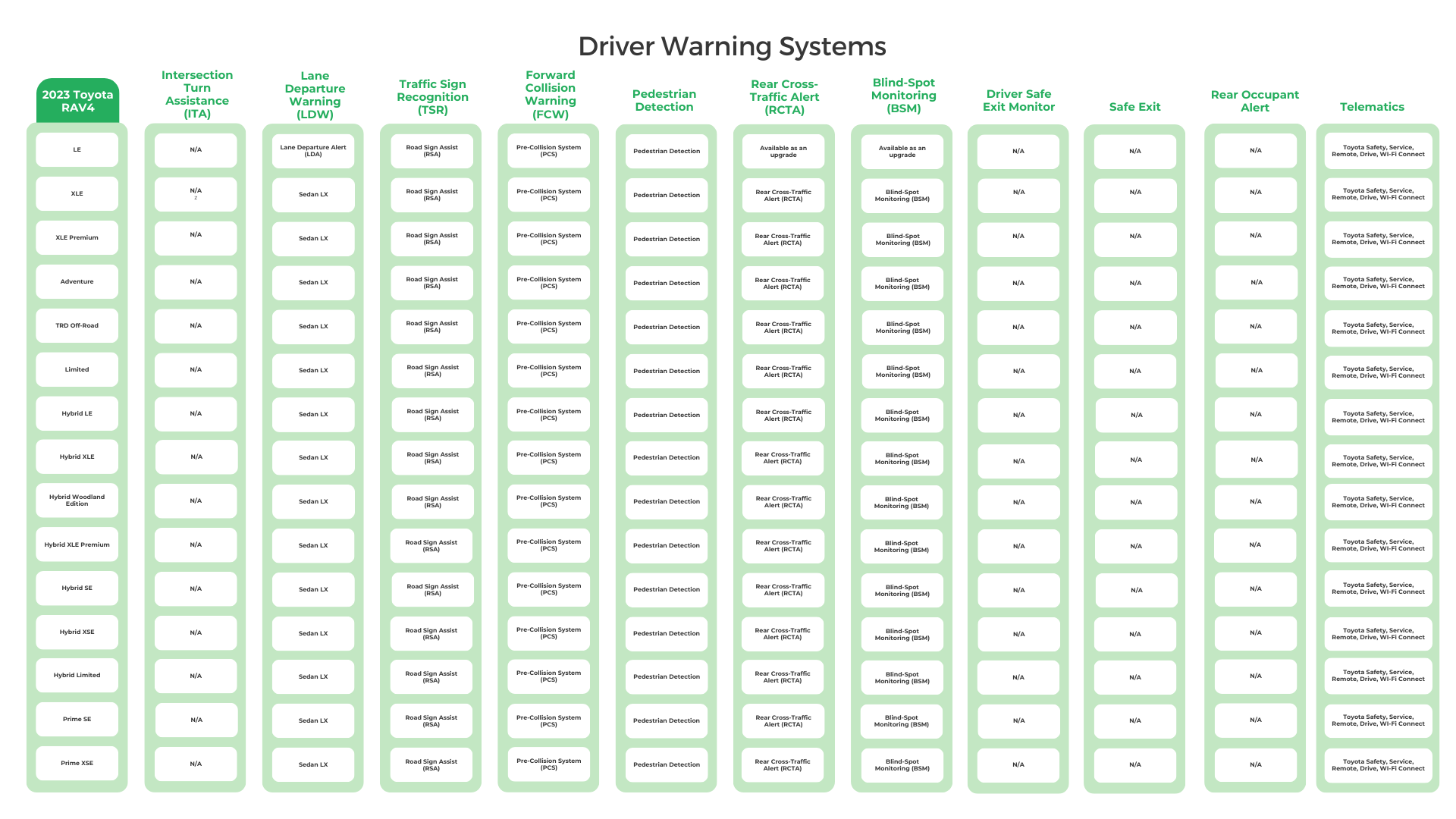
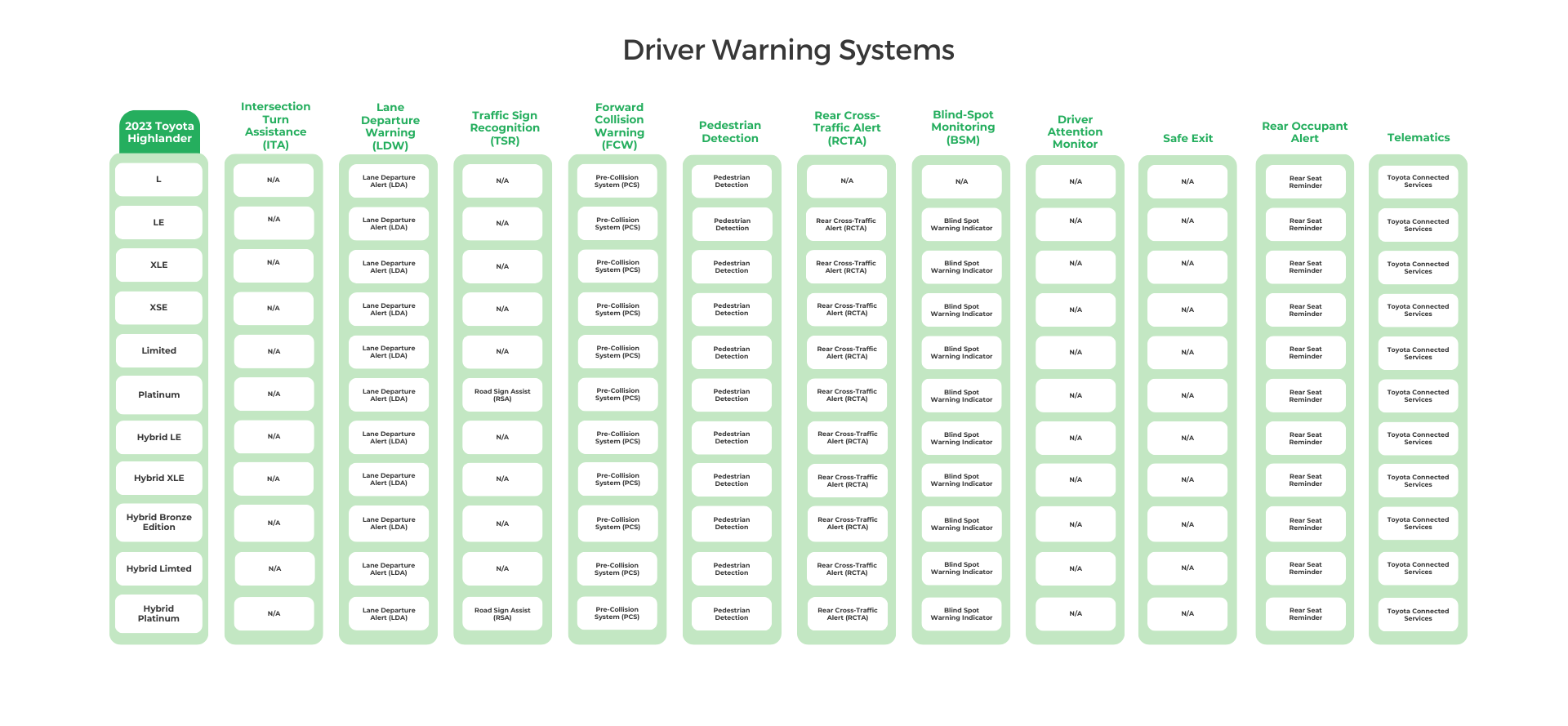
Forward collision warning (FCW), automatic emergency braking (AEB), and other advanced driver assistance systems (ADAS) are standard on all 2023 RAV4 and Highlander trims. However, if blind-spot monitoring (BSM) and rear cross-traffic alert (RCTA) are preferred, you’ll want to pay closer attention to which Toyota you buy. BSM and RCTA are optional on the least expensive RAV4 (the LE) and aren’t available with the base Highlander (the L trim).
In addition, only the Highlander comes with a rear seat reminder. This feature is absent from the RAV4. In contrast, all RAV4s have road sign assist (applicable traffic signs, like speed limits, are displayed in the instrument panel). Still, only the Highlander Platinum trims (non-hybrid and hybrid) get this notification.
If ADAS technology appears like alphabet soup, check out an effort from AAA, Consumer Reports, J.D. Power, and other groups working to standardize the terminology for these systems.
Road Visibility Features:
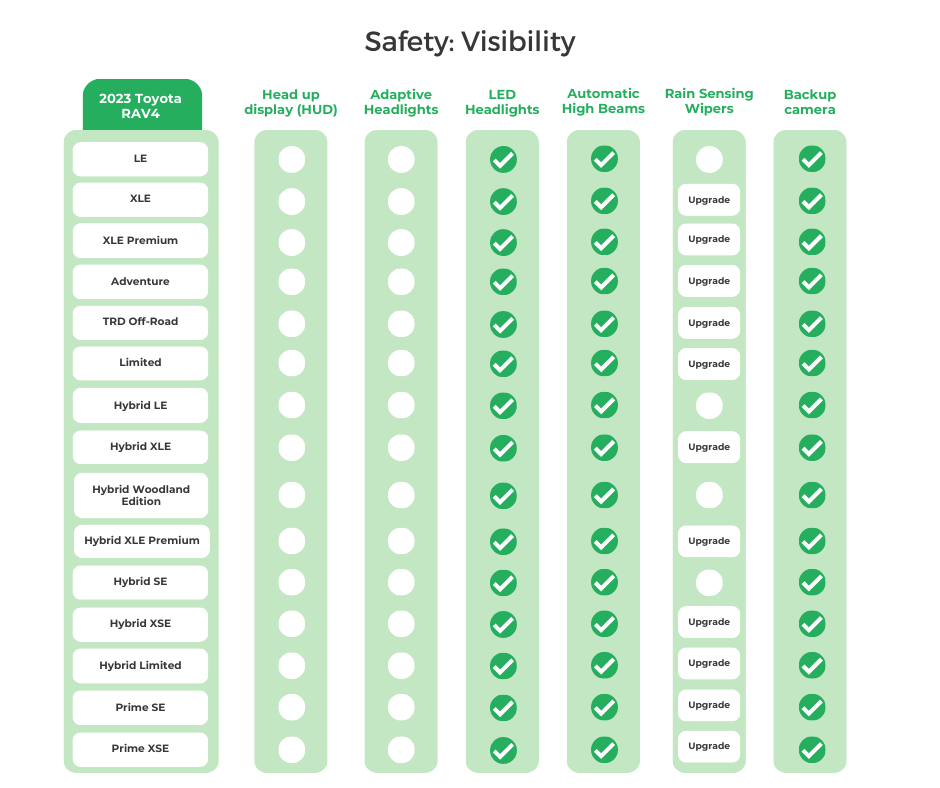
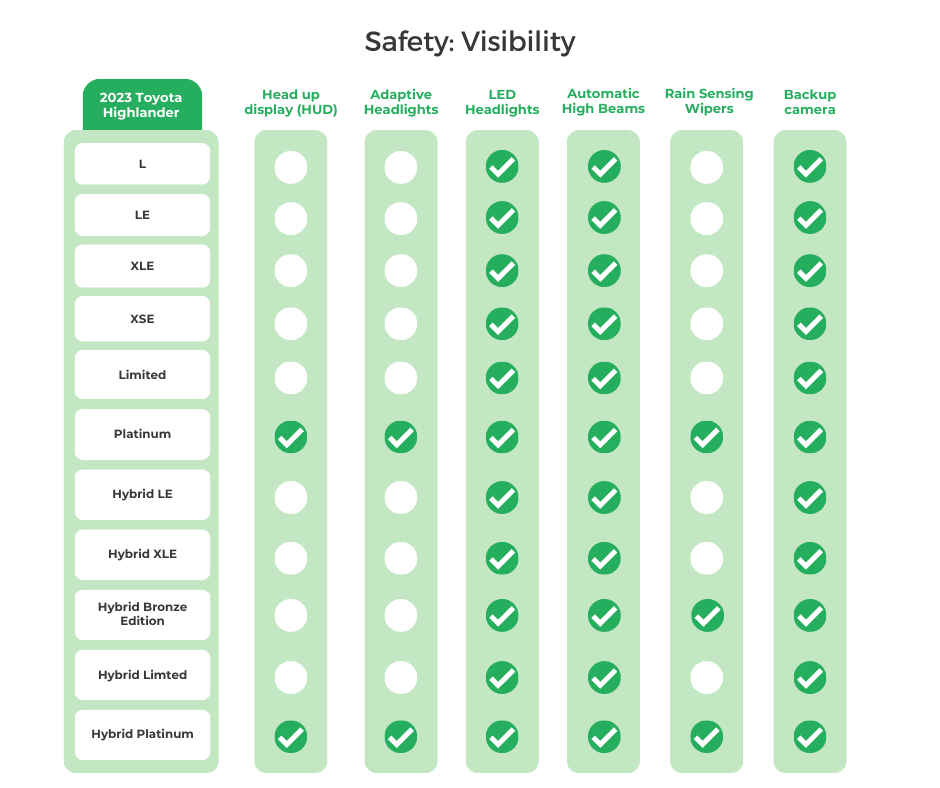
LED headlights have numerous advantages, including brighter illumination, lower energy use, and improved longevity. The RAV4 and Highlander have this as a standard feature. All trims also have automatic high beams. In addition, a rearview is standard (it’s required by law).
Other driver visibility equipment is hit-or-miss. Most RAV4 trims are available with an option for rain-sensing windshield wipers, while this feature is standard on high-end Highlanders but is not available at all on lower trims.
Meanwhile, only the RAV4 Prime XSE (the most expensive 2023 RAV4) is available with a head-up display (projects vital driving information like speed onto the windshield). Toyota includes this technology as standard equipment with the Highlander Platinum trims, but it’s excluded from the less expensive editions. These top-tier Highlanders also get adaptive headlights (the direction of the beams syncs with the steering), but it’s not even an option on lower trims or any RAV4.
Interior:
Quick Take: RAV4 and Highlander buyers don’t have to worry about smartphone connectivity. The Highlander wins the space race.
Interior Features:
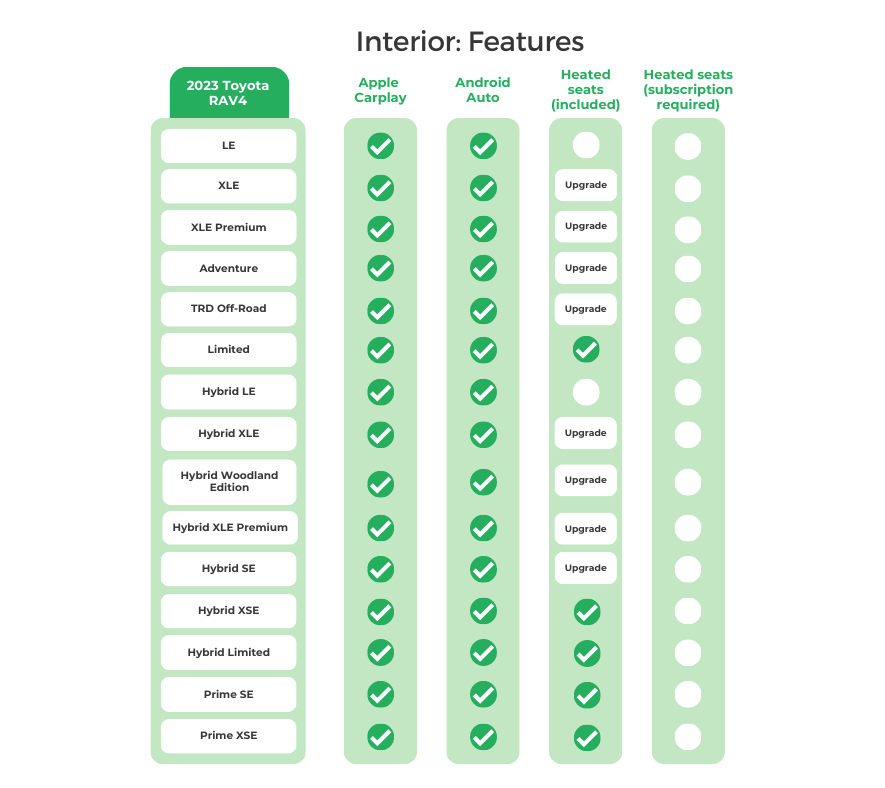
With people just as dependent on their phones as their cars, it’s unsurprising that Toyota includes Apple CarPlay and Android Auto on all 2023 RAV4 and Highlander trims.
On the other hand, heated front seats can be a take-it-or-leave-it item, depending on your preferences and where you live. This feature is optional or standard on most RAV4 trims. Only the base LE trims are left out. Yet all Highlanders, including the base L edition, get heated front seats.
And speaking of heated seats, some automakers offer this feature through a subscription service. This hasn’t yet happened in the U.S., but in certain countries, BMW offered heated seats for a monthly fee. The advantage is you can shut off the service during warm months, but you’ll need to keep paying (or pay a one-time upfront fee) to activate the heated seats. Recently, BMW announced it was backing away from this practice. Moving forward, the automaker will only charge a subscription for software-based services (like upgraded navigation). Hardware-based features will be part of the vehicle’s initial purchase price.
One industry study shows mixed results for consumer acceptance of features on demand (FoD), with about one-fifth not even being aware of the concept.

Interior Dimensions:
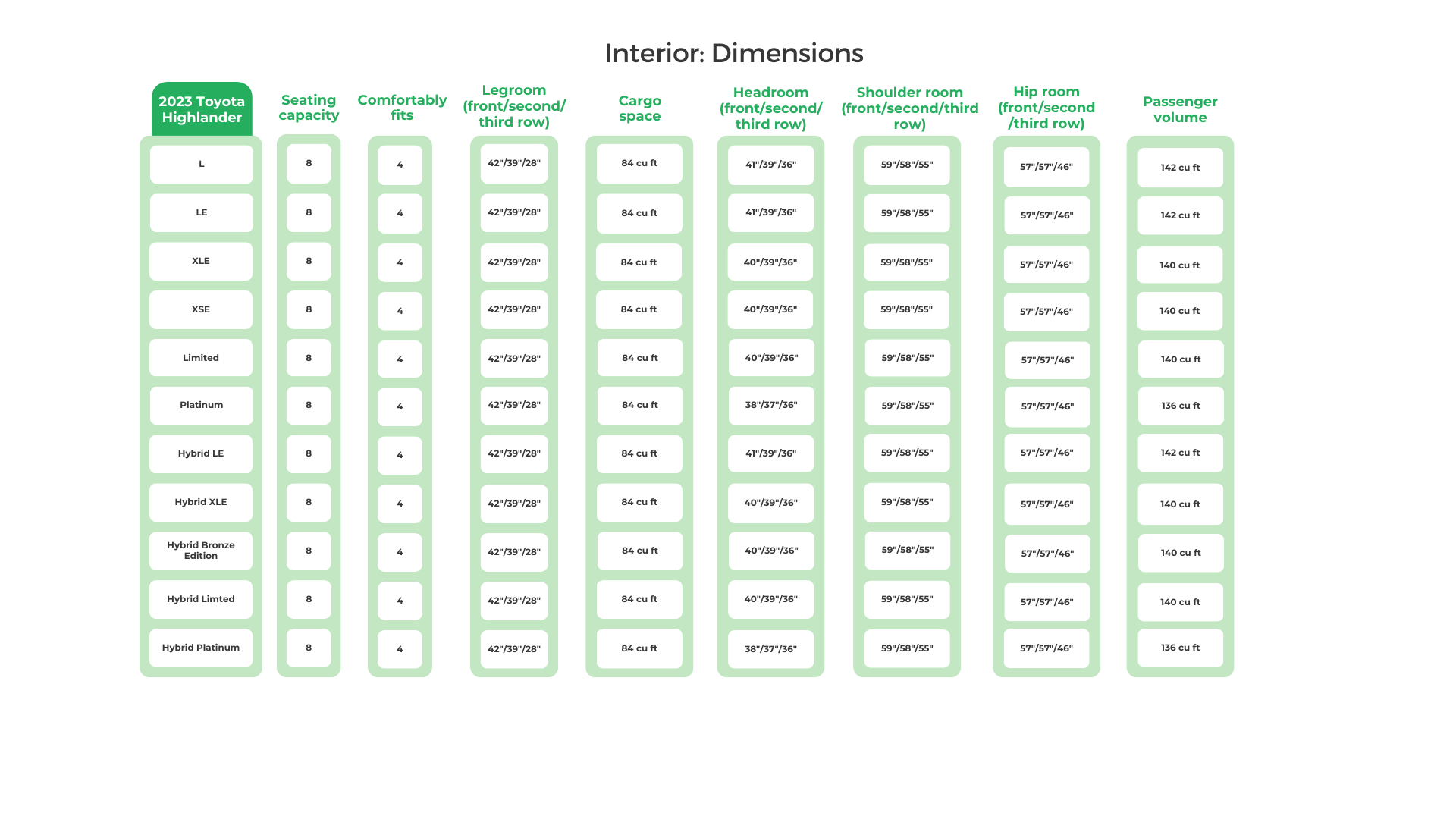
The interior space difference between the RAV4 and Highlander is inescapable. How the extra room gets used in the Highlander may surprise you. Sure, the Highlander has greater first- and second-row legroom, but not that much more. The RAV4’s 41 inches of front legroom and 38 inches of second-row legroom is only one inch less than the Highlander offers.
Toyota engineered the Highlander’s interior to accommodate a third row. Although with 28 inches of legroom, I wouldn’t want to spend much time in the back of this bus. Nonetheless, the third row is a feature that doesn’t exist in the 2023 RAV4.
Further, cargo capacity is another reason the Highlander dominates this space race. Behind the second row, the Highlander’s 48.4 cubic feet is 28% larger than what’s in the RAV4. Behind the first row, the Highlander has 21% more cargo space than the RAV4 (84.3 cubic feet versus 69.8 cubic feet). Whether you need to haul people, goods, or a combination, the RAV4 clearly takes second place.
And speaking of people, the Highlander’s additional passenger volume means more shoulder and hip room, an advantage that’s hard to ignore with a crowded vehicle.

Exterior:
Quick Take: The RAV4 and Highlander share many of the same colors, but the RAV4 gets a splashier red. There’s no escaping the Highlander’s larger exterior.
Exterior Features:
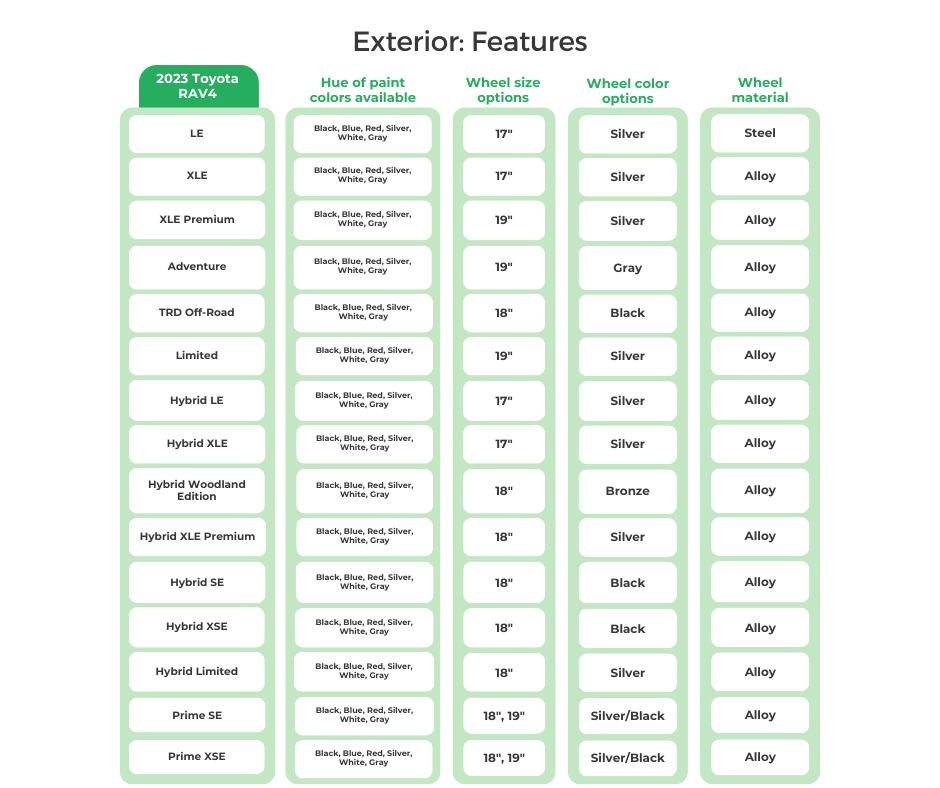
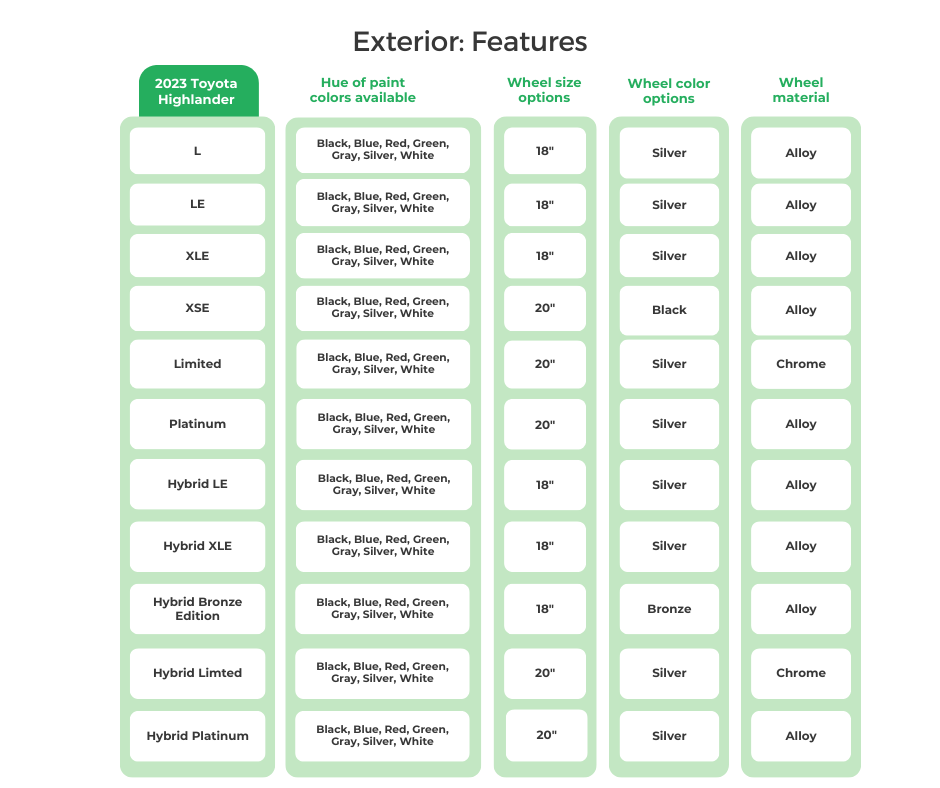
Wheels may also be an afterthought for many car buyers. But wheel size can impact ride quality. Larger rims can translate into better traction and cornering but may result in a bumpier ride. Bigger wheels also offer better aesthetics by filling out the wheel wells more completely. This is why the higher the trim, the larger the wheel. Different materials (steel or alloy) and finishes also help separate the wheels among the various trim levels.
The RAV4 and Highlander share a pallet of muted colors, including Blueprint, Ruby Red Flare, Midnight Black Metallic, and Wind Chill Pearl. If a monotone (black, white, gray, or silver) shade or a subtle dash of color is your thing, then Toyota has you covered with either vehicle. However, only the RAV4 gets Supersonic Red, a bright shade that gives this compact crossover a more sporty vibe.
Exterior Dimensions:
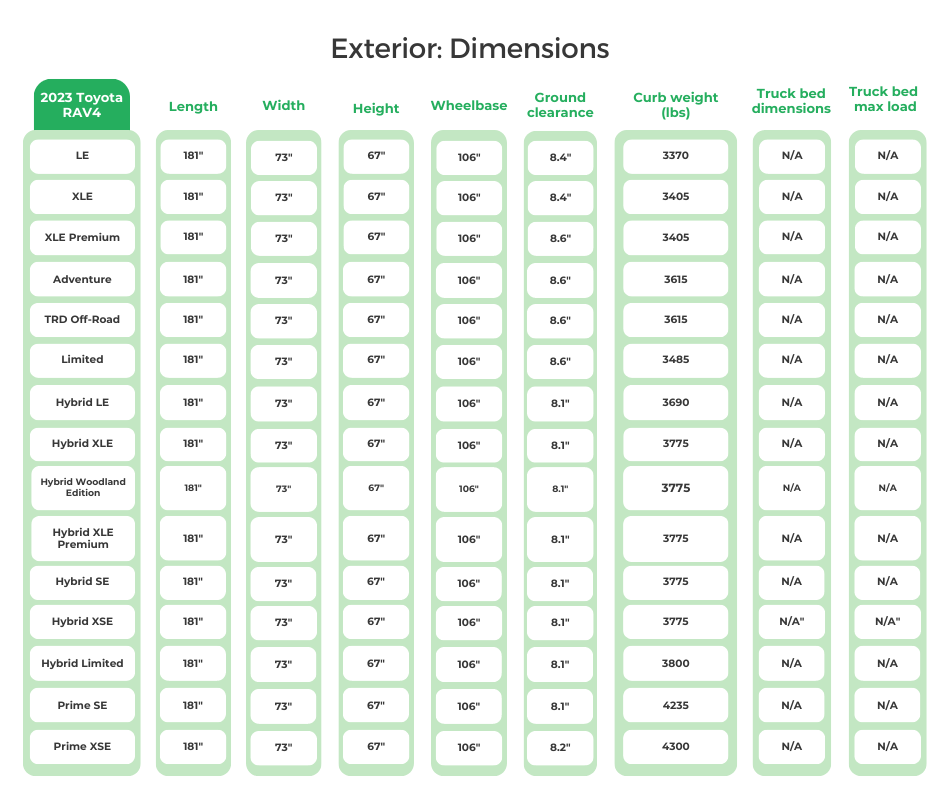
It restates the obvious, but the Highlander’s large cabin has to come from somewhere. This means that this three-row Toyota is substantially larger on the outside than its stablemate. The Highlander’s 195-inch length is 14 inches longer than the RAV4, a significant difference, especially if you have to navigate parking garages and urban surroundings. An extra three inches of width can also make maneuvering in tight areas a challenge.
But a larger size isn’t always a disadvantage. The Highlander’s 112-inch wheelbase (six inches more than the RAV4’s) makes for a smoother ride over rough surfaces and highway expansion strips.

Warranty:
Quick Take: The RAV4 and Highlander have the same warranty coverage.
There’s no factory warranty advantage for the RAV4 or Highlander. Both vehicles have the same protections: three years of 36,000 miles of bumper-to-bumper coverage and a powertrain warranty for five years or 60,000 miles.
Buyers also receive free scheduled maintenance for two years or 25,000 miles) and roadside assistance for two years.
| 2023 Toyota RAV4 Factory Warranty Coverage: | 2023 Toyota Highlander Factory Warranty Coverage: | |
| Basic warranty: | 36 Months/36,000 Miles | 36 Months/36,000 Miles |
| Powertrain warranty: | 60 Months/60,000 Miles | 60 Months/60,000 Miles |
| Corrosion perforation warranty: | 60 Months | 60 Months |
| Air conditioning warranty: | Federal: 36 months/36,000 miles (defect), 24 months/24,000 miles (performance)California: 36 months/50,000 miles (performance) | 12 Months/12,000 Miles |
| Battery warranty: | 120 months/150,000 miles (Hybrid Battery). Reduction in traction battery capacity for Plug-in Hybrid trims is not covered. | 120 months/150,000 miles (Hybrid Battery) |
| Emissions warranty: | Federal: 36 months/36,000 miles (defect), 24 months/24,000 miles (performance)California: 36 months/50,000 miles (performance) | Federal: 36 month/36,000 miles (defect), 24 months/24,000 miles (performance)California: 36 months/50,000 miles (performance) |
| Roadside assistance coverage: | 24 months/25,000 miles | 24 months/25,000 miles |
| Complimentary scheduled maintenance: | 24 months/25,000 miles | 24 months/25,000 miles |
| Total unique recalls: | 1 (recall no. 23V485000) | 1 (related to driver’s airbag, NHTSA Campaign number: 23V480000) |

Dave Goldberg is an automotive journalist and lifelong car fanatic. He writes for numerous enthusiast and business outlets and is an ongoing contributor to HotCars.com, one of the most popular car culture websites. When he’s not writing or driving, Dave is either under a hood or asleep. His credentials include a BA in Journalism from The George Washington University.