
Does comparing the Honda Pilot, an SUV, against the Honda Odyssey, a minivan, make sense? Yes, especially if you’re a Honda fan needing three-row transportation.
The Odyssey joined the Honda lineup three decades ago as a compact minivan but was transformed into a larger offering in 1999. Meanwhile, Honda was a little late to the midsize SUV game by launching the Pilot in 2003 (two years after the Toyota Highlander). Along the way, the Pilot and Odyssey have served customers wanting a three-row vehicle with a Honda badge.
Some buyers would rather walk than drive a minivan (OK, that’s an exaggeration). However, in today’s SUV-heavy marketplace, there’s still a spot for the Odyssey, especially as a second-hand vehicle.
Matching the Pilot against the Odyssey really comes to picking the most important features and advantages. Why? Because, with a few exceptions (which I’ll get to shortly), these Hondas are very much alike (beyond the different body styles).
The Pilot and Odyssey share a platform, engine, transmission, and other vital components. So you get similar performance and capabilities. Data from the past two decades shows that both cars have somewhat parallel engine reliability and safety scores. Maintenance and repair expenses, market values, and lifespan are comparable, too.
How does each of these family haulers stand out?
The most significant advantage of the Pilot is that it’s available with all-wheel drive. If spinning all four corners isn’t vital, then the front-wheel-drive Odyssey should definitely come into play. I’d also argue that another factor in the Pilot’s favor is that it’s not a minivan (preconceived notions are hard to escape).
One strong point for the Odyssey, mostly for older examples, includes better fuel economy. A 10%-15% improvement over the Pilot may not seem compelling, but this adds up to savings over time. In addition, Honda tended to introduce new features (especially safety tech) to the Odyssey before the Pilot.
For instance, you can go back as far as 2011 to find an Odyssey with blind-spot monitoring, but this equipment didn’t reach the Pilot until 2016. So, you can buy an older and cheaper Odyssey and still get the features you prefer.
I’ll also chime in that the Odyssey is considerably larger inside than the Pilot. This minivan has a more spacious third row and additional cargo space. Not only do the measurements bear this out, but my years of dealing with car seats and countless occasions of having to move stuff confirm these positives in very practical terms. Pilots and Odysseys are the official vehicles of my neighborhood.
Looking for the latest model? Explore: Honda Pilot Vs. Honda Odyssey | 2023 Comparison.
Keep reading to see how this Honda Pilot and Honda Odyssey contest turns out. Other match-ups to review include Outback vs. Forester, RAV4 vs. CR-V, Civic vs. Corolla, Pilot vs. Highlander, and Odyssey vs. Sienna.
| Income Bracket | Monthly Financing Cost Range | Cash Purchase Price Range | Honda Pilot Years | Honda Odyssey Years | Best Model Year: | Why? |
| < $5k | $42 – $83 | $1,500-$3,000 | 2005 | 2004 | 2005 Pilot | Good value, above-average engine reliability |
| $5k-$10k | $83 – $125 | $3,000-$4,500 | 2009 | 2009 | 2009 Odyssey | Above-average engine reliability, excellent safety score |
| $10k-$15k | $125 – $187 | $4,500-$6,750 | N/A | 2010 | 2010 Odyssey | Above-average engine reliability, excellent safety score |
| $15k-$25k | $187 – $312 | $6,750-$11,250 | 2013 | 2013 | 2013 Pilot | Excellent engine reliability |
| $25k-$35k | $312 – $437 | $11,250-$15,750 | 2015 | 2015 | 2015 Pilot | Exceptional engine reliability, excellent safety score |
| $35k-$50k | $437 – $625 | $15,750-$22,500 | 2019 | 2017 | 2017 Odyssey | Good value, excellent engine reliability, strong safety score |
| $50k-$74k | $625 – $925 | $22,500-$33,300 | 2021 | 2018 | 2018 Odyssey | Good value, excellent engine reliability, strong safety score |
See the methodology for the table above.
Before you respond to the “For Sale” ad, check out this How to Buy a Used Car article for a step-by-step checklist.
Price History Comparison | Honda Pilot vs. Honda Odyssey
Average Market Value – Based on Owners’ Self-Reported Mileages | Honda Pilot vs. Honda Odyssey

Understanding selling prices is essential to used car shopping; it’s the best way to ensure you’re paying a fair price. Data from Kelley Blue Book (KBB) shows market values for the Pilot (green) and Odyssey (gray), which reflect private-party transactions and owner-reported mileage via FIXD surveys.
The results are predictable: older models are worth less than newer ones. There’s also not much difference between the Pilot and Odyssey for most model-year pairs. It’s because these Hondas have similar depreciation rates and original selling prices. For example, the MSRP for a 2010 Pilot LX was $27,895, compared to an almost identical $27,585 for the 2010 Odyssey LX.
The 2017 Pilot has a significantly higher value than the 2017 Odyssey because that Pilot has much lower mileage (according to FIXD owner surveys). Missing information reflects a lack of owner-supplied data (2019 and 2021 Odyssey) or the model not yet existing (the Pilot launched for the 2003 model year).
Similar market values for the Pilot and Odyssey mean you won’t save much money by choosing one model over the other. Prices will be relatively consistent, given comparable age, condition, and mileage.
Note that you’ll pay 33%-50% more at a dealer than what’s in the graphic because retail prices reflect markups usually absent from private sales. If dealer prices exceed the budget, look for an older Pilot or Odyssey or one with less equipment or higher mileage.
Be sure to read our Best and Worst Years series of articles highlighting the Honda Pilot and Honda Odyssey winners and losers.
Depreciation vs. Maintenance Expenses
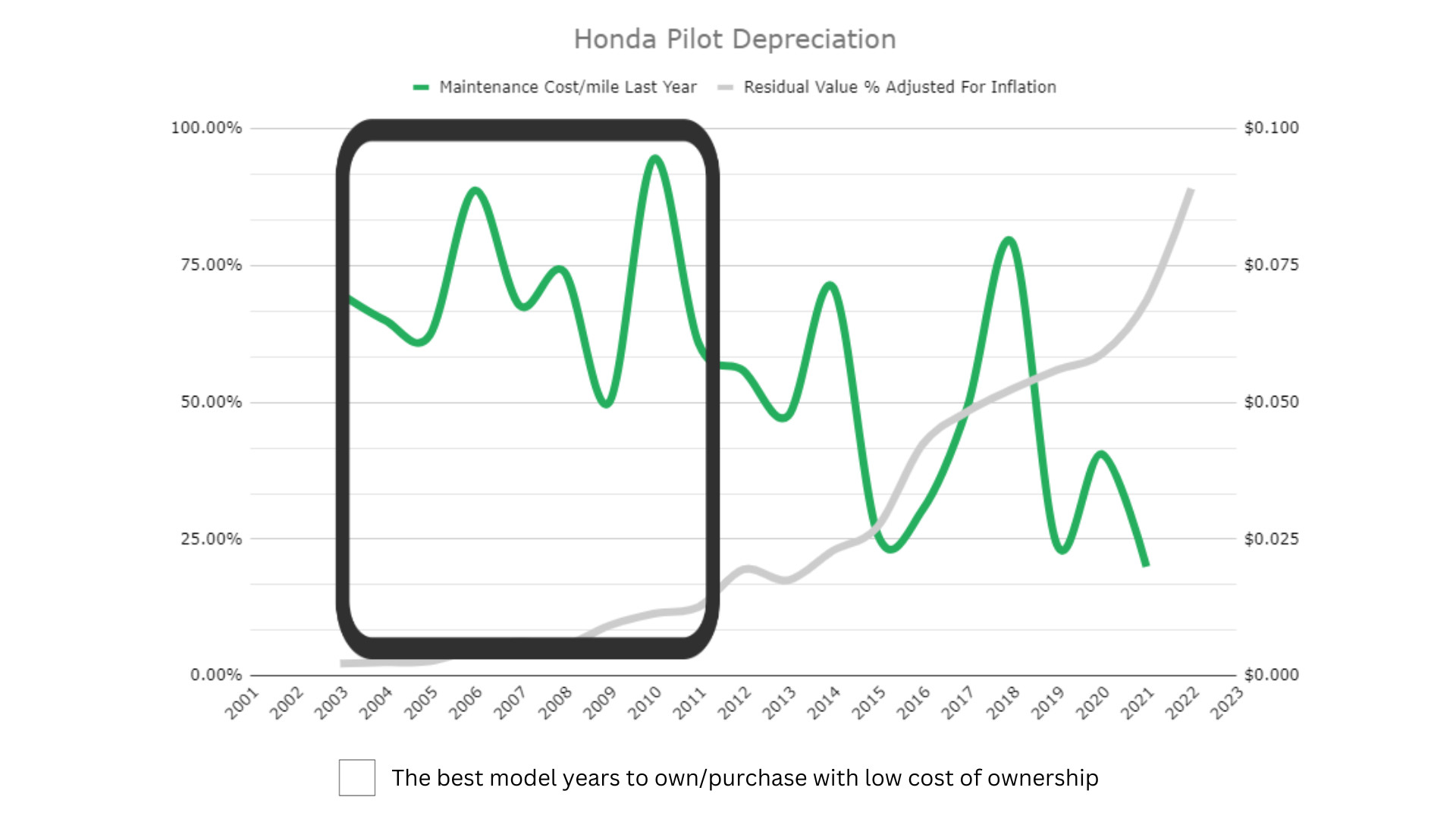
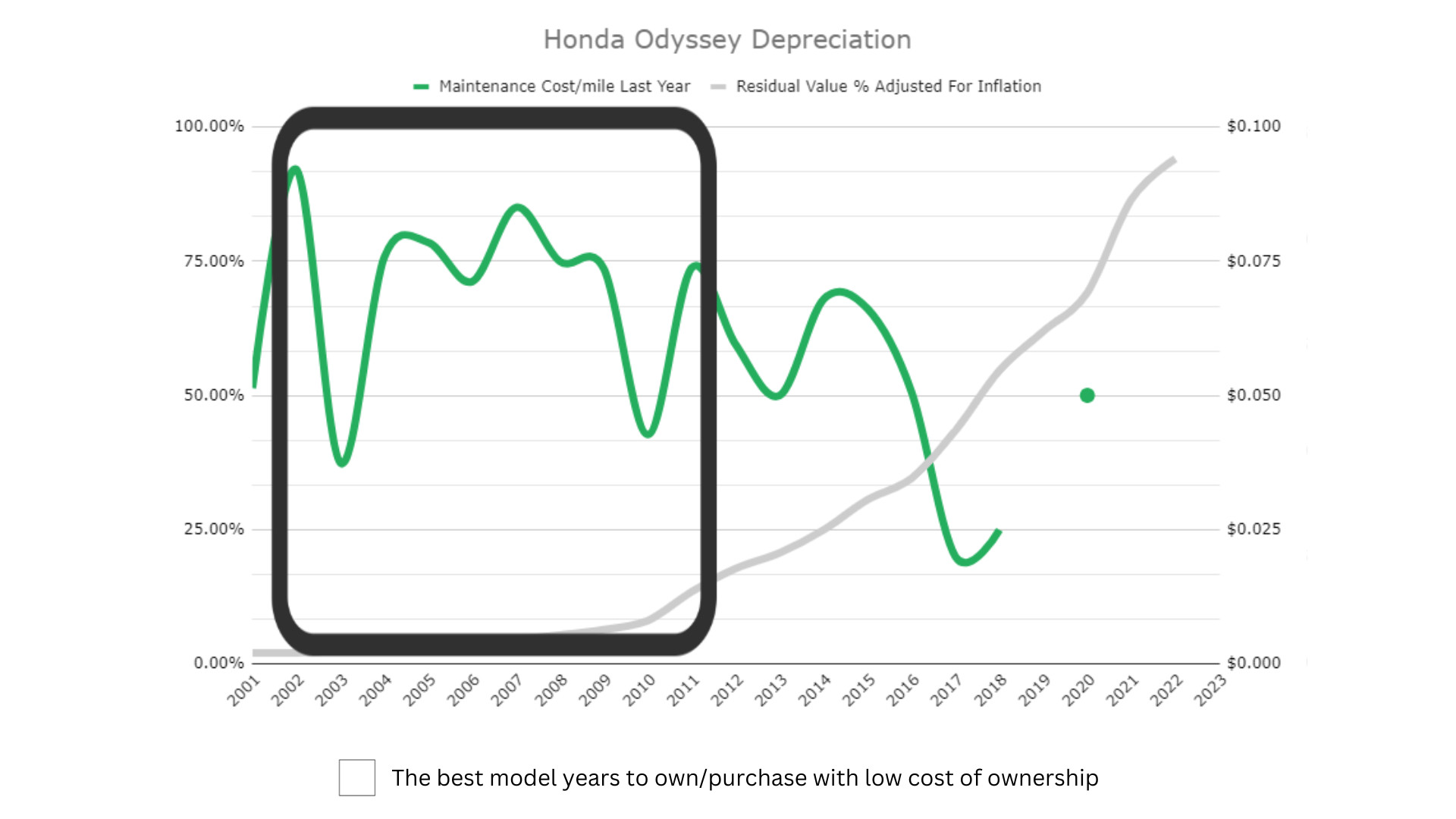
Hondas may have a solid reputation for reliability, but the data says otherwise for the first decade of the 21st century. Only the 2005 Pilot manages a modestly better-than-average engine reliability score of 6 (out of 10). The 2008 Odyssey rates an average of 5.
FIXD Reliability Scores don’t get any better until the 2009 model year. At this point, check engine lights (CELs) become less of a problem. To be fair, lower engine reliability with older cars isn’t exclusive to the Pilot and Odyssey. It’s a common issue with many automaker’s products. So, these reduced scores reflect vehicle age as much as anything else.
By 2011, engine reliability for the Pilot and Odyssey never dropped below an 8 (except for the 2020 Pilot). Think about that for a moment. You can buy a car a dozen years old with still-stellar engine reliability. Now you know why these Hondas hold their value so well.
Despite the Pilot’s and Odyssey’s sub-par engine reliability scores for older years, owners still think highly of these cars. For example, owners of the 2003 Pilot rank their cars very favorably, giving these Hondas an Owner Reliability Score of 9 (out of 10). These results sharply contrast with an Engine Reliability Score of 4. It’s a clear case of perceptions not matching reality.
Review the Best and Worst Years articles on the Honda Pilot and Honda Odyssey to learn more about these vehicles’ FIXD Reliability and Owner Reliability Scores.
Longevity Comparison | Honda Pilot vs. Honda Odyssey
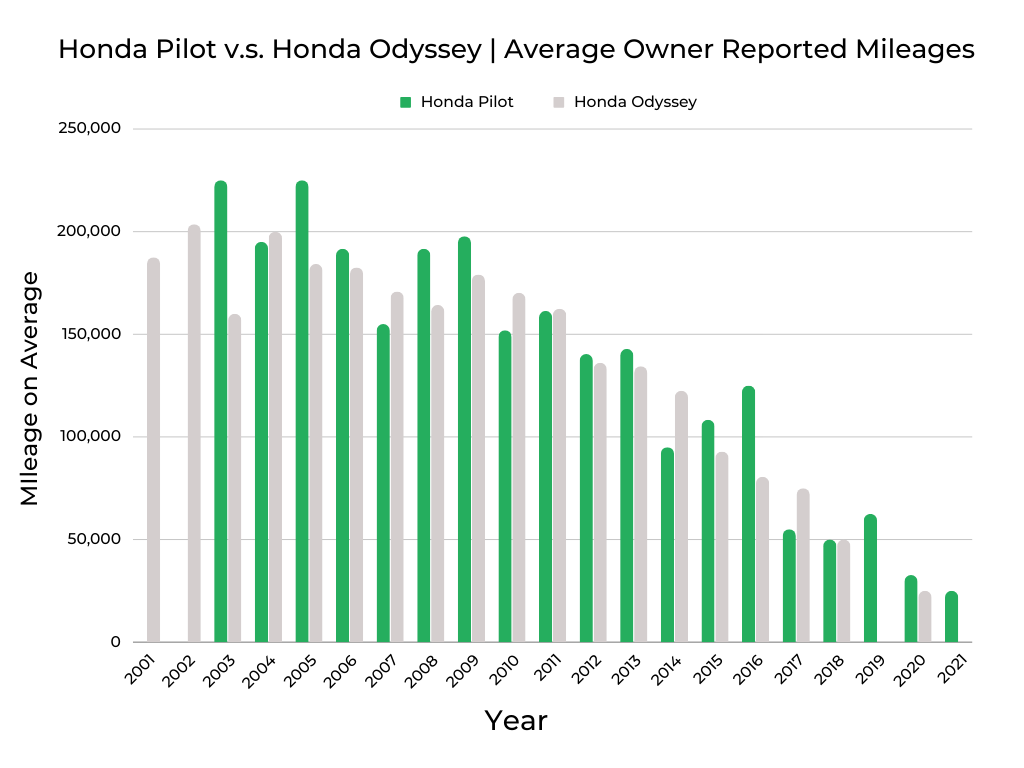
Check engine lights aside, one thing is for sure: the Pilot and Odyssey can reach 150,000 miles, if not 200,000 miles, according to FIXD owner surveys. This is encouraging for someone shopping for a vehicle that’s already crossed the six-figure mark on the odometer.
But don’t assume every Honda is capable of this achievement. Research in another article, Volkswagen Jetta vs. Honda Civic | The Best Model Year For Every Budget, showed that 150,000 miles was the upper range of the Civic’s lifespan.
Owner surveys showed that only the Pilot had crossed into ultra-high-mileage territory (200,000 miles or more). However, I suspected the Odyssey was equally capable because this minivan shares many components with the Pilot. An unscientific look at for-sale listings from autotrader.com (January 3, 2004) confirmed my assumptions.
This review found 723 Pilots and 1,027 Odysseys available from the years 2001-2012 (2003-2012 for the Pilot). Older models were analyzed because they’re more likely to be high-mileage examples. Of these listings, 168 (23.2%) Pilots and 198 Odysseys (19.8%) had at least 200,000 miles. My suspicions were verified: the Odyssey can rack up the miles just as well as the Pilot.
These unusually high numbers serve as a confidence boost for used Pilot and Odyssey buyers. In contrast, a similar Autotrader review of the Civic revealed that only 8.1% of these compact Hondas entered the ultra-high-mileage domain.
Review the individual articles on the best and worst years of the Honda Pilot and Honda Odyssey for a more thorough look at longevity.
Who Should Buy These Cars: The Legacy of Honda Pilot vs. Honda Odyssey
You can guess that the Pilot and Odyssey are used more for family transportation than any other purpose. After all, people buy three-row vehicles for a reason. FIXD surveys show that 50% of Pilot owners and 55% of Odyssey owners prioritize hauling kin. Meanwhile, “lots of driving” (long commutes and road trips) shows up as the second most common use (30% for the Pilot and 27% for the Odyssey).
Although these Hondas have towing capabilities, trailering isn’t a common task for Pilot and Odyssey owners. Likewise, despite these vehicles being large and spacious, few get used as offices on the go.
| Frequent Use Categories: | Honda Pilot | How Useful? (Out of 5 Stars) | Honda Odyssey | How Useful? (Out of 5 Stars) |
| Family Vehicle | * * * * * | * * * * * |
| Lots of Driving (travel/long commute) | * * * | * * * |
| Hauling/Towing | * | * |
| Office on Wheels | * | * |
| Sport/Fast Driving | * | * |
| Luxurious Driving | * | * |
| Outdoor/Off-Road | * | * |
Driver Experience | A Summary of The Top 10 Honda Pilot vs. Honda Odyssey Reddit Posts:
The Honda Pilot and Odyssey are frequent topics of conversation on Reddit. Here’s an overview of some of the exchanges posted on Reddit: r/whatcarshouldIbuy.
The Odyssey is more focused as a family and kid hauler, with easy access and more space for car seats and passengers due to its minivan form factor (including sliding doors). One Redditor also called out the “stuff-swallowing magic” of the Odyssey. One user, who owns a 2013 Honda Odyssey, preferred the Odyssey, especially for long road trips with kids.
Commenters noted that while the Honda Pilot might be perceived as cooler, it’s harder to get into and out of. The lack of sliding doors and difficulty accessing the third row were mentioned as drawbacks of the Pilot. The Pilot, on the other hand, has more handling capability with optional AWD but lacks some of the kid-focused convenience features of its minivan stablemate. In addition, the Pilot scored points for being nicer to drive, while visibility was better with the Odyssey despite its size.
Redditors cited both vehicles doing well with Consumer Reports as a thumbs up for the Honda brand. Meanwhile, the Pilot is said to have better resale value, though the Odyssey isn’t far behind.
Regarding price, the Pilot starts cheaper but is missing some key convenience features available on the Odyssey, like a built-in vacuum and cabin intercom system. Fully loading the trims brings the prices closer. Ultimately, most suggest test driving both as personal preference in driving dynamics and interior layout tends to make the decision. One user concluded, “You can’t go wrong with either one. Two great vehicles.”
Best & Worst Years | Honda Pilot vs. Honda Odyssey | 2001-2024
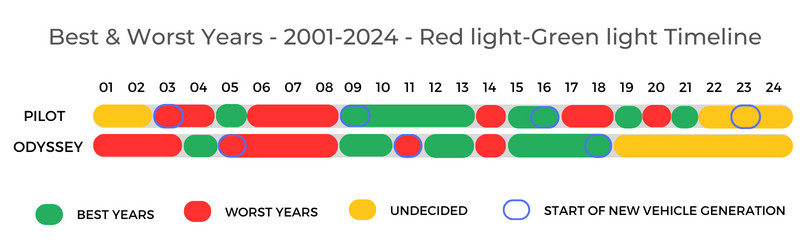
As covered, low engine reliability plagues older Pilots and Odysseys. It’s the principal reason most of these Hondas are best left in others’ driveways. However, two options, the 2005 Pilot and 2004 Odyssey, make for reasonable buying opportunities with the understanding that these won’t be flawless. What 20-year-old car is?
There’s a lack of data for the 2022-2024 Pilot and 2019-2024 Odyssey, so these model years fall into the undecided category. Buying one of these vehicles would be a roll of the dice.
If possible, start shopping with a Pilot or Odyssey from the 2009 or newer model year. FIXD Engine Reliability scores are better, particularly after 2011. Just watch out for the red light -years: Pilots from 2014, 2017-18, and 2020, and Odysseys from 2011 and 2014.
Important Features Timeline | Honda Pilot vs. Honda Odyssey
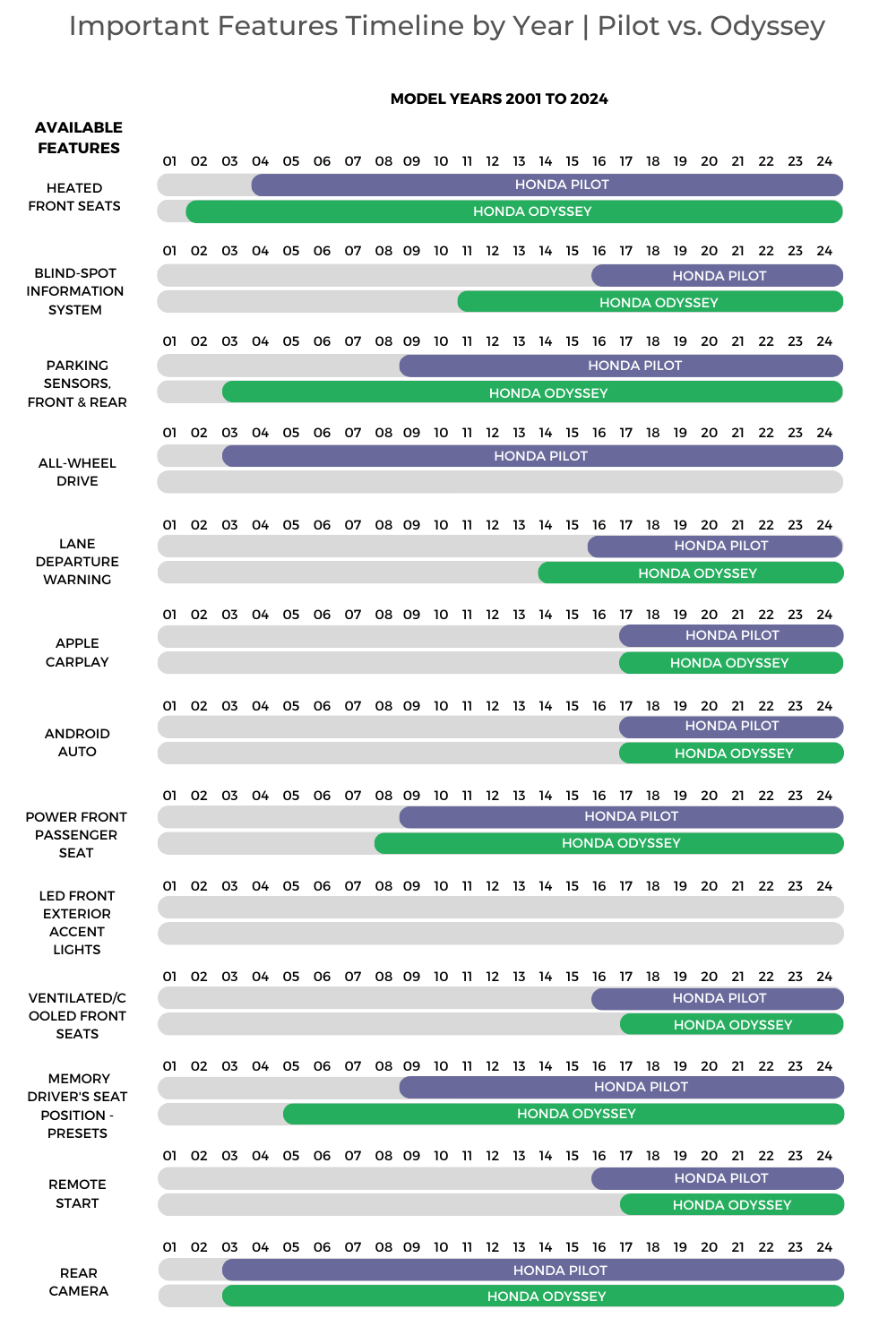
Given that the Pilot and Odyssey share similar systems and occupy premium spots in Honda’s lineup, you’d expect them to get new features at the same time. Yet, this is the exception, not the rule. Both vehicles received Apple CarPlay and Android Auto in 2017 and a rearview camera in 2003. Otherwise, except for heated and ventilated front seats and remote start, the Odyssey was first in line for the goodies.
Arguably, this approach makes sense with safety technology (like blind-spot monitoring, parking sensors, and lane departure warning) because the Odyssey is more family-oriented. However, Honda’s minivan also received several comfort features, like heated front seats, a power front passenger seat, and a driver’s memory system before the Pilot.
The Pilot can hold all-wheel drive (AWD) over the Odyssey, which Honda has never offered in this minivan. I found this curious because it would seem that giving the Odyssey this capability wouldn’t be difficult because of the shared platform with the Pilot. In addition, AWD has been a periodic feature with competing vehicles, the Toyota Sienna and Chrysler minivans.
Maintenance Costs (Year-by-Year Average) | Honda Pilot vs. Honda Odyssey
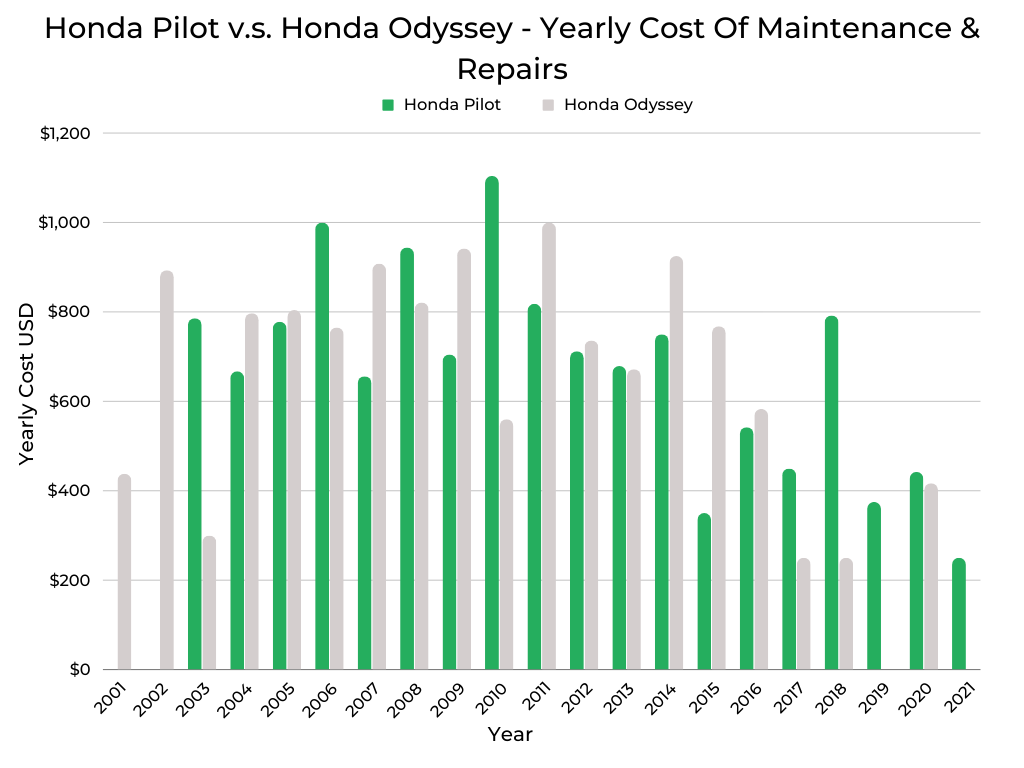
Thinking that used Pilots and Odysseys have similar maintenance and repair expenses is logical because of the shared platform, engine, and transmission. It’s a correct assumption confirmed by FIXD surveys. Pilot owners reported spending an average of $674 to keep their cars on the road, compared to $675 for the Odyssey.
But averages are just that, average—there are always exceptions. Owners of 2006, 2008, 2010, and 2011 Pilots and 2002, 2007-2009, 2011, and 2014 Odysseys incurred expenses at least 20% above average. This doesn’t necessarily mean these model years are prone to larger repair bills because upkeep is also tied into driver habits and maintenance. Of course, older model years are more vulnerable to repairs because, eventually, major components wear down due to age or mileage.
That said, if given a choice between buying a Pilot or Odyssey with a history of higher expenses versus one without such a background, I’d go for the former (assuming everything else is equal).
Review the best and worst years of the Honda Pilot and Honda Odyssey to learn more about maintenance and repair costs for these vehicles.
Safety Rating Comparison | Honda Pilot vs. Honda Odyssey
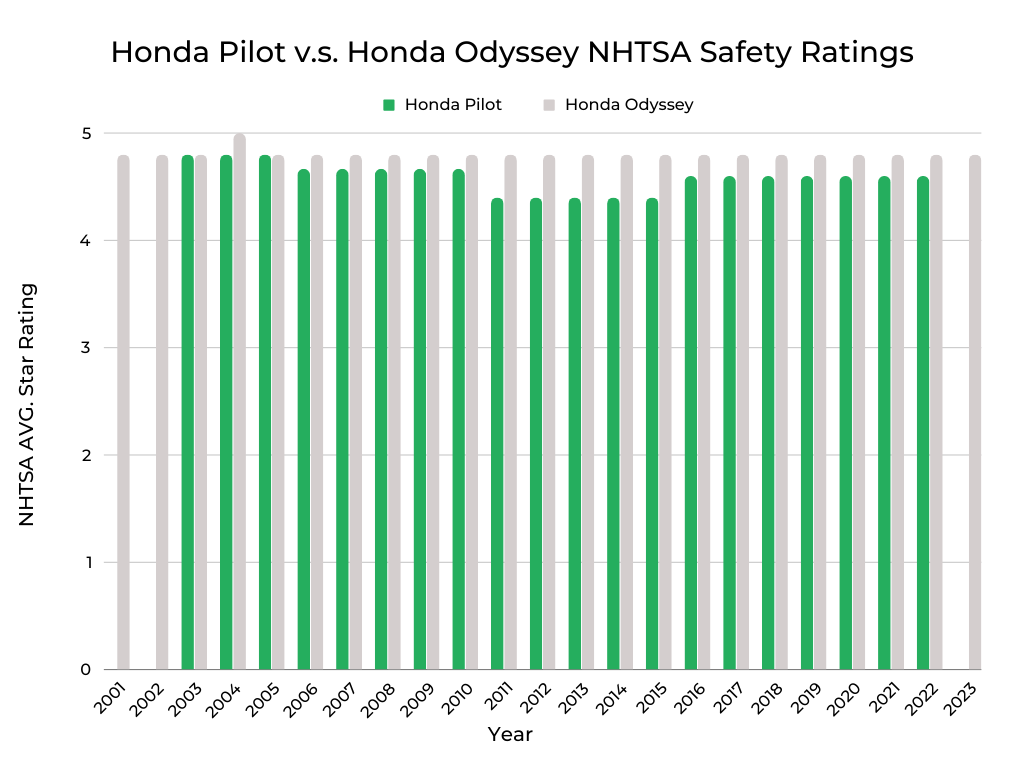
One thing used Pilot and Odyssey buyers don’t have to worry about is poor crash test scores. Both models did exceptionally well in National Highway Traffic Safety Administration (NHTSA) testing.
What’s especially noteworthy is that older model years still perform well, with no Pilot or Odyssey dipping below 4.4 (out of 5). I consider 4.0 to be a minimum “good” score. In contrast, the early years of the Toyota Highlander failed to crack the 4.0 barrier in the same testing. Honda deserves credit for keeping its eye on the safety ball.
The Pilot’s score dropped slightly for the 2011-2015 model years. This is due to the government introducing more rigorous testing. Nonetheless, the 4.4 rating is still admirable. The improvement for the 2016 model year coincides with the launch of the third-generation Pilot.
More details about crash test safety scores are covered in articles about the Honda Pilot and Honda Odyssey.
Fuel Efficiency Comparison | Honda Pilot vs. Honda Odyssey
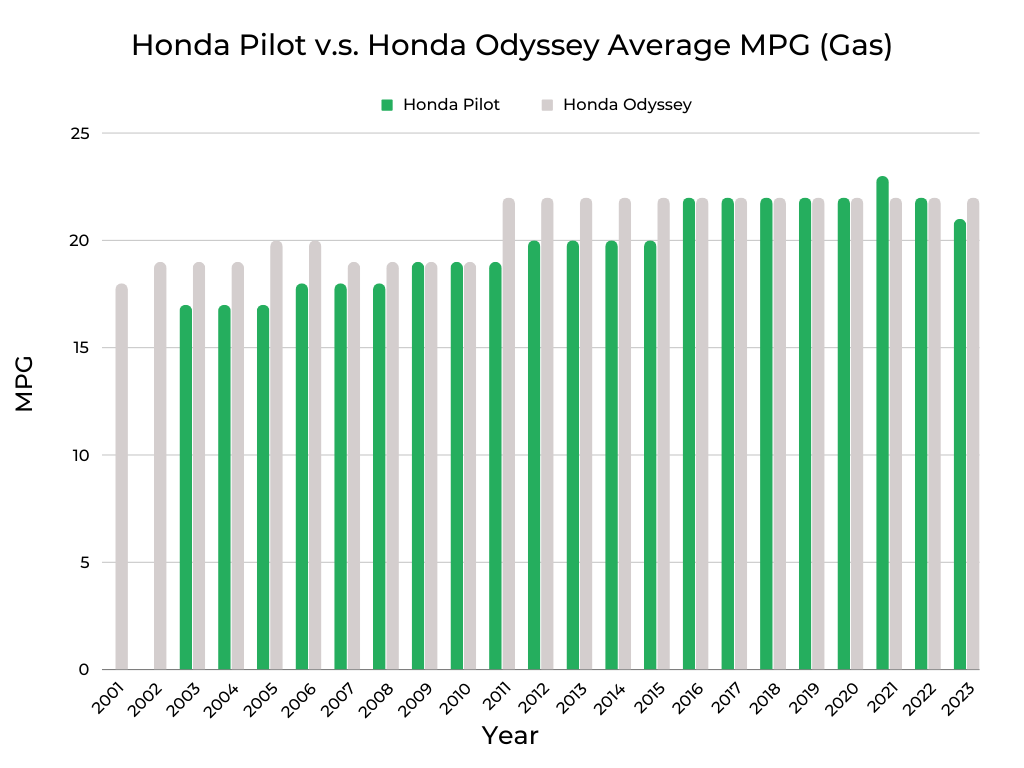
No one buys a conventionally powered midsize three-row vehicle like the Honda Pilot or Odyssey, expecting exceptional fuel economy. It’s the cost of hauling so many people and having a reasonably robust engine under the hood.
Older Pilots and Odysseys delivering below 20 mpg was the norm, but Honda engineers helped 2012 and later examples cross this same crucial threshold.
The fuel economy for 2016 and newer Pilots and Odysseys is mostly the matching (at or near 22 mpg). However, you’ll find that many older Odyssey model years are more efficient than the equivalent Pilot. This results from the Odyssey weighing less (no AWD running gear) and its V6 engine often having less horsepower than the same V6 in the Pilot. Keep this in mind if you need an excuse to tilt toward an older Odyssey.

Dave Goldberg is an automotive journalist and lifelong car fanatic. He writes for numerous enthusiast and business outlets and is an ongoing contributor to HotCars.com, one of the most popular car culture websites. When he’s not writing or driving, Dave is either under a hood or asleep. His credentials include a BA in Journalism from The George Washington University.