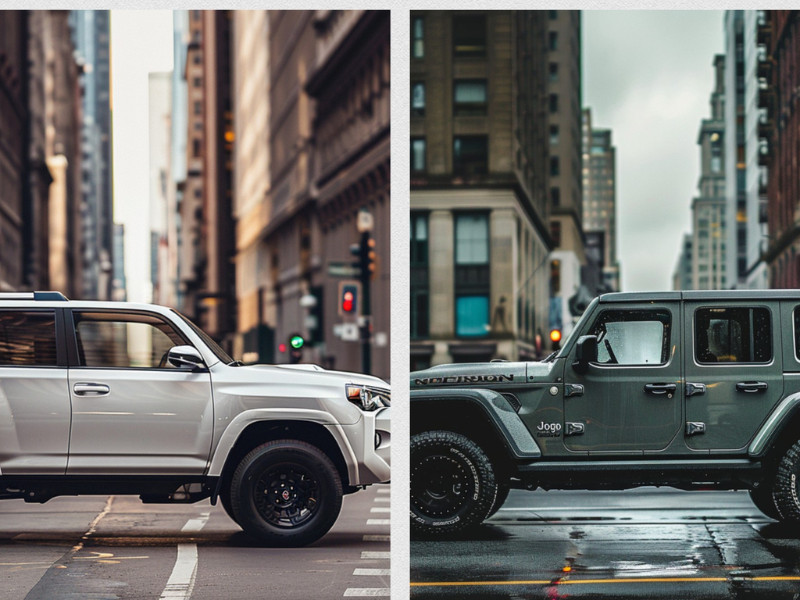
While ‘SUV’ describes almost every five-door car made these days, it has a more authentic meaning: a body-on-frame utility vehicle. It’s the same construction used for most pickup trucks, providing extra durability and improved off-road performance.
Two classic examples of SUVs are the Toyota 4Runner and Jeep Wrangler. The 4Runner has been part of Toyota’s lineup for 40 years and traces its lineage to the legendary Hilux pickup. The Wrangler’s heritage goes back further. Its predecessors include the World War II-era Willys Jeep and the post-war CJ series.
The 4Runner and Wrangler are extra capable off-road, so it makes sense to cross-shop both vehicles. But their respective qualities are different. The 4Runner has two or three rows and generous cargo space when the third row isn’t used. Its long wheelbase also makes it more comfortable for everyday use.
On the other hand, the Wrangler is more about enjoying the outdoors than practicality. You’ll only find its removable roof and doors on a Ford Bronco, not a 4Runner. Meanwhile, while excellent in the wild, two-door Wranglers can be cramped in the second row, modest in the cargo area, and bouncy on highways. Four-door versions are more spacious but still fall short of the 4Runner.
4Runners and Wranglers are common in my suburban neighborhood. My neighbor, Ken, uses his Toyota 4Runner primarily for commuting but is known to drive to the mountains to camp. Rather than set up a tent, he removes the second-row seats and pops in an air mattress. There’s plenty of room for two.
Another neighbor, Tim, is a Jeep guy. His two-door Wrangler gets driven every day and for outdoor adventures. However, his approach to an overnight with Mother Nature is to pitch a tent. Tim’s Wrangler can go just about anywhere; he just doesn’t have a lot of room for stuff or people.
But there’s more to buying a used 4Runner or Wrangler than figuring out how you’ll use it. Each vehicle has distinct pros and cons. The 4Runner has one of the lowest depreciation rates. Add a higher original MSRP, and these SUVs cost more than a comparable Wrangler. Looking for a deal? Chances are you’ll find one with a Wrangler instead of a 4Runner.
The Jeep Wrangler has other strong points. Its engine reliability ratings actually top the 4Runner. At the same time, both vehicles have similar maintenance and repair expenses. Clearly, the Wrangler holds its own against the 4Runner.
But don’t just march out and buy a Wrangler. This Jeep has its share of flaws, like all vehicles. The main issue is poor crash test scores among more recent model years. This will be a concern, especially if you transport kids. The 4Runner has higher safety ratings but still comes up short against crossovers like the Toyota Highlander or Honda Pilot.
Lastly, data points to the Wrangler having a much shorter lifespan. You may save money upfront by purchasing a Wrangler, but it may not be around as long as a more expensive 4Runner.
Keep reading to see how this Toyota 4Runner and Jeep Wrangler contest turns out. You can learn about resale values, depreciation, reliability, longevity, maintenance costs, safety, and fuel economy—essentials to understand to make a more informed car-buying decision.
Other match-ups to review include Pathfinder vs 4Runner, Tahoe vs Expedition, Suburban vs. Tahoe, Jetta vs. Civic, Sentra vs. Corolla, Outback vs. Forester, 4Runner vs. Highlander, RAV4 vs. CR-V, Civic vs. Corolla, Pilot vs. Highlander, and Odyssey vs. Sienna.
| Income Bracket | Monthly Financing Cost Range | Cash Purchase Price Range | Toyota 4Runner Years | Jeep Wrangler Years | Best Model Year: | Why? |
| $10k-$15k | $125-$187 | $4,500-$6,750 | 2004 | 2004 | 2004 4Runner | Acceptable engine reliable, good safety score |
| $15k-$25k | $187-$312 | $6,75 -$11,250 | 2007 | 2007 | 2007 Wrangler | Above-average engine reliability, very good safety score |
| $25k-$35k | $312-$437 | $11,250-$15,750 | 2012 | 2014 | 2012 4Runner | Above-average engine reliability, very good safety score |
| $35k-$50k | $437-$625 | $15,750-$22,500 | 2014 | 2016 | 2014 4Runner | Above-average engine reliability, very good safety score |
| $50k-$74k | $625-$925 | $22,500-$33,300 | 2018 | 2020 | 2020 Wrangler | Top engine reliability |
| $75k-$99k | $925-$1,238 | $33,300-$44,550 | 2021 | N/A | 2021 4Runner | Top engine reliability, good safety score |
See the methodology for the table above.
Before you respond to the “For Sale” ad, check out this How to Buy a Used Car article for a step-by-step checklist.
Price History Comparison | Toyota 4Runner vs. Jeep Wrangler
Average Market Value – Based on Owners’ Self-Reported Mileages | Toyota 4Runner vs. Jeep Wrangler

A review of market values highlights one significant difference between the Toyota 4Runner (green) and the Jeep Wrangler (gray): price. These numbers are based on private-party sales reported by Kelley Blue Book (KBB) and adjusted to reflect owner-reported mileage from FIXD surveys.
If you’ve been shopping for a used 4Runner or Wrangler from 2010 or newer, you’ll find the Jeep, on average, to be appreciably cheaper than the Toyota. Two principal factors are at play: MSRPs and depreciation.
Overall, Wranglers have lower starting prices than 4Runners. Sure, pick a top trim and pile on the options and a Wrangler can be pretty expensive. However, the chart reflects averages, which include base models.
For instance, in 2008, the cheapest Wrangler cost $22,765 compared to $34,804 for an equivalent 4Runner. The spread narrowed for the 2012 model year but was still significant, with a Wrangler starting at $25,865 against $34,570 for a 4Runner. 2016 is no different, with Wranglers costing at least $28,995 versus $37,030 for the Toyota.
I could go on, but you get the picture—a lower MSRP usually translates into a cheaper used car.
Depreciation is also part of the formula. However, the 4Runner and Wrangler both enjoy lower value losses than most vehicles. According to CarEdge, a new 4Runner has a depreciation rate of 19% over five years. Meanwhile, the Wrangler declines in value by 22% over the same period. This 3% gap is modest but can add to a 4Runner costing hundreds or thousands more than a similar Wrangler.
It’s also worth mentioning that some of the price separation among specific model years is due to above-average owner-reported mileage. For instance, owners of 4Runners from 2001, 2008, 2012, and 2014 drove significantly more than their Wrangler peers, suppressing the value of their Toyotas. On the flip side, there’s above-average mileage reported for 2016 and 2019 Wranglers.
As mentioned, the KBB data reflect private sales. Buy from a dealer, and you’ll pay 30% to 50% more. Offsetting higher retail prices can occur by looking for an older vehicle or one with more miles on the odometer.
Be sure to read our Best and Worst Years series of articles highlighting the Toyota 4Runner and Jeep Wrangler winners and losers.
Depreciation vs. Maintenance Expenses
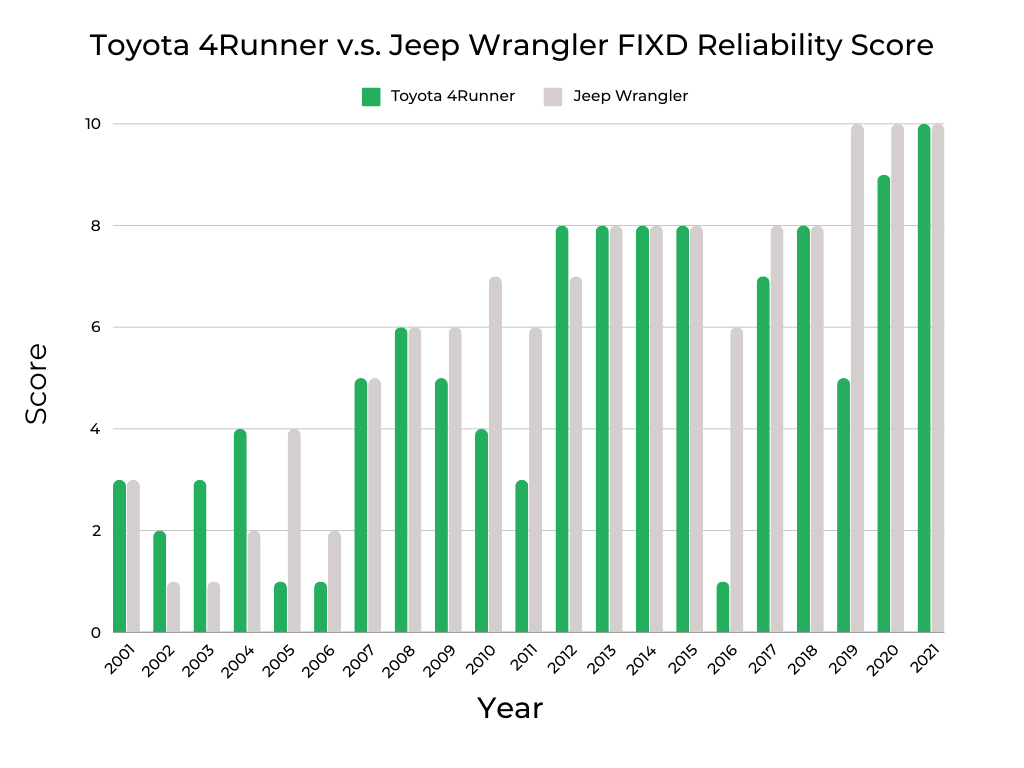
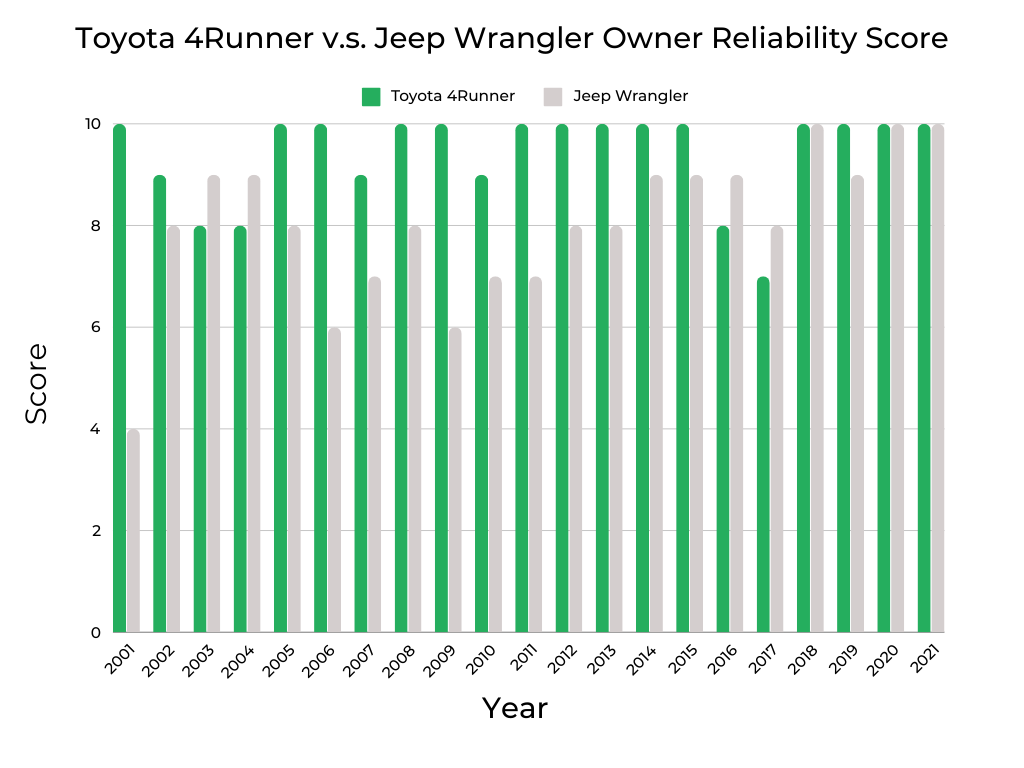
Data has a knack for smashing assumptions. Such is the case for SUV shoppers who believe the 4Runner to be bulletproof. This is undoubtedly true for some model years, but the Wrangler has better overall engine reliability. Let’s break it down.
Among the 21 model years analyzed through FIXD Reliability Scores, the Wrangler outperforms the 4Runner for eight years. In comparison, the Toyota only comes out ahead for five years. There was a tie for eight years.
If you separate the list into old (2001-2009) and new (2010-2021) examples, the engine reliability rankings are still notable. Among the 2001-2009 model years, ratings are basically even—three better years each for the 4Runner and the Wrangler and three tied years.
However, the results are more surprising among the more recent years. Here, the Wrangler has six years of better engine reliability compared to just one for the 4Runner. The two vehicles tied for five years.
Unsurprisingly, owners love their 4Runners and Wranglers, vehicles that traditionally have had a dedicated fan base. Yet, FIXD surveys indicate that 4Runner owners are more enthusiastic about their rides than those with Wranglers. These Toyotas don’t appear concerned about check engine light frequency.
In contrast, Wrangler owners are more sensitive to their vehicles’ imperfections, with a few years dipping to a 6 out of 10 rating.
Review the Best and Worst Years articles on the Toyota 4Runner and Jeep Wrangler to learn more about these vehicles’ FIXD Reliability and Owner Reliability Scores.
Longevity Comparison | Toyota 4Runner vs. Jeep Wrangler
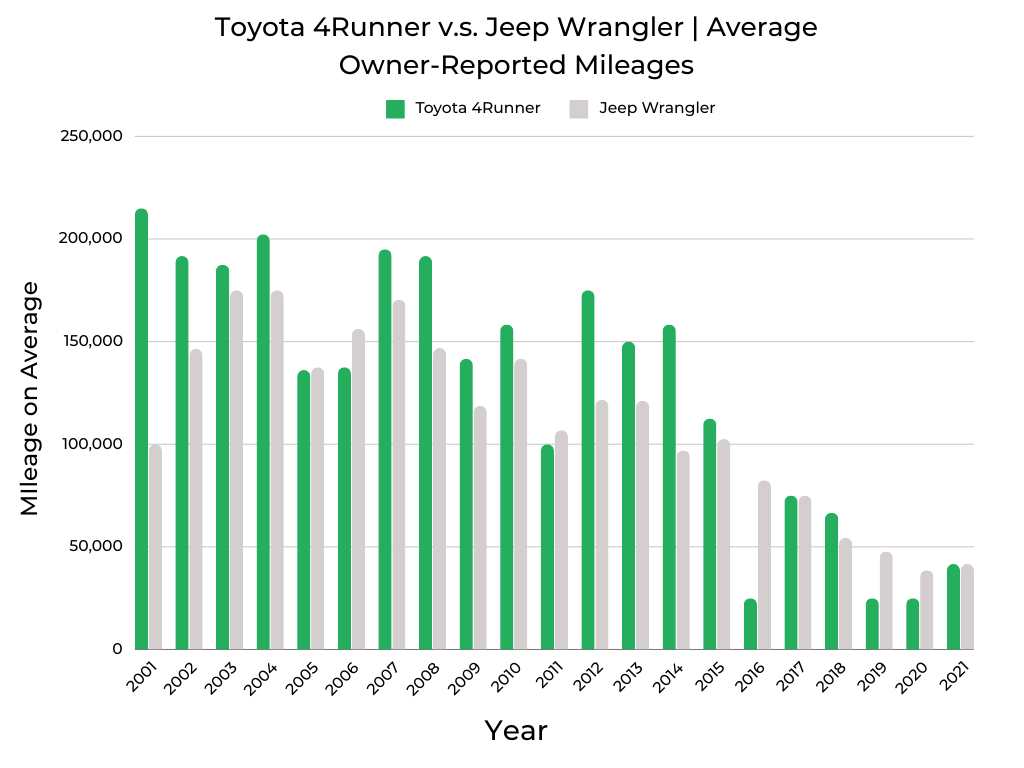
FIXD surveys show that the Toyota 4Runner has a modest edge over the Jeep Wrangler regarding reported mileage. Several 4Runner model years have crossed or are close to reaching the 200,000-mile mark. Meanwhile, older Wranglers hover closer to 150,000 miles.
Let’s expand this look at longevity by analyzing 4Runner and Wrangler marketplace listings from autotrader.com (as of March 26, 2024). This unscientific review shows 900 4Runners and 3,737 Wranglers for sale from the 2001-2012 model years. These examples are the most likely to have accumulated the highest amount of miles.
The listings reveal 338 (37.6%) 4Runners and 650 (17.4%) Wranglers with 150,000-200,000 miles. The percentages show a substantial longevity tilt toward these Toyotas, which is eye-opening, especially given the greater number of Wranglers.
More dramatic results are found in high-mileage examples. There are 276 (30.7%) 4Runners and 110 (2.9%) Wranglers with at least 200,000 miles.
It’s evident that lifespan favors the 4Runner over the Wrangler. This is a crucial consideration for anyone looking at high-mileage vehicles.
Are there Wranglers out there capable of racking up the miles? Of course. Undoubtedly, there are well-maintained models in existence. It’s just that the data suggests this is less of an expectation than it is with the 4Runner.
For a more thorough look at longevity, review the individual articles on the best and worst years of the Toyota 4Runner and Jeep Wrangler.
Who Should Buy These Cars: The Legacy of Toyota 4Runner vs. Jeep Wrangler
The 4Runner and Wrangler are the automotive equivalents of Leatherman Multi-Tools; they serve many functions. Unsurprisingly, more 4Runner owners (37%) use their cars for family transportation than Wrangler owners (24%). 4Runners are a bit more people-friendly, and some have three rows.
Both vehicles see similar usage for “lots of driving,” a category that combines commuting and road trips.
Meanwhile, the Wrangler’s off-road credentials explain why these Jeeps see more outdoor and off-road duty. 4Runners can certainly hit the trails, but the Jeep’s shorter wheelbase and approach-friendly design make it better suited for extreme off-pavement travel.
| Frequent Use Categories: | Toyota 4Runner | How Useful? (Out of 5 Stars) | Jeep Wrangler | How Useful? (Out of 5 Stars) |
| Family Vehicle | * * * * | * * * |
| Lots of Driving (travel/long commute) | * * * | * * * |
| Hauling/Towing | * | * |
| Office on Wheels | * | * |
| Sport/Fast Driving | * | * |
| Luxurious Driving | * | * |
| Outdoor/Off-Road | * * | * * * * |
Driver Experience | A Summary of The Top 10 Toyota 4Runner vs. Jeep Wrangler Posts:
Redditors are vocal about their thoughts on the Toyota 4Runner and Jeep Wrangler. Here’s an overview of some of the most popular discussions from Reddit: r/whatcarshouldIbuy.
Reliability
Redditors often discuss the Toyota 4Runner’s reliability, with one commenter stating it’s “the most reliable car you can buy in today’s world.” Another user emphasized the 4Runner’s longevity and high resale value, suggesting that Toyota vehicles are built to last and maintain their value over time. In contrast, the Jeep Wrangler received negative comments regarding its durability, with one Redditor advising against purchasing a Jeep due to concerns about rapid deterioration and rusting within two years.
Value and Resale
The conversation around value and resale heavily favors the 4Runner. Commenters highlight the Toyota 4Runner’s ability to retain value over time, with one user noting the significant resale value of Toyota vehicles compared to others. The Jeep Wrangler, while popular for its off-road capabilities, was criticized for its depreciation and maintenance concerns, which could affect its long-term value.
Comfort and Performance
Comfort and performance were less frequently discussed, but one user preferred the 4Runner for its more comfortable ride than the Jeep Wrangler. The discussion did not deeply dive into performance specifics, but the comfort of the 4Runner’s interior and ride quality are points of preference for daily use.
Reddit Recap
The Reddit discussions about the Toyota 4Runner and Jeep Wrangler reveal a strong preference for the 4Runner in terms of reliability, value, and comfort. The 4Runner is praised for its durability, resale value, and comfortable ride. In contrast, the Jeep Wrangler is appreciated for its aesthetics and off-road capabilities but criticized for its long-term reliability and depreciation.
Year-by-Year Comparison |Toyota 4Runner vs. Jeep Wrangler
Best & Worst Years | Toyota 4Runner vs. Jeep Wrangler | 2001-2024
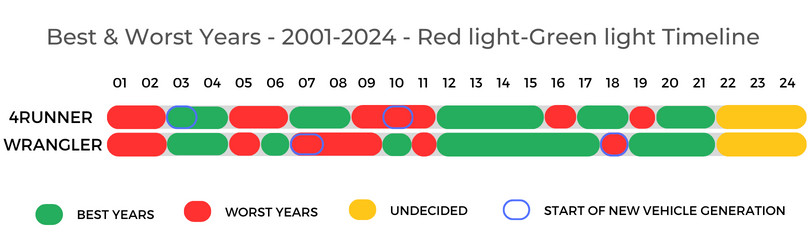
While 20-year-old vehicles are seldom perfect, at least a few older 4Runners and Wranglers get thumbs-ups. The 2003-2004 model years for either SUV are the most wallet-friendly.
Buyers with a bigger bank account balance can choose a 2007-2008 4Runner or a 2006 or 2010 Wrangler.
Starting with the 2012 model year, choices expand considerably. For the 4Runner, just avoid the 2016 and 2019 model years and there’s smooth sailing through 2021. The options for the Wrangler are even greater, with 2018 being the only red-light year from 2012-2021. A 2018 Wrangler may be tempting, but it’s the first year of the JL generation, which has a history of electrical and steering problems.
I’ll call attention to the undecided years (yellow) only because there isn’t enough information to give these editions a thumbs-up or thumbs-down.
Important Features Timeline | Toyota 4Runner vs. Jeep Wrangler
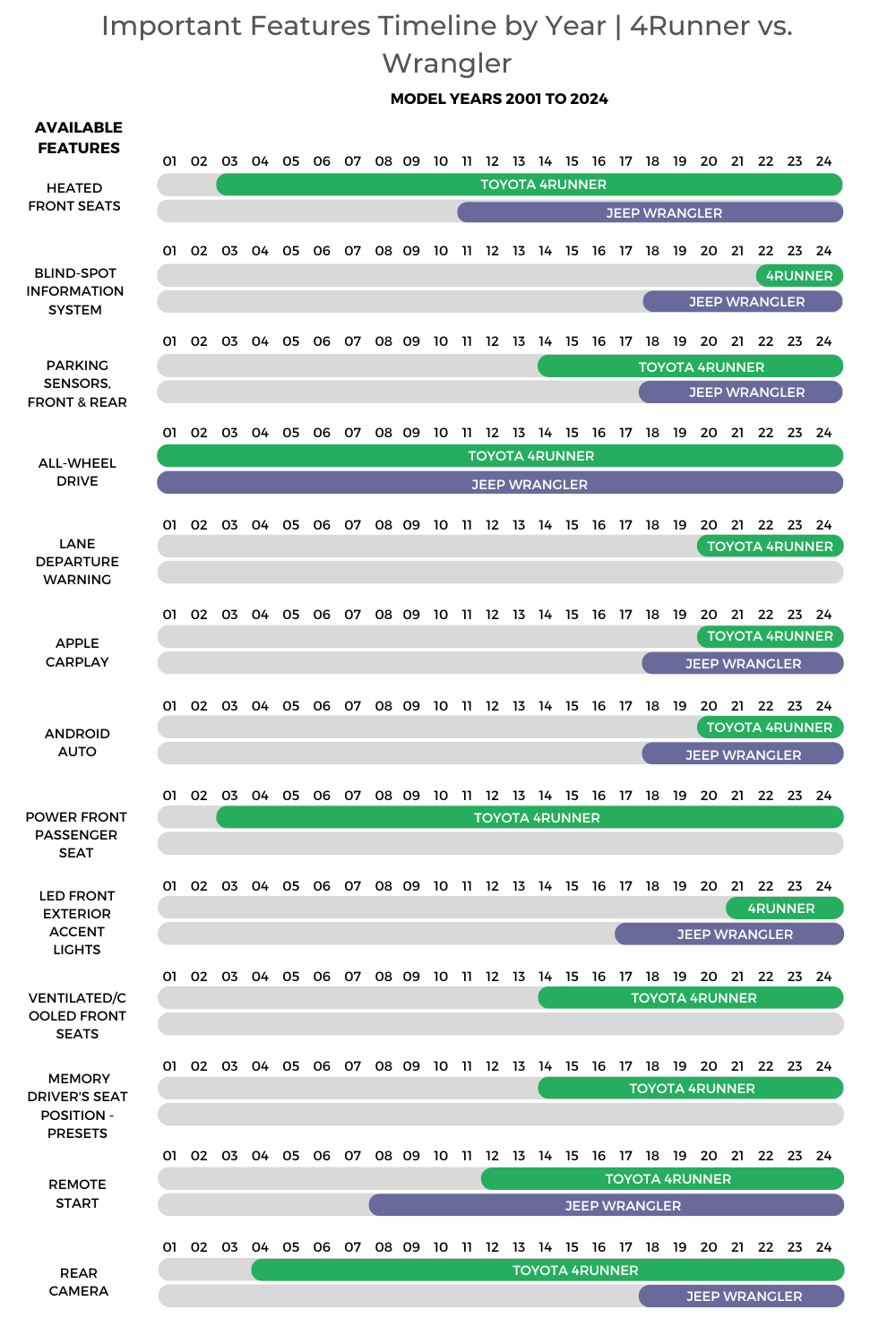
Neither the 4Runner nor the Wrangler is known for being feature-rich. If anything, these vehicles are more notable for being throwbacks from a simpler time. Four-wheel drive and body-on-frame construction are the name of the game.
However, competition and consumer demand are powerful forces. Eventually, Toyota and Jeep relented by gradually upgrading the 4Runner and Wrangler. Given the 4Runner’s somewhat greater orientation toward passenger comfort, it’s not unexpected that this Toyota first had conveniences like heated front seats, parking sensors, and a rearview camera.
Along the same lines, the 4Runner has a power front passenger seat, ventilated front seats, lane departure warning, and a driver’s memory system, equipment that has yet to be added to a Wrangler.
But the Wrangler isn’t a total dinosaur. It received blind-spot monitoring, remote start, Apple CarPlay, and Android Auto before the 4Runner.
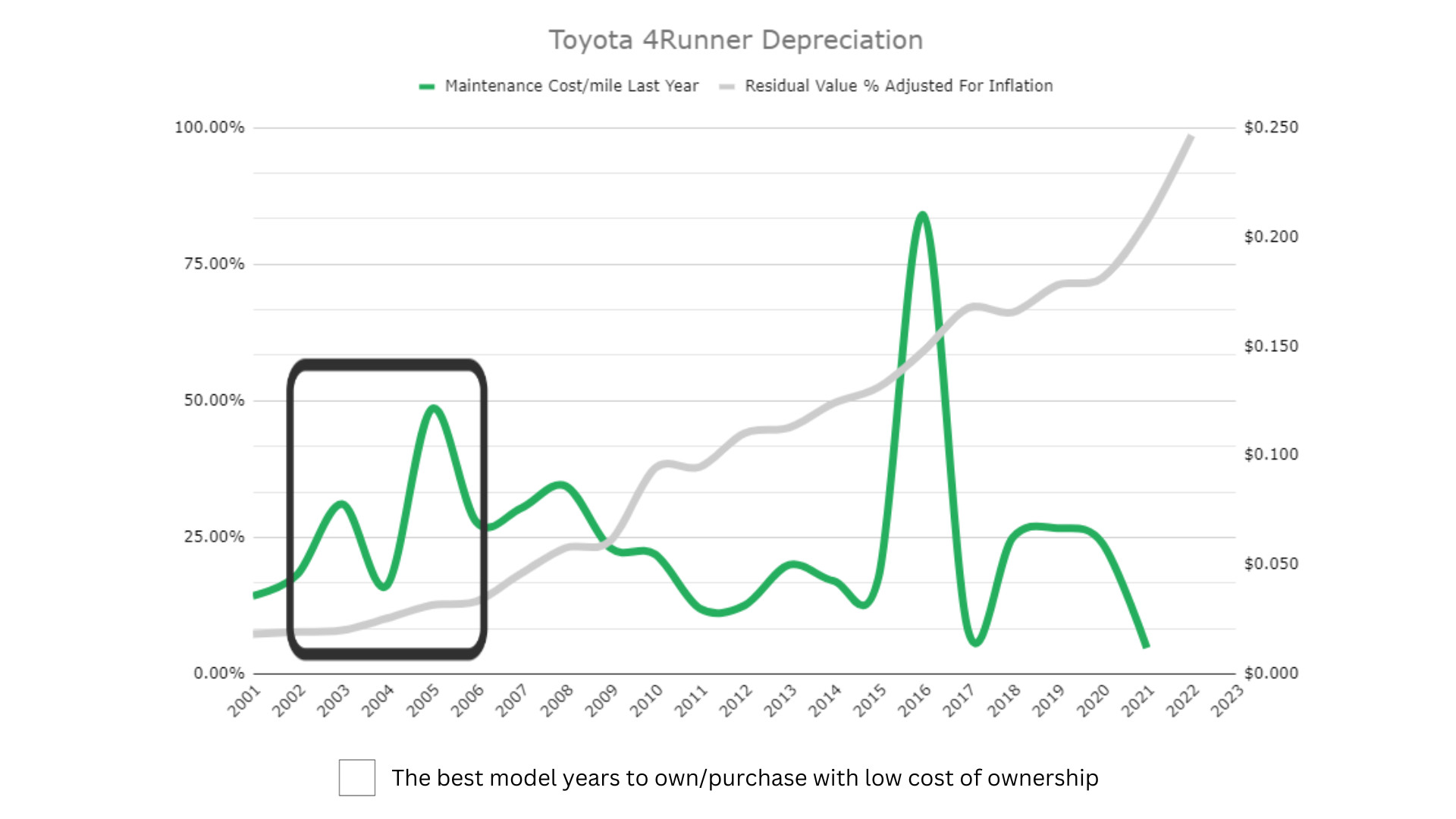
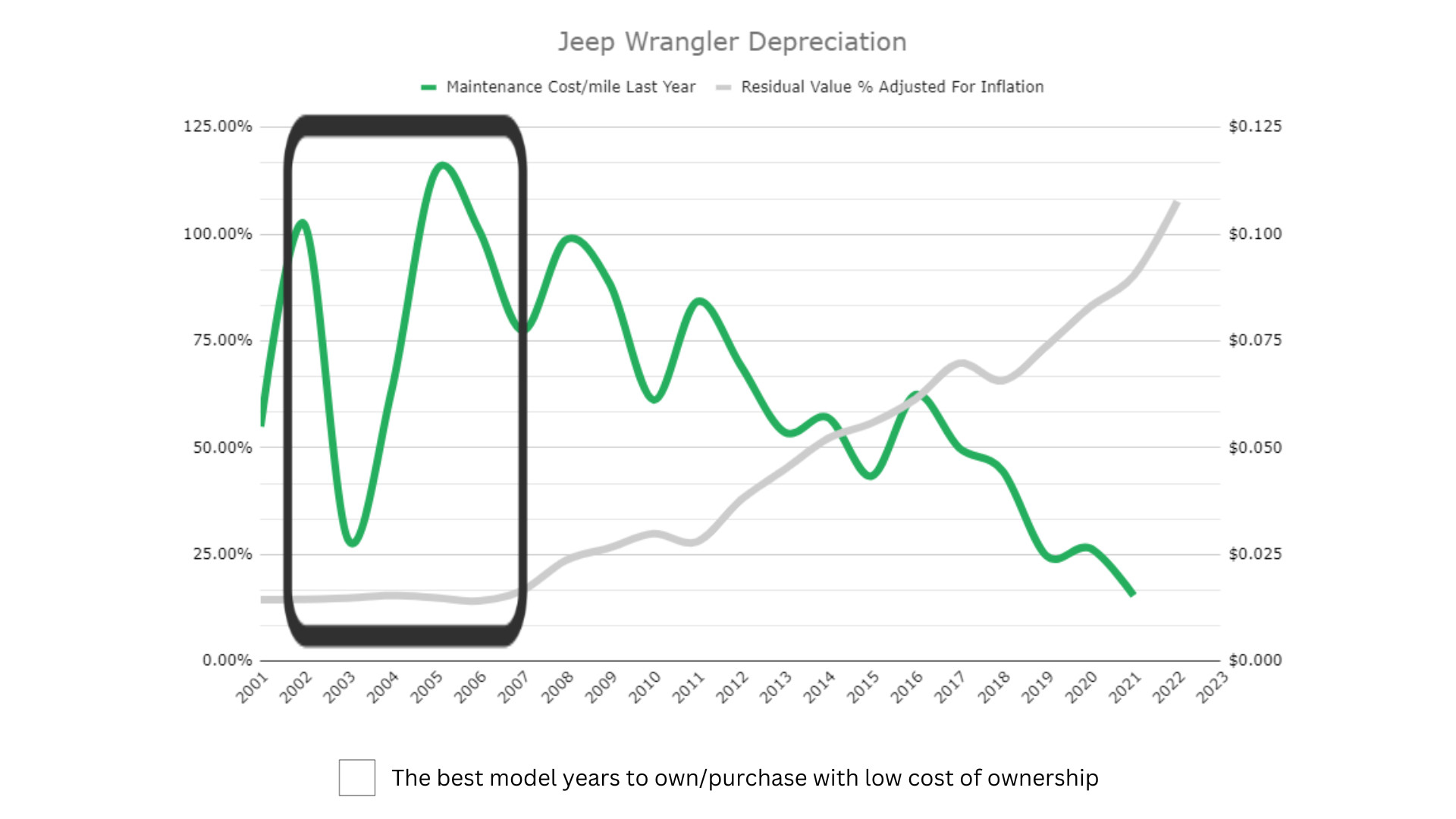
Maintenance Costs (Year-by-Year Average) | Toyota 4Runner vs. Jeep Wrangler
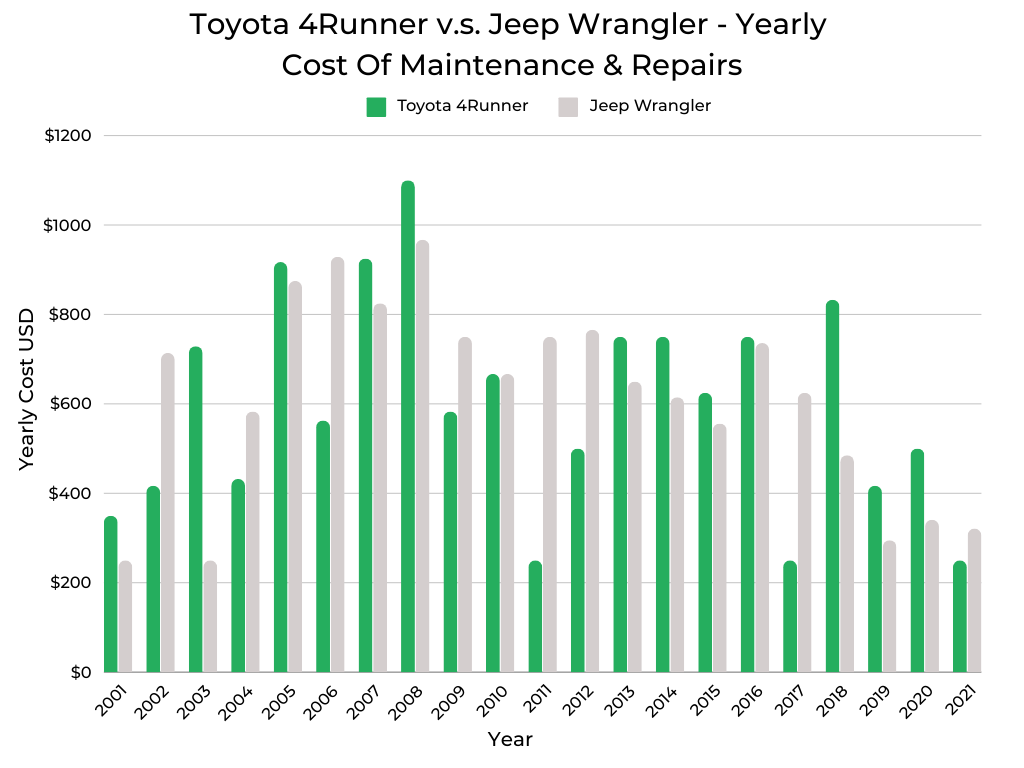
Despite the rollercoaster appearance of 4Runner and Wrangler maintenance costs in the chart, average upkeep expenses for these SUVs are almost identical. FIXD surveys show that 4Runner owners spent an average of $598 on repairs and maintenance in 2022. Wrangler owners paid $617.
These calculations do paint maintenance costs with a broad brush. So, looking at specific model years can provide additional insight. Both vehicles have offending examples that exceed the above averages by at least 20%.
For the 4Runner, this means that the 2003, 2005, 2007, 2008, 2013, 2014, 2016, and 2018 model years require a deeper wallet for upkeep costs. Wranglers with the same tendencies are from 2005-2009 and 2011-2012.
Review the best and worst years of the Toyota 4Runner and Jeep Wrangler to learn more about maintenance and repair costs for these vehicles.
Safety Rating Comparison | Toyota 4Runner vs. Jeep Wrangler
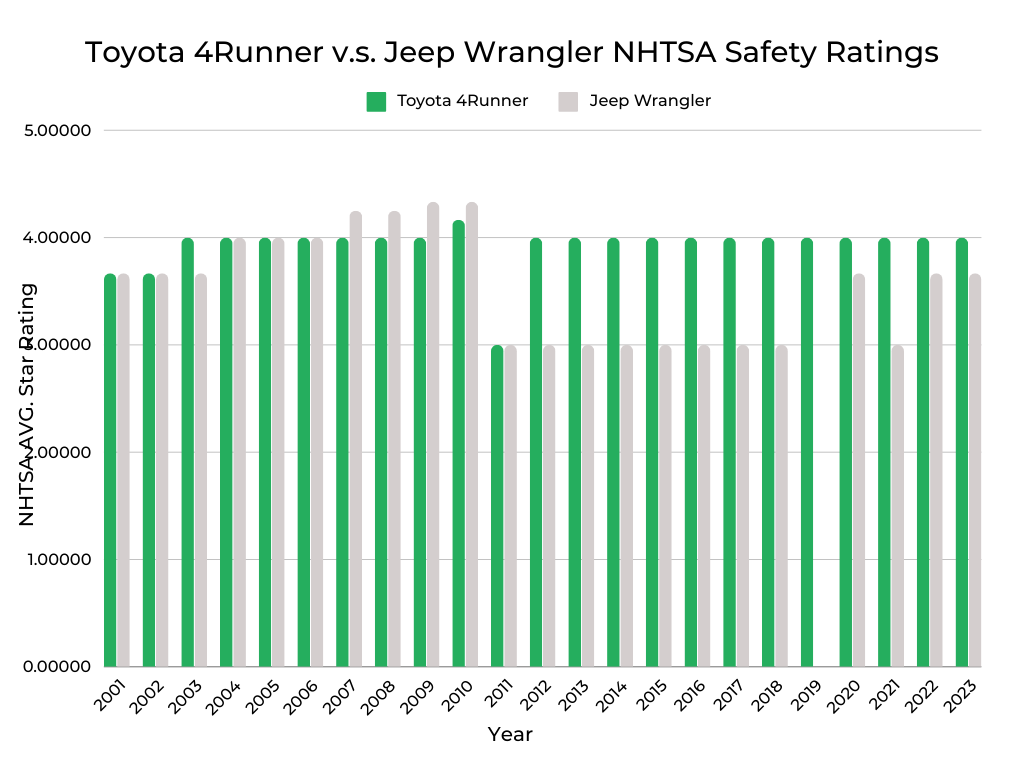
If top safety scores are a priority, you’ll probably want to consider something other than a Toyota 4Runner or a Jeep Wrangler. At best, these vehicles received a 4.0 out of 5 rating from the National Highway Traffic Safety Administration (NHTSA). I’d give these results a “B” grade; good but not great.
However, Wrangler shoppers (and 4Runner buyers, too) should be aware of the change that NHTSA made to its testing procedures starting with the 2010 model year. These more stringent requirements caused many vehicles’ safety scores for that year to plummet.
Most manufacturers (including Toyota) could resurrect good safety scores in a year or two through re-engineering techniques or the launch of a new model generation. This didn’t happen with the Jeep Wrangler. In fact, even the 2018 introduction of a new generation didn’t lead to better testing. Improvements didn’t occur until the 2020 model year, but results are still sub-par with a 3.7 rating.
More details about crash test safety scores are covered in the Toyota 4Runner and Jeep Wrangler articles.
Fuel Efficiency Comparison | Toyota 4Runner vs. Jeep Wrangler
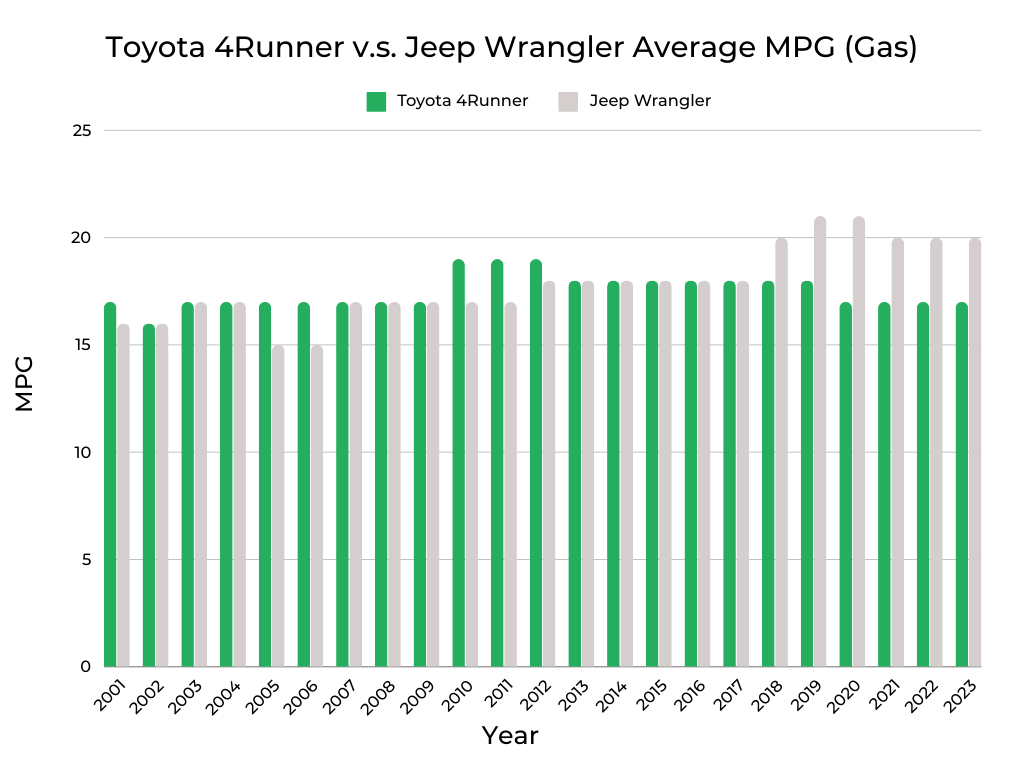
There’s not much to say about the 4Runner and Wrangler’s fuel economy; it’s less than spectacular. That’s the price you’ll pay for an old-school vehicle. Modern crossovers like the Toyota RAV4 and Honda CR-V are much more fuel efficient, but taking either of these “cute utes” too far offroad could be a disaster.
Set your expectations to an average of 15-18 mpg for 4Runner or Wrangler fuel economy, and you won’t be disappointed. Of course, different engines can impact the results. Older 4Runners were available with V8s. Otherwise, there’s an inline-four or V6 under the hood.
Likewise, Wrangler powerplants have different cylinder counts (four, six, or eight). Yet, the latest Wrangler, the JL, has something the 4Runner doesn’t: a sophisticated eight-speed automatic transmission. The 4Runner relies on a four- or five-speed self-shifting gearbox (depending on the engine and model year).
As a result of the new automatic transmission (along with other generational improvements), the Wrangler’s fuel economy cracked the 20-mpg threshold. Expect to see similar improvements when Toyota launches an all-new 4Runner for the 2025 model year.

Dave Goldberg is an automotive journalist and lifelong car fanatic. He writes for numerous enthusiast and business outlets and is an ongoing contributor to HotCars.com, one of the most popular car culture websites. When he’s not writing or driving, Dave is either under a hood or asleep. His credentials include a BA in Journalism from The George Washington University.