
While dozens of SUVs are on the market, the selection gets narrowed by adding a third row into the equation. The choices are even fewer with minivans. So, focusing on pre-owned vehicles that can fit more than five or six will often lead to a Toyota Highlander or a Honda Odyssey. Both are benchmarks for their respective classes.
Comparing a crossover to a minivan might appear odd, but the match-up makes sense. The used car market is rich with Highlanders and Odysseys, owing to their popularity as new cars. More choices are always better when it comes to used car shopping. Those who need three rows are doing themselves a disservice by not exploring all their options.
For instance, you may have a Highlander mindset but will be surprised to discover that a second-hand Odyssey can often carry more people and stuff for less money upfront. In contrast, your idea of a family hauler may start with an Odyssey but may change when you realize the advantages of a Highlander with all-wheel drive or a hybrid powertrain.
The considerations are numerous. One is the “blot” of owning a minivan. No comparison will persuade you if you can’t get over the negative perceptions of driving a box on wheels. I almost pulled the trigger on an Odyssey twice but decided it was more vehicle than I needed. There was no concern about “image.”
In truth, if your priority is cabin space, you need to check out an Odyssey (or any comparable minivan, like a Toyota Sienna or Chrysler Pacifica). It’s enormous inside, making the Highlander seem smallish. Where the Odyssey stands apart is in the third row. If you need to put a long-legged teen or an adult in the far back, this Honda is way more comfortable than the Highlander.
Yet, no matter how the Odyssey shines, it can’t keep up with a Highlander in other areas. Despite the Odyssey sharing a platform with the Honda Pilot crossover, all-wheel drive isn’t available. Neither is a hybrid powertrain. If these are essentials, then choosing a Highlander makes sense.
Casting aside the already-mentioned differences, the Highlander and Odyssey share common characteristics. Both vehicles have similar maintenance expenses, offer comparable fuel economy (excluding hybrids), and score high in government crash tests. They also have parallel longevity records.
Explore this article to learn more about how the Highlander and Odyssey are alike and where they differ.
Looking for the latest model? Check out: Toyota Highlander Vs. Honda Odyssey | 2023 Comparison.
Keep reading to see how this Toyota Highlander and Honda Odyssey contest turns out. Other match-ups to review include Outback vs. Forester, RAV4 vs. CR-V, Civic vs. Corolla, Pilot vs. Highlander, 4Runner vs. Highlander, and Odyssey vs. Sienna.
| Income Bracket | Monthly Financing Cost Range | Cash Purchase Price Range | Toyota Highlander Years | Honda Odyssey Years | Best Model Year: | Why? |
| $5k-$10k | $83-$125 | $3,000-$4,500 | 2002 | 2004 | 2004 Odyssey | Low price, top-notch safety score |
| $10k-$15k | $125-$187 | $4,500-$6,750 | 2007 | 2009 | 2009 Odyssey | Above-average engine reliability, excellent safety score |
| $15k-$25k | $187-$312 | $6,750-$11,250 | 2010 | 2013 | 2013 Odyssey | Good value, above-average engine reliability |
| $25k-$35k | $312 – $437 | $11,250-$15,750 | 2015 | 2015 | Tie | Excellent engine reliability, strong safety scores |
| $35k-$50k | $437 – $625 | $15,750-$22,500 | 2017 | 2017 | Tie | Excellent engine reliability, strong safety scores |
| $50k-$74k | $625-$925 | $22,500-$33,300 | 2019 | 2018 | 2019 Highlander | Top engine reliability |
| $75k-$99k | $925-$1,238 | $33,300-$44,550 | 2021 | N/A | 2021 Highlander | Top engine reliability score, very good safety score, |
See the methodology for the table above.
Before you respond to the “For Sale” ad, check out this How to Buy a Used Car article for a step-by-step checklist.
Price History Comparison | Toyota Highlander vs. Honda Odyssey
Average Market Value – Based on Owners’ Self-Reported Mileages | Toyota Highlander vs. Honda Odyssey

Getting a handle on prices and values is the ideal place to begin a used Highlander and Odyssey comparison. The graph shows average private-party sales for Highlanders (green) and Odysseys (gray). The information incorporates Kelley Blue Book (KBB) data adjusted for owner-reported mileage via FIXD surveys.
As is typical, older examples cost less than newer ones. This applies to the Highlander and the Odyssey. However, when examining model year pairs, the Highlander consistently sells for more than the Odyssey. While factors like condition and equipment can impact used car prices, the difference between these Toyotas and Honda is primarily due to depreciation.
Generally, the Highlander holds its value better than the Odyssey. For instance, CarEdge reports that a new Highlander loses 21% of its value over five years, while the Odyssey’s value declines by 27% over the same period. Looking outside the numbers, this makes sense because SUVs are in higher demand than minivans. Minivans and vans account for less than 5% of new vehicle sales (compared to 55% for SUVs and crossovers); interest in used vehicles is similar.
The one “blip” is the 2015 model year, with the Highlander and Odyssey having near equal value. This is due to above-average reported mileage for the Toyota.
In practical terms, this information shows that a second-hand Highlander will cost more than an equivalent Odyssey (similar age, mileage, condition, and equipment). You can work around higher prices (including the 33%-50% more you’d pay at a dealer) by looking for older model years or examples with higher mileage.
Be sure to read our Best and Worst Years series of articles highlighting the Toyota Highlander and Honda Odyssey winners and losers.
Depreciation vs. Maintenance Expenses
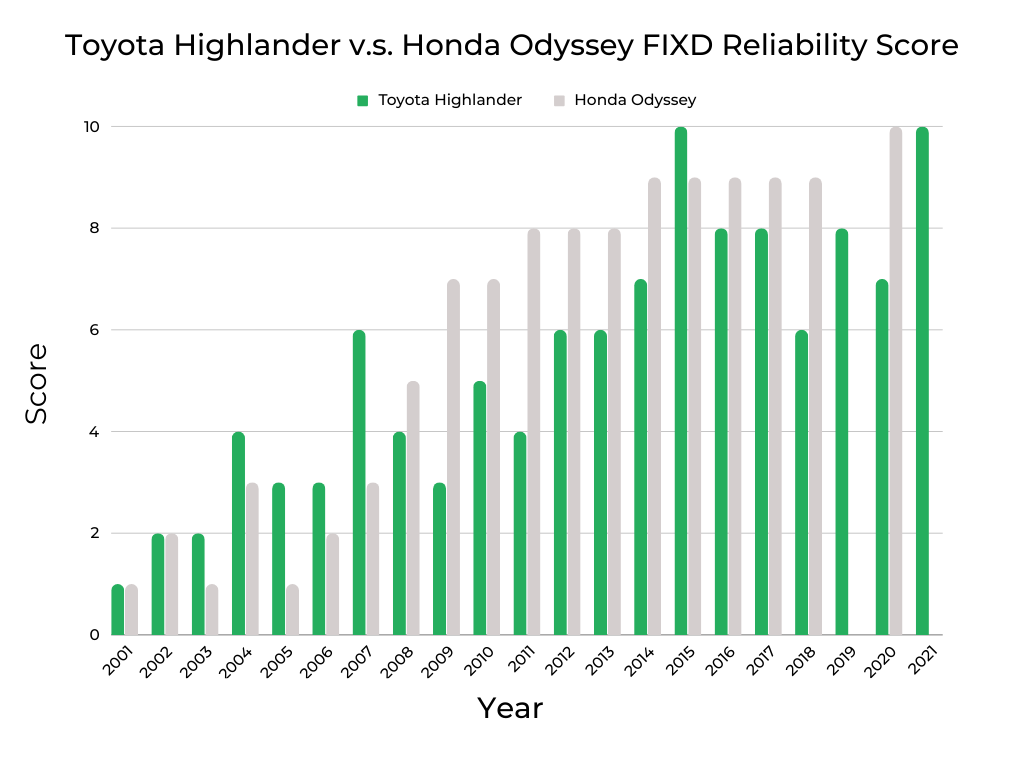
Seeing below-average FIXD Reliability Scores (less than 5) in 20-year-old cars is as common as ants at a summer picnic. But sorting the bad from the terrible shows that older (pre-2008) Highlanders have fewer check engine lights than their Odyssey equivalents. So, if you have to buy something this old, you’ll likely have fewer troubles with the Highlander.
However, once 2008 rolled around, something interesting happened: the Odyssey has consistently better engine reliability. For every comparison year, except 2015, the Highlander has a lower FIXD Reliability Score. There’s insufficient FIXD sensor data for comparing the 2019 and 2021 Odysseys.
Some model year match-ups are quite eye-opening. For 2011, the Highlander gets a disappointing engine reliability rating of 4 versus an 8 for the Odyssey. 2018 was equally surprising. Highlanders from this year averaged a FIXD Reliability Score of 6 against a near-perfect 9 for the Odyssey.
To be fair, not every check engine light (CEL) turns into a high-dollar repair bill. A failing car battery or loose wire can set off a warning light. Nonetheless, the difference in CEL frequency between these two models is quite revealing, especially when examining newer editions.
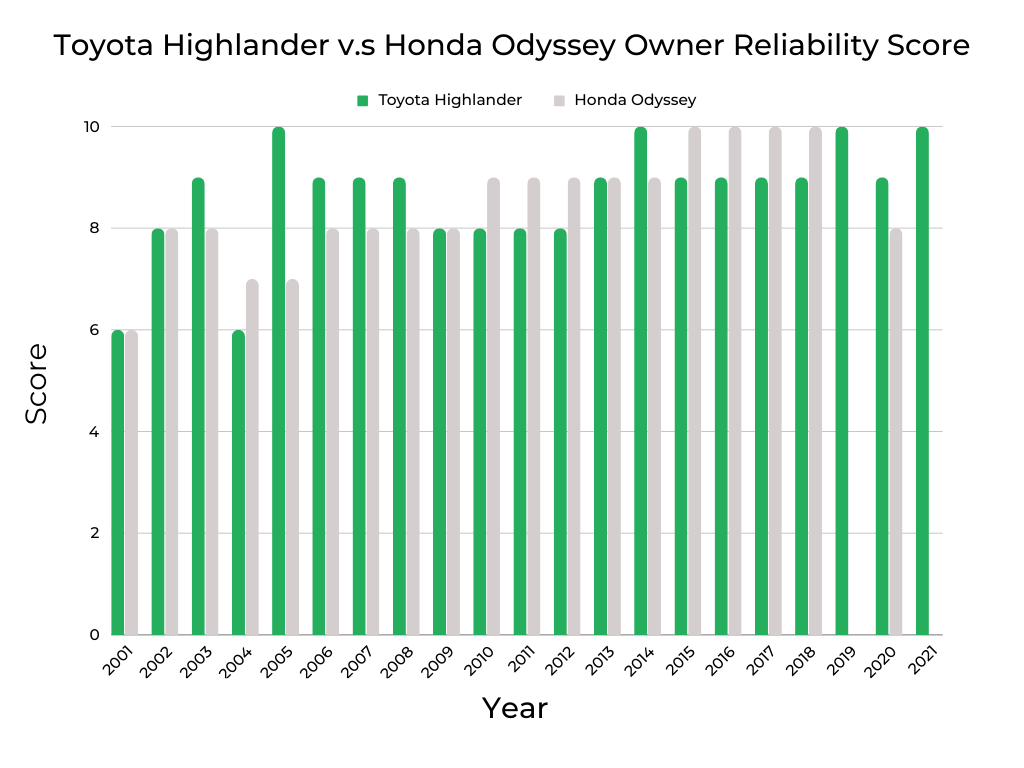
Regardless of what might be flashing on the dashboard, Highlander and Odyssey owners approve of their respective vehicles, according to these Owner Reliability Scores. No one ranked their car below a 6 (out of 10), and most of these Highlanders and Odysseys scored an 8 or better.
Review the Best and Worst Years articles on the Toyota Highlander and Honda Odyssey to learn more about these vehicles’ FIXD Reliability and Owner Reliability Scores.
Longevity Comparison | Toyota Highlander vs. Honda Odyssey

FIXD owner surveys show that older Highlanders and Odysseys readily cross the 150,000-mile threshold, regardless of check engine lights. Plus, many of these same vehicles are well on their way or have already reached the 200,000-mile mark. These are impressive results.
Looking at the 2001-2012 model years, more Odysseys (11) have crossed into 150,000-mile territory than Highlanders (8). However, this may just be that some Highlander owners don’t drive as much as their Odyssey counterparts. At the same time, four Highlander model years are at the 200,000-mile level, compared to two for the Odyssey.
The data can be sliced and sorted in many different ways. But let’s check alternate information to see if other Highlanders and Odysseys have similar longevity.
For-sale listings from autotrader.com (January 16, 2024) show 1,165 Highlanders and 1,365 Odysseys available from 2001-2012 (years most likely to have high-mileage examples). Of these, 231 (19.8%) Highlanders and 200 (14.7%) Odysseys had at least 200,000 miles.
These numbers don’t quite align, but they’re close enough to make an unscientific assumption that these Toyotas and Hondas have similar lifespans.
Review the individual articles on the best and worst years of the Toyota Highlander and Honda Odyssey for a more thorough look at longevity.
Who Should Buy These Cars: The Legacy of Toyota Highlander vs. Honda Odyssey
There’s no getting away from the fact that the Highlander and Odyssey are prototypical modern family vehicles. As much as Toyota and Honda introduce crisp designs and layer in more features, these cars are meant to transport kin. FIXD surveys show this is the principal task for 47% of Highlanders and 58% of Odysseys—unsurprising numbers.
Owners also rely on the Highlanders and Odysseys for “lots of driving” (road trips and extended commutes) 27% of the time. These vehicles are workhorses, too, although not to the extent of other purposes. 11% of Highlander owners use their vehicles for hauling and towing. It’s 8% for those with an Odyssey in the garage.
| Frequent Use Categories: | Toyota Highlander | How Useful? (Out of 5 Stars) | Honda Odyssey | How Useful? (Out of 5 Stars) |
| Family Vehicle | * * * * * | * * * * * |
| Lots of Driving (travel/long commute) | * * * | * * * |
| Hauling/Towing | * * | * |
| Office on Wheels | * | * |
| Sport/Fast Driving | * | * |
| Luxurious Driving | * | * |
| Outdoor/Off-Road | * | * |
Driver Experience | A Summary of The Top 10 Toyota Highlander vs. Honda Odyssey Reddit Posts:
Reddit is ripe with conversations about the Highlander and Odyssey, including comparisons between the two. Here’s an overview of some of the discussions from Reddit: r/whatcarshouldIbuy.
One key point mentioned by several users is that the third row of the Highlander is relatively small and may not be suitable for accommodating more than six people comfortably. This sentiment was echoed by multiple Redditors, with one noting that the Highlander’s third row is “among the smallest in its class.” Another user suggested that the Highlander might not be the best choice if the third row is necessary.
On the other hand, the Honda Odyssey was praised for its comfort and spaciousness. A commenter highlighted that the Odyssey would be more comfortable and offer more space, which could be crucial for families or those needing extra room.
Overall, the conversation leaned towards the Odyssey being a better choice for those who need more space, especially in the third row. However, the Highlander was also appreciated for its features and suitability for smaller families. The choice between the two hinges on the specific needs for space and comfort, with the Odyssey being favored for more room.
Best & Worst Years | Toyota Highlander Vs. Honda Odyssey| 2001-2024

There aren’t many green-light options for an older (and cheaper) Highlander or Odyssey. Toyota fans can choose from the 2002 and 2007 model years, while Honda buyers are limited to examples from 2004.
The selection expands considerably (and prices rise) beginning with the 2009 model year. Highlander shoppers will still want to avoid some examples (2011, 2013-2014, 2016, 2018, and 2020). Yet there are only two worst-year Odysseys in this group: 2011 and 2014. Fewer red-light Honda minivan years means a broader selection.
I’ll call attention to the undecided years (yellow) only because there isn’t enough information to give these editions a thumbs up or down.
Important Features Timeline | Toyota Highlander vs. Honda Odyssey

The race to introduce new features is evenly split between the Highlander and the Odyssey. The Toyota can claim victory for being the first with heated front seats, a power front passenger seat, ventilated front seats, and remote start. Of course, the Highlander has all-wheel drive, a feature never available on the Odyssey.
Meanwhile, the Honda gets the win for first introducing blind-spot monitoring, parking sensors, Apple CarPlay, Android Auto, driver’s seat memory, and a rearview monitor. Both cars received the lane departure warning feature at the same time.
There’s more than bragging rights involved with the rollout of specific features. Knowing when an automaker added preferred equipment means being able to buy an older and less expensive vehicle and still get desired features.
Maintenance Costs (Year-by-Year Average) | Toyota Highlander vs. Honda Odyssey

On average, the Highlander and Odyssey have remarkably similar yearly maintenance and repair expenses. FIXD surveys show that Highlander owners spent $646 in 2022 to keep their cars on the road, compared to $675 for those with an Odyssey,
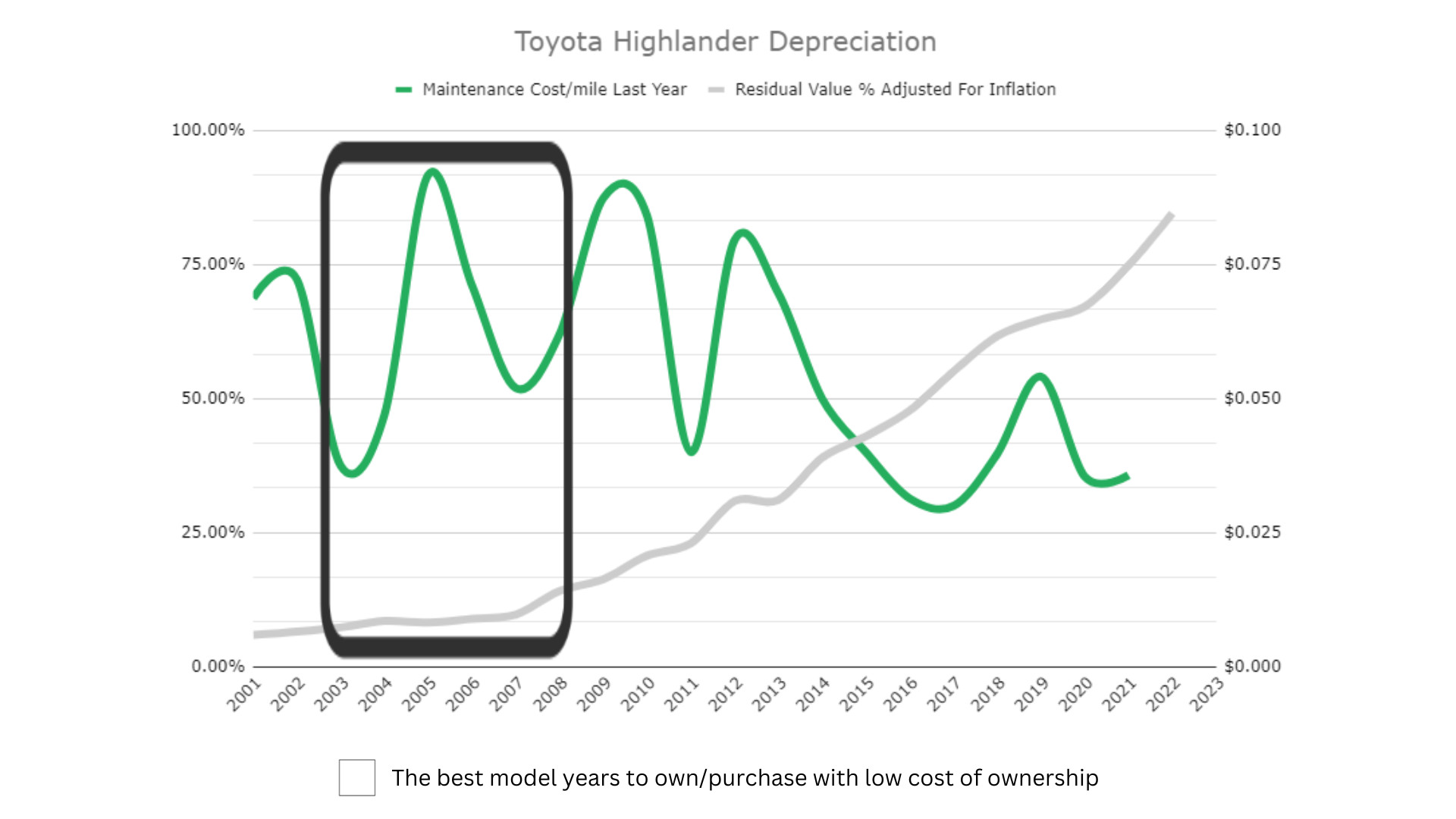
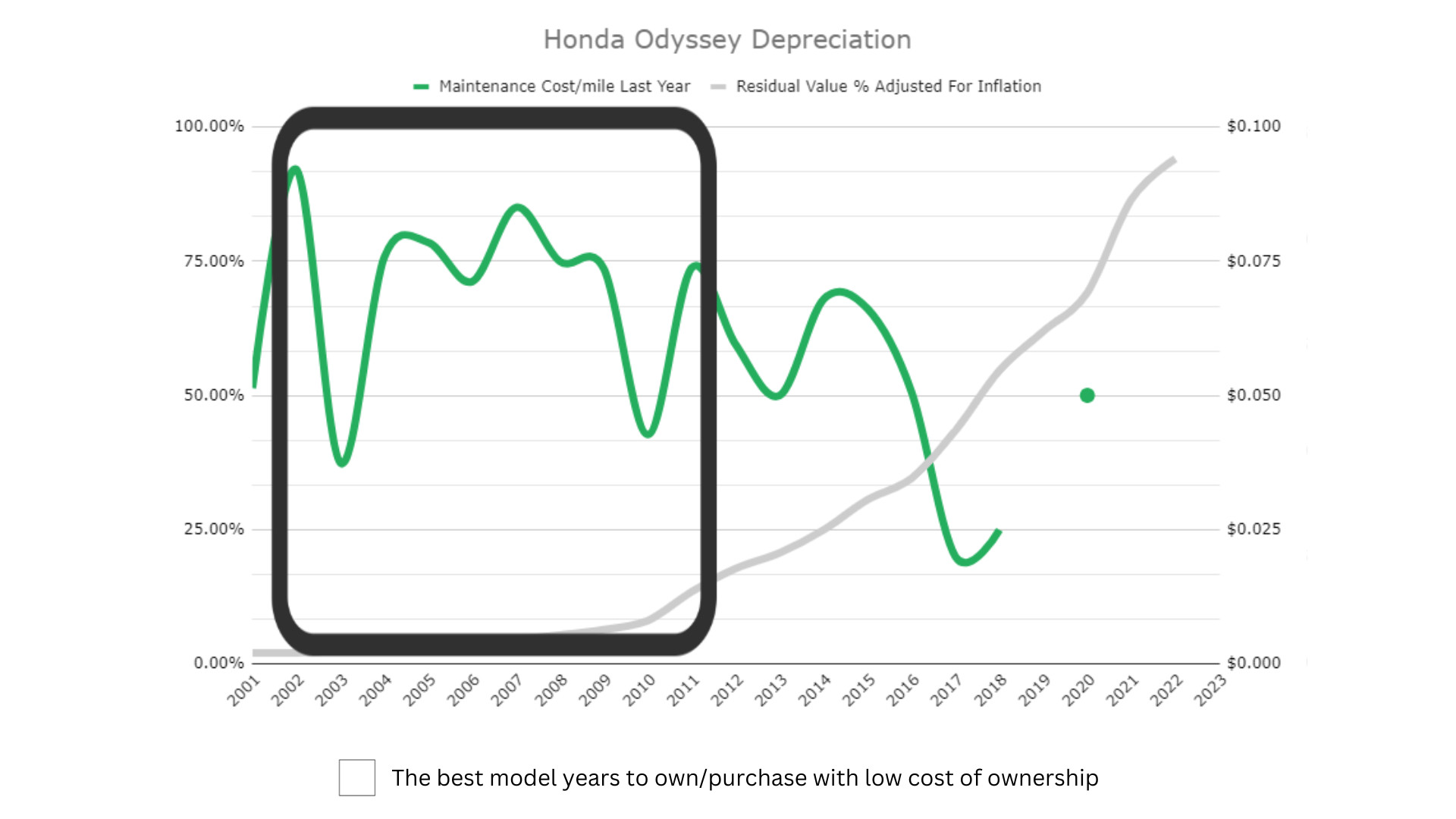
Averages provide a general overview of what owners can expect, but drilling into specific model years offers greater insight. In particular, being alert to higher-than-normal service bills can be helpful during shopping. Owners of Highlanders from 2005, 2009, 2010, 2012, 2013, and 2015 reported upkeep costs of 20% or more above average. The same goes for 2002, 2007-2009, 2011, and 2014 Odysseys.
Typically, higher maintenance and repair costs kick in after ten years. Even considering Toyota’s and Honda’s build quality, parts still wear out over time. Keep this in mind while shopping. Ideally, you can find service records to review.
Review the best and worst years of the Toyota Highlander and Honda Odyssey to learn more about maintenance and repair costs for these vehicles.
Safety Rating Comparison | Toyota Highlander vs. Honda Odyssey

Strong safety scores are necessary for family vehicles like the Highlander and Odyssey. Parents want to know their little loved ones are as safe as possible. A look at testing scores from the National Highway Traffic Safety Administration (NHTSA) testing shows this is the case with these Toyotas and Hondas. Only the 2002 Highlander fails to cross the 4.0 (out of 5.0) threshold for a “good” safety rating. The 2001 Highlander wasn’t tested.
For those hyper-focused on safety, it’s worth noting that the Odyssey consistently outperforms the Highlander in NHTSA assessments. Yet these scores are only incrementally better. I’d still consider the Highlander safe, except for those early years.
More details about crash test safety scores are covered in articles about the Toyota Highlander and Honda Odyssey.
Fuel Efficiency Comparison | Toyota Highlander vs. Honda Odyssey
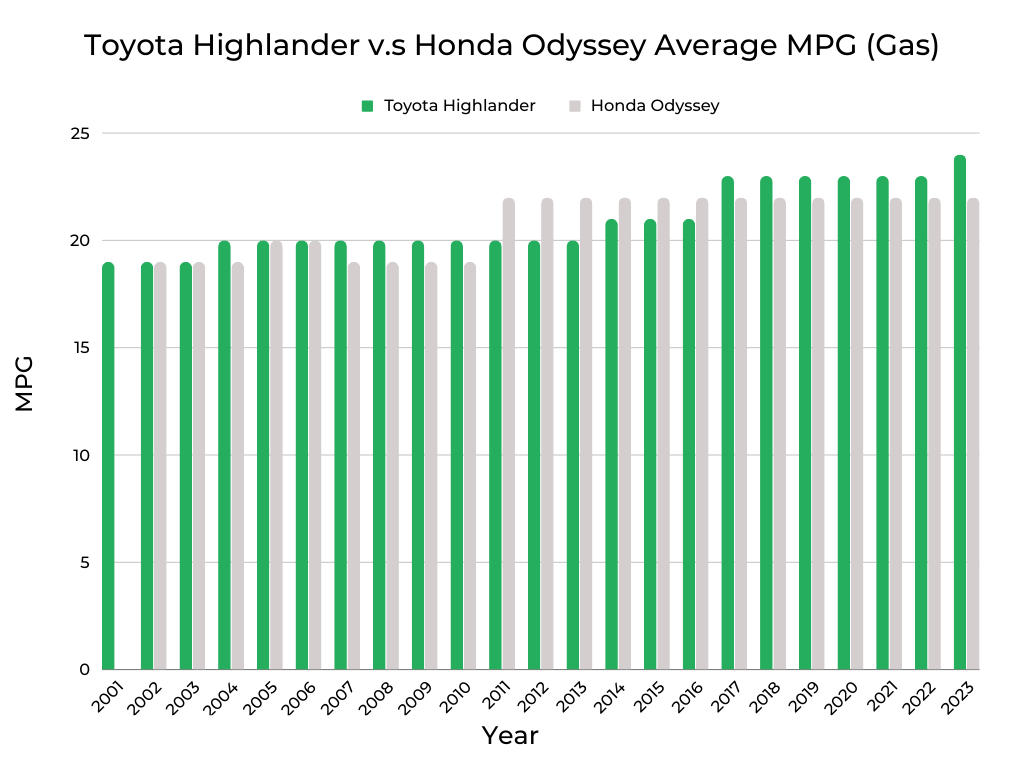
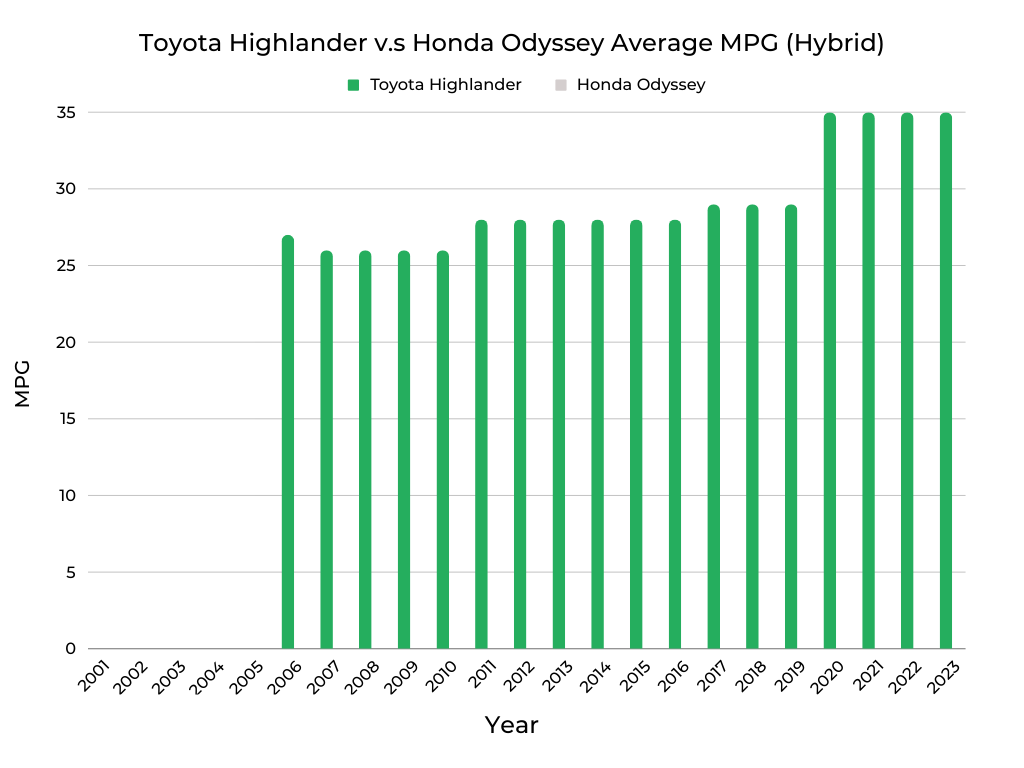
The conversation about Highlander and Odyssey fuel economy is best split into non-hybrid and hybrid discussions. With conventional powerplants, these grocery getters perform similarly in the mpg department.
The Highlander offers a one mpg advantage for many years, while the Honda provides a 1-2 mpg gain from 2011-2016. Toyota introduced a four-cylinder base engine for 2023 (dropping the Highlander’s standard V6), which helped provide a modest two mpg gain over the Odyssey. Nonetheless, I’d call fuel economy a wash, as neither vehicle has a commanding lead.
The same can’t be said when talking about hybrids. For one, the Odyssey doesn’t offer a hybrid engine. Plus, the Highlander Hybrid’s fuel economy (up to 35 mpg in later years) is leaps and bounds above the regular Highlander and the Odyssey. If saving on fuel is a priority, there’s only one winner in this contest, the Highlander Hybrid.

Dave Goldberg is an automotive journalist and lifelong car fanatic. He writes for numerous enthusiast and business outlets and is an ongoing contributor to HotCars.com, one of the most popular car culture websites. When he’s not writing or driving, Dave is either under a hood or asleep. His credentials include a BA in Journalism from The George Washington University.