

| Table of Contents | |
| Possible Causes of P0128 & Their Repair Costs | P0128 indicates that the engine is running cooler than it should, failing to reach its normal operating temperature. |
| How to Diagnose the Cause of Your P0128 Code | A faulty thermostat is the most likely cause of code P0128. However, low coolant, a defective radiator fan, a bad coolant temperature or intake air temperature sensor, or a malfunctioning engine control module can also be the problem. |
| Can I drive with a P0128 code? | Yes, driving for a week or two is okay, but the problem should be resolved soon to avoid the increased emissions, reduced fuel economy, and the risk of damage over the long term. |
| DIY | How To Fix P0128 Causes |
DIYable P0128 triggers include: Low coolant |
| P0128 Code FAQs |
Frequently asked questions:
|
Diagnostic trouble code (DTC) P0128: Coolant Temperature Below Thermostat Regulating Temperature signals that the engine coolant temperature is not reaching the expected operating temperature within a specified time after a cold start. This measurement is captured by the engine control module (ECM) or powertrain control module (PCM). This issue typically involves a malfunctioning engine thermostat, but there are other possible causes (which are covered below). Adjacent codes involving engine/coolant temperatures (and often bad thermostats) include DTC P0125, P0126, and P0127.
The engine thermostat is crucial to the proper operation of your car’s cooling system. A temperature-regulating valve controls the coolant flow between the engine and the radiator. Keeping an engine at an optimal operating temperature helps with efficiency and performance and promotes longevity.
When a cold engine is first started, the thermostat remains closed. This action keeps the coolant from reaching the radiator, allowing the engine to reach its ideal temperature more quickly. Once the engine reaches its peak temperature, usually 195°F to 220°F, the thermostat opens, allowing coolant to flow to the radiator to draw off excess heat and maintain a steady engine temperature.
In most cases, a check engine light associated with a P0128 code won’t immediately be accompanied by noticeable symptoms. This condition can make the problem easy to ignore, but prompt attention is recommended. You can continue to drive with a P0128 code but address the issue over the next week or two. However, the problem should be treated more urgently if there is any noticeable performance loss or other unusual conditions.
Let’s explore the root of P0128 causes and symptoms. In addition, we’ll look at typical repairs and what cars have the greatest history with P0128 codes.
Possible Causes of P0128 & Their Repair Costs
A faulty thermostat is the most likely reason for a P0128 code. However, considering other possible causes is the smart way to diagnose the trouble. Replacing a thermostat isn’t the most complex or expensive car repair, but you’ll want to root out other problems to avoid wasting time and money.
Check out the FIXD article on the most common causes of check engine lights.
Here’s an overview of the most likely parts and systems that can cause a P0128 code and their average repair costs. Actual prices can depend on the vehicle and location.
| Part To Repair | Part / DIY Price | Mechanic Total Cost |
| Coolant | $10–$20 | N/A |
| Thermostat | $378–$383 | $506–$544 |
| Radiator Fan | $562–$572 | $703–$749 |
| Coolant Temperature Sensor | $306–$325 | $400–$443 |
| Intake Air Temperature Sensor | $34–$43 | $99–101 |
| Engine Control Module/Powertrain Control Module | $929–$978 | $1,006–$1,075 |
Here’s a brief look at how faulty parts trigger a P0128 code.
| Parts that can cause P0128 | How it could cause P0128 |
| Low Coolant | A lack of coolant means engine heat may not be extracted effectively, causing the engine to struggle to warm up to normal operating temperature quickly. |
| Faulty Thermostat | A stuck-open thermostat allows coolant to flow continuously through the radiator, preventing the engine from reaching its proper operating temperature. |
| Defective Radiator Fan | A constantly running fan (or one that comes on too soon) overcools the engine and prevents it from reaching normal operating temperature. |
| Bad Coolant Temperature Sensor | A malfunctioning coolant temperature sensor sends incorrect, low-temperature readings to the engine control module, even when the engine is actually at normal operating temperature. |
| Malfunctioning Intake Air Temperature Sensor | A defective intake air temperature sensor can incorrectly report low air temperatures to the engine control module, causing it to enrich the fuel mixture unnecessarily and potentially cool the engine below its optimal operating temperature. |
| Defective Engine Control Module / Powertrain Control Module | A failing engine control module can misread the coolant temperature, leading to improper temperature regulation even when other cooling system components are working correctly. |
Makes Commonly Affected By P0128
Code P0128 is among the most common diagnostic trouble codes, and a review of FIXD sensor data reveals that it impacts many models. However, some makes are particularly susceptible to code P0128-related issues.
Chevy’s long-serving (and now discontinued) Impala sedan is the worst offender, followed closely by General Motors’ best-selling vehicle, the Silverado 1500 pickup. The Malibu slides into third. Unlike the other automakers, Chevy’s top three on this list have very high code P0128 occurrence levels. Nissan’s greatest culprits are all sedans, the Altima, Sentra, and Maxima.
The venerable F-150 is Ford’s most likely vehicle to experience a P0128 code. Meanwhile, the Fusion and Focus follow, but with a much lower occurrence rating.
Although the Jeep Wrangler might have a good reputation for off-road capability, this SUV’s standing isn’t so good when it comes to P0128-related issues. In this matter, it’s the worst Jeep on the road, far exceeding the occurrence levels of the brand’s runner-ups, the Grand Cherokee and Liberty.
Dodge completes the P0128 top five brands, with the company’s Grand Caravan minivan having quite a robust history with this DTC. The Charger and Durango occupy the second and third-place spots, respectively.
| Top 5 Makes Affected by P0128 | Most Affected Model(s) |
| Chevrolet | Impala |
| Silverado 1500 | |
| Malibu | |
| Nissan | Altima |
| Sentra | |
| Maxima | |
| Ford | F-150 |
| Focus | |
| Fusion | |
| Jeep | Wrangler |
| Grand Cherokee | |
| Liberty | |
| Dodge | Grand Caravan |
| Charger | |
| Durango |
How to Diagnose the Cause of Your P0128 Code
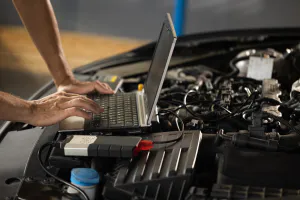
Diagnosing a check engine light starts with using an OBD-II scanner to identify what’s causing the issue. The FIXD plug-in sensor will show the code and likely causes on your phone via the accompanying FIXD app. You can also try a basic code reader with a cable to plug into the car’s OBD-II port. In truth, there are only a few things a novice DIYer can do to identify what triggered a P0128 code. You’ll want a flashlight, gloves, safety goggles, and a rag if you’re going under the hood. A more involved effort will require essential hand tools.
The FIXD sensor (via the smartphone app) and more advanced code readers can monitor the coolant temperature; this can help target the problem. Specifically, you’ll want to check if the coolant temperature remains well below the thermostat rating (195°F to 220°F) after the car has been running for several minutes. A coolant temperature that hasn’t reached the thermostat rating strongly indicates a faulty thermostat.
Symptoms of P0128 Causes
Numerous causes can trigger code P0128, so you’ll want to review each trouble spot. This starts with inspecting accessible components and observing any unusual conditions.


Click on each Possible Cause of a P0128 code to know the symptoms to look out for and what to inspect.
Symptoms:
- Check engine light
- Lower coolant level
- Slow engine warm-up
- Lack of cabin heat
- Temperature gauge reading low
- Engine running cooler
- Fluctuating temperature readings
- Coolant leak
- Reduced fuel economy
- Engine performance issues
What to Inspect:
Check the coolant reservoir’s level. If it’s low, look for a leak, often indicated by an accumulation under the car or a sweet smell (ethylene glycol, the primary coolant ingredient, has a syrupy aroma).
Symptoms:
- Check engine light
- Lower coolant level
- Slow engine warm-up
- Lack of cabin heat
- Temperature gauge reading low
- Engine running cooler
- Fluctuating temperature readings
- Coolant leak
- Reduced fuel economy
- Engine performance issues
- Cool upper radiator hose
What to Inspect:
Start the engine from cold, monitor the temperature gauge, or use an infrared thermometer on the upper radiator hose. Alternatively, an OBD-II scanner can monitor the coolant temperature (see above). If the temperature doesn’t reach the normal operating range within 10-15 minutes, or the upper hose doesn’t get hot, the thermostat may be stuck open. A moderately skilled DIYer or a professional mechanic can remove the thermostat for further testing/replacement.
Symptoms:
- Check engine light
- Slow engine warm-up
- Lack of cabin heat
- Temperature gauge reading low
- Engine running cooler
- Fluctuating temperature readings
- Reduced fuel economy
- Engine performance issues
- Fan running constantly
- Unusual fan noises
- Battery drain (if the fan is continuously running)
What to Inspect:
Start the engine and let it warm up to operating temperature, then observe if the fan activates when it should (typically when the engine reaches about 195°F to 220°F). A mechanic (or advanced DIYer) can also test the fan by disconnecting its electrical connector and applying 12-volt power directly to it—if it doesn’t spin, it’s likely faulty.
Symptoms:
- Check engine light
- Slow engine warm-up
- Lack of cabin heat
- Temperature gauge reading low
- Engine running cooler
- Fluctuating temperature readings
- Reduced fuel economy
- Engine performance issues
What to Inspect:
Use an OBD-II scanner to compare the sensor’s reading with the actual engine temperature measured by an infrared thermometer. A technician can also test the sensor’s resistance with a multimeter.
Symptoms:
- Check engine light
- Slow engine warm-up
- Lack of cabin heat
- Temperature gauge reading low
- Engine running cooler
- Fluctuating temperature readings
- Reduced fuel economy
- Engine performance issue
- Inconsistent air-fuel mixture
What to Inspect:
Use an OBD-II scanner to read and compare the sensor’s output to the ambient air temperature. A technician can also test the sensor’s resistance with a multimeter.
Symptoms:
- Check engine light
- Slow engine warm-up
- Lack of cabin heat
- Temperature gauge reading low
- Engine running cooler
- Fluctuating temperature readings
- Reduced fuel economy
- Engine performance issue
- Difficulty starting the engine
- Incorrect idle speed
- Transmission shifting issues
- Multiple, seemingly unrelated error codes
What to Inspect:
Testing a potentially malfunctioning engine control module (ECM) requires advanced diagnostic equipment and expertise. Leave this job for a professional, but multiple unrelated DTCs strongly indicate ECM problems.
Can I drive with a P0128 code?
Quick answer: Yes, it’s acceptable to drive with a P0128, but don’t delay getting the problem looked at.
In the short term (a week or two), driving with a P0128 code is fine. However, anytime you’re dealing with a cooling system issue, there’s always a risk of engine damage. In addition, P0128-related problems can lead to emissions issues and reduced fuel economy.
In extreme cases, a low coolant temperature can lead to a fuel mixture that is too rich. Over time, this can destroy an expensive-to-replace catalytic converter. Lastly, stop driving if there’s any stalling or hesitation. A poorly performing car can create a safety hazard, especially on the highway and at intersections.
Here’s an expanded look at driveability with a P0128 code.
| Causes | Can I Drive? | Risks / Safety / Performance |
| Low Coolant | Yes, driving for a short period is fine, but don’t put off repairs for too long. You want to avoid causing more substantial damage. To avoid potential safety issues, don’t drive with reduced engine performance. | Driving with low coolant can cause poor engine efficiency and increased wear due to improper temperature regulation. If not addressed quickly, it may also lead to more serious engine damage. |
| Faulty Thermostat | Yes, driving for a short period is fine, but don’t put off repairs for too long. You want to avoid causing more substantial damage. To avoid potential safety issues, don’t drive with reduced engine performance. | Driving with a faulty thermostat can cause poor fuel economy and accelerated engine wear due to below-normal operating temperatures. |
| Defective Radiator Fan | Yes, driving for a short period is fine, but don’t put off repairs for too long. You want to avoid causing more substantial damage. To avoid potential safety issues, don’t drive with reduced engine performance. | A defective radiator fan can cause engine overcooling, reducing efficiency and potentially increasing wear on engine components. |
| Bad Coolant Temperature Sensor | Yes, driving for a short period is fine, but don’t put off repairs for too long. You want to avoid causing more substantial damage. To avoid potential safety issues, don’t drive with reduced engine performance. | A faulty coolant temperature sensor can cause incorrect air-fuel mixtures, which can reduce engine performance and cause damage over time. |
| Malfunctioning Intake Air Temperature Sensor | Yes, driving for a short period is fine, but don’t put off repairs for too long. You want to avoid causing more substantial damage. To avoid potential safety issues, don’t drive with reduced engine performance. | A defective intake air temperature sensor can cause incorrect air-fuel mixtures, which can reduce engine performance and cause damage over time. |
| Malfunctioning Engine Control Module/Powertrain Control Module | Yes, driving for a short period is fine, but don’t put off repairs for too long. You want to avoid causing more substantial damage. To avoid potential safety issues, don’t drive with reduced engine performance. | A faulty CM/PCM can cause erratic engine performance, poor fuel efficiency, and unexpected stalling. Over time, improper timing and fuel management may damage various engine components. |
DIY | How To Fix P0128 Causes
Many repair projects for a code P0128-related issue require a reasonable amount of mechanical skill. Diagnostic equipment may also be necessary. While swapping out a thermostat (the most likely remedy) isn’t overly technical, accessing the component can be challenging in some cars. In addition, the correct method involves draining and refilling the cooling system. There are other precise steps to follow.
Likewise, swapping out a bad coolant temperature or intake air temperature sensor isn’t that complex. But again, finding the part’s location and properly performing the repair isn’t for beginners. Unless you have moderate or higher repair skills, we suggest limiting your activities to the basic diagnostic steps outlined earlier (see Symptoms of P0128 Causes) and consulting a professional mechanic.
That said, there’s one area that every car owner should know how to resolve: low coolant.
Possible Cause: Low Coolant
What is it?
Coolant is an essential fluid for every vehicle with an internal combustion engine. Low coolant can trigger a P0128 code but it’s easy to resolve (absent any leaks).
How hard is it to fix?
Difficulty Level: Easy
Locate the coolant reservoir under your car’s hood to check for a low coolant level. Look at the side of the reservoir to find the “Full” and “Low” markings. The coolant level should be between these marks when the engine is cool. Review the owner’s manual for more specifics. Use the correct coolant for your car (see the owner’s manual), open the reservoir (when the engine is cold), and add more coolant as needed. This task is as fundamental as checking the oil level or tire air pressure.
Be observant of leaks (look for coolant puddles under the car) that might be causing the low level. If a low coolant level returns, see a mechanic.
IMPORTANT SAFETY ISSUES:
- Never open a hot cooling system (the pressurized liquid is hazardous)
- Although coolant is toxic, its sweet smell can be attractive to pets, and its bright color can be appealing to children.
Cost of Repairs
A gallon of coolant costs $10 to $20 for most brands.
Before dealing with any code P0128-related repair, check whether your car is under warranty. You can save money by letting the automaker handle the work. In addition, research if there are any technical service bulletins (TSBs) for your car. TSBs are official repair/correction notices issued by the manufacturer that cover specific problem areas. You can research this online or contact a dealer.
P0128 Code FAQs
What makes and models does code P0128 affect the most?
Here’s a breakdown of the vehicles most affected by code P0128, according to FIXD sensor data collected in 2023.
| Make | Model | Occurrence Frequency |
| Chevrolet | Impala | High |
| Chevrolet | Silverado 1500 | High |
| Chevrolet | Malibu | High |
| Dodge | Grand Caravan | High |
| Ford | F-150 | High |
| Jeep | Wrangler | High |
| Nissan | Altima | High |
| Chevrolet | Cobalt | Medium |
| Chevrolet | Colorado | Medium |
| Chevrolet | Equinox | Medium |
| Chevrolet | Camaro | Medium |
| Chevrolet | Sonic | Medium |
| Chrysler | Town & Country | Medium |
| Dodge | Charger | Medium |
| Ford | Focus | Medium |
| GMC | Acadia | Medium |
| GMC | Envoy | Medium |
| GMC | Sierra | Medium |
| Jeep | Grand Cherokee | Medium |
Is there anything I can do to prevent a P0128 code from occurring?
One way to avoid a P0128 issue is to monitor the coolant level regularly. Ideally, you should check it monthly. However, you can do nothing about staying on top of the thermostat’s condition. It can last for years without any problem and then one day go bad. The same applies to the other possible trouble spots, such as the radiator fan, coolant temperature sensor, intake air temperature sensor, or the engine control module. Address any P0128-related issue promptly to avoid greater trouble down the road.
What causes code P0128?
A P0128 code is triggered when the engine doesn’t reach its normal operating temperature within a set time after a cold start. This is usually due to problems with the cooling system, with a stuck-open thermostat being the most probable reason. However, a code P0128 can also be due to low coolant levels, a malfunctioning coolant temperature or intake air temperature sensor, or issues with the radiator fan. In rare cases, a bad engine control module might be at fault.
References:
- Repair-cost estimates, repairpal.com (various dates). Retrieved July 23, 2024, from repairpal.com.

Dave Goldberg is an automotive journalist and lifelong car fanatic. He writes for numerous enthusiast and business outlets and is an ongoing contributor to HotCars.com, one of the most popular car culture websites. When he’s not writing or driving, Dave is either under a hood or asleep. His credentials include a BA in Journalism from The George Washington University.