


| Table of Contents | |
| Possible Causes of P0335 & Their Repair Costs | Code P0335 indicates a malfunction in the crankshaft position sensor “A” has been detected. |
| How to Diagnose The Cause of Your P0335 Code | P0335-related problems can usually be traced to a faulty crankshaft position sensor. However, the issue can also involve sensor wiring, the reluctor ring, the timing belt/chain, or the engine control module (ECM)/powertrain control module (PCM). |
| Can I drive with a P0335 code? | P0335 is a DO NOT DRIVE condition due to the potential for catastrophic engine damage. |
| DIY | How To Fix P0335 Causes | DIYable P0335 triggers include:Faulty Crankshaft Position SensorOther DIY Considerations for Code P0335 |
| P0335 Code FAQs | Frequently asked questions:What Makes and Models does code P0335 affect the most?What is a P0335 fault code?What are the most likely reasons for a P0335 Chevy error code? |
Among all the internal components of a modern automobile engine, the crankshaft is one of the most critical. Its sole task is to convert the up-and-down motion of the engine’s pistons into rotational motion. This energy is transferred to the transmission and, ultimately, to the wheels.
Monitoring crankshaft timing is essential for proper and efficient engine operation. The engine control module (ECM) or powertrain control module (PCM) uses a crankshaft position sensor. The ECM stays on top of the combustion cycle with the camshaft position sensor.
P0335—Crankshaft Position Sensor “A” Circuit Malfunction is one of several diagnostic trouble codes (DTCs) indicating a sensor error. In this case, the problem lies in the sensor circuitry. Other codes that cover the crankshaft position sensor include:
- P0336—Crankshaft Position Sensor ‘A’ Circuit Range/Performance
- P0337—Crankshaft Position Sensor ‘A’ Circuit Low Input
- P0338—Crankshaft Position Sensor ‘A’ Circuit High Input
- P0339—Crankshaft Position Sensor ‘A’ Circuit Intermittent
Related codes, P0385 through P0389, refer to crankshaft position sensor “B” issues (for engines with a second sensor). All these DTCs indicate potential problems with the sensor, wiring, or the circuit carrying crankshaft position data to the engine control module.
Every code, including P0335, involving a crankshaft position sensor requires immediate attention to avoid severe internal engine damage. On a serious scale of 1 to 10, this is an 11. The best approach is to pull over in a safe spot, shut off the engine, and get towed to the repair shop. Driving for even a short distance risks catastrophic engine failure.
A comprehensive look at P0335 codes awaits. Keep reading to learn about likely causes, repairs, and which vehicles have the most significant history with this problem.
Possible Causes of P0335 & Their Repair Costs
Regardless of your familiarity with car repairs, having a basic understanding of potential P0335-related codes is essential. You’ll be better prepared whether or not you hire a mechanic or take a DIY approach.
Check out the FIXD article on the most common causes of check engine lights.
Here’s a look at the parts most likely involved with a P0335 code and how much things cost. Note that actual prices depend on the vehicle and location.
P0335 Code Triggers & Typical Repair Costs
| Part To Repair | Part / DIY Price | Mechanic Total Cost |
| Sensor Wiring | $15–$90 | $90–$320 |
| Crankshaft Position Sensor | $96–$121 | $168–$224 |
| Reluctor Ring | $30—$80 | $200–$600 |
| Timing Belt | $293—$395 | $603–$785 |
| Timing Chain | $694—$707 | $1,604–$1,905 |
| Engine Control Module (ECM)/Powertrain Control Module (PCM) | $929–$978 | $1,006–$1,075 |
Here’s how different malfunctioning parts can trigger a P0335 code.
Parts Most Likely to Fail & Cause a P0335 Code
| Parts that can cause P0335 | How it could cause P0335 |
| Bad Sensor Wiring | Damaged, corroded, or loose wiring can interrupt the signal between the sensor and the ECM or create a short circuit. Physical damage from rubbing against engine parts or heat-related deterioration often causes these issues. A defective connector can also be to blame. |
| Faulty Crankshaft Position Sensor | When the sensor fails internally, it cannot accurately read and transmit crankshaft position data to the ECM. Age, heat exposure, and vibration are common causes of sensor failure. |
| Malfunctioning Reluctor Ring | The sensor cannot accurately read the crankshaft’s position if teeth are missing or damaged or if the ring is warped. Metal debris buildup on the ring can also interfere with proper readings. |
| Faulty Timing Chain/Belt | When stretched or improperly tensioned, the crankshaft is out of sync with the camshaft. Advanced wear can cause timing components to skip teeth or slip. |
| Defective Engine Control Module (ECM)/Powertrain Control Module (PCM) | If the ECM fails, it may not be able to process the signals it receives from the sensor properly. Internal circuit board damage or corrupted software can prevent proper interpretation of sensor data. Sometimes, a software update is all that’s needed. ECM problems are rare but still a possibility. |
Makes Commonly Affected By P0335
FIXD sensor data reports that while most major automotive brands have a certain degree of code P0335 incidents, some vehicles are more vulnerable to these problems. Here’s a breakdown of the top five manufacturers.
Chevrolet leads the list with the Silverado 1500. It’s the only Bow Tie brand vehicle with a high occurrence rating. The Malibu and Impala are at a medium level for P0335 codes. Meanwhile, Toyota has two cars, the Camry and Corolla, with an extensive history of these problems. The RAV4 slots into third place for this company.
Nissan follows Toyota due to the extensive P0335 background of the Altima and Frontier. The Pathfinder completes the Japanese automaker’s podium. German manufacturers are represented on this list by the venerable Audi A4, the brand’s only entry with a high occurrence rating for P0335 codes.
The Grand Caravan, Ram 1500, and Charger represent the worst Dodges for the P0335 DTC. However, the Grand Caravan stands out, and not in a good way, for its excessive incident level compared to its stablemates.
Ford fans may be relieved that Blue Oval vehicles didn’t make the top five index. However, their relief was short-lived, as the automaker just missed the cut by landing in sixth place. On the positive side, the Ford F-150 has zero recorded incidents of P0335 codes.
| Top 5 Makes Affected by P0335 | Most Affected Model(s) | |
|
Chevrolet |
Silverado 1500 | |
| Malibu | ||
| Impala | ||
|
Toyota |
Camry | |
| Corolla | ||
| RAV4 | ||
|
Nissan |
Altima | |
| Frontier | ||
| Pathfinder | ||
| Audi | A4 | |
|
Dodge |
Grand Caravan | |
| Ram 1500 | ||
| Charger | ||
How to Diagnose P0335 Causes
Determining if the check engine light is due to a P0335 code comes from using an OBD-II scanner. A basic handheld reader will suffice, but these only provide the code; you’ll still need to decipher the underlying cause. Alternatively, a FIXD plug-in sensor and app provide next-level diagnostic information, including typical causes and likely repairs. Live data streaming can also be useful.
With a P0335 code confirmed, you may want to do some preliminary investigating under the hood before getting a professional involved. Here are the safety-minded steps to follow:
- Find a flat, safe spot to park.
- Turn off the car.
- Set the parking brake.
- Wait for the engine to cool before proceeding.
Recommended tools/supplies: safety goggles, gloves, a flashlight, and a rag.
Symptoms of P0335 Causes
Chances are the P0335 code you’re encountering is caused by a defective crankshaft position sensor. However, other conditions can be at play, so expanding your investigation is wise, even if it’s just a visual inspection of other possible trouble spots.
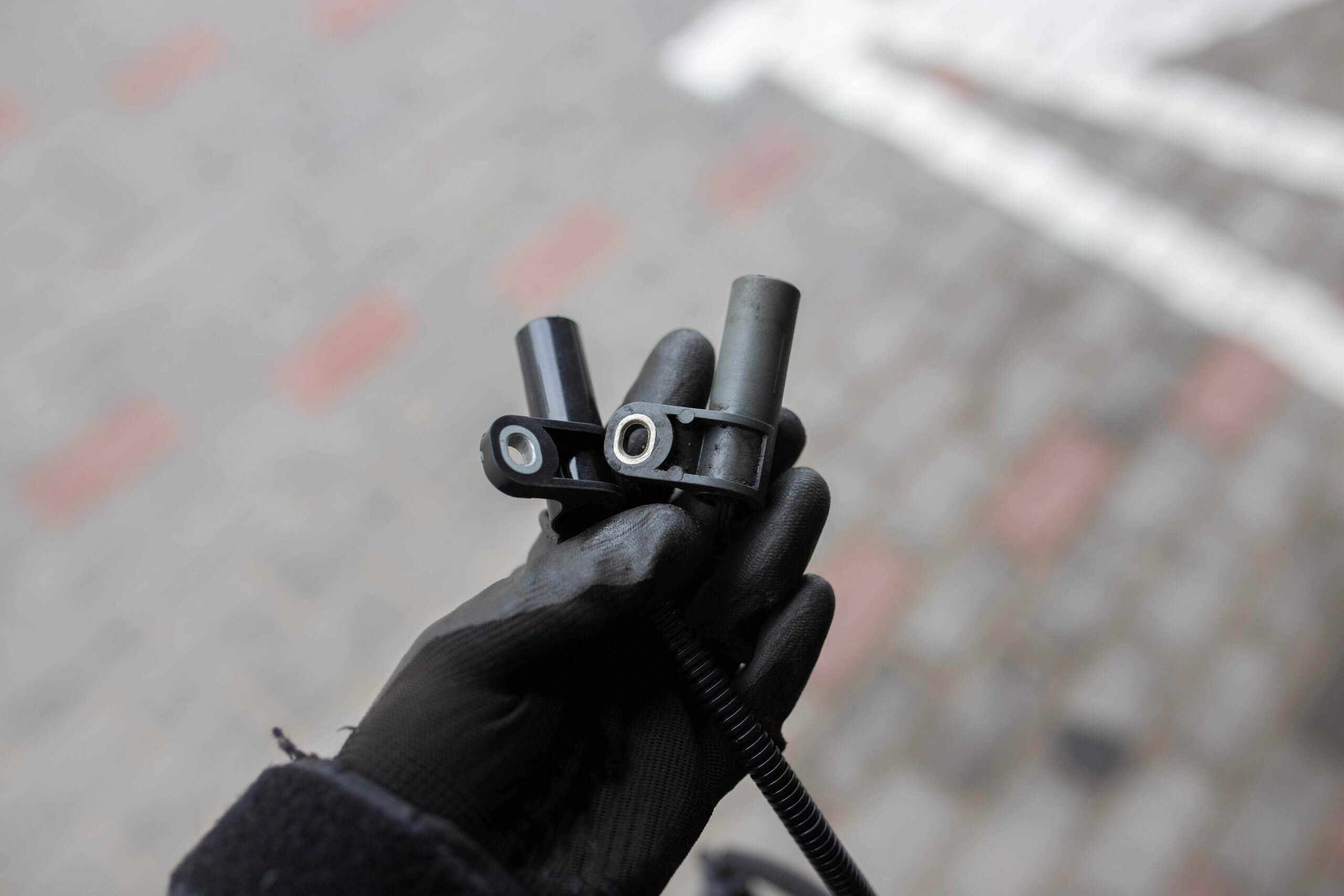


Symptoms:
- Check engine light
- Rough running engine
- Decreased fuel economy
- Reduced engine performance
What to Inspect:
Locate the crankshaft position sensor. Depending on the car, it can be at either end of the engine, on the side of the engine block, or near the timing cover. For details, refer to a technical guide for your car.
With the engine off and cool:
- Visually inspect visible wiring for apparent damage, cuts, or burns
- Gently wiggle the connector to check for looseness
- Look for signs of rubbing against other components
- Check for green corrosion on connector pins
Note: On some vehicles, the crankshaft position sensor is inside the timing cover, making inspection impractical for the casual DIYer.
Symptoms:
- Check engine light
- Rough running engine
- Decreased fuel economy
- Reduced engine performance
What to Inspect:
The sensor itself can be inspected visually while you’re checking the wiring:
- Look for oil leaks around the sensor (could indicate a bad seal)
- Check for physical damage to the sensor body
- Make sure the mounting bolts are tight
Pro Tip: Don’t remove the sensor unless you’re prepared to deal with potential oil leakage and have a replacement gasket on hand.
Note: On some vehicles, the crankshaft position sensor is inside the timing cover, making inspection impractical for the casual DIYer.
Symptoms:
- Check engine light
- Rough running engine
- Decreased fuel economy
- Reduced engine performance
What to Inspect:
In most cases, investigating the reluctor ring requires a more extensive inspection and professional tools. However, you can:
- Look for metal shavings in your oil during oil changes (could indicate ring damage)
- Listen for grinding or scraping sounds near the crankshaft area
Note: Full inspection requires removing components and should be done by a professional.
Symptoms:
- Check engine light
- Rough running engine
- Decreased fuel economy
- Reduced engine performance
- Ticking sound/unusual noise
- Engine misfire
- Oil leaks from the front of the engine.
- Hard start/no start
What to Inspect:
Some basic checks you can perform:
- Listen for rattling sounds during engine operation
- Check maintenance records; if the timing belt is overdue for replacement, that could be the issue
Warning: Don’t attempt timing belt/chain replacement unless you’re very experienced. Incorrect installation can result in catastrophic damage to the valves and pistons.
Symptoms:
- Check engine light
- Rough running engine
- Decreased fuel economy
- Reduced engine performance
- Multiple trouble codes appear simultaneously (not just P0335)
- Erratic gauge readings on the dashboard
- Engine stalling or failing to start with no apparent pattern
- Transmission shifting problems
- Electronic features behaving erratically (like power windows or radio)
What to Inspect:
This is the hardest to diagnose without professional equipment, but you can:
- Check if multiple diagnostic trouble codes are present
- Notice if other electrical systems are acting strangely
- Check battery connections first; loose or corroded battery terminals can mimic ECM problems
- Look for signs of water damage or corrosion around the ECM (usually located under the dash or in the engine bay)
Can I drive with Code P0335?
Quick answer: No. Driving with a P0335 risks severe engine damage. Call a tow truck.
Could you drive a short distance to a repair shop while dealing with a P0335 code? Possibly. However, the inconvenience and cost of towing far outweigh the potential consequences. An engine with an out-of-synch crankshaft or a problematic timing belt or chain is a recipe for disaster and a wallet-draining repair bill. Playing it safe is always the best philosophy.
Here’s a more detailed look at driveability with a P0335 code.
| Causes | Can I Drive? | Risks / Safety / Performance |
|---|---|---|
|
Bad Sensor Wiring |
No, avoid the risk of catastrophic engine failure. |
Intermittent engine stalling could occur at anytime, potentially in dangerous traffic situations. The engine may also suddenly fail to restart, leaving you stranded. |
|
Faulty Crankshaft Position Sensor |
No, avoid the risk of catastrophic engine failure. |
The engine could stall without warning while driving and may not restart, which is especially dangerous at highway speeds or in heavy traffic. |
|
Malfunctioning Reluctor Ring |
No, avoid the risk of catastrophic engine failure. |
Metal debris from a failing ring can contaminate the engine oil and cause severe damage. The engine might also stall unexpectedly as the computer loses track of the crankshaft position. |
|
Faulty Timing Chain/Belt |
No, avoid the risk of catastrophic engine failure. |
This is extremely serious. Continued driving could break the timing chain/belt, causing substantial engine damage, including bent valves and pistons. Complete engine replacement might be needed if this occurs. |
|
Defective Engine Control Module (ECM)/Powertrain Control Module (PCM) |
No, avoid the risk of catastrophic engine failure. |
Multiple critical systems, including the engine, transmission, and safety systems, could fail simultaneously, making this particularly dangerous for highway driving. The vehicle might also shut down without warning or exhibit unpredictable behavior. |
DIY | How To Fix P0335 Causes
Unlike some repairs, fixing a P0335-related problem through DIY efforts will be limited for the average car owner. Outside of basic inspections, as outlined above, most remedies require some degree of experience and mechanical skills.
The one repair detailed here, replacing the crankshaft sensor, is moderately difficult, something a novice probably won’t want to tackle, let alone be able to do. Other repairs require even more specialized skills. In short, it’s best to contact a mechanic before you get in over your head and risk injury or more damage. Consider these indicators when it’s time to call in a pro:
- If visual inspection doesn’t reveal obvious issues
- If you lack specialized tools
- If you’re not comfortable working around engine components
- If multiple systems are affected
Possible Cause: Faulty Crankshaft Position Sensor
What is it?
A bad crankshaft sensor can send wrong information to the engine control module, causing the car to lose power, run rough, or become less efficient. Changing a malfunctioning unit can restore normal operations and ensure a smooth-running engine.
How hard is it to fix?
Difficulty Level: Moderate
In most cars, the actual work of changing a crankshaft sensor is uncomplicated. It’s not much more complex than installing a light bulb in a hard-to-reach fixture or connecting the components of an entertainment system. However, the real challenge is accessing the sensor itself. Often, it’s buried behind other elements, making repairs difficult. A seasoned mechanic may know a hack or two to make the task easier, but a DIYer probably won’t. In addition, specialized tools may also speed up the work, things that may not be in the DIYer’s toolbox. In addition, turn the repair over to a pro if the problem is related to the sensor connector and not the sensor. Dealing with loose wires or replacing a harness is delicate work.
Cost of Repairs
A new crankshaft sensor runs from $96 to $121.
Other DIY Considerations for Code P0335
Working on other P0335-related repairs is not a casual activity. Replacing crankshaft sensor wiring demands a specialized touch while installing a new reluctor ring or timing belt/chain is not for amateurs. Further, working on an engine control module (ECM) or powertrain control module (PCM) calls for sophisticated equipment and training that most DIYers, no matter their skill level, won’t have.
Before dealing with any code P00335-related repair, check whether your car is under warranty. You can save money by letting the automaker handle the work. In addition, research if there are any technical service bulletins (TSBs) for your car. TSBs are official repair/correction notices issued by the manufacturer that cover specific problem areas. You can research this online or contact a dealer.
P0335 Code FAQs
What Makes and Models does code P0335 affect the most?
Here’s a breakdown of the vehicles most affected by code P0335, according to FIXD sensor data collected in 2023.
| Make | Model | Occurrence Frequency |
| Audi | A4 | High |
| Chevrolet | Silverado 1500 | High |
| Dodge | Grand Caravan | High |
| Nissan | Altima | High |
| Nissan | Frontier | High |
| Toyota | Camry | High |
| Toyota | Corolla | High |
| Chevrolet | Malibu | Medium |
| Chevrolet | Impala | Medium |
| Chevrolet | Equinox | Medium |
| Dodge | Ram 1500 | Medium |
| Nissan | Pathfinder | Medium |
| Nissan | Sentra | Medium |
| Nissan | Maxima | Medium |
| Nissan | Xterra | Medium |
| Infiniti | G35 | Medium |
| Lexus | IS 250 | Medium |
| Subaru | Impreza | Medium |
| Toyota | RAV4 | Medium |
| Toyota | Tundra | Medium |
What is a P0335 fault code?
A P0335 is a diagnostic trouble code indicating a malfunction of the crankshaft position sensor circuit. This sensor monitors the crankshaft’s position and rotational speed, sending vital data to the engine’s computer to control ignition timing and fuel injection. When this code appears, it typically means there’s an issue with either the sensor itself, its wiring, or related components like the reluctor ring that could affect engine performance and starting reliability. Driving with a P0335 is not advisable due to the risk of catastrophic engine damage.
What are the most likely reasons for a P0335 Chevy error code?
The most common causes of a P0335 code in Chevrolet vehicles are a failed crankshaft position sensor or damaged wiring/connections to the sensor. Less frequently, it can be caused by a damaged reluctor ring or timing chain issues, particularly in higher mileage engines. Rarely, a faulty engine control module (ECM) or powertrain control module (PCM) could be at fault.
References:
Repair-cost estimates, repairpal.com (various dates). Retrieved December 10, 2024, from repairpal.com.

Dave Goldberg is an automotive journalist and lifelong car fanatic. He writes for numerous enthusiast and business outlets and is an ongoing contributor to HotCars.com, one of the most popular car culture websites. When he’s not writing or driving, Dave is either under a hood or asleep. His credentials include a BA in Journalism from The George Washington University.