
Vehicle Class & Body Style:
Quick Take: The VW Jetta and Toyota Camry both fall into the midsize sedan segment, but the Camry offers more cabin space than the Jetta in every metric.
Per the U.S. Environmental Protection Agency (EPA), a 2023 Volkswagen Jetta and Toyota Camry are both midsize sedans, a classification based on passenger volume. However, the EPA uses a range for this classification as evidenced by the Camry being wider, longer, and more voluminous inside by 5 cubic feet than the Jetta.
Most of these measurement advantages are only a few inches, but as we’ll look at more closely below, an extra 2 inches of backseat hip room can seem like 2 miles when you’ve got kids back there.
| 2023 Volkswagen Jetta | 2023 Toyota Camry | |
| Class | Mid-size Sedan | Mid-Size Sedan |
| 4-Door Sedan | S,Sport,SE,SEL, GLI Autobahn | LE, XLE, XLE V6, SE, SE Nightshade Edition, XSE, XSE V6, TRD, LE Hybrid, SE Hybrid, SE Hybrid Nightshade Edition, XLE Hybrid, XSE Hybrid |
Powertrain:
Engine Options & Specifications:
Quick Take: The Jetta edges out the base Camry in fuel economy with its smaller engine, but the Toyota offers a far more potent V6 and hyper-miling-ready hybrid, neither of which can be found in the Veedub.
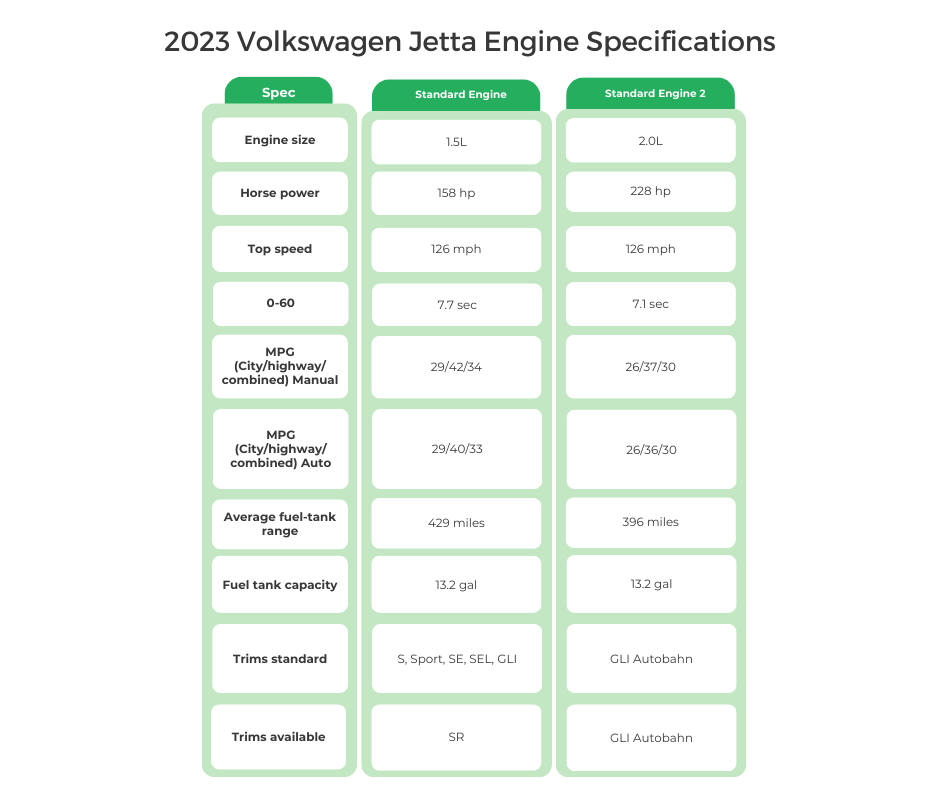
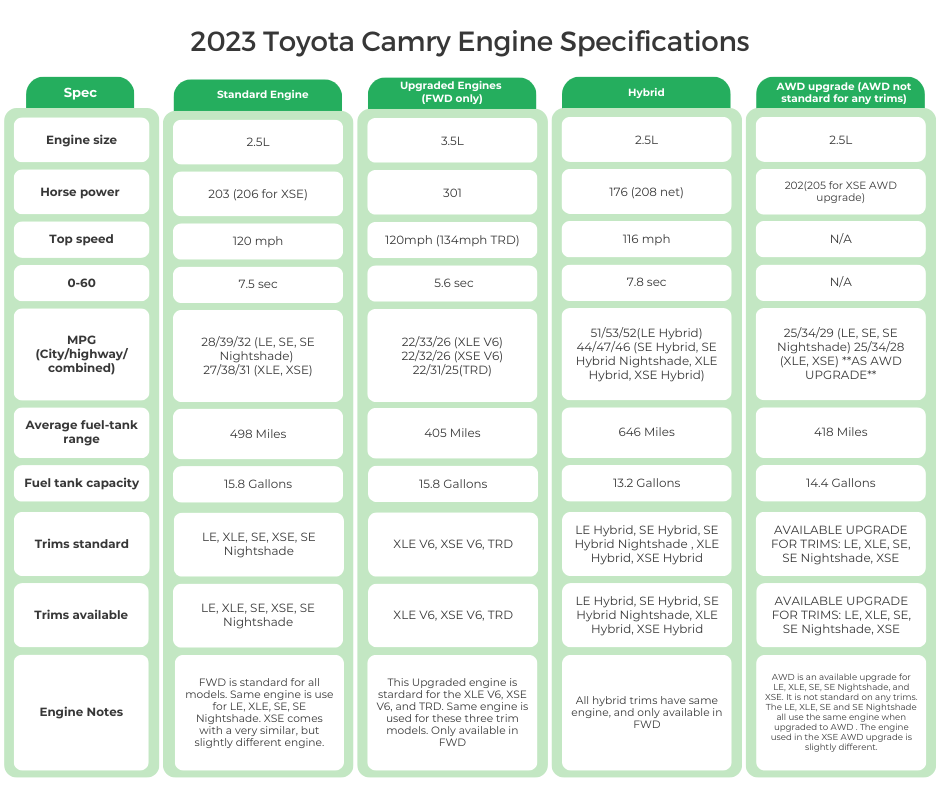
Part of the reason a 2023 Camry is more expensive than a 2023 Jetta is found under the hood. Most new Jettas are powered by a 1.5L turbocharged inline-4 making 158 horsepower. Compare that to the entry-level Camrys running naturally aspirated 2.5L four-pots good for 203 hp.
Both of these setups are good for similar 0-60 mph runs and deliver virtually identical fuel economy figures with an automatic transmission. Hat tip to the stick shift Jetta for standing tall in this conversation by offering the best highway efficiency.
If you want more juice from your Jetta, the GLI Autobahn variant packs 228 ponies, but this model is aimed more at handling than drag racing. That’s backed up by the V6-powered Camry, which makes 73 more horsepower than the Jetta GLI, and the legitimately quick 5.6-second sprint to 60 mph a TRD model can manage.
Need even more variety? The Toyota steps ahead by offering a hybrid powertrain that knocks fuel efficiency out of the park with up to 53 mpg in highway driving.
Transmission Options & Specifications:
Quick Take: The Camry is for commuters, and the Jetta is for drivers.
In this 2023 Volkswagen Jetta vs. Toyota Camry comparison, the Camry is the pricier sedan but largely backs that up with more variety, more space, more technology, and so on. However, if you’re a gearhead, only the Jetta allows you to row your gears.
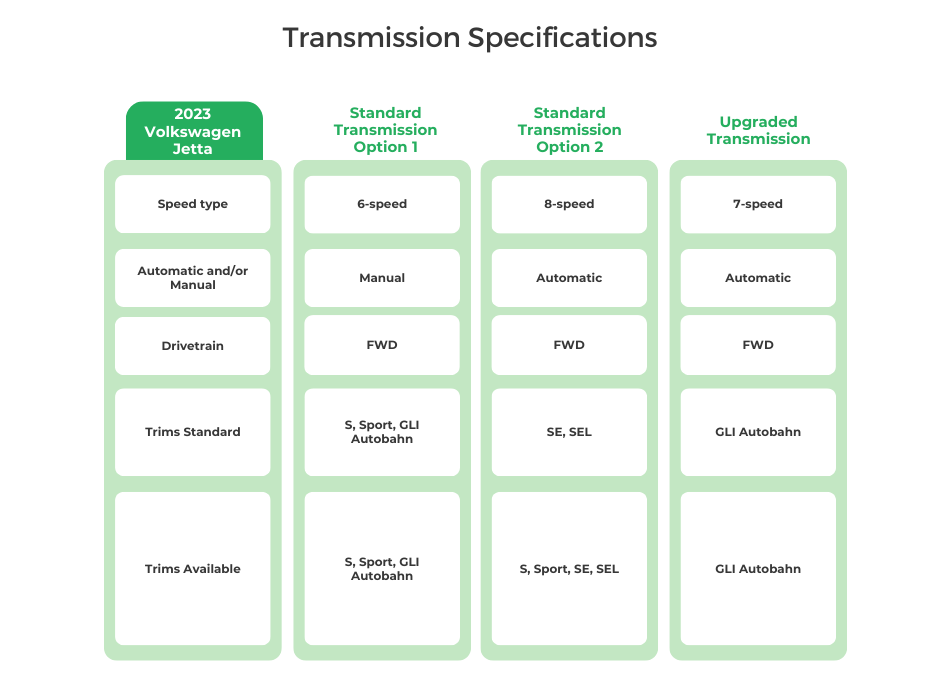
The manual transmission is slowly disappearing from the automotive landscape, so don’t miss the standard 6-speed stick that comes in a new Jetta. A traditional 8-speed automatic is also offered and the GLI models bring a 7-speed dual-clutch automatic for an extra racy vibe.
Though the Camry has the power to smoke the Jetta, it’s an automatic-only affair I’m afraid. An 8-speed unit is fitted to all 2023 Camrys except hybrids that receive an even less interesting electronic continuously variable transmission (eCVT).
Of course, most drivers likely aren’t too concerned with how their car shifts itself, but if you ARE interested, be sure to check out the “Tech Talk” section below!

TECH TALK: CVTs
A continuously variable transmission (CVT) does not use gears like a typical automatic transmission. Instead, it has two pulleys connected by a belt. One pulley connects to the engine, and the other connects to the wheels. The belt transfers the power between the pulleys. This setup allows the pulleys to continuously change positions as needed. The CVT automatically adjusts the pulleys as required, providing smooth and efficient power delivery.
An electronic continuously variable transmission (eCVT) uses electronic controls and electric motors to vary gear ratios instead of a belt and pulley system. Unlike a regular CVT, an eCVT has no physical pulleys or belts—the gear ratio is adjusted seamlessly by controlling the speeds of electric motors and generators. This electronic control allows faster, smoother gear ratio changes compared to a traditional CVT. An eCVT also provides more flexibility, needing less space and having fewer moving parts.
Wheel Drive:
Quick Take: The Jetta is FWD-only versus the FWD Camry which offers AWD for an additional cost.
As with most mainstream sedans, the 2023 Jetta and Camry are front-wheel-drive (FWD). However, the Toyota can be fitted with an all-wheel-drive (AWD) configuration, which the VW does not offer. It’ll cost you about $1,400 extra, but cannot be optioned on hybrid models.
| 2023 Volkswagen Jetta Wheel Drive | FWD | AWD | RWD |
| S | S | ||
| Sport | S | ||
| SE | S | ||
| SEL | S | ||
| GLI Autobahn | S |
| 2023 Toyota Camry Wheel Drive | FWD | AWD | RWD |
| LE | S | U | |
| LE Hybrid | S | ||
| SE | S | U | |
| SE Nightshade Edition | S | U | |
| SE Hybrid | S | ||
| SE Hybrid Nightshade Edition | S | ||
| XLE | S | U | |
| XLE Hybrid | S | ||
| XSE | S | U | |
| XSE Hybrid | S | ||
| TRD | S | ||
| XLE V6 | S | ||
| XSE V6 | S |
U = Available in upgrade
Safety:
Quick Take: The Camry lives up to Toyota’s safety reputation by besting the Jetta in crash testing, including more airbags, and offering a longer list of standard driver-assistance systems.
NHTSA Safety Ratings:
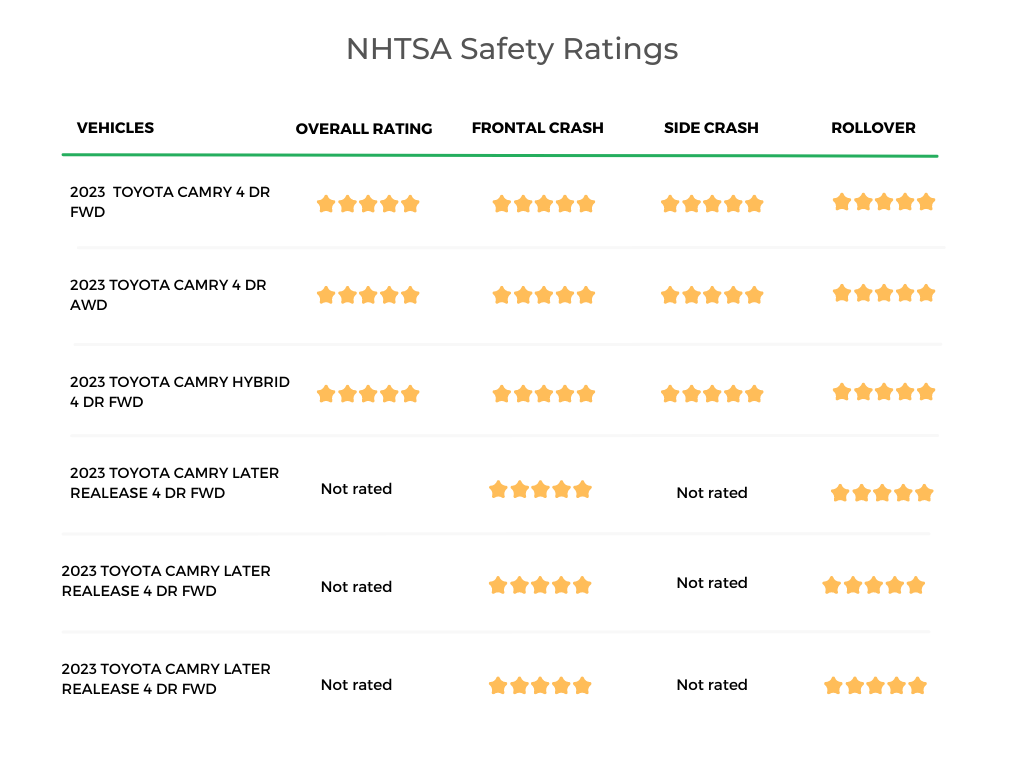
Browse a Reddit thread and you’ll find that Toyotas generally enjoy a reputation for strong safety scores. As you can see in the graphics below, this rings true as the 2023 Camry earns 5 out of 5 stars in all NHTSA crash-test protocols.
The 2023 Jetta matches the Camry with 5 stars overall and for side crash testing but comes in at 4 stars for the frontal crash and rollover protocols. Granted, there is only a 13% chance of the Jetta rolling versus 9.9% for the Camry, but it’s worth understanding these subtle differences in safety.

IIHS Awards:
Like the NHTSA, the IIHS performs crash testing on new vehicles, but it has additional protocols that it covers.
As you can see in the table below, the Toyota Camry also performs better than the Jetta in IIHS safety testing. The “Top Safety Pick+” rating that the 2023 model earned is the highest award available from the IIHS and one the Jetta does not receive.
Digging into the test results, I found that the 2023 Jetta was rated Poor in the updated moderate overlap crash test and Moderate to Poor in the headlights protocol. The Camy received nothing lower than a Moderate rating for any test as a reference point.
| IIHS Award | Tested Vehicle | ||
| 2023 Volkswagen Jetta | MIDSIZE CAR/4-DOOR SEDAN | None | 2019 Volkswagen Jetta 1.4T SEL Premium 4-door |
| 2023 Volkswagen Jetta 1.5T S 4-door | |||
| 2023 Toyota Camry | MIDSIZE CAR / 4-DOOR SEDAN | 2023 TOP SAFETY PICK + | 2018 Toyota Camry LE 4-door |
Airbags & Head Restraints:
Airbags are often assumed in modern cars, which is fair as front airbags have been required for more than 20 years. But do a little research and you’ll find some key differences between vehicles like a new Jetta and Camry.
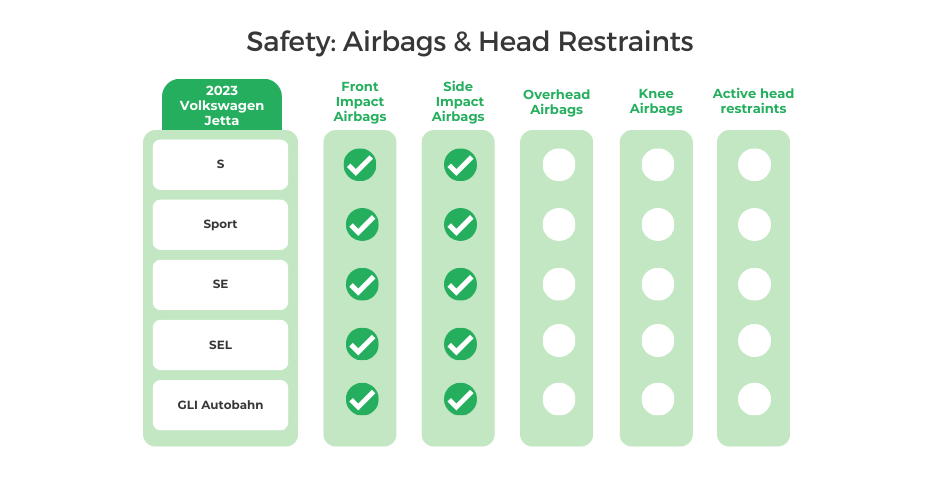
Volkswagen puts 6 airbags in every 2023 Jetta, but Toyota goes much further with 10 airbags for the Camry. Some of that advantage comes from the standard dual front knee units in the Camry, an airbag configuration that is unavailable in the Jetta.
Neither of these mainstream sedans offers overhead airbags or active head restraints. Just like they sound, overhead airbags are designed to protect occupants’ heads, while active head restraints aim to limit whiplash during rear-end collisions.

Semi-Autonomous Driving:
Semi-autonomous driving technology is a hot automotive topic these days and one the 2023 Jetta and Camry approach in different ways (and with different names). A continuous assistive and corrective steering system is standard on every Camry but is only included on Jetta SE models and above.
The theme continues with Toyota fitting every 2023 Camry with adaptive cruise control, but the VW Jetta requires you to buy at least an SE for this technology.
Both cars have standard automated emergency braking, but once again, a Jetta SE is needed to access forward collision warning, which comes with every 2023 Camry. Automatic parking is unavailable on either of these cars, which is unsurprising as this is more commonly seen on luxury vehicles.


Driver Warning Systems & Telematics:
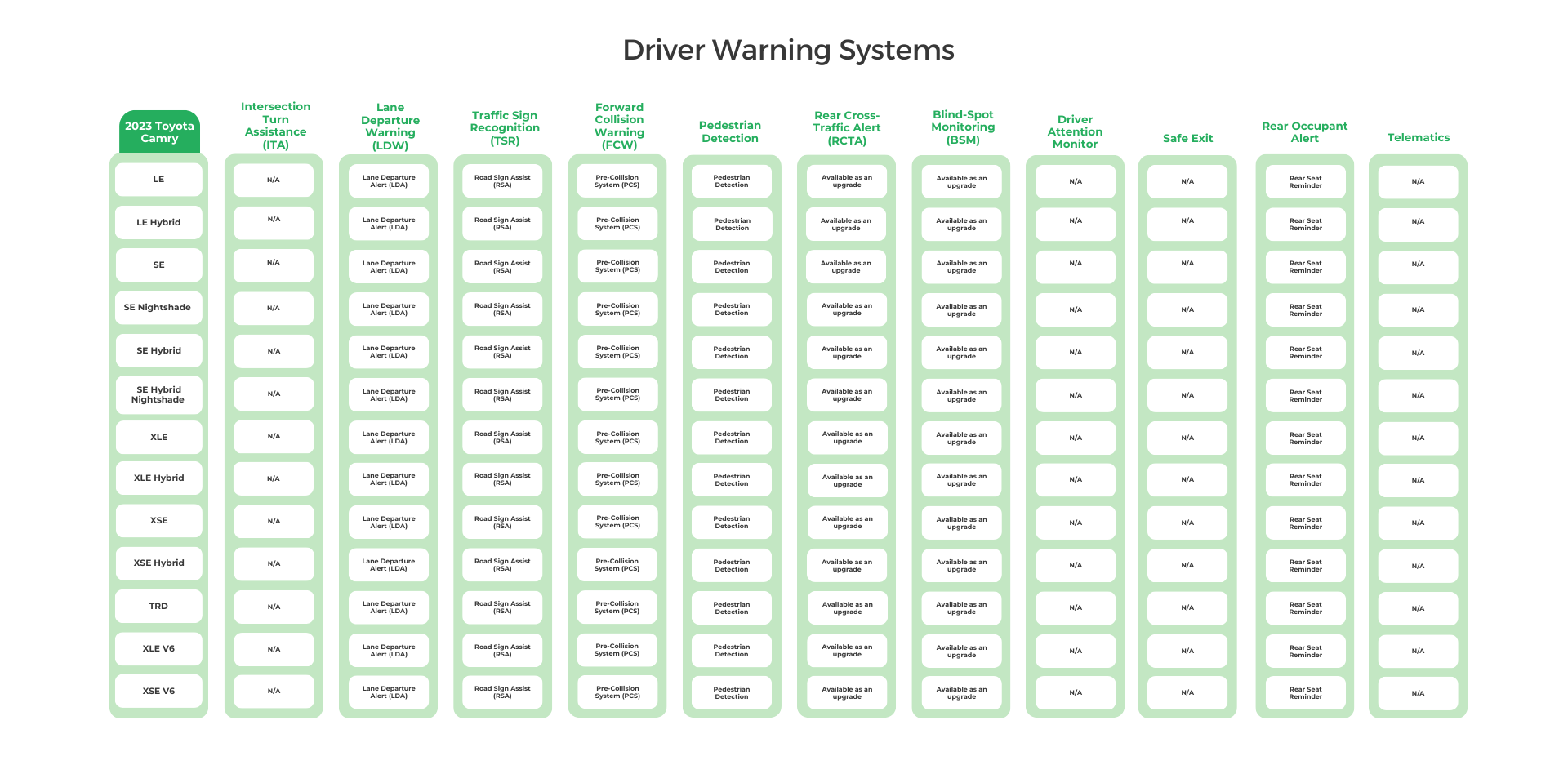
Going deeper down the advanced driver-assistance systems (ADAS) rabbit hole, we find that lane departure warning (LDW), traffic sign recognition (TSR), and rear occupant alert (ROA) are standard on the 2023 Camry. The Jetta offers LDW, but not TSR or ROA.
However, blind-spot monitoring (BSM) with rear cross-traffic alert (RCTA) and a driver attention monitor (DAW) are all standard Jetta fare. With the Camry, DAW is not offered on any model and BSM with RCTA requires an upgrade until you get to the XLE model.
Telematics systems are becoming more common these days and both the Jetta and Camry are outfitted with this tech, but keep in mind these systems require a subscription to utilize. Something you won’t find on either car is intersection turn assistance or safe exit assist.

Road Visibility Features:
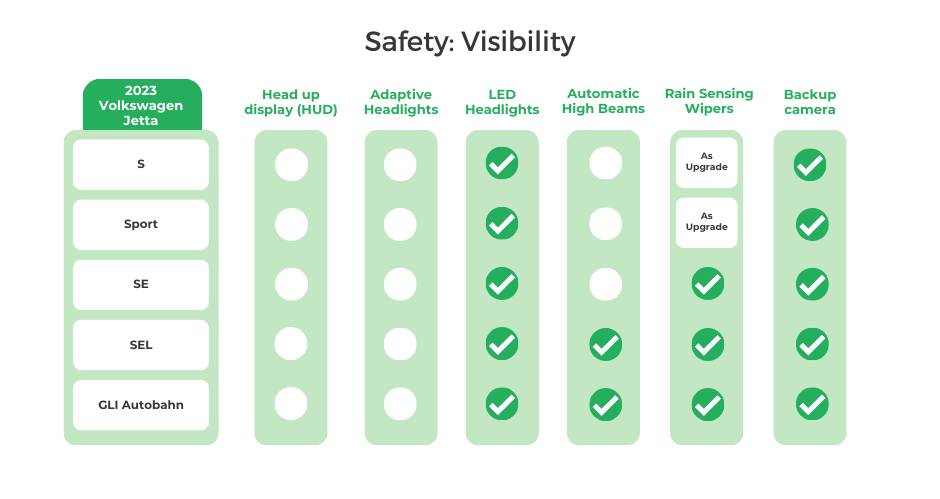
Headlights may sound as exciting as transmissions, but when it comes to visibility at night, LED headlights are far superior to old-school halogen units. Fortunately, they are standard on all 2023 Jettas and Camrys. Automatic high beams are also standard on the Camry, but not on the Jetta.
Only the Camry offers adaptive headlights, which swivel in concert with the steering wheel, and a head-up display, which projects information like vehicle speed and ADAS details into the driver’s sight line. But if rain-sensing windshield wipers are a must-have, you’ll only find them on the Jetta.

Interior:
Quick Take: Both of these sedans offer similar levels of creature comforts and content, but with the Camry, there is more room to stretch out and store your stuff.
Interior Features:
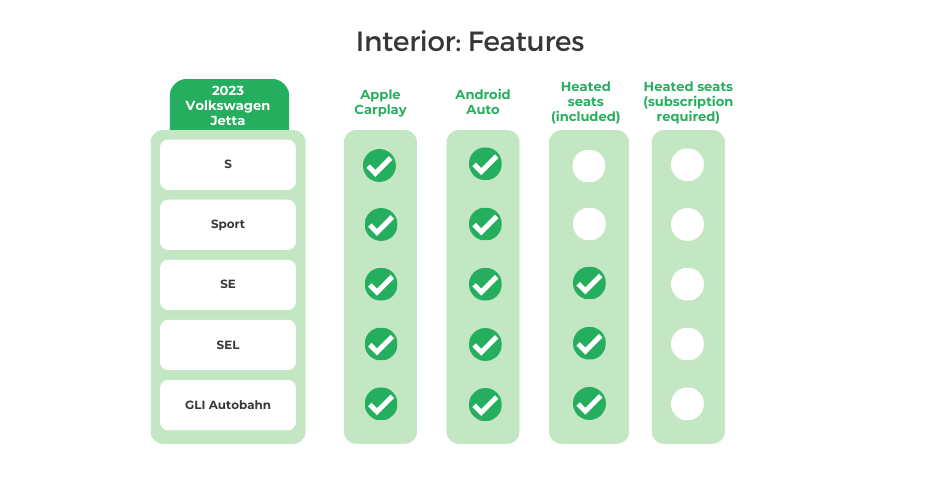
You’ll be hard-pressed to find a new car in 2023 that doesn’t have standard Apple CarPlay and Android Auto as consumer demand is so high. That’s the case here with both the 2023 Jetta and Camry making these systems standard.
Heated front seats are perhaps equally sought after – particularly for Snow Belters – but require buying something more expensive than a base model for both of these cars. If you haven’t heard of a heated seats subscription, you’re not alone as most car buyers remain unfamiliar with this concept.
It falls into the “Features on Demand” category, which McKinsey says is poised to explode in popularity. The idea is that a car owner only pays for a feature – like heated seats – when they need it – in the winter – and not in the summer. Thus far, VW and Toyota have not rolled it out.

Interior Dimensions:
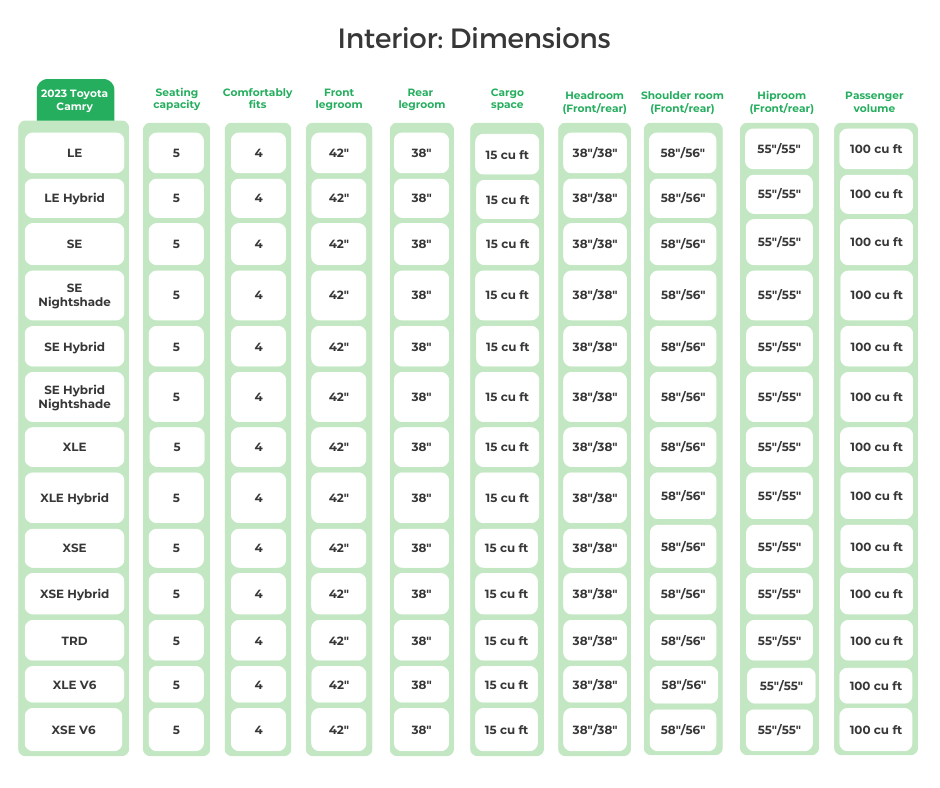
The table below really drives the point home about how two cars classified as midsize can be dramatically different inside. It’s also why you should spend some time sitting in any car you’re thinking about buying to get a sense of how well it does – or doesn’t – fit your needs.
Both the 2023 Jetta and Camry have two rows of seating with space to comfortably hold 4 people, but those people will arguably be more comfortable in the Toyota. That’s because the Camy offers close to 1 inch more space versus the Jetta in the legroom and rear headroom measurements.
The Camry’s trunk has an extra cubic foot of volume and 2 more inches of space for the front and rear shoulder room metrics and front hip room measurement. In the backseat, there is an extra 3.6 inches of hip space in the Camry plus an additional 5 cubic feet of passenger volume over the Jetta.
One, two, and three inches of space may sound like splitting hairs, but any parent will tell you that when it comes to putting kids in the back seats, every inch helps. Trust me, my kids just love it when I put all 3 of them across the back seat of my similarly-sized Mazda 6.

Exterior:
Quick Take: Not only is the Camry larger in all dimensions, it’s arguably the more stylish sedan with big wheels, wild wings, and swoopy lines.
Exterior Features:
Not long ago, a statement combining the words “Toyota Camry” and “style” would have been met with laughter. But ever since Akio Toyoda took the company reins, the Camry has exited Boring Boulevard and sauntered down Style Street.
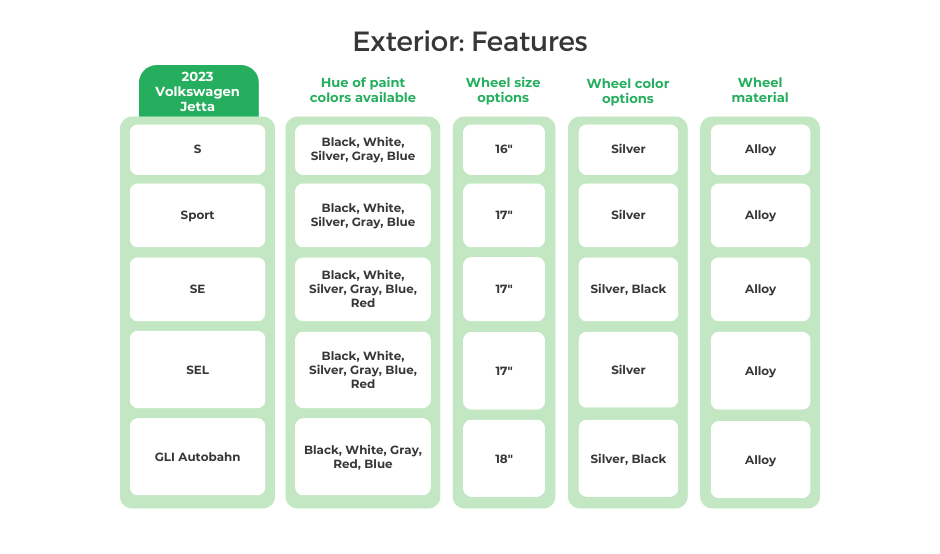
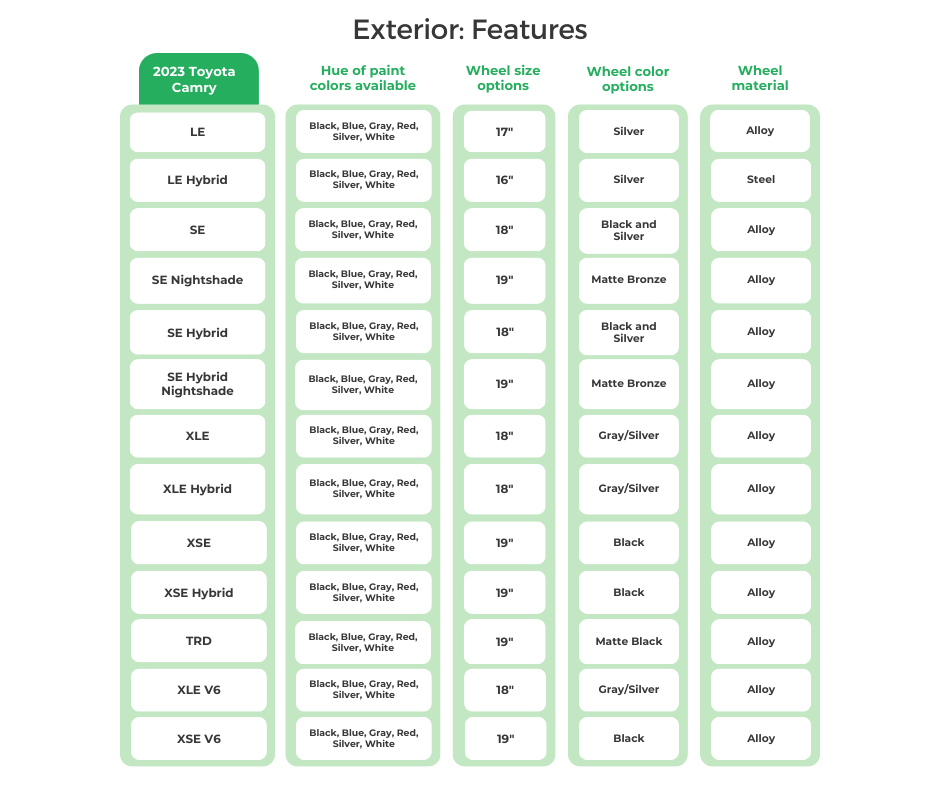
Yes, it is the only car here to still offer dowdy steel wheels and hubcaps, but that’s only on one model – looking at you LE Hybrid – while the rest of the lineup rolls on alloys ranging in size from 17 to 19 inches. Like the Jetta – which tops out at size 18 rims – the Camry offers silver or black wheel finishes. But Toyota gets even wilder with optional matte bronze or black looks.
As for paint options, neither of these family sedans gets too crazy, but the Camry offers a two-tone look on several models versus the Jetta which requires a GLI Autobahn for this level of swagger.
Exterior Dimensions:
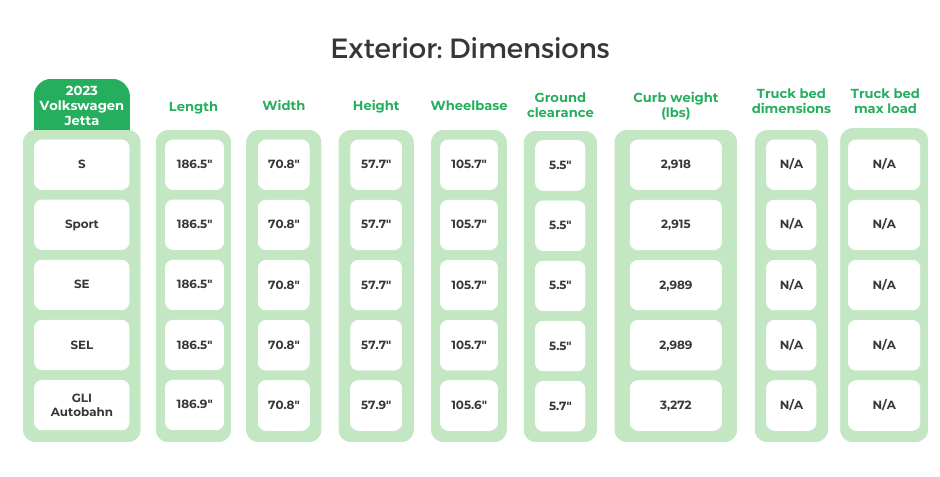
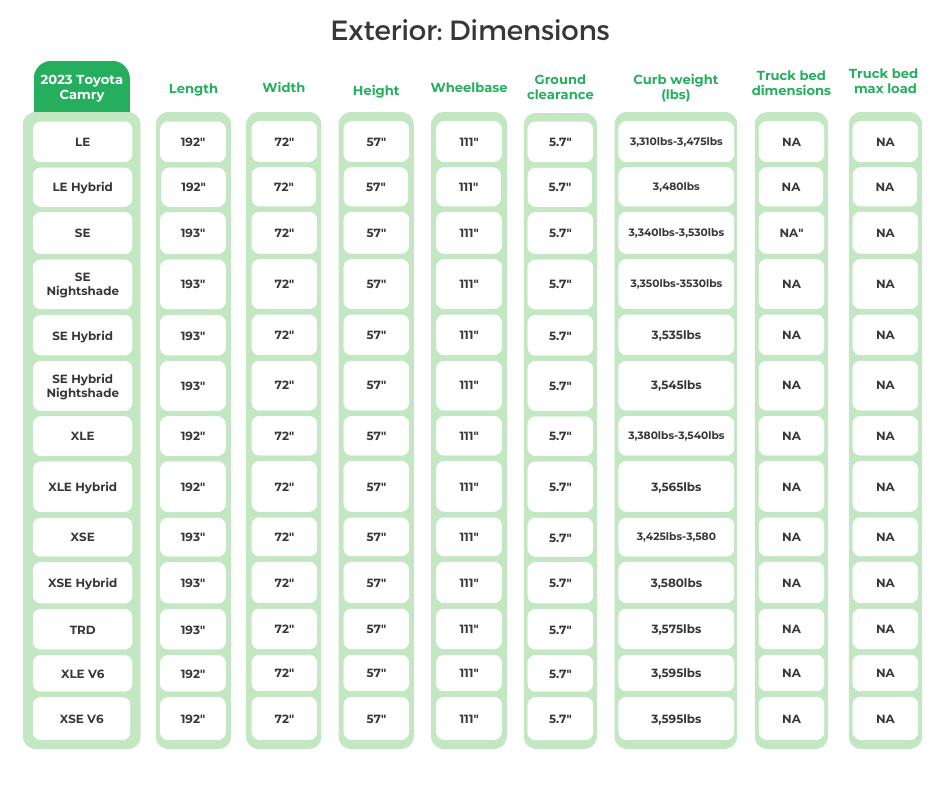
The table below of exterior dimensions helps explain why the Camry has a larger cabin. It also points to Toyota doing a better job of interior packaging as the Camry is only about 1” wider overall than the Jetta while managing to offer 2 to 3 more inches of interior width in the hip and shoulder room metrics.
The Camry is also 6” longer overall than the Jetta with 5 of those inches located between the wheels. As expected, Camrys with a V6 or hybrid powertrain tip the scales by an extra 300 to 600 pounds depending on configuration.
Warranty
Quick Take: Toyota’s powertrain coverage is better than Volkswagen’s, which is important as powertrain repairs tend to be more expensive, but otherwise the warranties are closely matched.
Toyota follows the industry norm for mainstream vehicle warranties by including 3 years or 36,000 miles of basic coverage and 5 years or 60,000 miles of powertrain coverage. VW goes its own way with a 4-year/50,000-mile bumper-to-bumper warranty. That means the basic coverage is longer than Toyota’s, but the powertrain coverage is shorter.
The 10-year battery warranty shown under the Camry only applies to that model’s hybrid battery pack. The Volkswagen’s comes with an extra year of roadside assistance over the Toyota and both the 2023 Jetta and Camry have 2 years of complimentary maintenance.
| 2023 Volkswagen Jetta Factory Warranty Coverage: | 2023 Toyota Camry Factory Warranty Coverage: | |
| Basic warranty: | 48 months/50,000 miles | 36 months/36,000 miles |
| Powertrain warranty: | 48 months/50,000 miles | 60 months/60,000 miles |
| Corrosion perforation warranty: | 84 months/100,000 miles | 60 months/unlimited miles |
| Air conditioning warranty: | 48 months/50,000 miles | 36 months/36,000 miles |
| Battery warranty: | 36 months/36,000 miles | 120 months or 150,000 miles (Hybrid HV Battery) |
| Emissions warranty: | Federal: (Defect & Performance) 24 months/24,000 miles – 96 months/80,000 miles California: (Defect & Performance) 36 months/50,000 miles – 72 months/70,000 miles |
Federal: 36 months/36,000 miles (defects) California: 36 months/50,000 miles |
| Roadside assistance coverage: | 36 months/36,000 miles | 24 months/25,000 miles (ToyotaCare) |
| Total unique recalls: | 0 | 1 (recall no. 23V432000) |

Niel Stender grew up doing replacement work on his old Cherokee and sweet Mitsubishi Starion, which led to a degree in mechanical engineering and a job at Ford as a vehicle dynamics engineer. His writing infuses that automotive background with sales and marketing experience. Writing about cars for close to a decade now, he enjoys digging into some of the more technical mechanical systems under the hood and throughout a vehicle.