
Comparing two venerable family haulers—the Honda Pilot and Toyota Sienna—may seem odd because one is a crossover SUV while the other is a minivan. Yet, at the heart of both vehicles is three rows of seating. Looking beyond the packaging, the Pilot and Sienna have similar, but not the same, capabilities, so savvy buyers are wise to expand their shopping horizons.
Not too long ago, I took a similar approach when comparing the Toyota Highlander and Honda Odyssey. But now the script has flipped with the minivan being from Toyota. Yet the Sienna has many advantages over the Odyssey. Not only is it one of the few minivans on the market available with all-wheel drive, but newer examples have hybrid-only engines, offering stellar fuel economy.
Without a hybrid option, the Pilot may not be as technologically advanced as a late-model Sienna (or a Highlander, for that matter). Yet, this vehicle has come a long way since its 2003 introduction. It may not be the best-selling three-row crossover from a mainstream brand (the Highlander and Ford Explorer get those honors), but it’s a solid performer with ample room for car seats or soccer teams.
Compared to more recent Siennas, the Pilot has another thing going for it: V6 power. Automakers are increasingly switching to four cylinders (usually with a turbo) for even large vehicles (recent examples include most Explorer trims, the latest Highlander, and the 2025 Chevrolet Traverse). I’ve owned other Honda products with the venerable 3.5-liter V6, and this engine gets the job done with no fuss.
But make no mistake, the Sienna is a workhorse in its own right. With greater passenger volume, this Toyota minivan can out-transport the Pilot. It has a larger maximum cargo space, and the Sienna’s third-row legroom is especially welcoming for adults.
But I’ll temper all this Pilot and Sienna praise with a dose of reality. Despite Honda’s and Toyota’s reputation for building bulletproof cars, older Pilots and Siennas don’t always benefit from this legacy. Even some newer Siennas suffer from less-than-perfect engine dependability.
The key to choosing between a Honda Pilot and a Toyota Sienna is sorting through the nitty gritty. You’ll want to learn what separates these three-row grocery getters: market values, depreciation, reliability, maintenance costs, and fuel economy.
Keep reading to see how this Honda Pilot and Toyota Sienna contest turns out. Other match-ups to review include Outback vs. Forester, 4Runner vs. Highlander, RAV4 vs. CR-V, Civic vs. Corolla, Pilot vs. Highlander, and Odyssey vs. Sienna.
| Income Bracket | Monthly Financing Cost Range | Cash Purchase Price Range | Honda Pilot Years | Toyota Sienna Years | Best Model Year: | Why? |
| $5k – $10k |
$83 – $125 | $3,000 – $4,500 | 2005 | N/A | 2005 Pilot | Low price, decent engine reliability |
| $10k – $15k | $125 – $187 | $4,500 – $6,750 | 2009 | N/A | 2009 PIlot | Good value, decent engine reliability |
| $15k – $25k | $187 – $312 | $6,750 – $11,250 | 2013 | 2013 | Tie | Very good engine reliability, solid safety scores |
| $25k – $35k | $312 – $437 | $11,250 – $15,750 | 2015 | 2015 | 2015 Pilot | Lower price |
| $25k – $35k | $312 – $437 | $11,250 – $15,750 | N/A | 2018 | 2018 Sienna | Very good engine reliability |
| $35k – $50k | $437 – $625 | $15,750 – $22,500 | 2019 | 2019 | Tie | Top engine reliability scores |
| $50k – $74k | $625 – $925 | $22,500 – $33,300 | 2021 | 2020 | 2021 Pilot | Top engine reliability score |
See the methodology for the table above.
Curious about other car pairings? Check these articles to explore:
Volkswagen Jetta vs. Honda Civic
Before you respond to the “For Sale” ad, check out this How to Buy a Used Car article for a step-by-step checklist.
Price History Comparison | Honda Pilot vs. Toyota Sienna
Average Market Value – Based on Owners’ Self-Reported Mileages | Honda Pilot vs. Toyota Sienna

Starting the car shopping process with a rough idea of prices is always smart—most buyers have a budget in mind. The chart, which shows Kelley Blue Book (KBB) data for private-party sales, reveals that prices for used Honda Pilots (green) and Toyota Sienna (gray) are relatively consistent among model-year pairs.
Owner-reported mileage via FIXD surveys is also baked into these figures. These real-world numbers provide a more accurate glimpse of today’s marketplace and account for some price variations. For example, the 2018 model year shows a greater gap in the valuation between the Pilot and Sienna. This is due to owners of the 2018 Sienna reporting significantly higher mileage than their Pilot counterparts.
The one anomaly is the 2021 model year, with the Sienna worth substantially more than the equivalent Pilot.
The Sienna has modestly better depreciation (23% over five years for a new car, according to CarEdge). But the Pilot’s 27% five-year depreciation rate isn’t far off. Both vehicles had near-identical MSRPs for 2021 base models ($35,775 for a Pilot LX and $35,635 for a Sienna LE). Yet a 4% difference in depreciation isn’t enough to account for an approximate $10,000 separation in market value. I’ll just attribute this variance to the weirdness of today’s used car marketplace.
Resale values are more understandable among older examples. In 2015, the Pilot LX and Sienna LE had almost identical original MSRPs (around $32,000). Here, we can see used Siennas being worth slightly more thanks to a bump from lower depreciation.
In 2008, a Pilot LX stickered at $30,275, compared to $27,174 for a Sienna LE. The gap shows a modestly higher market value for 2008 Pilots despite lower depreciation.
It’s important to know that shopping at a dealer will cause these market values to increase by 30% to 50%. If that price spike doesn’t match your spending plans, consider shopping for an older vehicle or one with more miles.
So, outside the oddity of the 2021 Sienna market value, buyers can expect to pay slightly more for a used Sienna than a similar Pilot. However, the difference is unlikely to have a significant impact on a purchase decision.
Be sure to read our Best and Worst Years series of articles highlighting the Honda Pilot and Toyota Sienna winners and losers.
Depreciation vs. Maintenance Expenses
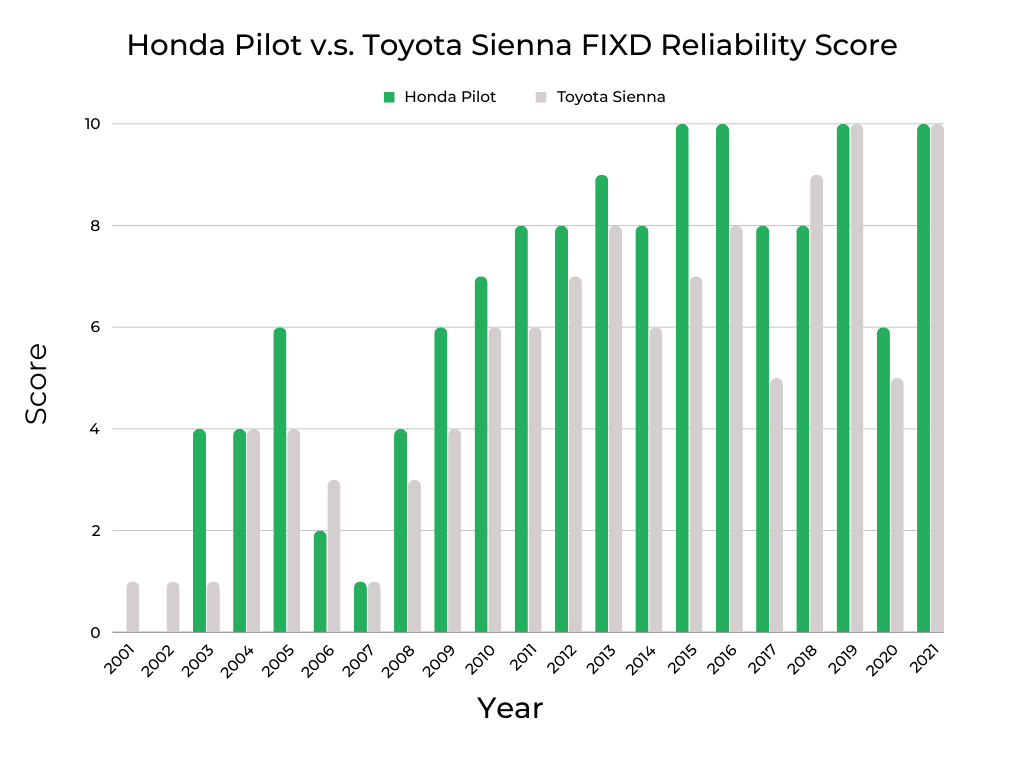
Toyota’s reputation for building reliable vehicles has near-mythic status. But reality has a way of tarnishing the shine. Toyota fans will be shocked to learn that for the 19 comparison years (2003-2019) detailed in the graph, the Sienna came out on top only twice. Call me surprised as well. The Pilot had better engine reliability for 13 years, with both models having equal engine reliability for four years.
To be fair, the Pilot’s dependability is nothing to brag about before 2010. However, Pilots built more recently leave the same-year Siennas in the dust.
Except for two years (2010 and 2020), Pilots from 2010 and later never received a FIXD Reliability Score below 8, an impressive achievement. In addition, there are four years with a perfect 10 out of 10 score. Further, scores for those two less-than-ideal years (2010 and 2020) never dropped below 6.
It’s quite a different story for Siennas from 2010-2021. Most years (seven out of eleven) have a FIXD Reliability Score of 7 or lower. Meanwhile, there are only two years with perfect engine reliability. In addition, the oldest Sienna with an excellent (9 out of 10) score only dates back to 2018, while a similarly ranked Pilot is from 2012.
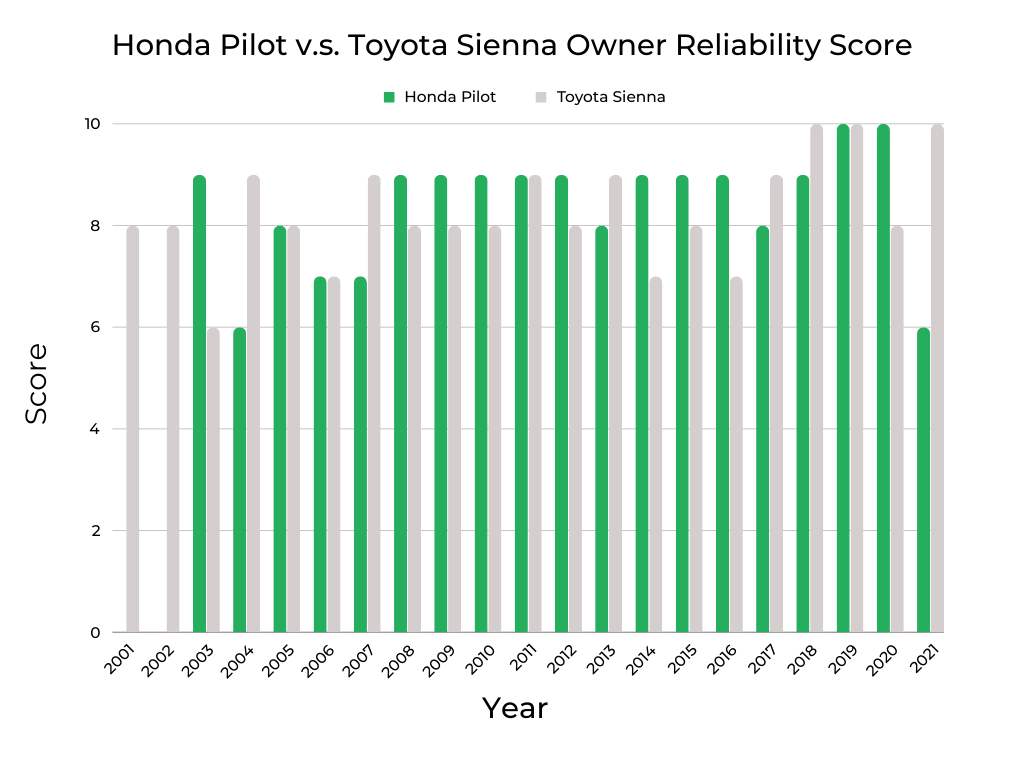
While the hard data says that Siennas have far more check engine lights than Pilots, this fact isn’t a turn-off for Sienna owners. Most people with a Sienna in the driveway rate their vehicles 8 or better.
But Pilot owners one-up their Sienna counterparts, with the majority ranking their SUVs 9 for perceived reliability. The only odd duck is the 2021 Pilot’s Owner Reliability Score of 6. It’s an unusual ranking because this model has a perfect FIXD Reliability Score of 10. I can only guess that these owners had problems unrelated to engine dependability.
Review the Best and Worst Years articles on the Honda Pilot and Toyota Sienna to learn more about these vehicles’ FIXD Reliability and Owner Reliability Scores.
Longevity Comparison | Honda Pilot vs. Toyota Sienna

It’s unsurprising that so many Pilot and Sienna model years cross the 150,000-mile threshold. That’s the minimum mileage a modern automobile should be able to reach. What’s encouraging for used car shoppers, especially those looking for older examples, is that 200,000 miles isn’t a stretch. FIXD owner surveys further show that some Pilot model years are well on their way to 250,000 miles.
Among older model years (2003-2012), Pilots generally rack up more miles than Siennas. This doesn’t necessarily mean that the Pilot has greater longevity. The data could simply reflect that surveyed Pilot owners drive more than their Sienna opposite numbers.
For another look at vehicle lifespan, I unscientifically examined listings from autotrader.com (February 13, 2024). Overall, there are 949 Pilots and 930 Siennas from 2003-2012, models most likely to have higher mileage. Remember, the Pilot didn’t debut until 2003.
The results show 405 (42.7%) Pilots and 333 (35.8%) Siennas with 150,000-200,000, pointing to equivalent longevity in this mileage range. Expanding into a higher mileage range (200,000 miles and above) uncovers 189 (19.9%) Pilots and 163 (17.5%) Siennas that qualify. Again, the two vehicles have similar lifespans even with greater usage.
In summary, most older Pilots and Sienna max out as they approach 200,000 miles. However, about one-fifth continue above this mark.
For a more thorough look at longevity, review the individual articles on the best and worst years of the Honda Pilot and Toyota Sienna.
Who Should Buy These Cars: The Legacy of Honda Pilot vs. Toyota Sienna
There’s no escaping that the Pilot and Sienna are, first and foremost, family haulers. FIXD surveys confirm that over half of the owners of these vehicles are involved in transporting loved ones. Long commutes and road trips (collectively grouped as “lots of driving”) are other principal activities for the Pilot and Sienna—an average of 28.5% between the two vehicles.
Despite the availability of all-wheel drive with the Pilot, this Honda doesn’t see much off-road use. In addition, the Pilot and Sienna offer spacious interiors (especially in the front row), but neither vehicle gets tasked much as an office on wheels.
| Frequent Use Categories: | Honda Pilot | How Useful? (Out of 5 Stars) | Toyota Sienna | How Useful? (Out of 5 Stars) |
| Family Vehicle | * * * * * | * * * * * |
| Lots of Driving (travel/long commute) | * * * | * * * |
| Hauling/Towing | * | * |
| Office on Wheels | * | * |
| Sport/Fast Driving | * | * |
| Luxurious Driving | * | * |
| Outdoor/Off-Road | * | * |
Driver Experience | A Summary of The Top 10 Honda Pilot vs. Toyota Sienna Reddit Posts:
You’re not the only one wondering how the Honda Pilot and Toyota Sienna compare. These vehicles are very much the topic of conversation on Reddit. Here are some discussion summaries from Reddit: r/whatcarshouldIbuy.
Reliability and Value
Many Redditors emphasize the reliability of the Honda Pilot and Toyota Sienna, noting their long-term value as family vehicles. With its hybrid option, the Sienna is frequently praised for its fuel efficiency, which adds to its value proposition over time. The Pilot is recognized for its robust build and the reliability that Honda vehicles are known for. However, some users express concerns about the perceived decline in Honda’s reliability over recent years, suggesting that while both cars are solid choices, the Sienna might edge out slightly in terms of long-term reliability and operational savings due to its fuel efficiency.
Comfort and Functionality
In terms of comfort, the Sienna’s easy sliding doors and spacious interior make it a favorite among families, especially those with young children or larger family needs. The Pilot’s third-row seating is recognized for its space and comfort, making it one of the best in its class among SUVs. However, the Sienna is often highlighted for its superior cargo space compared to the Pilot, making it more versatile for family trips, groceries, and hauling gear. The AWD option available on the Sienna is also noted as a significant advantage for those living in areas with harsh winters, providing added safety and performance in snowy conditions.
Performance
Performance-wise, the Pilot is often mentioned for its better torque and overall driving dynamics compared to the Sienna, which some find to be slower, particularly the hybrid version. However, the Sienna’s fuel efficiency is a trade-off that many are willing to make for the benefit of lower fuel costs.
Resale Value
The Pilot and Sienna score points for strong resale values. One Redditor commented that the Sienna’s hybrid option might offer a slight edge in future resale value due to the increasing market demand for fuel-efficient and hybrid vehicles.
Year-by-Year Comparison | Honda Pilot vs Toyota Sienna
Best & Worst Years | Honda Pilot vs. Toyota Sienna | 2001-2024

The Sienna’s lower engine reliability scores come to a head with red-light (don’t buy) recommendations for the 2001-2011 model years. Does this mean that every Sienna during these years is terrible? No. It’s all about considering the odds of running into reliability problems. The data says that Siennas from these years are the most likely ones to cause trouble.
So, if you need an older and cheaper three-row family vehicle, the 2005 Honda Pilot is your only choice. It won’t be perfect either, but you’ll have a greater chance at more reliable transportation.
That said, all Siennas from 2012-2021 get a clean bill of health. This broad range of used minivan options makes for easier research and shopping.
On the other hand, the Honda Pilot has been more hit-and-miss in recent years. Between 2009 and 2021, you’ll want to avoid the 2014, 2017-2018, and 2020 editions. The remaining green-light years still provide an array of purchase choices.
I’ll also call attention to the undecided years (yellow) only because there isn’t enough information to give these editions a thumbs up or down.
Important Features Timeline | Honda Pilot vs. Toyota Sienna

While the Pilot and Sienna occupy important positions in their manufacturer’s lineup, each automaker looks at different targets to maintain a leg up against rivals. Honda keeps an eye on the Toyota Highlander to ensure the Pilot is up-to-date with the latest features. Similarly, Toyota is watchful of the Honda Odyssey to help maintain the Sienna’s competitiveness.
The Pilot can boast about getting some comfort and convenience features (Apple CarPlay, Android Auto, and ventilated front seats) before the Sienna. But this Toyota got heated front seats, power front passenger seats, remote start, and a driver’s memory system before the Pilot.
Regarding safety equipment, the Sienna was the first to have blind-spot monitoring but fell behind the Pilot, which received parking sensors, lane departure warning, and all-wheel drive sooner.
Maintenance Costs (Year-by-Year Average) | Honda Pilot vs. Toyota Sienna

While the Pilot and Sienna are different vehicles from different manufacturers, they have one thing in common: almost identical maintenance and repair costs. FIXD surveys report that the average Pilot owner spent $674 in 2022 to keep their vehicle on the road, compared to $662 for Sienna owners. This is about as close to a tie as it gets. To put these numbers in perspective, RepairPal estimates that owners across all vehicle types spend an average of $652 annually for maintenance and repairs.
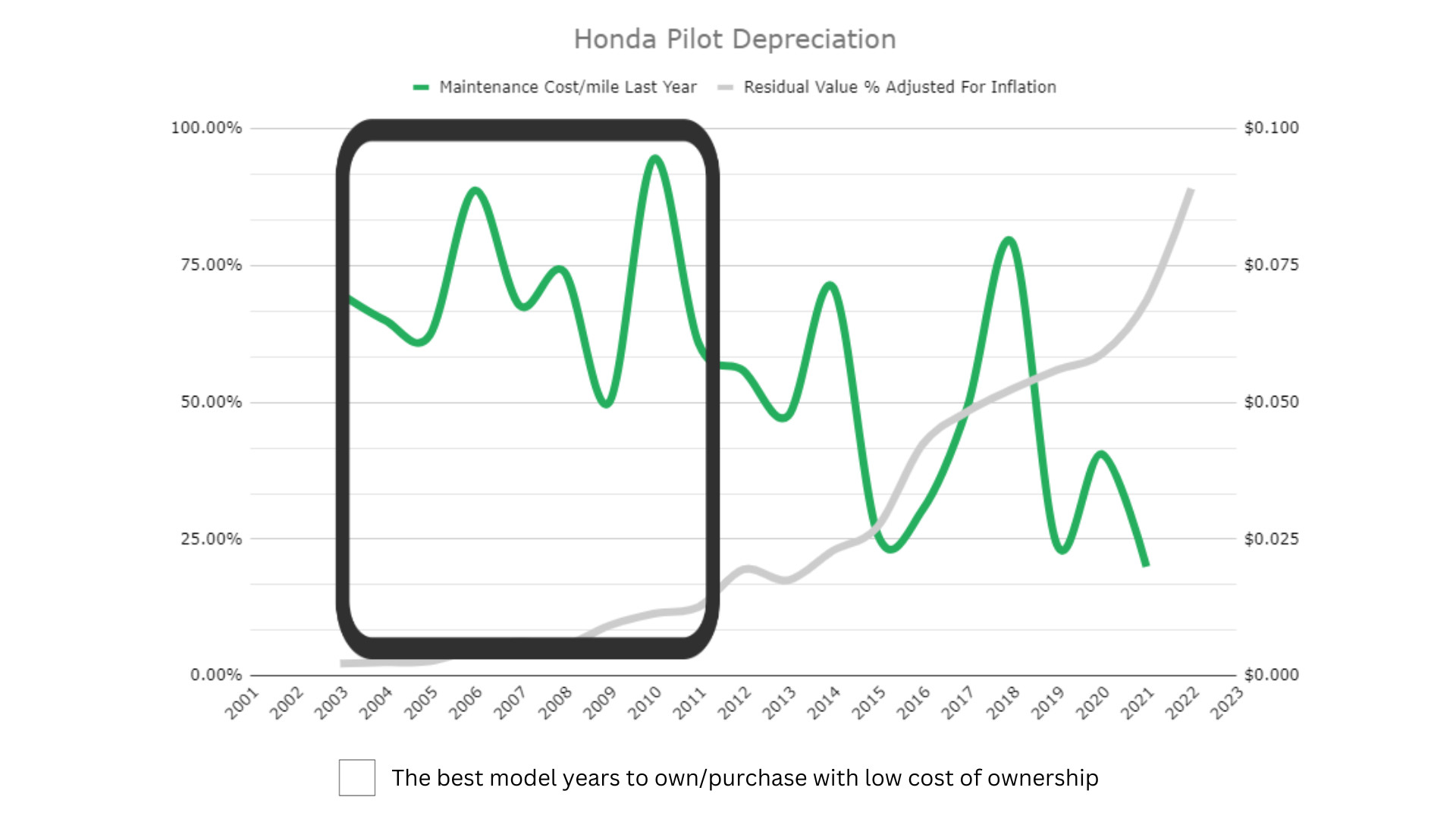
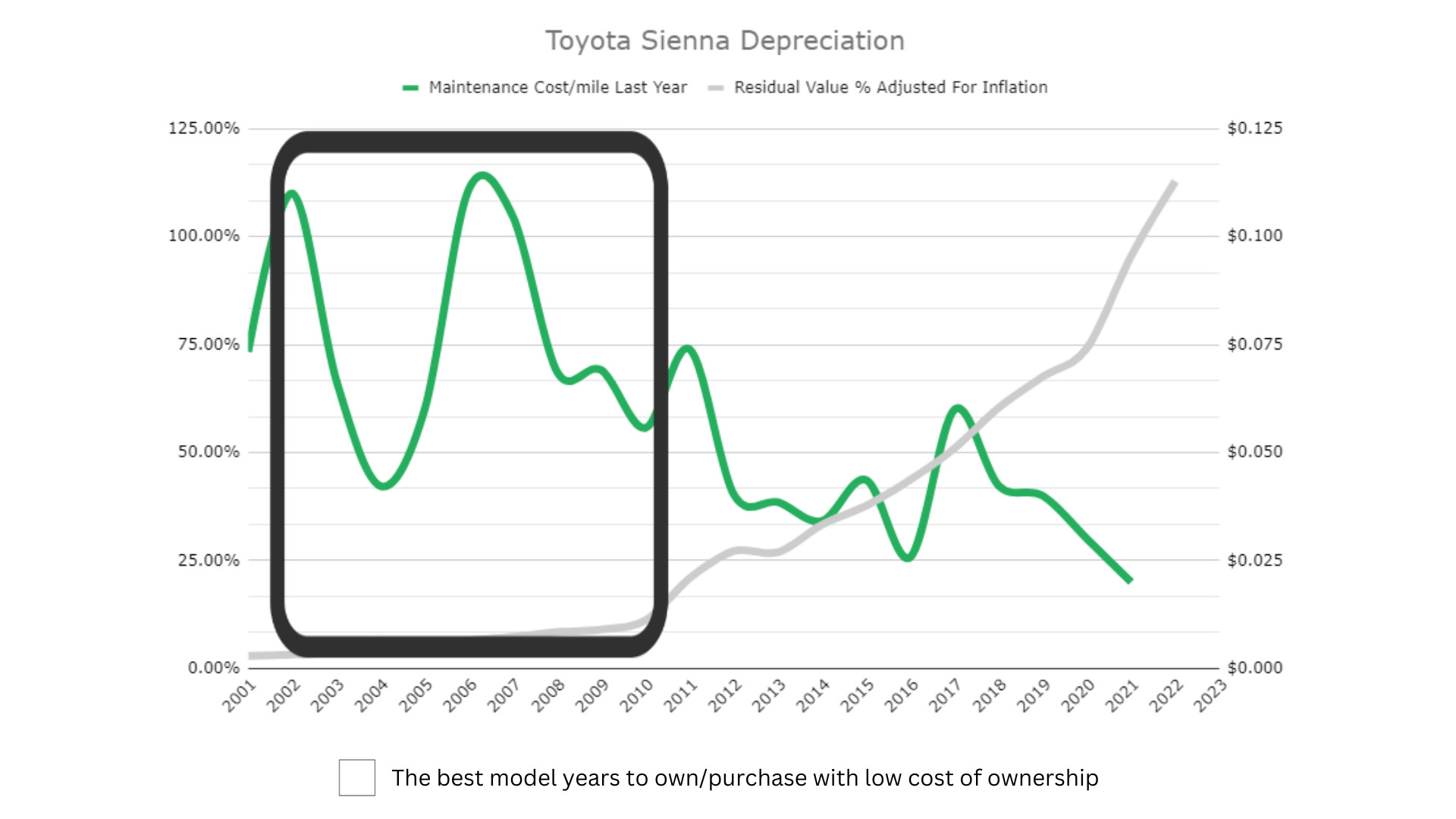
However, looking beyond averages shows that specific Pilot and Sienna model years are more expensive to own than others. For instance, Pilots from 2003, 2005-2006, 2008-2014, and 2018 cost 20% or more above average to maintain. The same applies to Siennas from 2002, 2005-2011, and 2018-2019.
Review the best and worst years of the Honda Pilot and Toyota Sienna to learn more about maintenance and repair costs for these vehicles.
Safety Rating Comparison | Honda Pilot vs. Toyota Sienna

When it comes to family cars, safety sells. Vehicles like the Honda Pilot and Toyota Sienna are expected to perform well in government crash tests, and they do. Even the earliest examples of the Pilot and Sienna receive good to excellent scores in evaluations by the National Highway Traffic Safety Administration (NHTSA). I consider a 4.0 (out of 5.0) rating the minimum for “good” safety performance. All 21st-century Pilots and Sienna meet this standard. Curiously, recent Sienna models (2021-2023) fall on the low end of this scale. But these minivans are certainly safe for passengers.
More details about crash test safety scores are covered in the Honda Pilot and Toyota Sienna articles.
Fuel Efficiency Comparison | Honda Pilot vs. Toyota Sienna

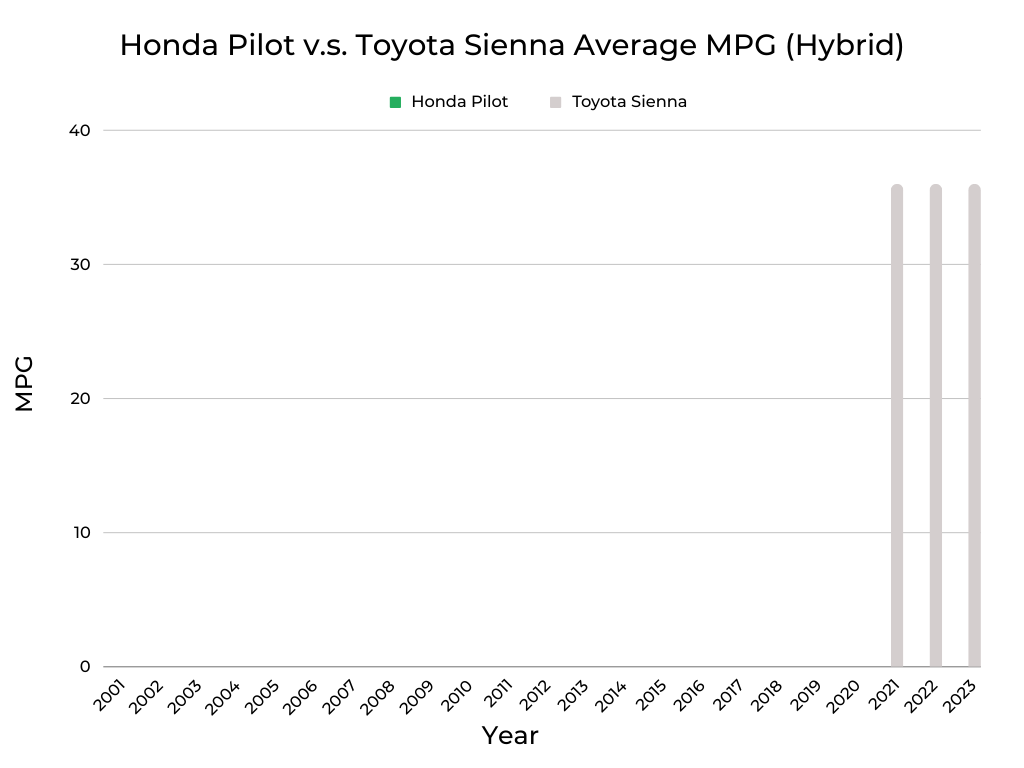
The Pilot and Sienna are large vehicles. So, seeing fuel economy below 20 MPG for older model years is typical. By 2012, Honda and Pilot worked their engineering magic to increase fuel efficiency to at least 20 MPG. Half a decade later, fuel economy has again improved for both. But through 2020, the Pilot and Sienna had more or less similar fuel economy.
The 2021 model year was a game-changer for the Sienna when Toyota launched the hybrid-only fourth generation. Buyers looking to minimize gas station visits will find 36 MPG quite appealing. Think about that for a moment—a three-row vehicle that gets economy car-level fuel economy.
A 15 MPG improvement over the conventionally powered 2020 Sienna or 2023 Pilot’s average of 21 MPG translates into significant savings. For instance, a vehicle with fuel economy performance of 21 MPG costs $2,500 per year to fill up (based on 15,000 miles per year and gas at $3.50 per gallon). In contrast, a hybrid Sienna has $1,458 annual refueling costs. A thousand-dollar-a-year difference is real money.

Dave Goldberg is an automotive journalist and lifelong car fanatic. He writes for numerous enthusiast and business outlets and is an ongoing contributor to HotCars.com, one of the most popular car culture websites. When he’s not writing or driving, Dave is either under a hood or asleep. His credentials include a BA in Journalism from The George Washington University.