
In the midsize sedan segment, the Nissan Altima and Toyota Camry are two of the top three sellers, making them an ideal pair to compare. Both have been on sale for decades and show no signs of slowing down even as the sedan marketplace continues to shrink.
So, we’ve put together this comparison of the Altima and Camry to help shoppers decide between a shiny new 2023 model and a used version going back as far as 2001. This table is a good place to start for those focused on the used market with details on how it’s structured below.
| Income Bracket | Monthly Financing Cost Range | Cash Purchase Price Range | Nissan Altima Years | Toyota Camry Years | Best Model Year: | Why? |
| <$5k | $42-$83 | $1,500-$3,000 | N/A | N/A | N/A | There are no options from our “best of” rankings at this price point |
| $5k-$10k | $83-$125 | $3,000-$4,500 | N/A | N/A | N/A | Only models that get a thumbs down for reliability fit this price range |
| $10k-$15k | $125-$187 | $4,500-$6,750 | 2010, 2012-2014 | 2008, 2009 | 2014 Altima | Better reliability score and fuel economy, cheaper to maintain |
| $15k-$25k | $187-$312 | $6,750-$11,250 | 2015, 2016 | 2012-2016 | 2016 Camry | Higher safety scores and FIXD Reliability Score |
| $25k-$35k | $312-$437 | $11,250-$15,750 | 2017, 2018 | 2017-2018 | 2018 Altima | Lower upkeep costs, higher reliability rating |
| $35k-$50k | $437-$625 | $15,750-$22,500 | 2019, 2020 | 2019-2020 | 2020 Camry | Both models have perfect FIXD Reliability Scores, but the Camry has a higher safety rating |
| $50k-$74k | $625-$925 | $22,500-$33,300 | 2021 | 2021 | 2021 Camry | 5 out of 5 for safety |
See the methodology for the table above.
There is a lot to like about both the Nissan Altima and Toyota Camry, which makes sense as they’ve been fierce competitors for over 30 years. The Camry has been consistently outselling the Altima for years, but that doesn’t necessarily mean the Altima is a lesser sedan.
Toyota’s vaunted reliability doesn’t apply to EVERY Camry ever made as we cover in this best and worst model year ranking for the Toyota Camry. Likewise, some years of the Altima are better than others per this model year ranking for the Nissan Altima.
So, to determine which midsize sedan has the best purchase value over the past 20 years, we’ve crafted this Nissan Altima vs. Toyota Camry matchup.
It looks at reliability from an objective and subjective perspective, National Highway Traffic Safety Administration (NHTSA) crash-test scores, current market values per Kelley Blue Book (KBB), fuel economy figures from FuelEconomy.gov, and how much owners pay annually to keep their Altima or Camry on the road.
To give you a Cliff’s Notes rundown, we put together the table above so you can get an idea of how far your budget will go. Each row includes the best model year Altima and Camry according to income range, monthly financing costs, and KBB market values.
The model years listed under the Altima and Camry columns on this table are only included because they already got a thumbs up on the respective best and worst model year rankings. From there, we choose a winner and a brief reason as to why.
We’ll go into detail on this below, but the idea is to give buyers a place to start. If you’ve already started shopping, be sure to check out our used car buying checklist to learn some tips on how to proceed. For those looking to cross-shop the Altima and Camry, take a look through this list of model year rankings and comparisons of competitive vehicles:
Best and Worst Model Year Rankings
Competitor Comparisons
Price History Comparison | Nissan Altima vs Toyota Camry
Average Market Value – Based on Owners’ Self-Reported Mileages | Nissan Altima vs Toyota Camry

Looking over the above chart of Altima vs. Camry market values for used models going back 20 years is a good way to get a sense of what model years fit your budget. It also paints a clear picture of the Camry being consistently more expensive than the Altima.
Every year, except the 2018 and 2020 models, the Camry commands more money. This appears to be driven by the Camry’s general popularity and a possibly higher perceived value leading to higher actual values as there are no clear correlations with reliability or mileage to explain this pattern.
Going back to 2001 and as recently as 2023, the Nissan Altima and Toyota have had base prices within $1,000 of one another, so it’s not as though one has charged more along the way. Something else to note is that as the years go on, mileage goes up, and prices decline.
But don’t assume that an older, high-mileage example of either car is “worse” than a lower mileage option as not all mileage is created equally. For example, a car with loads of miles that were accumulated on long highway drives could be in better shape than one with low miles that accrued in stop-and-go driving. Learn more on this topic with our “What Is Considered High Mileage” article.
The upshot here is that if you can find a Nissan in your budget that is on the right side of our best and worst Altima rankings, you could get a good deal as a buyer. Of course, if you’re dead set on a Toyota, consult the best and worst Camry model year rankings to ensure you find a reliable option.
Depreciation vs Maintenance Expenses
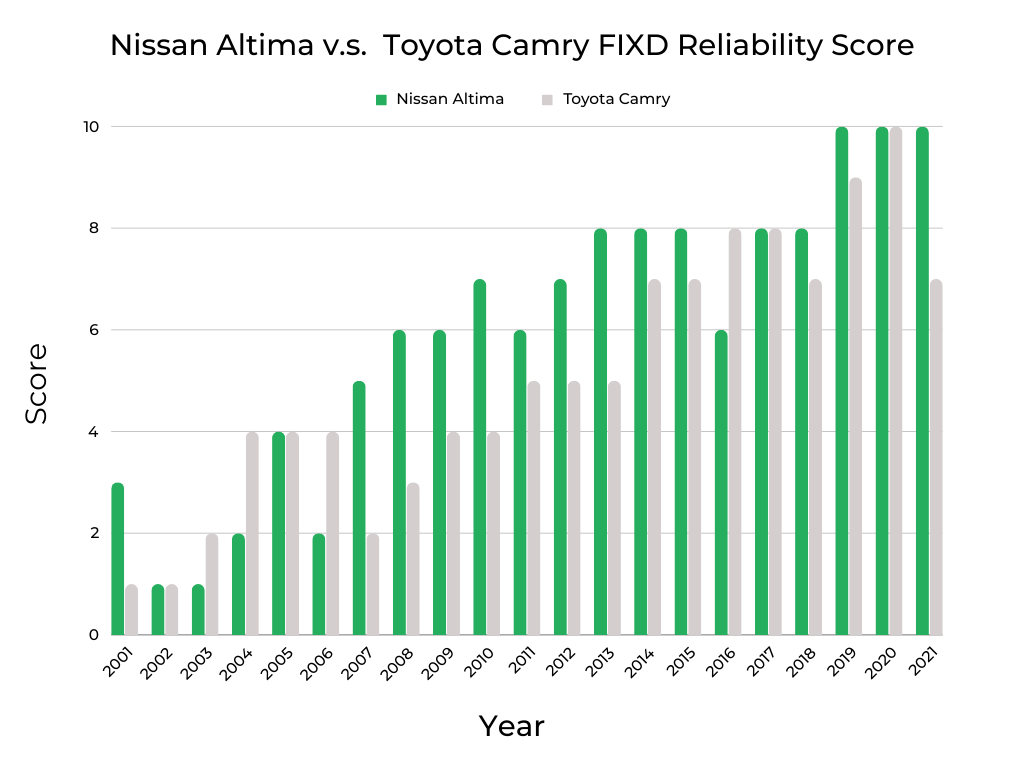
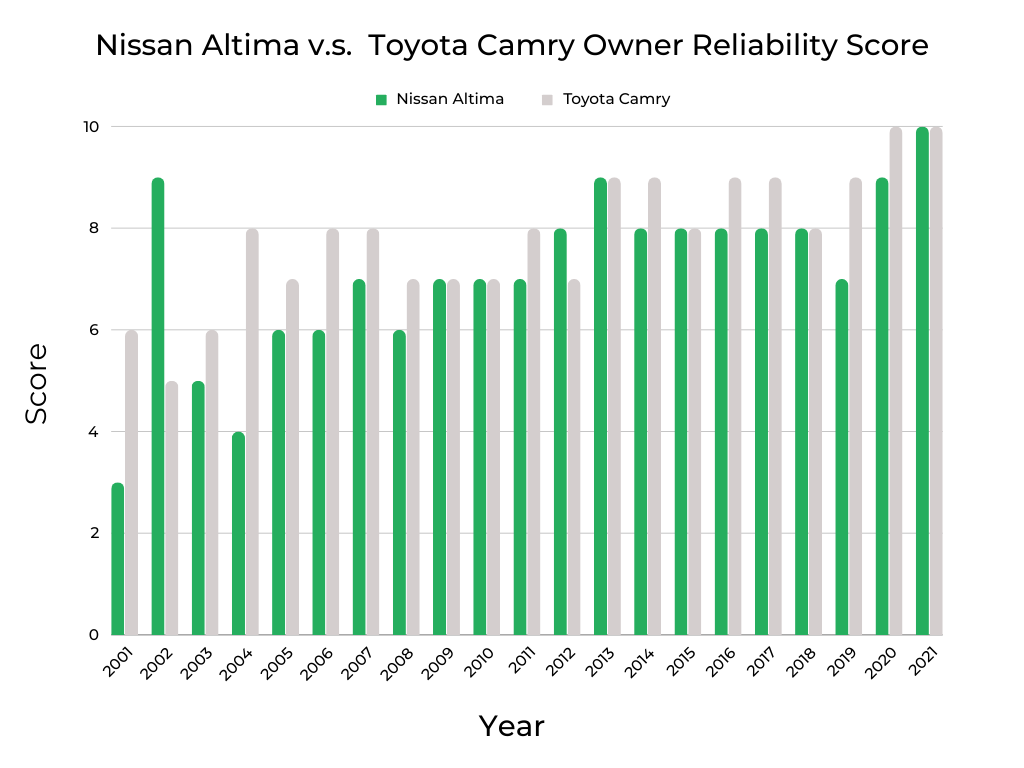
These charts comparing objective FIXD data-based reliability (left) and subjective owner-reported reliability (right) paint an interesting picture that counters the assumption that the Toyota Camry owns the bragging rights to top reliability.
Starting with the owner reliability comparison, we can see that for 13 of 21 years, Camry owners have a higher sense of reliability for their car than Altima owners. These scores come from survey responses and are based on how reliable Camry owners think their car is, a topic you can go deeper into in this best and worst model year ranking of the Toyota Camry.
And yet, looking at the FIXD Reliability Score comparison graph on the left, it’s just the opposite with the Nissan Altima posting higher scores for 14 of the 21 years that we have data. You can look at how this is calculated in our best and worst model year ranking of the Altima, but the gist is that these scores come from objective data with no owner biases.
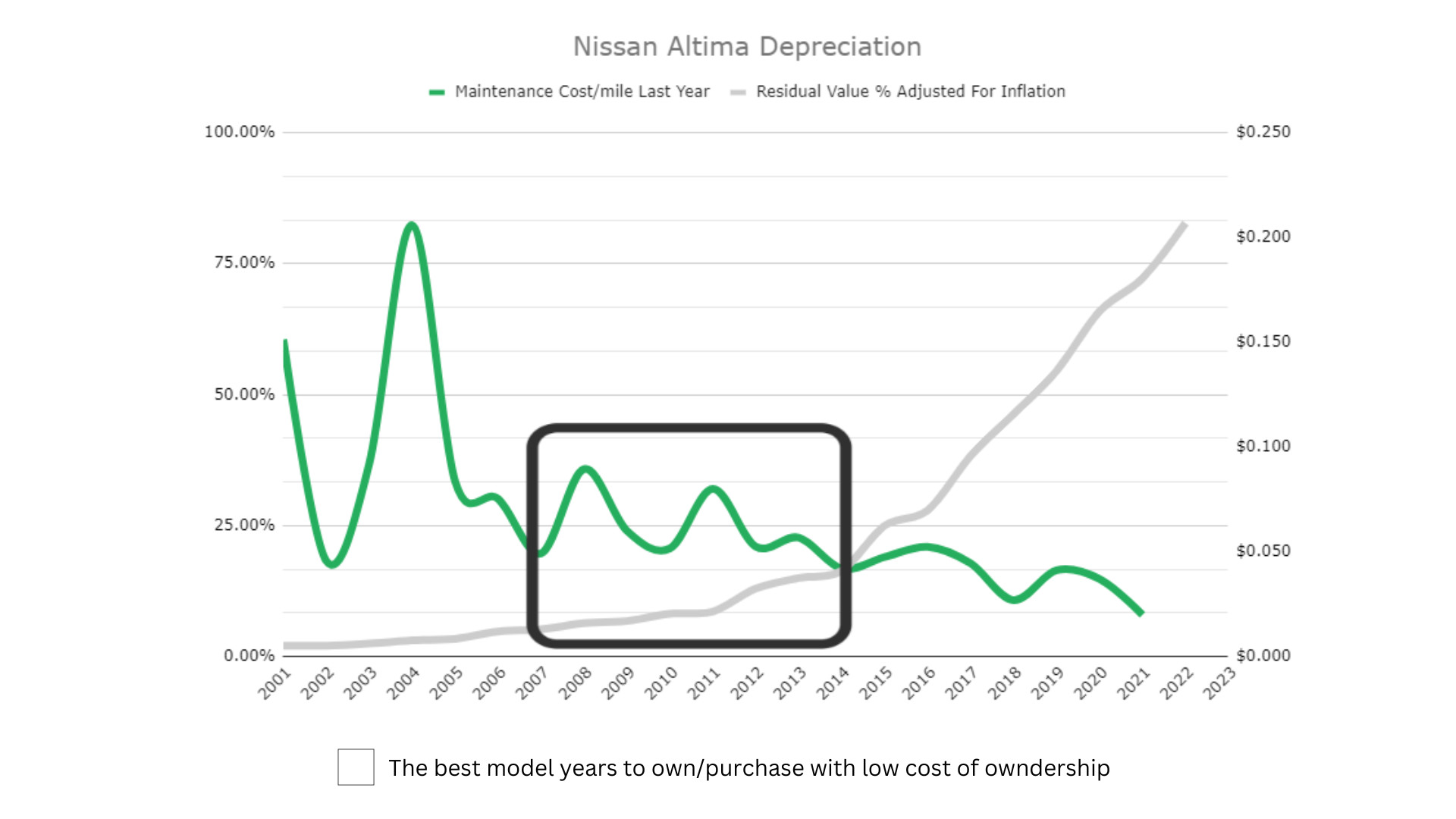
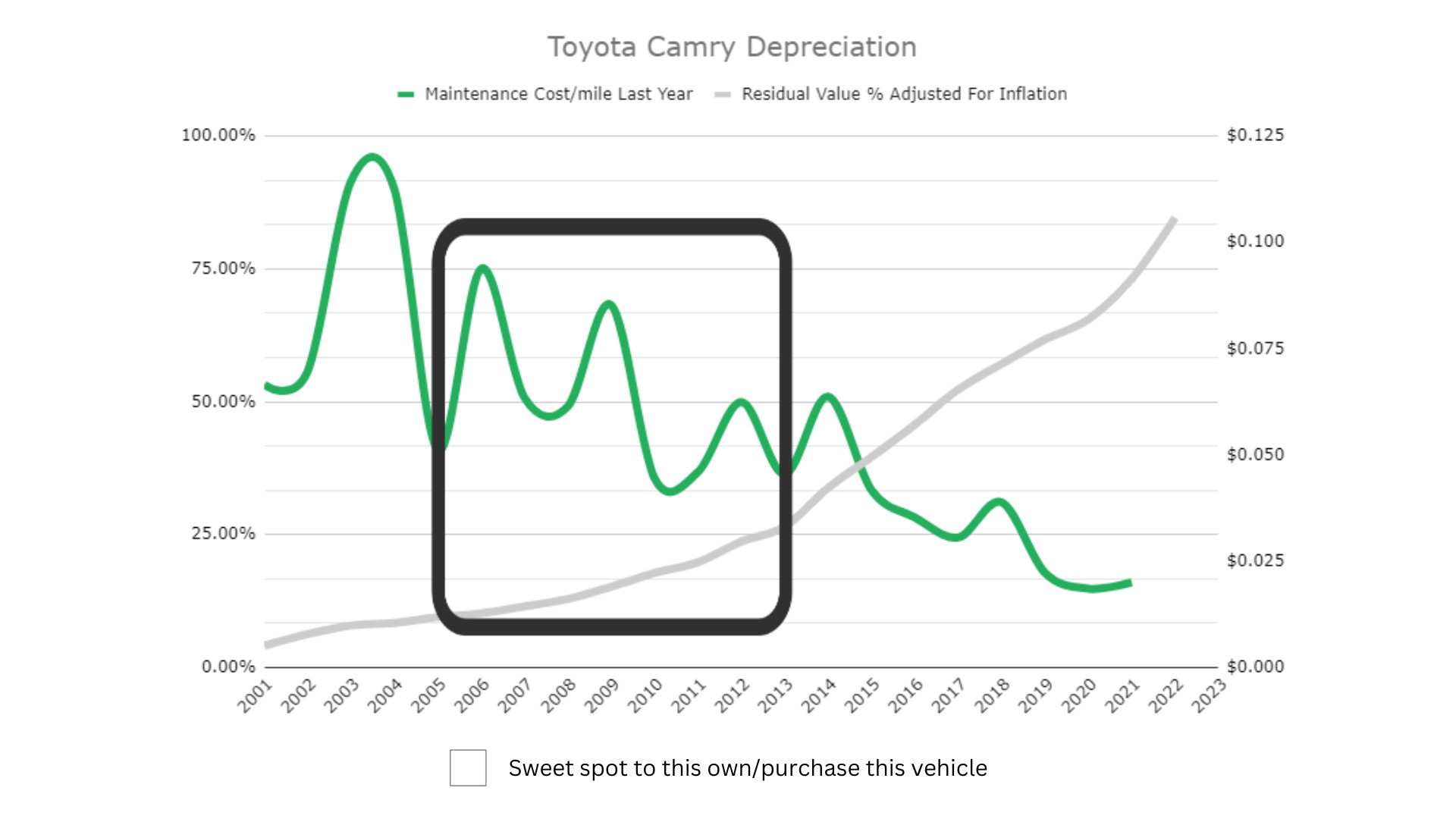
So, when you consider the Altima tends to have lower values than the Camry on the used market, this reliability comparison supports the idea of saving some money and going with the Nissan. The 2010 and 2013 model years are of particular interest as they are both on the right side of the model year rankings and inside the depreciation sweet spot.
And if you’re looking for something with fewer miles, the 2014, 2015, 2018, 2019, and 2021 Nissan Altimas are all part of the “best of” conversation and are objectively more reliable than the Toyota Camry for the respective model year.
Longevity Comparison | Nissan Altima vs Toyota Camry
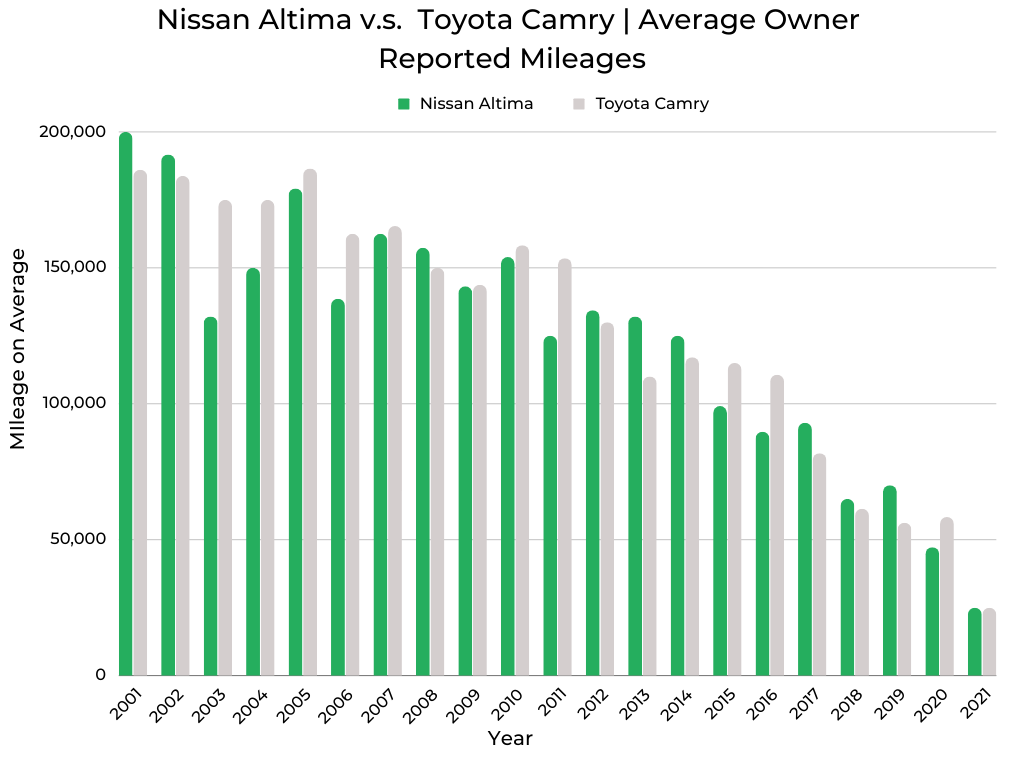
The idea behind this chart comparing Altima and Camry mileage by model per owner survey responses is to give buyers insight into how many miles they should expect to see while shopping. If 100,000 miles is too high, this chart suggests sticking with the 2016-2017 and newer model years.
But, for those comfortable with more than 100,000 miles, you can also see that both the Nissan Altima and Toyota Camry easily hit this mark from 2015 and earlier with neither vehicle doing a “better job” of piling up the mileage.
So, if you look over the best and worst model year rankings for the Altima and Camry, pick out the years that fit your bill, and compare them against this chart, it should help you choose an option that doesn’t have an odometer reading outside your comfort zone.
This is a useful piece of information when it comes to buying a used car, but don’t forget to balance this aspect against other important information like maintenance costs, safety scores, and fuel economy.
2023 Nissan Altima vs Toyota Camry | A Guide to Trim Levels & Optional Features
Trim Levels: Starting Prices
If it’s a new 2023 Nissan Altima or Toyota Camry you’re after, you’ve come to the right place. We’ll get into the nuts and bolts of specifications, amenities, technology, and the like below. But for starters, let’s take a look at how much these popular midsize sedans cost.
As you can see, the entry-level models of the Altima and Camry are within $400 of each other. At the top end of the Altima scale for standard models is the $33,425 SL trim line. Toyota tops out slightly lower for the $31,620 XSE trim when it comes to standard models or those that are not hybrid or performance-minded.
The SR VC-Turbo Altima has an exclusive motor aimed at performance that lines it up against the Camry TRD, albeit for thousands more. The remaining Camry lineup consists of more expensive V6 variants – a powertrain the Altima does not offer – and hybrids, which are also unavailable in the Nissan Altima.
| 2023 Nissan Altima Model | Starting Price |
| S | $26,725 |
| SV | $27,525 |
| SR | $28,925 |
| SR VC-Turbo | $36,425 |
| SL | $33,425 |
| 2023 Toyota Camry Model | Starting Price |
| LE | $26,320 |
| SE | $27,860 |
| SE Nightshade Edition | $28,860 |
| XLE | $31,070 |
| XSE | $31,620 |
| TRD | $33,385 |
| XLE V6 | $36,195 |
| XSE V6 | $36,745 |
| LE Hybrid | $28,655 |
| SE Hybrid | $30,190 |
| SE Hybrid Nightshade Edition | $31,190 |
| XLE Hybrid | $33,545 |
| XSE Hybrid | $34,095 |
2023 | Nissan Altima vs Toyota Camry | Specifications | Safety, Interior and Exterior Features
Vehicle Class & Body Style:
Per the U.S. Environmental Protection Agency, both the Nissan Altima and Toyota Camry are classified as mid-size sedans. These classifications are based on passenger volume and cargo space but don’t assume that means these sedans stack up the same inside.
For example, the trunk space and overall passenger volume of both cars are within a whisker of one another and yet, the Camry comes with nearly 3 inches of additional backseat legroom. We’ll go deeper on this below, but it’s worth keeping in mind depending on your particular needs.
| 2023 Nissan Altima | 2023 Toyota Camry | |
| Class | Mid-Size Sedan | Mid-Size Sedan |
| 4-Door Sedan | S, SV, SR, SR VC-Turbo, SL |
LE, XLE, XLE V6, SE, SE Nightshade Edition, XSE, XSE V6, TRD, LE Hybrid, SE Hybrid, SE Hybrid Nightshade Edition, XLE Hybrid, XSE Hybrid |
Powertrain:
Engine Options & Specifications:
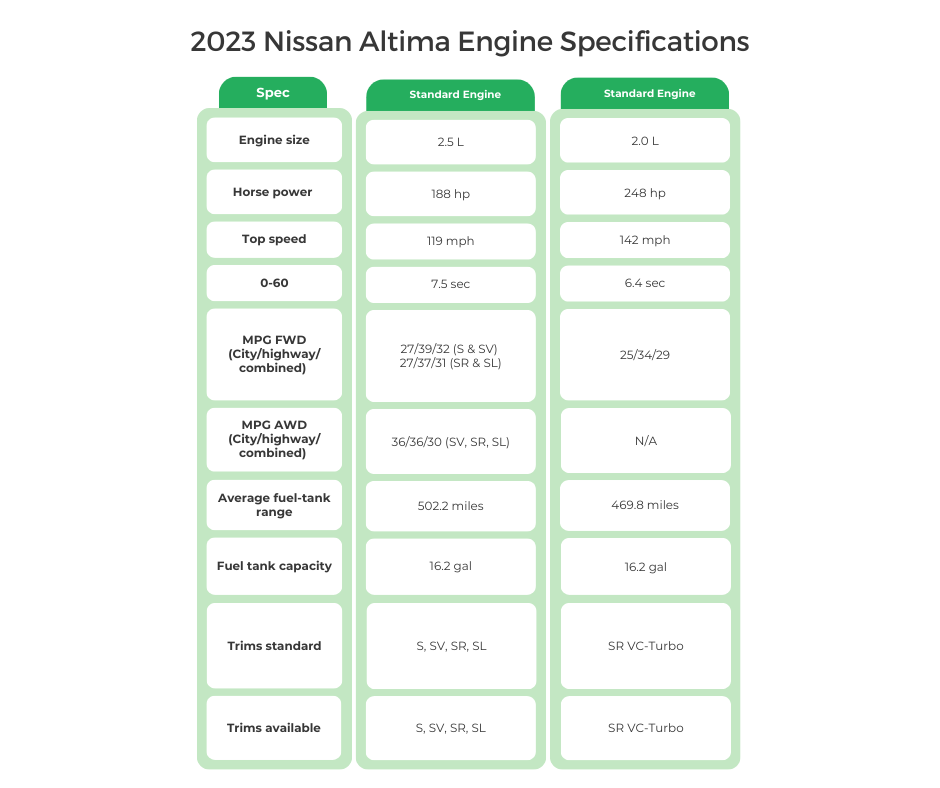
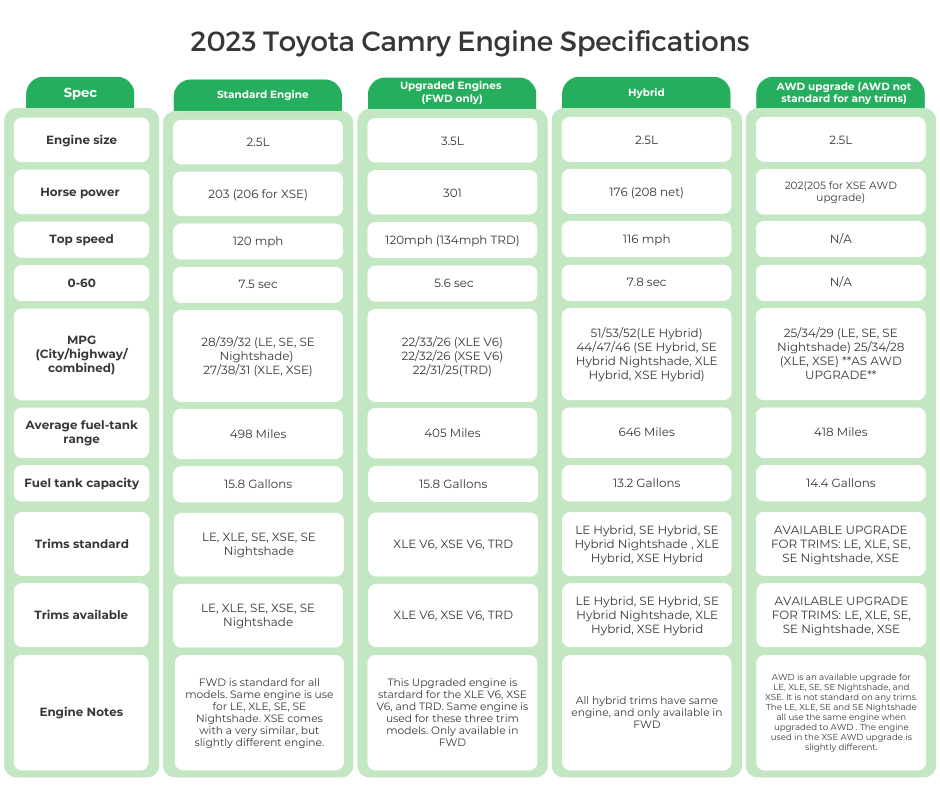
There are a lot of powertrain similarities with the 2023 Altima and Camry. Both are fitted with a 2.5L inline-4 on base models – though the Camry’s is more potent – both offer FWD or AWD, and both deliver the same 32 MPG combined for entry-level trim lines.
However, only the Toyota Camry offers a hybrid and V6 powertrain. In hybrid form, the Camry can deliver fuel economy as high as 52 MPG combined and nearly 650 miles of driving range on a full tank.
And though the Altima in SR VC-Turbo spec is a compelling model, its turbocharged 2.0L four-pot comes up short against the Camry’s 301-horse naturally aspirated 3.5L V6. If sedan stoplight racing is your thing, be aware that the Camry TRD will blow the doors off all Altima contenders.
Transmission Options & Specifications:
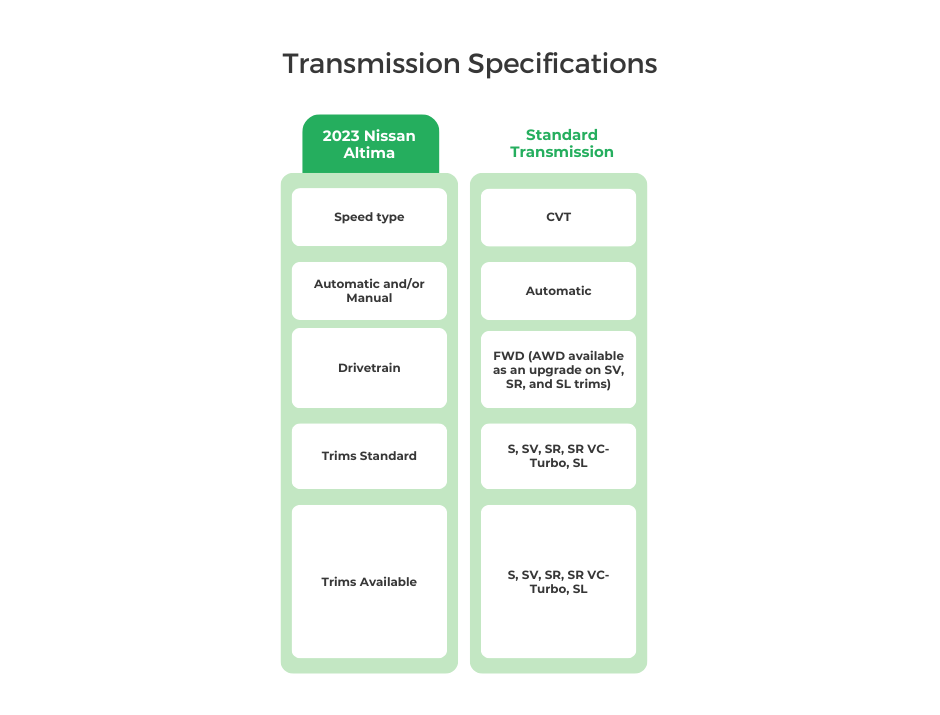
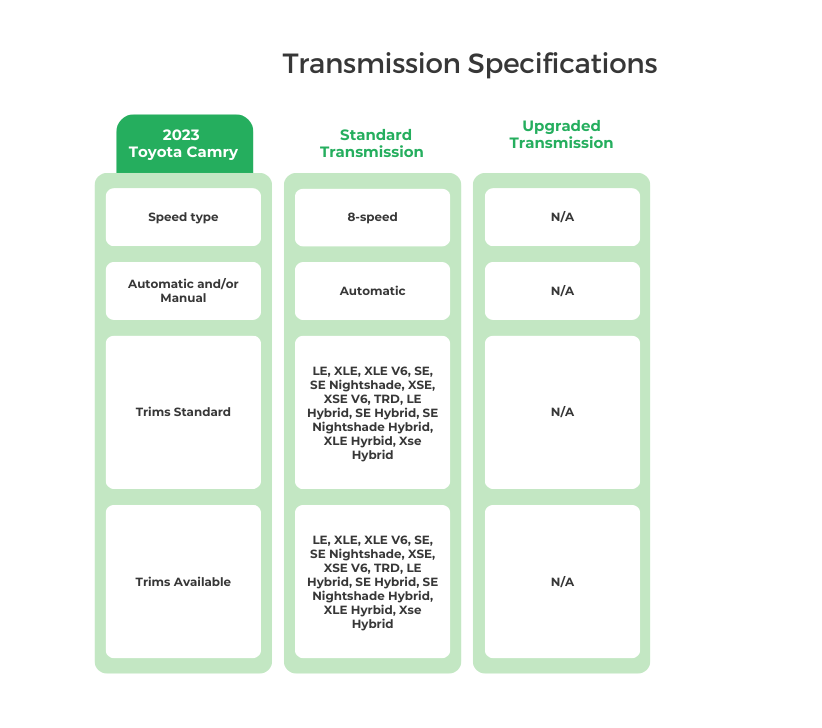
Nissan has been a staunch supporter of continuously variable transmission (CVT) for years, so no surprise that it is the only option for the 2023 Altima. Toyota follows suit with the hybrid Camry lineup but fits the rest of the models with a traditional 8-speed automatic transmission.
Curious about how a CVT differs from a typical automatic? Check out our Tech Talk section below and prepare to be educated!
TECH TALK: CVTs
A continuously variable transmission (CVT) does not use gears like a typical automatic transmission. Instead, it has two pulleys connected by a belt. One pulley connects to the engine, and the other connects to the wheels. The belt transfers the power between the pulleys. This setup allows the pulleys to continuously change positions as needed. The CVT automatically adjusts the pulleys as required, providing smooth and efficient power delivery.
An electronic continuously variable transmission (eCVT) uses electronic controls and electric motors to vary gear ratios instead of a belt and pulley system. Unlike a regular CVT, an eCVT has no physical pulleys or belts—the gear ratio is adjusted seamlessly by controlling the speeds of electric motors and generators. This electronic control allows faster, smoother gear ratio changes compared to a traditional CVT. An eCVT also provides more flexibility, needing less space and having fewer moving parts.
Wheel Drive:
Both Nissan and Altima build their respective midsize sedan with front-wheel-drive (FWD) but offer all-wheel-drive (AWD). Nissan doesn’t make AWD available on the VC-Turbo model and the Camry hybrids are FWD-only, but otherwise, it can be added for $1,400 on the Camry and $1,500 on the Altima.
| 2023 Nissan Altima Wheel Drive | FWD | AWD | RWD |
| S | S | ||
| SV | S | U | |
| SR | S | U | |
| SR VC-Turbo | S | ||
| SL | S | U |
| 2023 Toyota Camry Wheel Drive | FWD | AWD | RWD |
| LE | S | U | |
| LE Hybrid | S | ||
| SE | S | U | |
| SE Nightshade Edition | S | U | |
| SE Hybrid | S | ||
| SE Hybrid Nightshade Edition | S | ||
| XLE | S | U | |
| XLE Hybrid | S | ||
| XSE | S | U | |
| XSE Hybrid | S | ||
| TRD | S | ||
| XLE V6 | S | ||
| XSE V6 | S |
U = Available in upgrade
Safety:
NHTSA Safety Ratings:
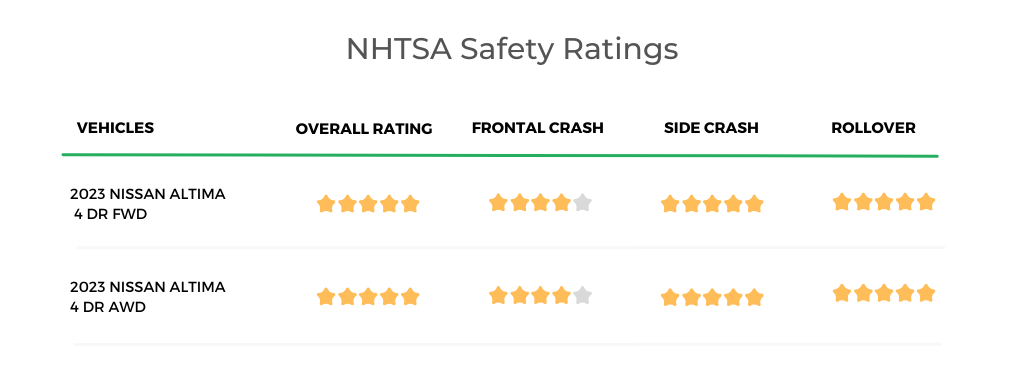
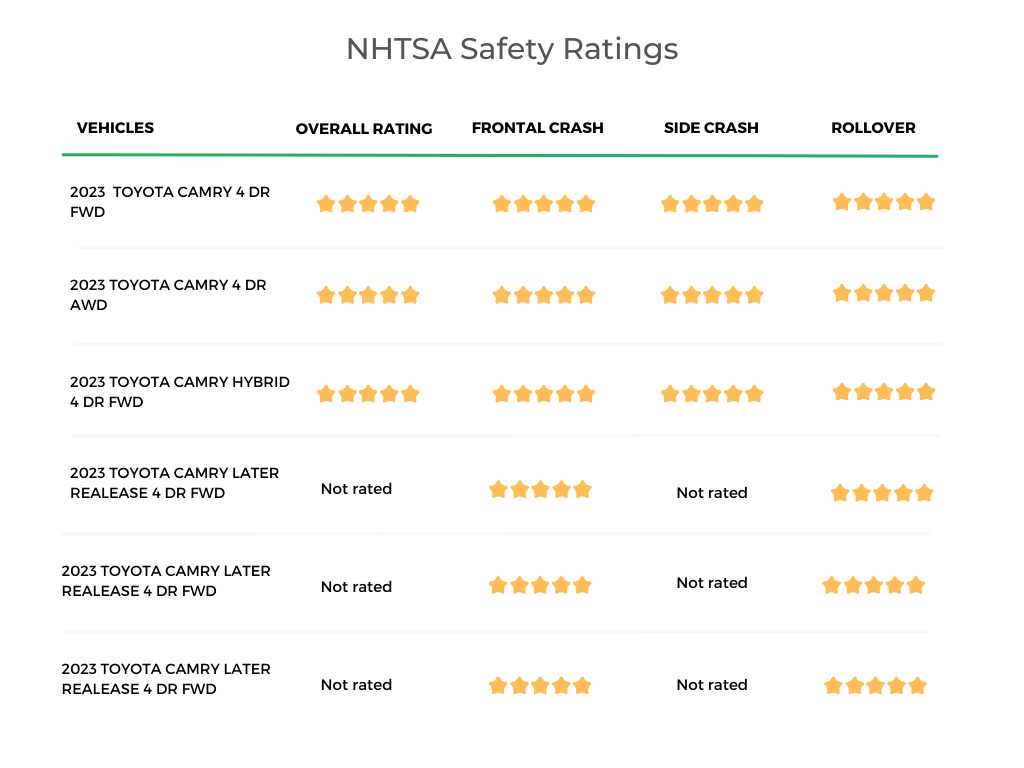
Safety is a priority for many Altima and Camry buyers as these cars are frequently used to tote families around. So, it’s good to know that both 2023 model years come with a 5-star overall crash-test rating from the NHTSA.
However, looking a little more closely, we can see that the Camry fares even better as it has a 5-star rating in every category – frontal crash, side crash, and rollover. The Altima comes close but earns 4 stars in the frontal crash test.
Digging into the NHTSA test results, we can also see that within the Altima’s frontal crash-test protocol, the driver’s side earned 5 stars, but the passenger side came in at 4 stars.
IIHS Awards:
The safety theme of the new Nissan Altima and Toyota Camry continues per the Insurance Institute for Highway Safety (IIHS). Like the NHTSA, the IIHS performs crash testing on vehicles, but it makes the testing more comprehensive by adding protocols for the evaluation of roof strength, head restraints & seats, headlights, and advanced safety nets like automatic emergency braking.
Instead of using stars to rank safety, the IIHS awards ratings of Good (the best), Acceptable, Marginal, and Poor (the worst). For vehicles with exceptionally high testing performance, like our comparison subjects, the IIHS gives out TSP+ awards. This top rating means a vehicle has ratings of Good in all crash test protocols.
| IIHS Award | Tested Vehicle | ||
| 2023 Nissan Altima |
Midsize Car/ 4-Door Sedan |
2022 TOP SAFETY PICK + |
2019 & 2023 Nissan Altima 2.5 S 4-door |
| 2022 Nissan Altima 2.5 SV 4-door |
|||
| 2023 Toyota Camry |
MIDSIZE CAR / 4-DOOR SEDAN |
2023 TOP SAFETY PICK + |
2018 Toyota Camry LE 4-door |
Airbags & Head Restraints:
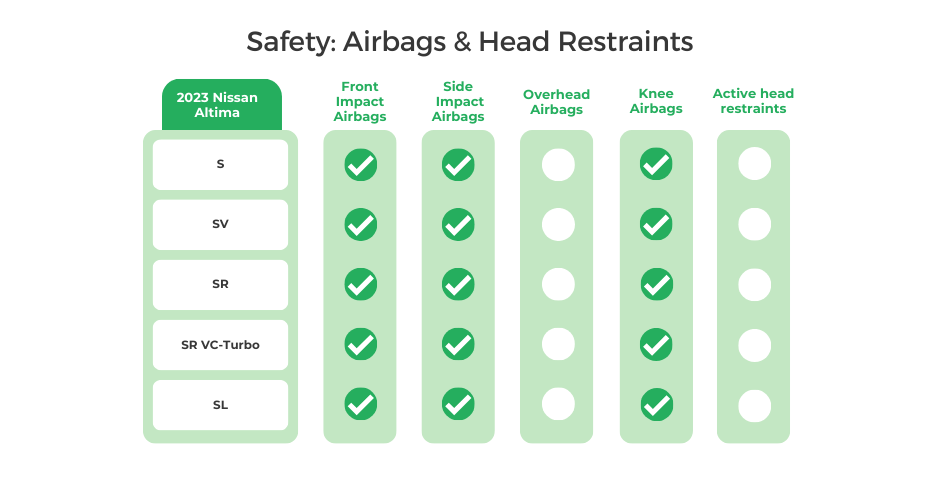
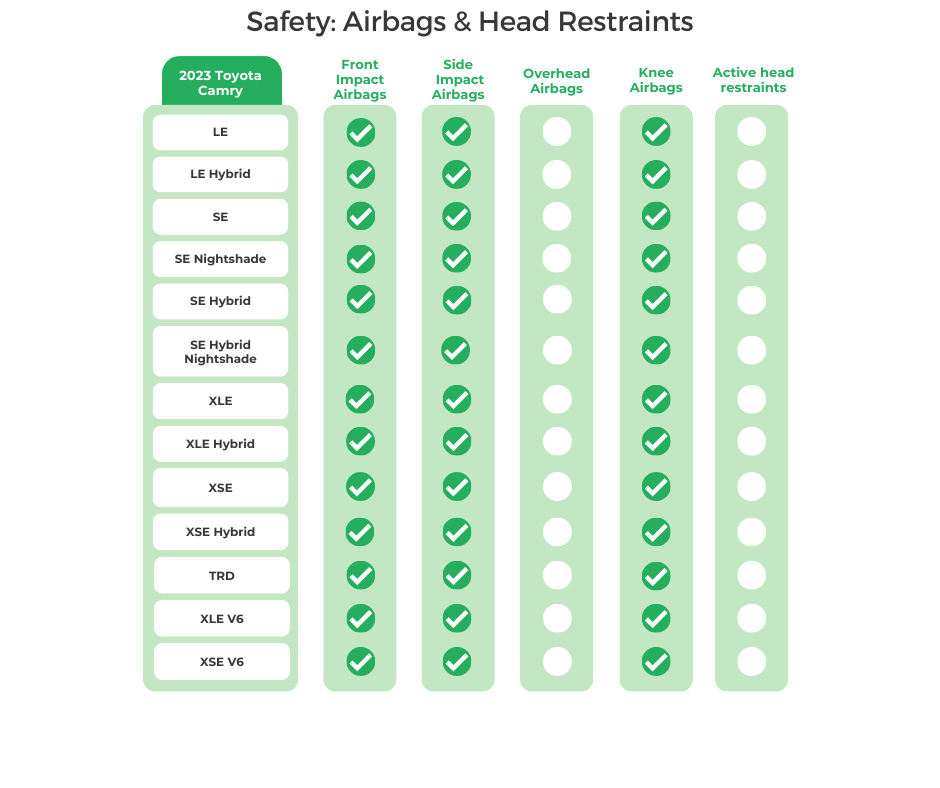
Further bolstering the safety creds of the Nissan Altima and Toyota Camry are the long list of standard airbags in both cars. These safety devices are easy to take for granted given their prevalence, but considering how well they work, it’s worth knowing the details.
Interestingly, Nissan says the Altima comes standard with 8 airbags and Toyota counts 10 in the Camry. But Nissan just counts them differently as both of these sedans have airbags in all the same places including front, side, and knee airbags for the first row, side airbags for the back row, and full-length curtain units.
That being said, neither offer overhead airbags nor active head restraints. Overhead airbags are a relatively new addition to the industry that offer additional head protection, while active head restraints are designed to reduce whiplash in rear-end collisions and are more common on high-end vehicles.
Semi-Autonomous Driving:
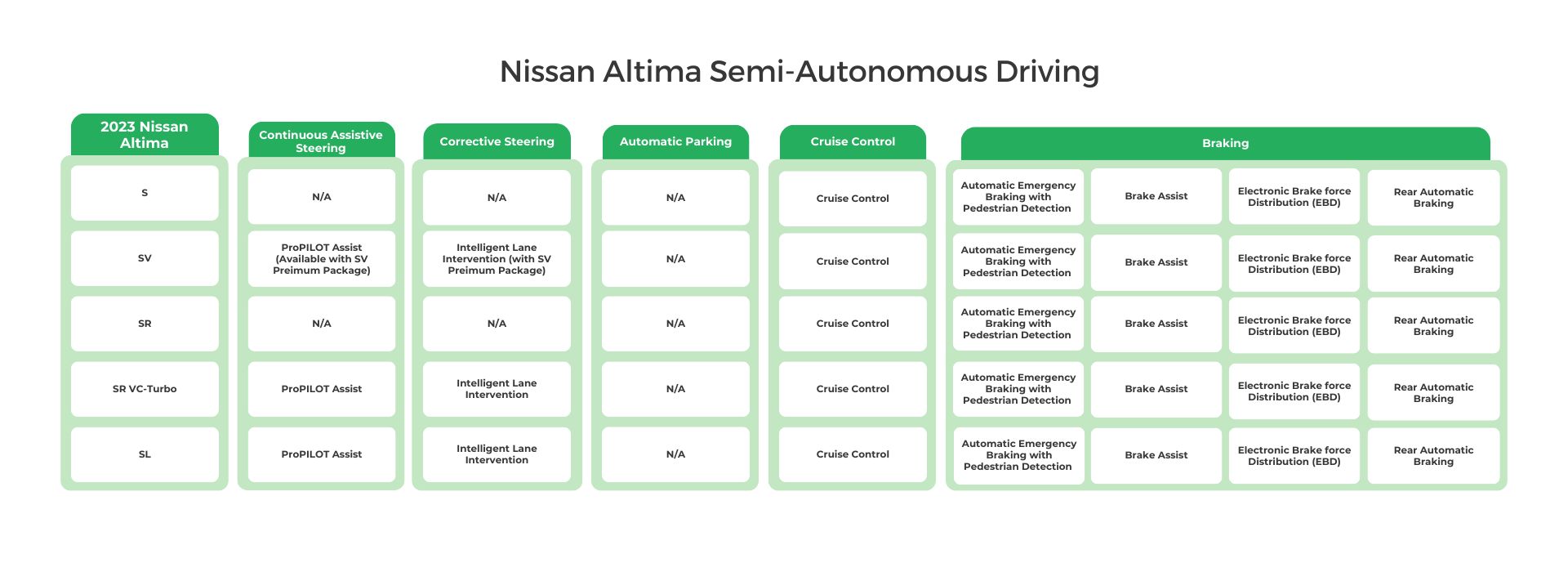
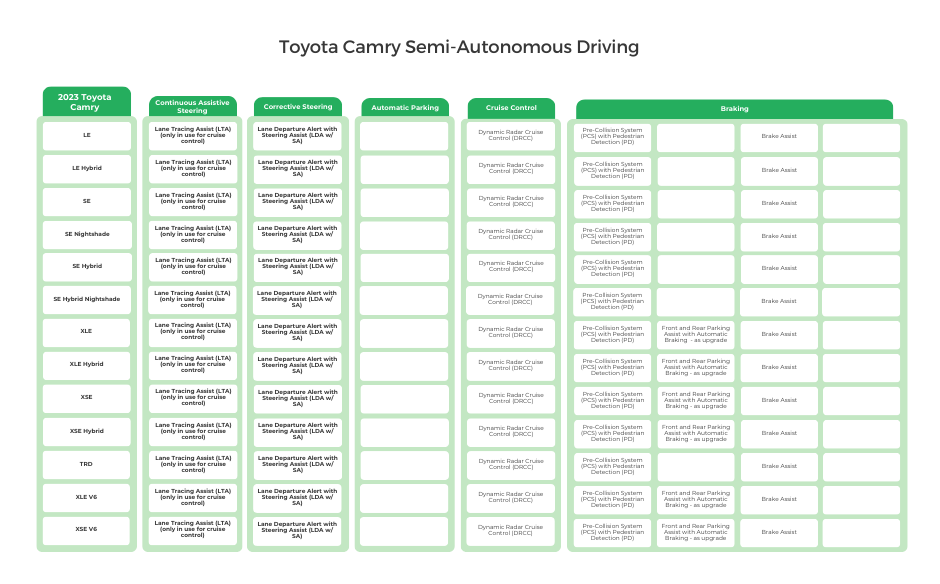
Semi-autonomous driving technology has become increasingly prevalent on new cars, but in this comparison of the Nissan Altima and Toyota Camry, the Toyota delivers a more comprehensive bundle of systems.
Continuous assistive steering with corrective ability and adaptive cruise control is lineup-standard for the 2023 Camry. While all of these systems are available on the 2023 Altima, that availability varies by model as shown below.
As for advanced braking technology, a frontal automated emergency system is standard across both sedans, but only the Altima includes rear auto braking on every model whereas the Camry offers it on certain models.
Neither the Altima nor Camry offer an automated parking system, which is more commonly seen on premium and luxury vehicles.
Driver Warning Systems & Telematics:
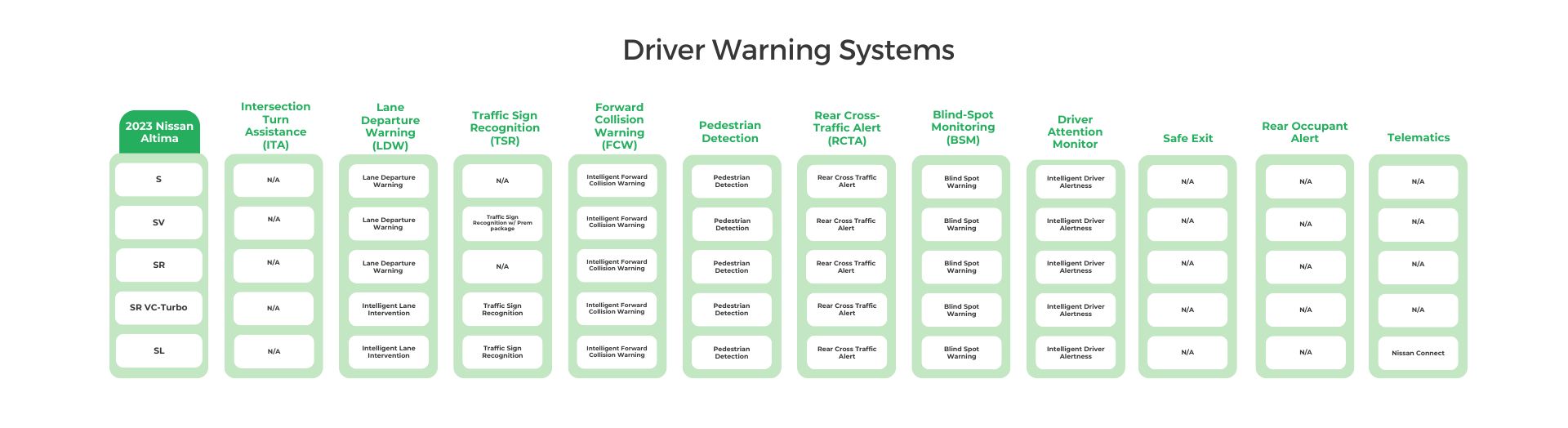
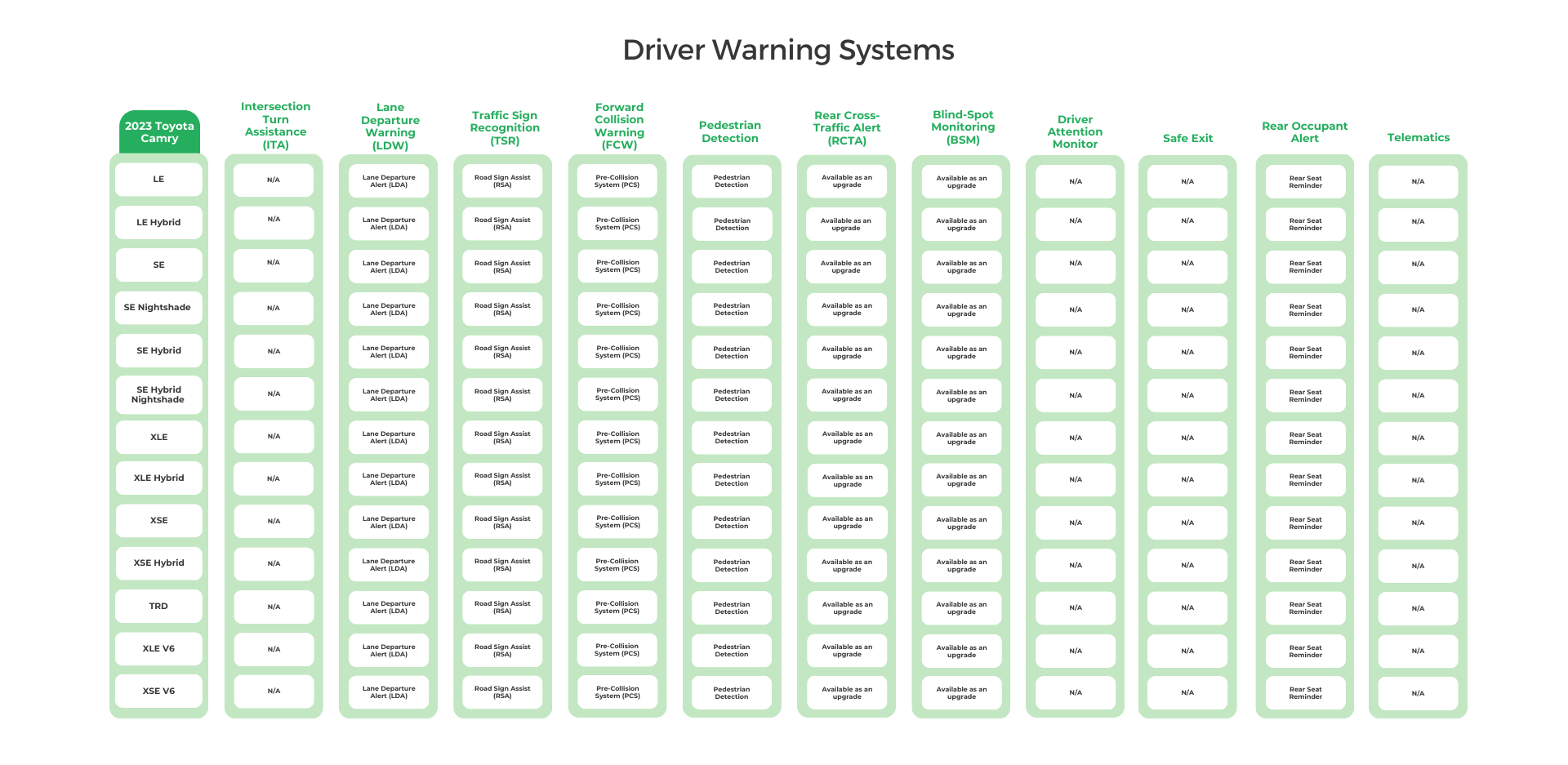
The chart below complements the semi-autonomous discussion above with more details on which advanced driver-assistance systems (ADAS) Nissan and Toyota fit to their midsize sedans.
Although both automakers include a robust ADAS roster – dubbed Safety Shield 360 in the Altima and Toyota Safety Sense 2.5+ in the Camry – there are enough differences that buyers should spend some time figuring out which are the most important to them.
For example, a forward collision warning with pedestrian detection and lane-departure warning are standard across the board, but only the Altima offers a lane-departure mitigation component. As well, blind-spot monitoring and rear cross-traffic alert are standard Altima systems but may require an upgrade on the Camry.
You won’t find intersection turn assistance or a safe exit alert on either vehicle, but traffic sign recognition and a rear occupant alert are both included on all Camrys versus varying availability on the Altima. Toyota also makes its telematics software standard equipment, but Nissan only fits it to the top-spec Altima SL.
Road Visibility Features:
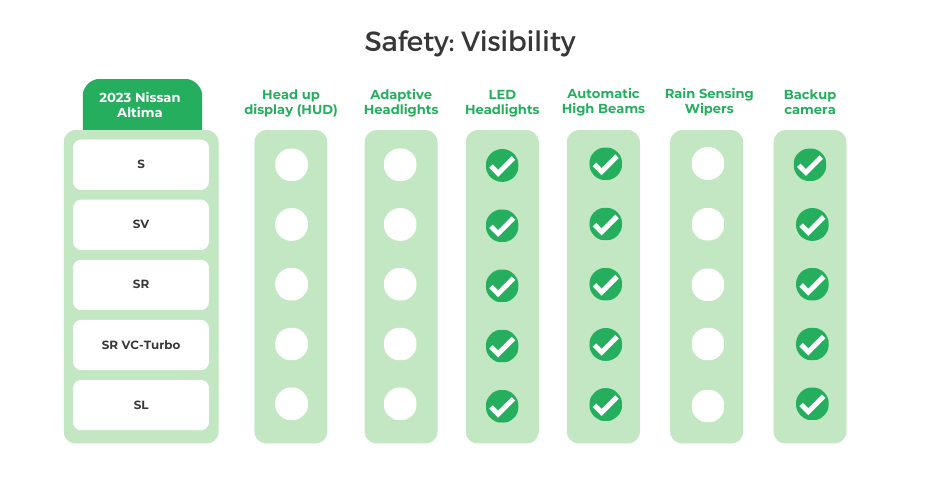
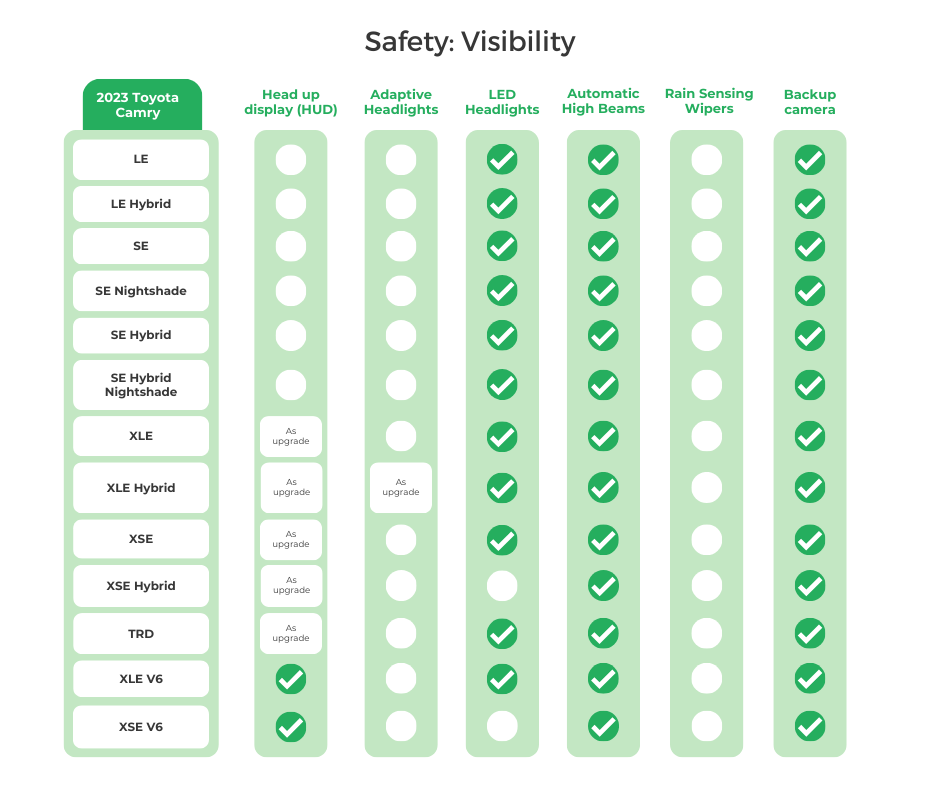
The difference between driving at night with old-school halogen headlights and modern LEDs is, ahem, truly night and day. This improvement in visibility is an important safety consideration on a new car and fortunately is standard on both the 2023 Altima and Camry as are automatic high beams and a backup camera.
Adaptive headlights and rain-sensing wipers are also modern conveniences that make for a safer car as the former swivel in concert with the steering wheel and the latter manage wiper speed in the rain automatically. But, these remain higher-end amenities and are not offered on either the Nissan Altima or Toyota Camry.
Lastly, there is the head-up display, a system that can project details like speed and ADAS information on the windshield in front of the driver. This relatively high-tech feature cannot be found on the 2023 Altima but is offered on certain 2023 Camry models as detailed in the table below.
Interior:
Interior Features:
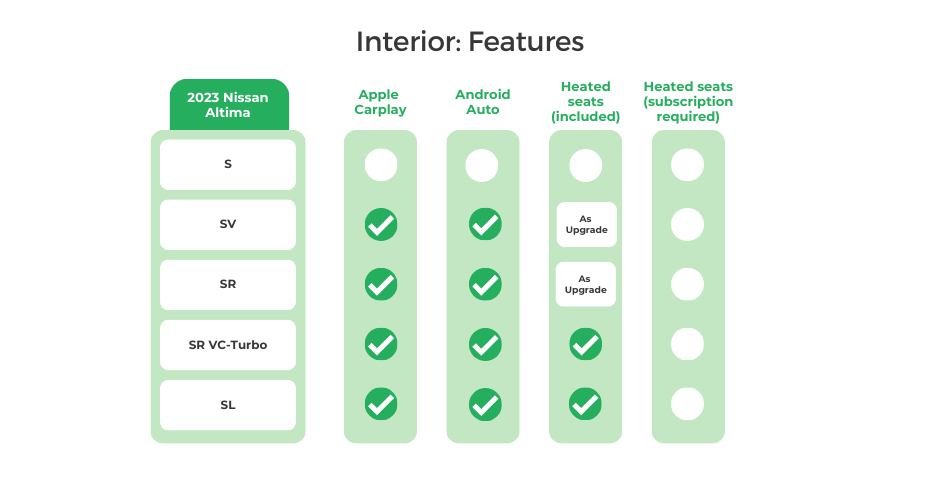
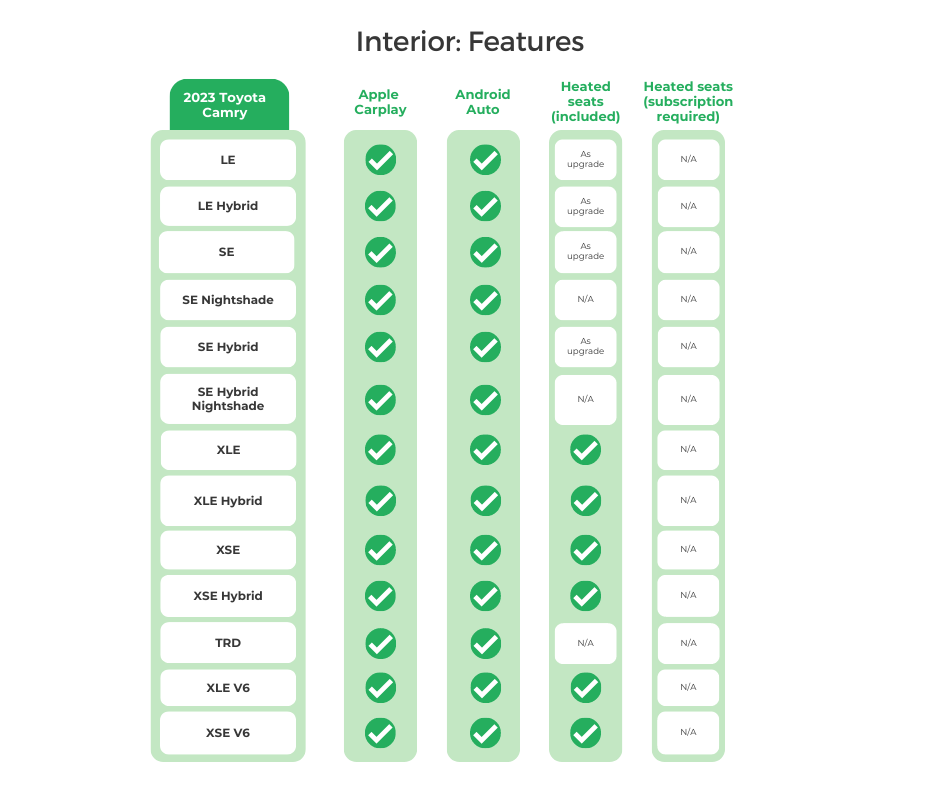
Considering how popular Apple CarPlay and Android Auto have become on modern cars, it’s surprising that Nissan doesn’t include it on the base Altima. However, it is standard on every other model and across the 2023 Camry lineup.
And when it comes to a chilly morning, there’s nothing better than warming up your keister with heated front seats. This creature comfort is widely available across both cars and standard on some, but subscription-based heated seats are not.
Part of a growing “Features On Demand” segment of the auto industry, paying for features like heated seats when you need them, but not when you don’t, is something most consumers remain unfamiliar with. But, you may want to get familiar as McKinsey says this type of thing is poised for serious growth.
Interior Dimensions:
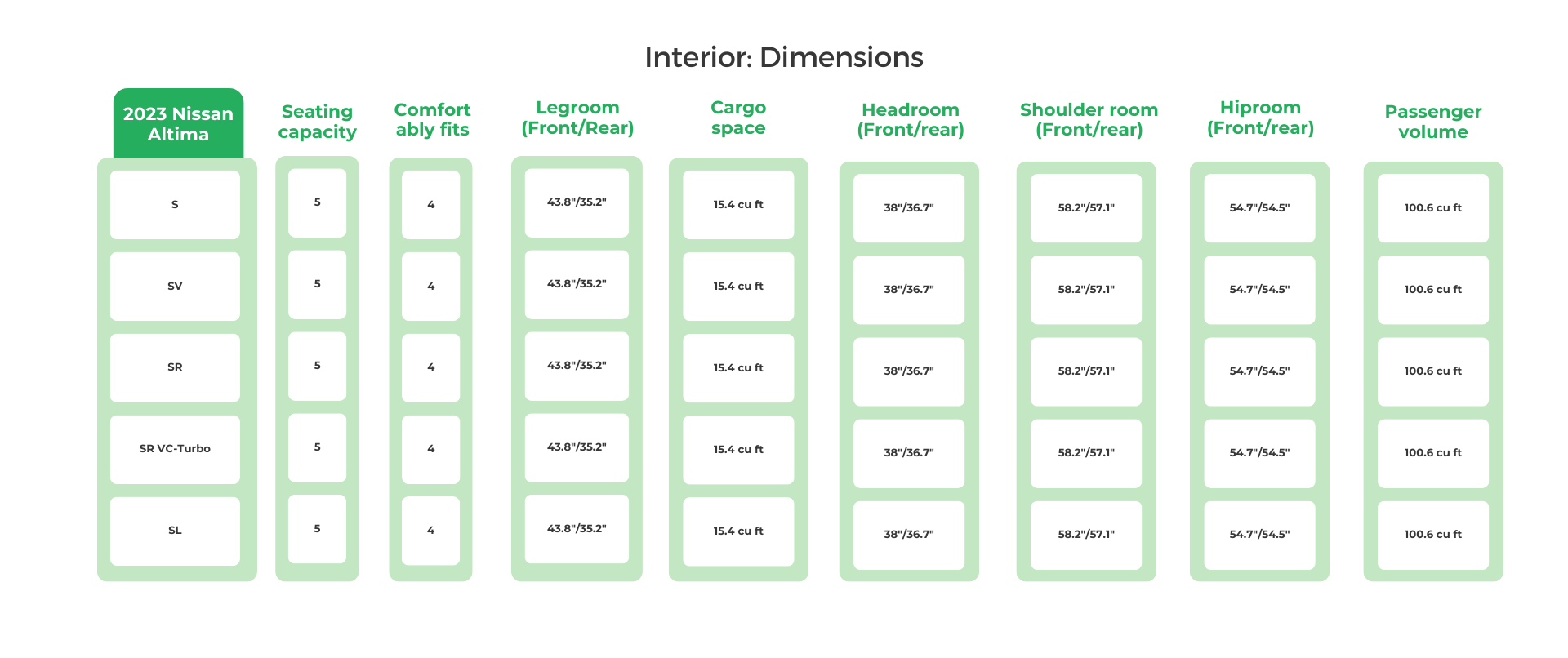
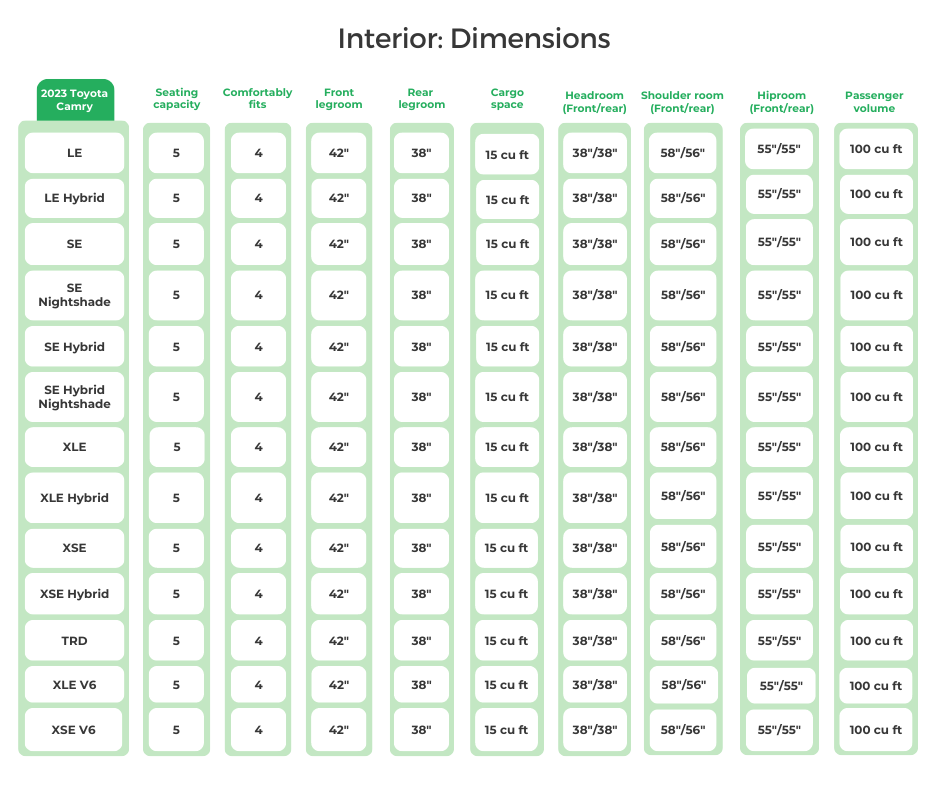
We touched on the interior dimensions of the 2023 Nissan Altima and Toyota Camry above, but it’s worth going deeper on this topic because everyone’s needs are different.
For instance, both of these cars comfortably seat 4 people in about 100 cubic feet of cabin space and offer around 15 cubic feet of trunk space.
But the Altima has nearly 2 more inches of front legroom, which may be important to those who aren’t planning to put anyone in the back seat. But if that is a possibility, the Camry has almost 3 extra inches of rear legroom and 1 more inch of headroom back there.
And if you intend to stuff 3 kids across the back row – which is a bad idea as I know from personal experience – both of these sedans have about 55 inches of hiproom across the back seat. However, the Altima enjoys 1 more inch of rear shoulder room and in this scenario, every little bit helps.
Exterior:
Exterior Features:
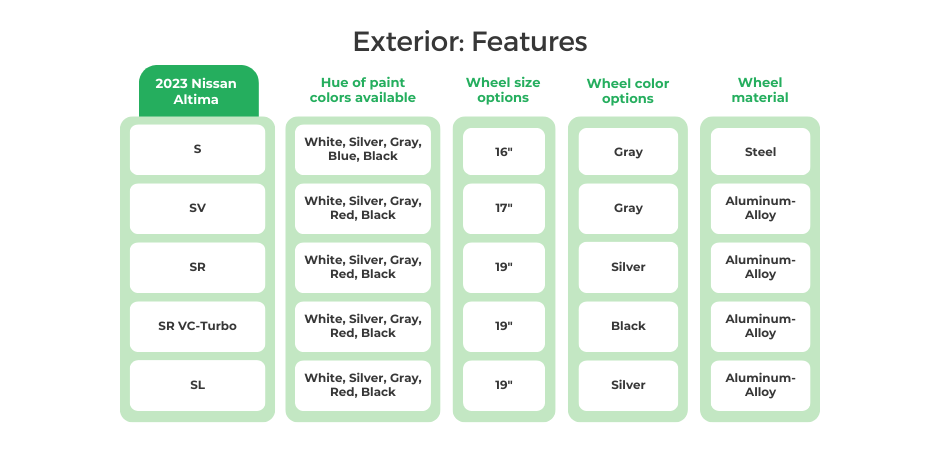
There was a time when saying a Toyota Camry beats anything in the style department would be met with laughter. But these days, the Camry looks pretty sweet with all manner of paint colors, including red, and no shortage of sweet wheels.
Yes, the Altima also offers red paint and wheels up to size 19. And yes, both of these sedans still show traces of their econo-car roots with steel wheels and hubcaps on lower-scale trims. But, the Altima SR VC-Turbo rims are mean-looking.
And how about the matte black or even matte bronze rims Camry offers? It’s a downright car show with these two mainstream family movers! Keep in mind, as those rims get bigger and the tire sidewall gets narrower, ride quality usually suffers, and replacement cost definitely goes up.

Exterior Dimensions:
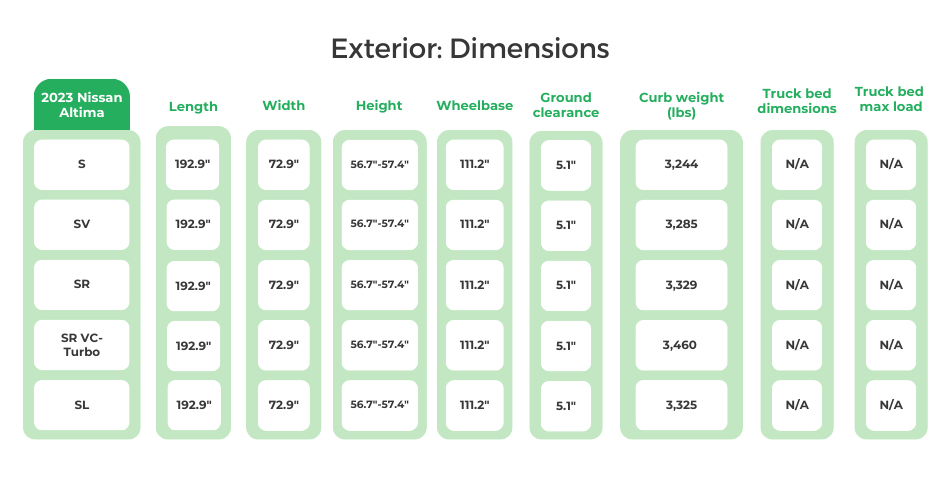
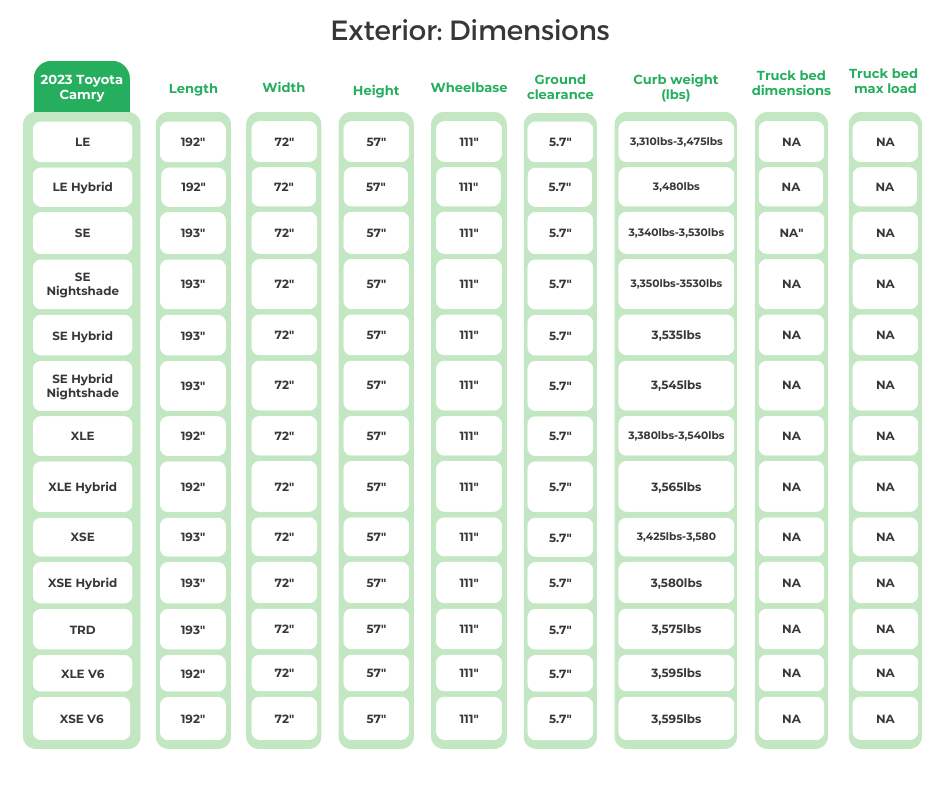
Looking at this table of exterior dimensions, it would appear that Toyota engineers are better at interior packaging. Though the Altima is slightly bigger in the length, width, and height department than the Camry, the Toyota offers more interior space in several key areas as noted earlier.
Other than that, these cars ride on virtually identical wheelbases and the gas-powered four-cylinder versions have similar curb weights. Hybrid Camrys tend to be heavier, but that’s ok, the fuel economy more than makes up for it.
Warranty:
As mainstream vehicles, the 2023 Nissan Altima and Toyota Camry share most warranty coverage terms. The basic warranty runs for 3 years or 36,000 miles and the powertrain is covered for 5 years or 60,000 miles in both cases. Toyota also includes a 10-year/150,000-mile warranty on battery packs for hybrid Camrys.
Though Nissan includes 3 years of roadside assistance to the 2 included by Toyota, the Camry comes with 2 years of complimentary service, something Nissan does not offer.
| 2023 Nissan Altima Factory Warranty Coverage: | 2023 Toyota Camry Factory Warranty Coverage: | |
| Basic warranty: | 36 months/36,000 miles | 36 months/36,000 miles |
| Powertrain warranty: | 60 months/60,000 miles | 60 months/60,000 miles |
| Corrosion perforation warranty: | 60 months/unlimited miles | 60 months/unlimited miles |
| Air conditioning warranty: | 36 months/36,000 miles | 36 months/36,000 miles |
| Battery warranty: | 36 months/36,000 miles | 120 months or 150,000 miles (Hybrid HV Battery) |
| Emissions warranty: | Federal: 36 months/36,000 miles (defect), 24 months/24,000 miles (performance) California: 36 months/50,000 miles (defect), 36 months/50,000 miles (performance) |
Federal: 36 months/36,000 miles (defects) California: 36 months/50,000 miles |
| Roadside assistance coverage: | 36 months/36,000 miles | 24 months/25,000 miles (ToyotaCare) |
| Total unique recalls: | 0 | 1 (recall no. 23V432000) |
Driver Experience | A Summary of The Top 10 Nissan Altima vs Toyota Camry Reddit Posts:
Though some responses require a grain of salt, the What Car Should I Buy Reddit does offer a wide array of unfiltered perspectives on which car is better – the Nissan Altima or Toyota Camry. Looking through recent discussions about these two cars reveals some important notes.
For one thing, there is a common thread of people pointing to the Camry being the best from a reliability perspective with statements like, “You just can’t beat Toyota in reliability.” While Toyotas are certainly reliable, we know from the objective FIXD Reliability Score comparison above that the Camry is not automatically more reliable than the Altima.
Users also frequently point out the need for solid gas mileage to go with reliability. And while the 30+ MPG ratings offered by both the standard Altima and Camry are respectable, neither can touch the hybrid Camry as one user pointed out.
The Camry is generally regarded as having a higher resale value, which we know is true, but is less helpful when you’re the buyer. And folks frequently commented on problems with Nissan’s CVTs, but that issue is typically related to the 2017 and earlier models, so keep that in mind when shopping.
The bottom line, as one user so succinctly summed up is, “There are a lot of good sedans…The right car is the one that works for you, whether it’s the best deal or, the best combination of features…”
Who Should Buy These Cars: The Legacy of The Nissan Altima & Toyota Camry
| Frequent Use Categories: | Nissan Altima | How Useful? (Out of 5 Stars) |
Toyota Camry | How Useful? (Out of 5 Stars) |
| Family Vehicle | * * * * * | * * * * * |
| Lots of Driving (travel/long commute) | * * * * | * * * * |
| Hauling/Towing | * | * |
| Office on Wheels | * | * |
| Sport/Fast Driving | * | * |
| Luxurious Driving | * | * |
| Outdoor/Off-Road | * | * |
Between high safety marks and strong fuel economy ratings, it’s not surprising to see “Family Vehicle” and “Lots of Driving” as the most frequent uses for the Nissan Altima and Toyota Camry per owner surveys.
Most of the other categories don’t apply to these mainstream midsize sedans, but if you fancy a bit of “Fast Driving”, the Altima SR VC-Turbo and Camry TRD should have what you’re looking for.
Year-by-Year Comparison | Nissan Altima vs Toyota Camry
Best & Worst Years | Nissan Altima vs Toyota Camry | 2001-2024
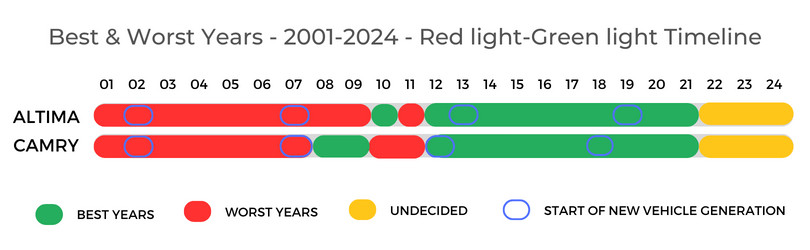
The graphic above condenses all the information from our Best and Worst Model Years Series of the Nissan Altima and Toyota Camry into one easy-to-read graphic for those shopping used models. Green sections represent the best model years, red is for the worst, and yellow represents years that we do not have enough data to make an informed decision.
Keep in mind, that the 2010 and 2012-2014 Altima are both “best of” model years and within the depreciation sweet spot. For the Camry, model years 2008, 2009, 2012, and 2013 fit that criteria – which is a good place to start for those looking for a good deal.
Just be sure to watch out for any years that marked the start of a new generation, which is indicated on this timeline by a blue circle. It’s an occasion often fraught with reliability gremlins as the manufacturer works through production kinks. As you can see, the 2002 and 2007 model years of both the Altima and Camry were new generations and in the “worst of” category.
Important Features Timeline | Nissan Altima vs Toyota Camry
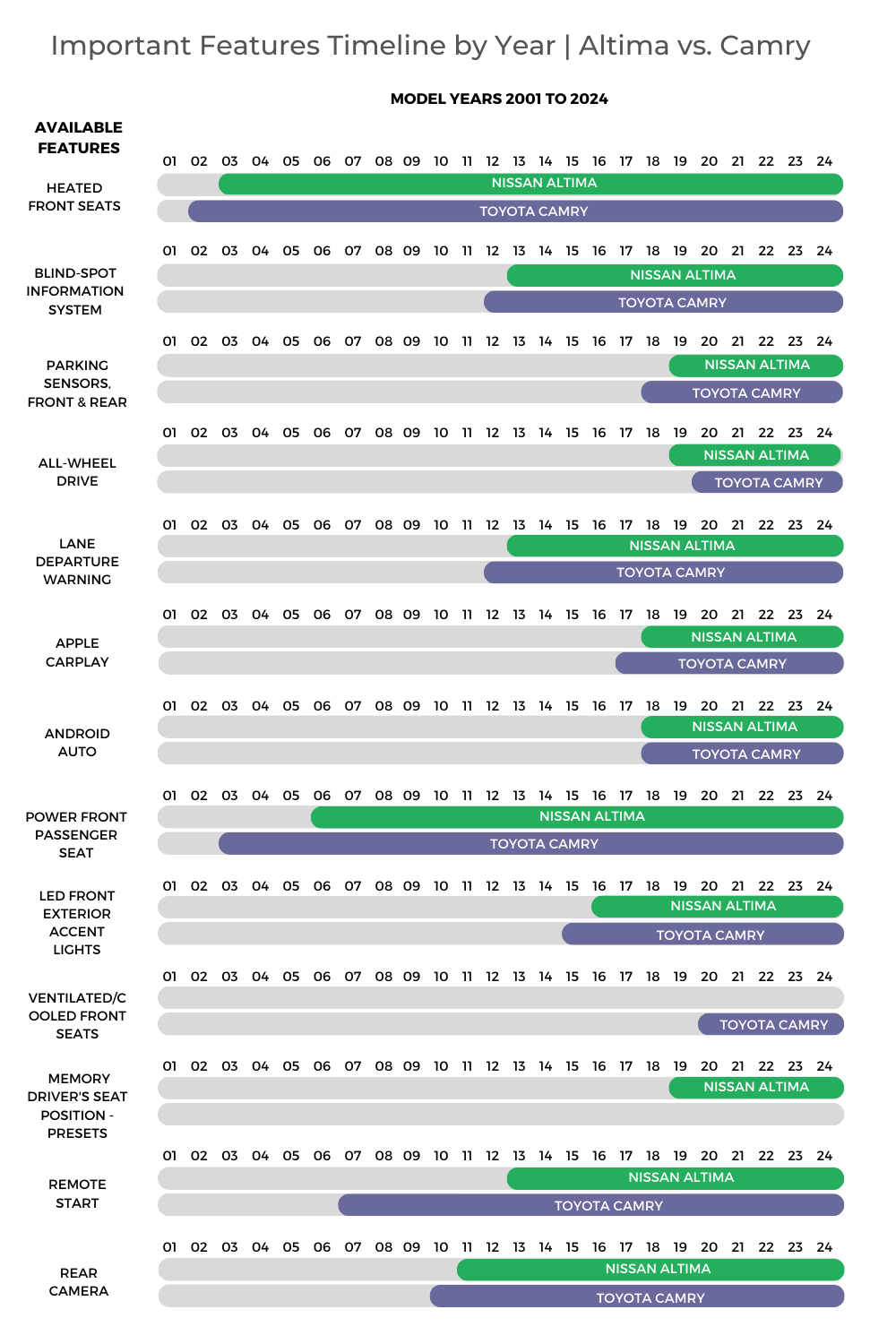
The above graphic is intended to help buyers learn when the features they’re looking for were first made available in the Nissan Altima and Toyota Camry. Considering how long these two sedans have been direct competitors, it’s not surprising to see that in most cases, popular features arrived within 1 year of each other.
Heated seats for both go back 20 years, while modern conveniences like Apple CarPlay and Android Auto landed between 2017 and 2018, followed by available AWD over the next couple of years. Ventilated front seats are exclusive to the Camry, but only the Altima offers driver memory settings.
Though Nissan’s Safety Shield 360 and Toyota’s Safety Sense ADAS suites have lately become standard and packed with systems, blind-spot monitoring, and lane-departure warnings go back to 2012 in the Camry and 2013 in the Altima.
Those looking to row their gears will need to find an Altima from 2012 or earlier or a Camry from 2011 and back. Find yourself the ultra-rare Altima SE-R with a 6-speed stick and you’ll be swarmed by the Car Nerd Police.
Our best and worst model year rankings of the Nissan Altima and Toyota Camry go deeper into the various features offered by these cars.
Maintenance Costs (Year-by-Year Average) | Nissan Altima vs Toyota Camry
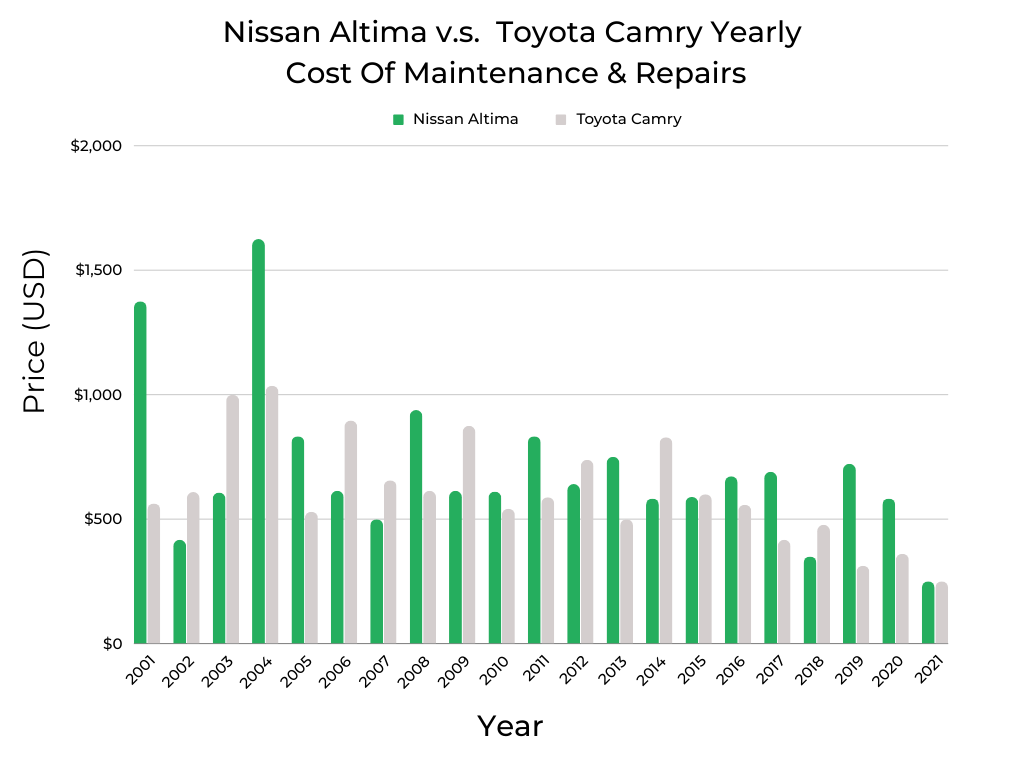
This chart compares the average annual repair costs that owners report spending on their Nissan Altimas and Toyota Camrys. As you can see, for the most part, both sedans hover in the $500-$750 range. This makes sense as the 20-year average for the Altima is $705 and $591 for the Camry.
Generally, costs trend up as the cars get older and accrue more miles, but it pays to investigate service history before buying a used Altima or Camry. Why? Because a high-mileage car that has had steady preventative maintenance over 10 years is likely more road-ready than the same car with a spotty maintenance history.
Obvious outliers include the 2001, 2004, and 2008 Altima on the chart above, but all three of those are on the wrong side of the best and worst model year ranking of the Nissan Altima, partly for this reason so are best avoided.
As for the Camry, 2003, 2004, and 2006 stick out like sore thumbs with high annual repair bills and as you might expect, all three get a thumbs down from us on the best and worst model year ranking of the Toyota Camry.
Safety Rating Comparison | Nissan Altima vs Toyota Camry
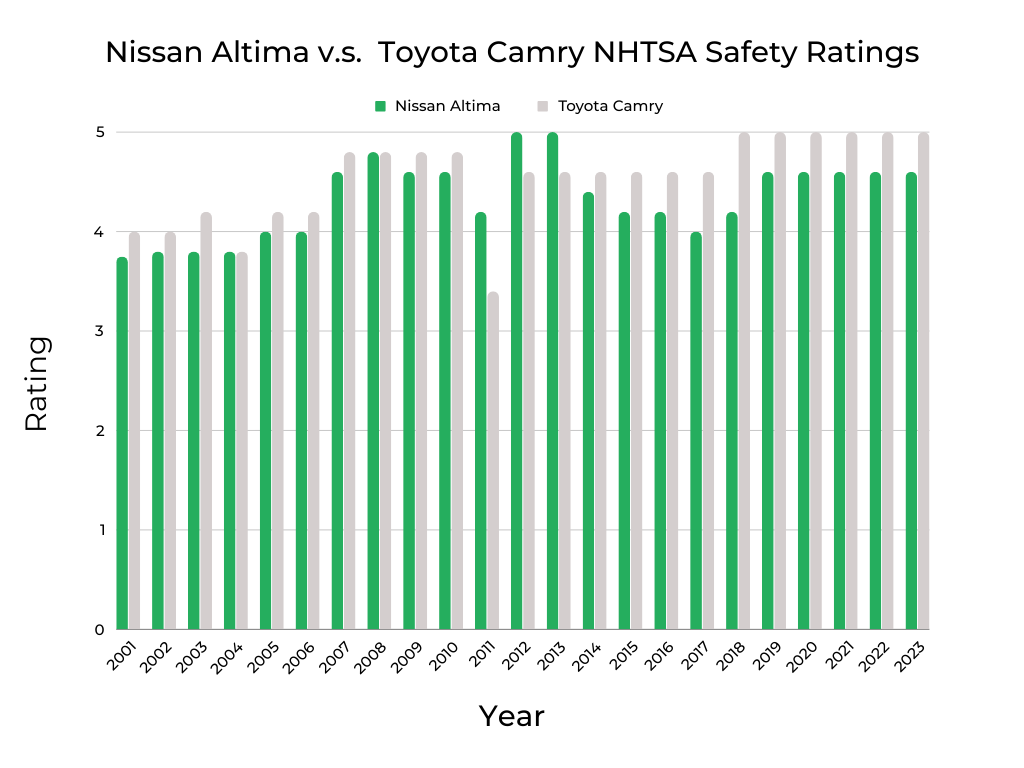
We already know that the brand-new Nissan Altima and Toyota Camry perform well in crash testing, but what if you’re in the market for a used model? That’s what the above chart is for as it compares the average NHTSA safety rating of both cars every year going back to 2001.
For the most part, the scores trend up over time and in several cases follow the theme of a new generation kicking off better safety ratings with the arrival of new technology and platform modifications. Such is the case with the 2007 model year for both sedans, the 2018 Camry, and the 2019 Altima.
The notable drop shown in 2011 is common across the auto industry. This was the year the NHTSA instituted new, stricter testing protocols that drove scores down. As you can see, the following year, both cars rebounded well, but for no clear reason, the Altima then began a troubling downtrend until 2017.
You can dig into the safety information for each of these vehicles in our best and worst model year rankings series for the Altima and Camry. As well, for specific crash-test data, just plug in the year and model you’re looking at on the NHTSA ratings site.
Fuel Efficiency Comparison | Nissan Altima vs Toyota Camry
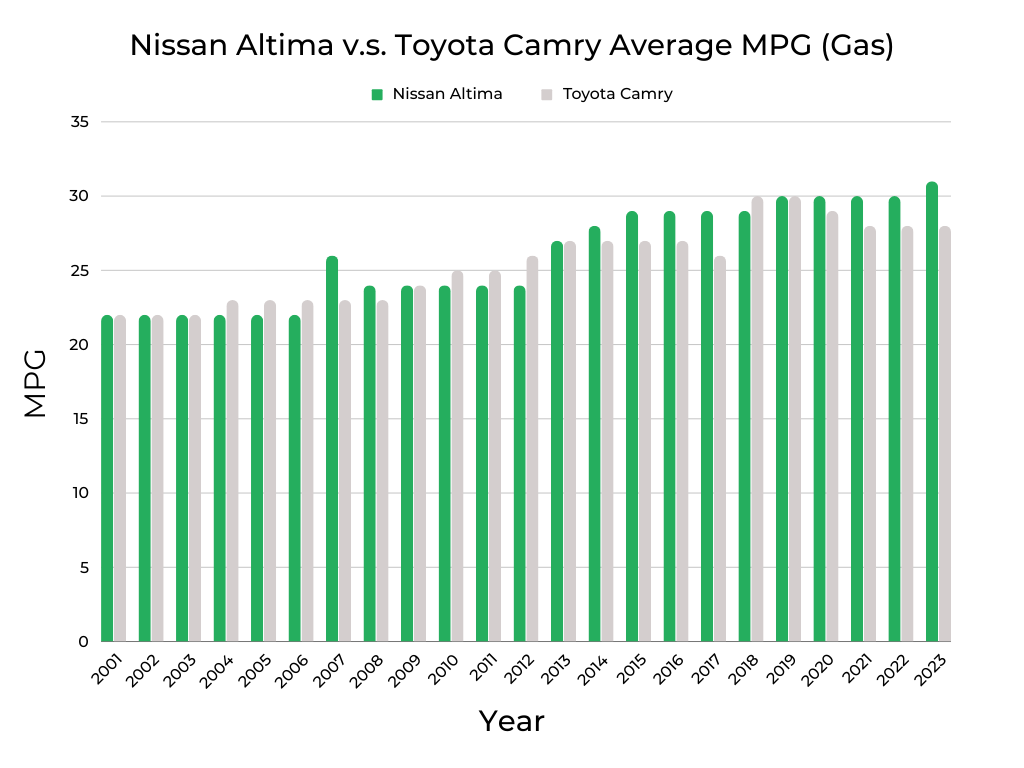
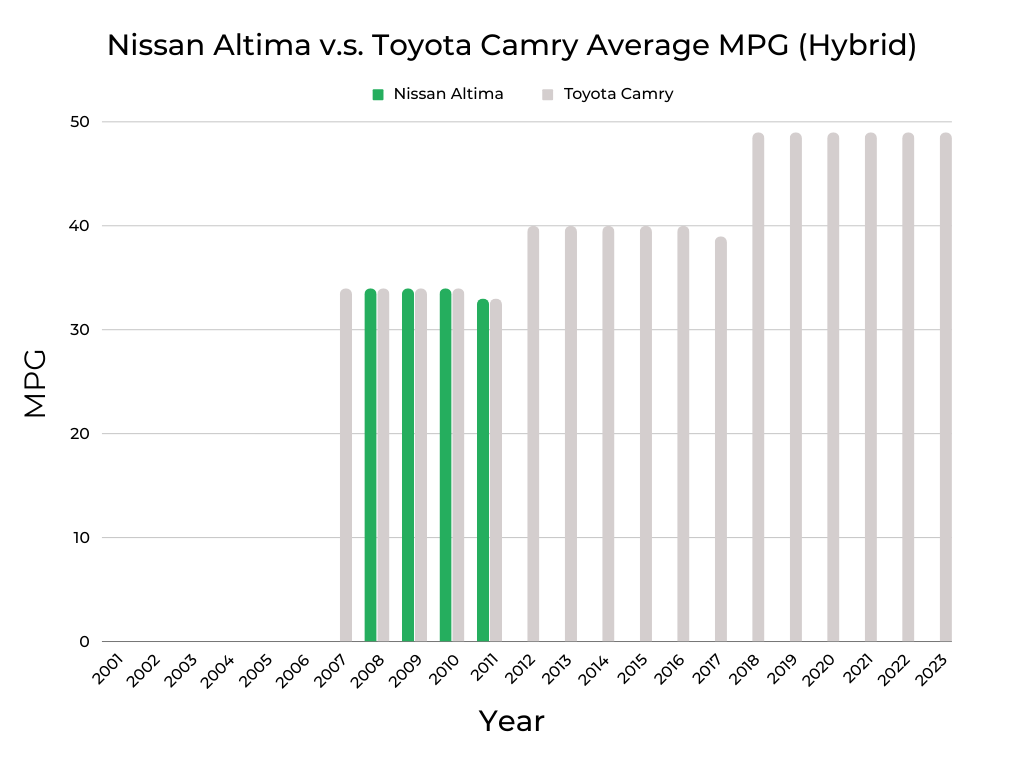
For those with fuel efficiency on their mind as they shop the used Nissan Altima and Toyota Camry market, we direct your attention to the above graph on the right. It compares the fuel efficiency of hybrid models of these two cars going back to when these powertrains were first offered.
Though the Altima was a strong competitor to the Camry during the stretch Nissan offered a hybrid variant, since 2012, only the Camry has offered a hybrid setup. And as you can see, it’s an efficiency champ with 10-year-old cars hitting the 40 MPG mark and more recent Camry hybrids approaching 50 MPG.
The gas versions aren’t exactly slouches as decade-old Altimas and Camrys are in the 25 MPG ballpark. This is illustrated on the left-hand chart above. It shows how over time, as powertrains become more efficient, these cars become ever more miserly with fuel consumption.
For the most part, the Altima and Camry have nearly identical average fuel economy year-over-year, though the Nissan noses out the Toyota in several instances. The drop in economy posted by the Camry in 2017 could be due to an updated testing protocol instituted by the EPA.
But, the dip seen in 2020 and later is without a doubt due to the arrival of the Camry TRD. Anytime a car has the word “racing” attached to it, chances are, fuel efficiency won’t be the top priority.
Don’t miss our best and worst model year rankings of the Nissan Altima and Toyota Camry to see the role fuel economy plays in whether we recommend a given model year or not.

Niel Stender grew up doing replacement work on his old Cherokee and sweet Mitsubishi Starion, which led to a degree in mechanical engineering and a job at Ford as a vehicle dynamics engineer. His writing infuses that automotive background with sales and marketing experience. Writing about cars for close to a decade now, he enjoys digging into some of the more technical mechanical systems under the hood and throughout a vehicle.