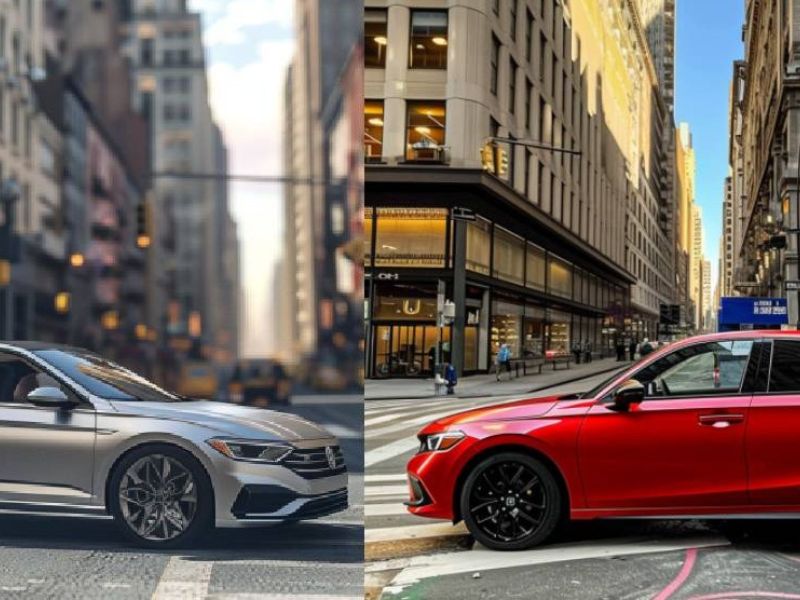
In an auto market dominated by SUVs and pickups, it’s easy to forget about passenger cars. But shopping for vehicles like the Volkswagen Jetta or Honda Civic is smart. Not only are these cars fuel efficient and safe, but they don’t command higher prices like utilities and trucks.
Having owned several VWs and Hondas, I can give you a big-picture look at what differentiates these cars. With its European flair, the Jetta offers a compact car option beyond the usual cast of characters (Honda Civic, Toyota Corolla, Nissan Sentra, Ford Focus, Chevrolet Cruze, Hyundai Elantra, Mazda Mazda3, Subaru Impreza, and Kia Forte). Volkswagen’s upscale interiors give the Jetta a premium vibe, uncommon in this price range. Plus, the Jetta (like many VWs) is more of a driver’s car, featuring zippier acceleration and crisper handling.
Meanwhile, the Honda Civic goes about its job with no fuss. The Type R and Si variants offer more excitement. But otherwise, the Civic is a mainstream car throughout, which is why people purchase them. At the same time, the Civic doesn’t quite reach “appliance” status like the Corolla or some others in this class. I wouldn’t call newer Civics premium, but they’re close.
Looking at data about market value, engine reliability, maintenance, and other factors provides more down-to-earth reasons that separate the Jetta and Honda. For instance, plan on spending more for a Civic than an equivalent Jetta. However, Jettas have higher maintenance and repair bills.
There are similarities, too. Both cars have a mixed record for engine reliability, especially with less recent model years (Assuming all Hondas are dependable would be a mistake. Likewise, not all Jettas are problematic). FIXD surveys also show that Jetta and Civic owners like their cars despite any troubles.
Looking for the latest model? Check out our 2023 Comparison.
Keep reading to see how this Volkswagen Jetta and Honda Civic contest turns out. Other match-ups to review include Outback vs. Forester, RAV4 vs. CR-V, Civic vs. Corolla, Pilot vs. Highlander, and Odyssey vs. Sienna.
| Income Bracket | Monthly Financing Cost Range | Cash Purchase Price Range | Volkswagen Jetta Years | Honda Civic Years | Best Model Year: | Why? |
| $5k-$10k | $83 – $125 | $3,000-$4,500 | N/A | 2006 | 2006 Civic | Strong safety score, reasonable engine reliability, and modest market value |
| $10k-$15k | $125-$187 | $4,500-$6,750 | 2011 | 2010 | 2010 Civic | Above-average engine reliability, excellent safety score |
| $15k-$25k | $187 – $312 | $6,750-$11,250 | 2016 | 2016 | 2015 Jetta | Solid value, near-perfect engine reliability, and strong safety score |
| $25k-$35k | $312-$437 | $11,250-$15,750 | 2019 | 2018 | 2018 Civic | Very good engine reliability, perfect safety score, and solid value |
| $35k-$50k | $437-$625 | $15,750-$22,500 | 2021 | 2021 | 2021 Jetta | Solid value, perfect engine reliability, and strong safety scorer |
See the methodology for the table above.
Before you respond to the “For Sale” ad, check out this How to Buy a Used Car article for a step-by-step checklist.
Price History Comparison | Volkswagen Jetta vs. Honda Civic
Average Market Value – Based on Owners’ Self-Reported Mileages | Volkswagen Jetta vs. Honda Civic

Comparing the Jetta and Civic starts with a look at prices, something on the mind of most car buyers. Kelley Blue Book (KBB) data is highlighted in this market value graph. Take note that these prices reflect private-party transactions. You can expect to pay 33%–50% more at a dealer. If going retail stretches your budget, consider shopping for an older car or one with more miles or fewer features. Further, mileage is incorporated into this data, reflecting reported owner use via FIXD surveys.
There’s one consistency worth paying attention to: the Jetta (green) is worth less than the Civic (gray). While there are some fluctuations in the spread year-to-year, Civic buyers can expect to pay more than their Jetta counterparts.
Some of the differences can be explained by mileage. In particular, you’ll see the values for the 2016-2017 and 2019-2021 Civics tower above the same year’s Jettas. This is primarily because these Hondas have 20%–25% less mileage. However, it’s safe to say that even without this reduced mileage advantage, these Civics would still have higher market values.
You can count on one thing: assuming mileage, condition, age, and equipment match, you’ll always pay more for a Honda Civic than a Volkswagen Jetta. For some, this means acknowledging paying more, while others will steer towards a Jetta to save money.
Be sure to read our Best and Worst Years series of articles highlighting the Volkswagen Jetta and Honda Civic winners and losers.
Depreciation vs. Maintenance Expenses
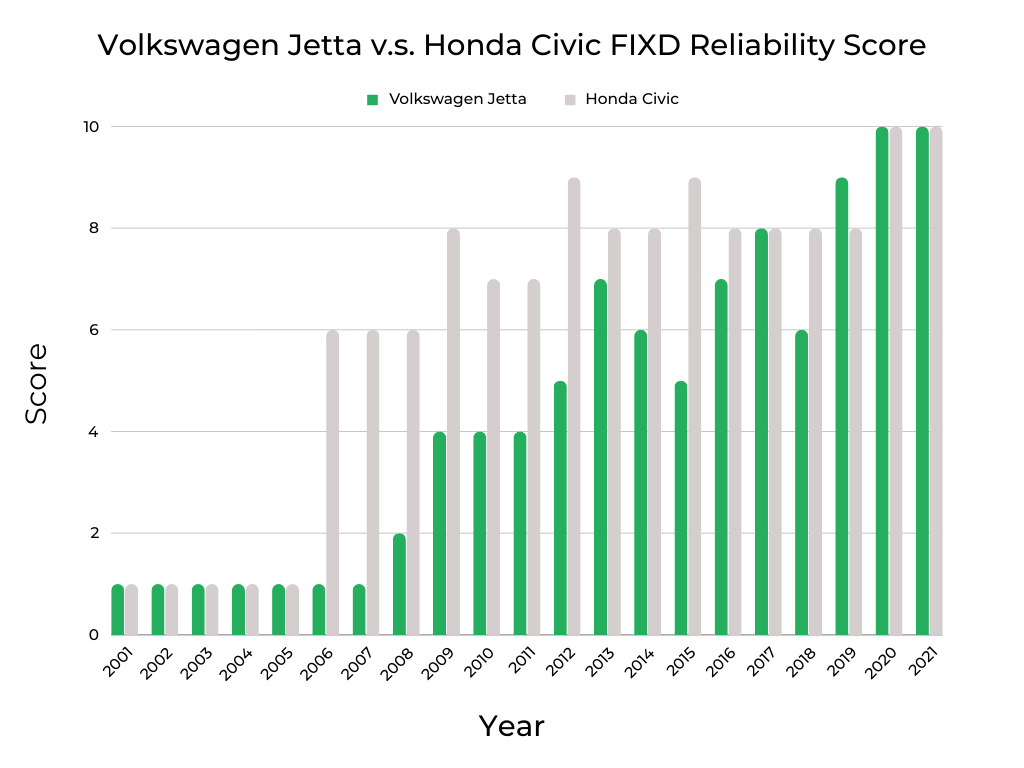
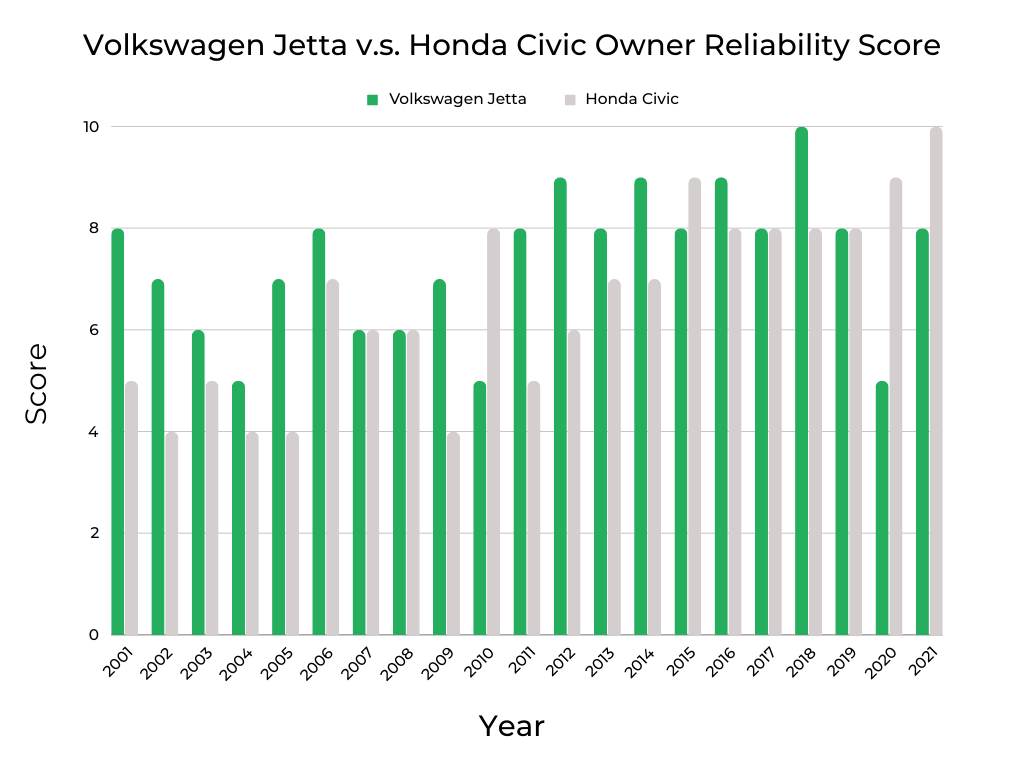
The first years of the 21st century are a sad story for engine reliability with the Jetta and Civic. FIXD Reliability scores of 1 for 2001-2005 are as bad as it gets. By 2006, the Civic turned the corner with a mid-tier score of 6 and never looked back.
The Jetta’s engine reliability takes several years to reach average status, achieving 5 in 2012. An above-average ranking takes another year; the Jetta’s first score of 7 (or better) occurred in 2013.
I’d divide engine reliability for both vehicles into two periods, with 2012 being the separation mark. In particular, FIXD Reliability Scores show pre-2011 Jettas to be more problematic, while more Civics from this same time frame are at least average performers.
It’s important to note that not every check engine light (CEL) is accompanied by an eye-watering repair bill. Simple things like a failing car battery or a cracked hose can cause CELs.
Owner Reliability Scores show that check engine lights don’t discourage those with a Jetta or Civic in the driveway. Positive perceptions are especially common among owners of older Jettas (2001-2005). Despite bottom-of-the-barrel engine reliability, these VW owners ranked their cars as average or better (5-8). This means they’re overly optimistic or just accept the problems associated with older Volkswagens. In contrast, owners of older Civics appear to be more grounded in reality, giving their cars a 4-5.
Review the Best and Worst Years articles on the Volkswagen Jetta and Honda Civic to learn more about these vehicles’ FIXD Reliability and Owner Reliability Scores.
Longevity Comparison | Volkswagen Jetta vs. Honda Civic
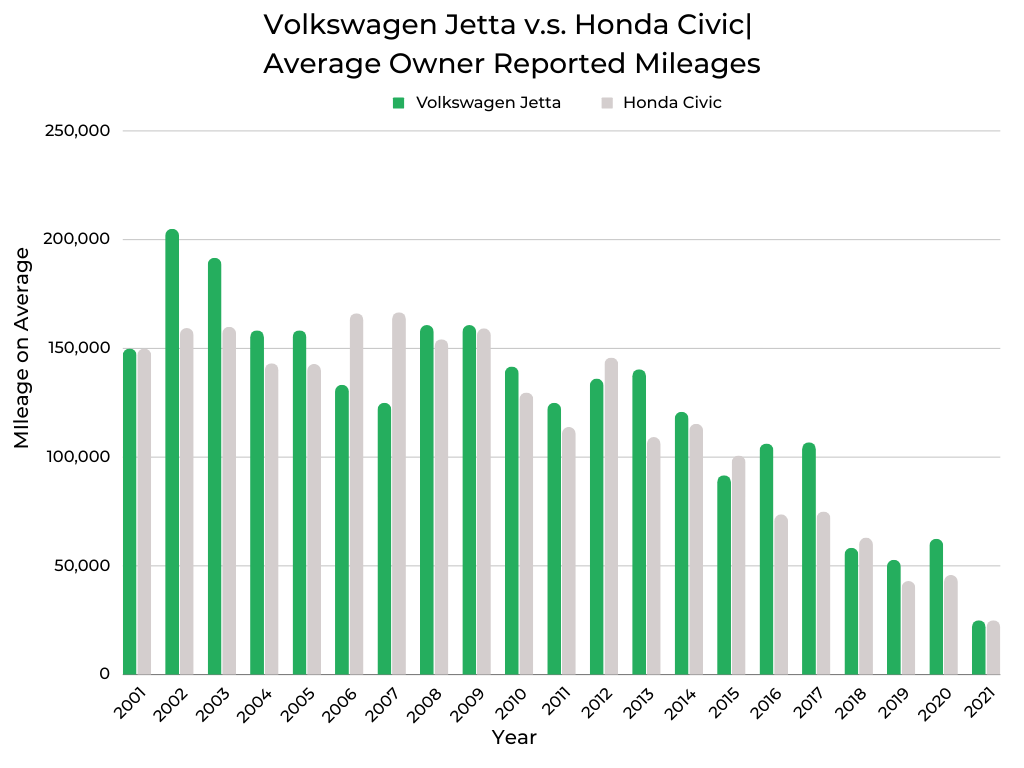
Regularly seeing the ups and downs of engine reliability (via FIXD Reliability Score data) causes me to be unmoved by most of what I encounter. Yet, every once in a while, I get surprised. Such is the case with the owner-reported mileage for the Civic. Frankly, I would have expected average use to be well above the 150,000-mile mark. Instead, the 2002-2003 Jetta has this claim to fame—I never would have guessed this; so much for assumptions.
Looking at for-sale listings can also be insightful, even if the effort is unscientific. A review of autotrader.com (December 13, 2023) shows 2,346 Civics and 768 Jettas from the 2001-2012 model years available. I examine older years as these vehicles are more likely to have higher mileage. In addition, don’t get put off by the larger number of Civics; Jettas aren’t as popular.
Drilling into listings shows 31 Jettas (4.0%) have 200,000 miles or more, compared to 192 Civics (8.1%). This flips initial perceptions and shows that Civics can cross this high-mileage barrier. Nonetheless, this achievement is the exception, not the rule.
A further examination of these on-sale listings shows that 156 Jettas (20.2%) and 536 Civics (20.6%) had 150,000-200,000 miles on the odometer. These results suggest this mileage tier is the end-stage for these VWs and Hondas.
It’s noteworthy that vehicle use (smooth and gentle versus rough and tumble), maintenance frequency, and accident-free driving also impact longevity.
Review the individual articles on the best and worst years of the Volkswagen Jetta and Honda Civic for a more thorough look at longevity.
Who Should Buy These Cars: The Legacy of Volkswagen Jetta vs. Honda Civic
FIXD surveys show owners use their Jettas and Civics principally for “lots of driving,” which is another way of saying longer commutes and road trips. Further, about one-third of these owners use their cars for family transportation. Volkswagen and Honda designed the Jetta and Civic with these functions in mind.
At the same time, the survey results show that not too many owners rely on these cars for hauling or sporty or luxurious driving. Not many report using their Jetta or Civic as an office on wheels, either.
These cars are all about daily driving, not much else.
| Frequent Use Categories: | Volkswagen Jetta | How Useful? (Out of 5 Stars) | Honda Civic | How Useful? (Out of 5 Stars) |
| Family Vehicle | * * * * | * * * * |
| Lots of Driving (travel/long commute) | * * * * * | * * * * * |
| Hauling/Towing | * | * |
| Office on Wheels | * | * |
| Sport/Fast Driving | * | * |
| Luxurious Driving | * | * |
| Outdoor/Off-Road | * | * |
Driver Experience | A Summary of The Top 10 Volkswagen Jetta vs. Honda Civic Reddit Posts:
Comparing the Volkswagen Jetta and Honda Civic is a frequent Reddit topic. Here’s an overview of the discussions from Reddit: r/whatcarshouldIbuy.
When comparing the Volkswagen Jetta and Honda Civic, Redditors tend to favor the reliability, lower ownership costs, and resale value of the Honda Civic. As one user commented, “The usual advice is Civic over Jetta because VW’s reliability doesn’t match Honda’s and you’ll spend more on repairs over time.” Several users echoed this sentiment about the Civic being the more sensible and trouble-free choice over the long run.
However, Redditors do acknowledge some advantages of the Jetta over the Civic. In a few comments, users pointed out the Jetta’s superior interior refinement, riding comfort, and driving dynamics compared to the Civic, which some described as “loud” and “harsh” in comparison.
As one user put it, “I’d go Jetta. The interior and driving dynamics are awesome. Much more refined than the loud and harsh Civic. Another Redditor chimed in, “If you hate CVTs, get the Jetta. Otherwise, I think the Civic will last longer and it gets slightly better gas mileage.”
In terms of tech and features, they compete very closely.” So, while the Civic gets points for practicality, the Jetta offers a more premium overall driving experience, according to some.
The other main advantage favoring the Civic that emerged from the Reddit commentary was resale value. Multiple users remarked that the Jetta tends to depreciate faster than the Civic. For example, one comment stated, “Older Jettas had reliability issues which is why they depreciate so fast. The new ones are better, but Civics still hold their value better.” So not only is the Civic cheaper to own over time, but it retains more value when selling or trading it eventually. As one user summed it up, “You really can’t go wrong with a Civic. It ticks all the boxes and holds value very well. The Jetta looks nice but doesn’t stack up as an overall package.”
Best & Worst Years | Volkswagen Jetta vs. Honda Civic | 2001-2024
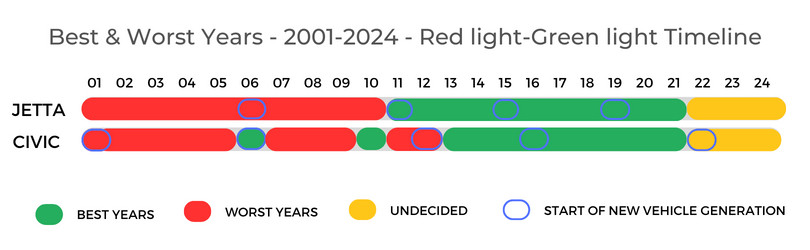
Shoppers without much to spend have only two options: a Civic from 2006 or 2010. Buying an older Jetta (2002-2010) carries too much risk for reliability.
However, the doors swing wide with Jettas from the 2011-2021 model years. Having a decade’s worth of options makes for easier shopping. You’re more likely to find something with a sharp price or preferred characteristics.
The same can be said for the 2013-2021 Civics. However, from earlier information, you’ll know these come at a higher cost than equivalent Jettas.
We’ll call attention to the undecided years (yellow) only because there isn’t enough information to give these editions a thumbs up or down.
Important Features Timeline | Volkswagen Jetta vs. Honda Civic
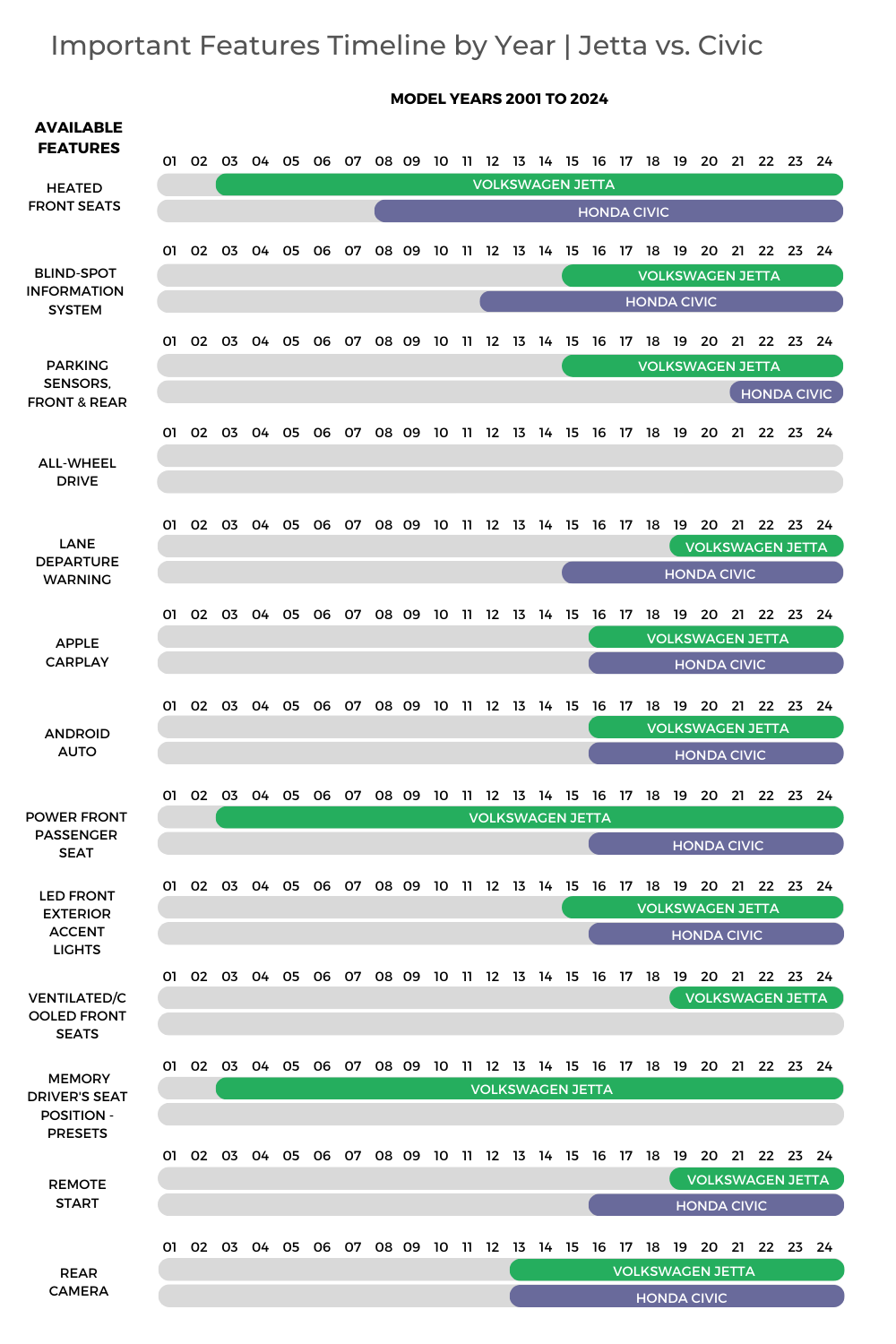
Although the Jetta and Civic are head-to-head competitors, their respective manufacturers have different approaches to car building. Like most German automakers, Volkswagen prefers to be seen as cutting-edge by offering new technologies and features. On the other hand, in the vein of many Japanese automakers, Honda prefers to stick with what works and is usually slower to add new equipment.
These differing strategies are why comfort and convenience features like heated front seats, parking sensors, and a power front passenger seat appear in the Jetta first. This also explains why upscale equipment such as ventilated front seats and a driver’s memory system has yet to be offered in a Civic. Some of these firsts are also due to VW positioning upper-end Jetta trims to straddle the line between mainstream and luxury.
Interestingly, Honda gains the upper hand with safety technology, something the German automakers usually take pride in. As a result, the Civic received blind-spot monitoring and lane departure warning before the Jetta.
Meanwhile, VW and Honda jumped on the Apple CarPlay and Android Auto bandwagon at the same time.
Maintenance Costs (Year-by-Year Average) | Volkswagen Jetta vs. Honda Civic
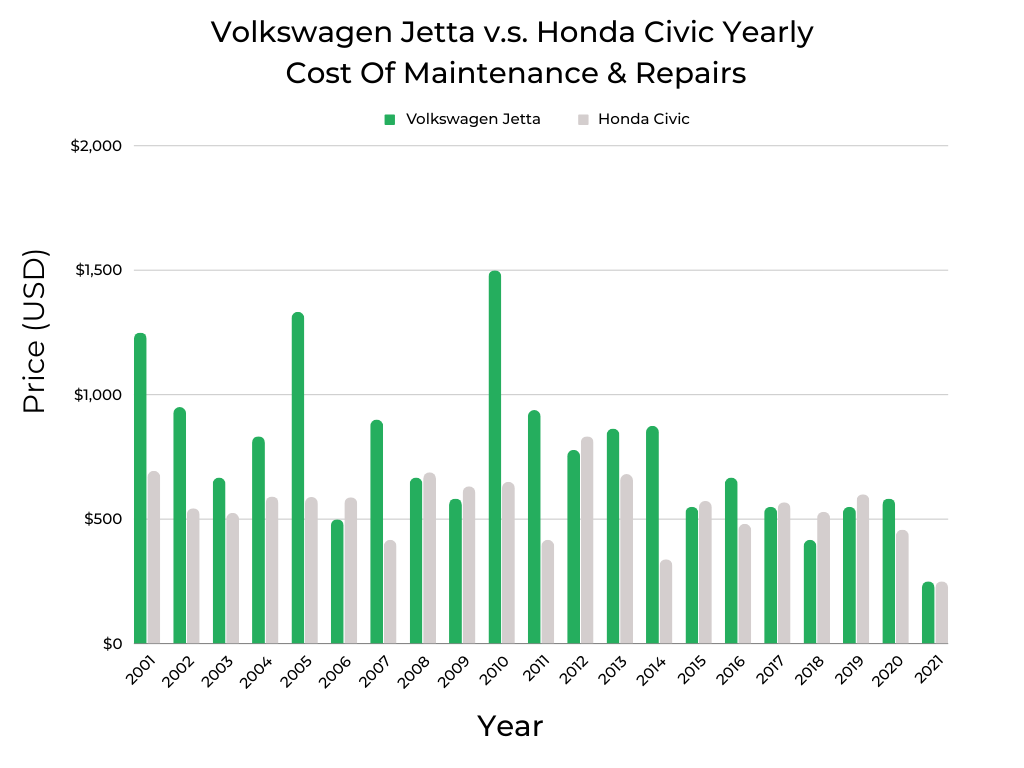
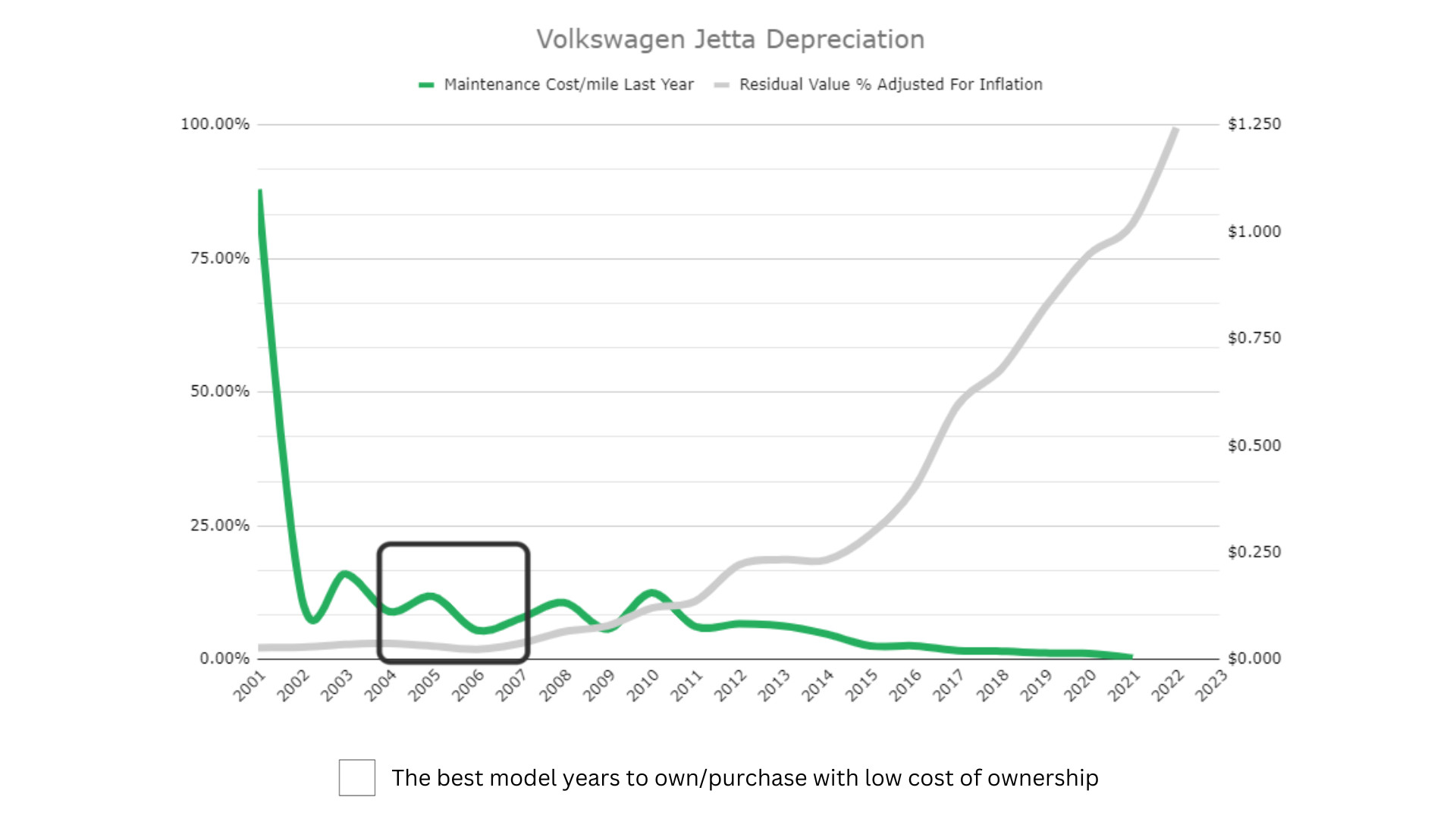
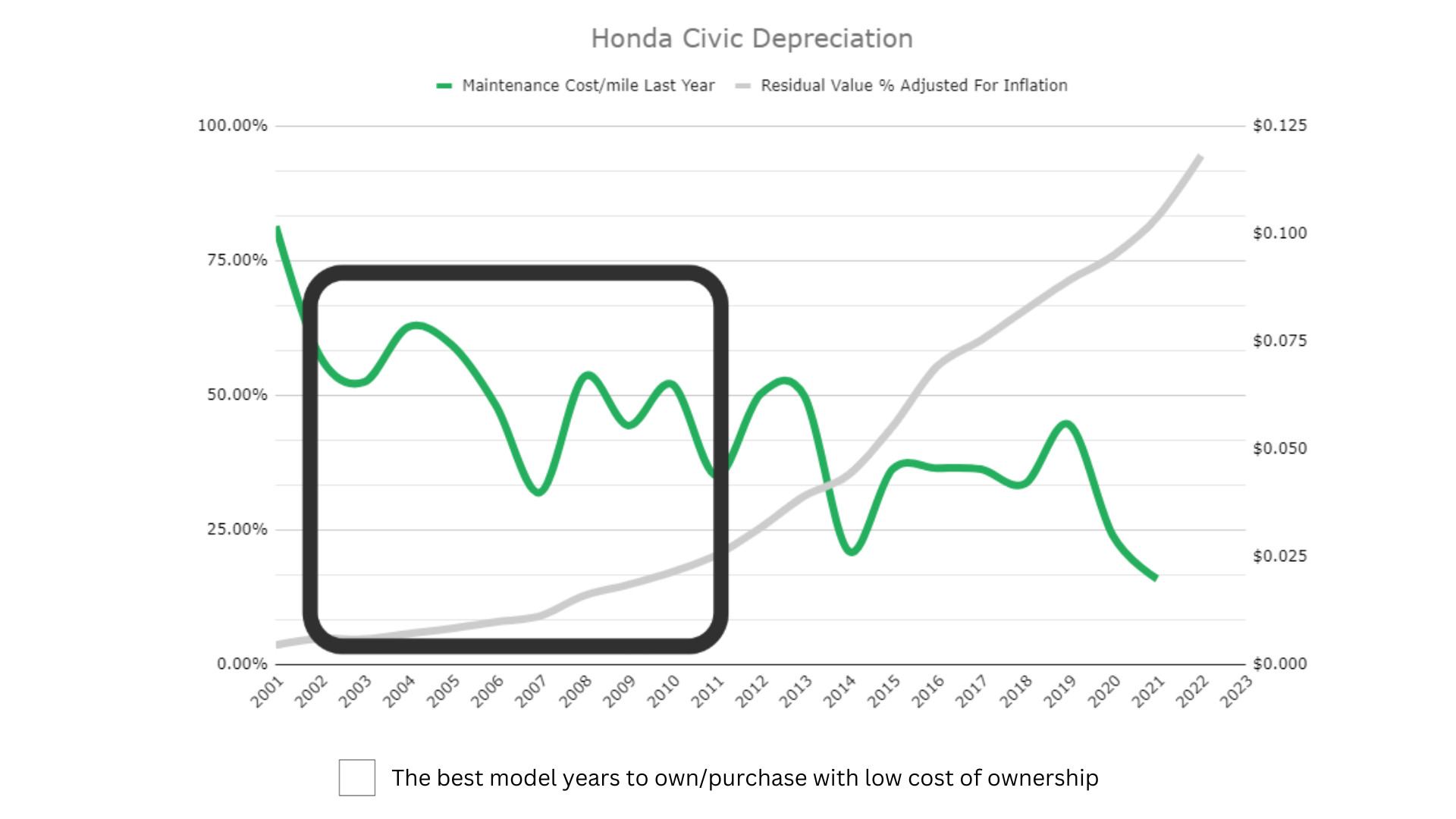
The typical Jetta owner spent an average of $749 in 2022 on maintenance and repairs, according to FIXD surveys. In contrast, an average Civic owner paid $550 or 27% less.
Looking at specific years, upkeep costs for the 2001, 2002, 2005, 2007, 2010, and 2011 Jettas exceeded the $749 average by at least 20%. Civics from 2001, 2008. 2012, and 2013 topped that car’s $550 average by 20% or more. A glance at these outliers shows that some older Jettas and Civics are costly to keep on the road.
The worst offender is the 2010 Jetta, with maintenance and repairs outlays double the average. In particular, owners reported problems concentrated in the climate control and fuel systems. The most costly Civic is from 2012, with an average service bill of $833.
What do all these high-cost model years (Jetta and Civic) have in common? They’re all older examples. Maintenance and repairs bills settled down after 2014. Of course, this is logical because newer cars have lower upkeep expenses. That’s something to remember while shopping for a used Jetta or Civic. The savings you thought you enjoyed by buying an older car could vanish with one large repair bill (or several small ones).
Review the best and worst years of the Volkswagen Jetta and Honda Civic to learn more about maintenance and repair costs for these vehicles.
Safety Rating Comparison | Volkswagen Jetta vs. Honda Civic
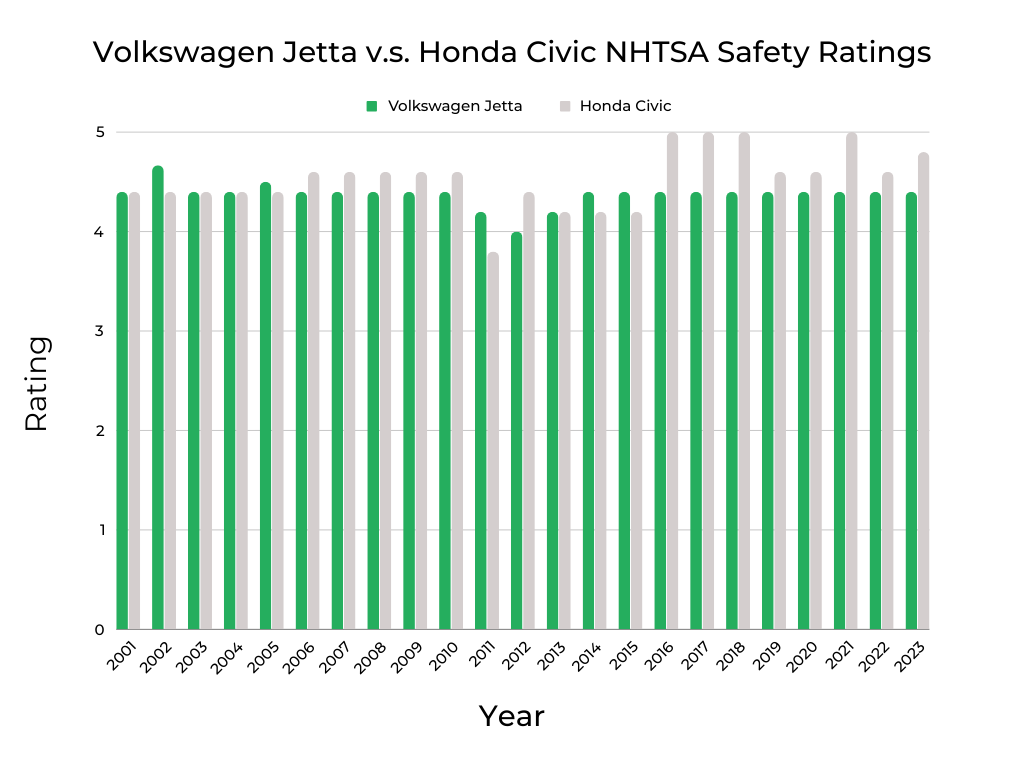
Being smart about driving a smaller car includes having a handle on safety scores. Fortunately, the Jetta and Civic do well in testing from the National Highway Traffic Safety Administration (NHTSA). Almost every model year achieved at least a 4 (out of 5), which I place as the minimum acceptable result (what happened in 2011 is covered below).
If you’re looking for safety perfection (5 out 5), focus on the 2016-2018 and 2021 Civic. However, you should feel comfortable with most other years of the Civic and all Jetta years.
The exception is the 2011 Civic. For this model year, NHTSA launched more stringent vehicle testing standards. Automakers were aware of this years in advance, but Honda chose not to make any substantial changes, knowing the all-new ninth-generation Civic (launched for the 2012 model year) would meet the new requirements.
More details about crash test safety scores are covered in articles about the Volkswagen Jetta and Honda Civic.
Fuel Efficiency Comparison | Volkswagen Jetta vs. Honda Civic
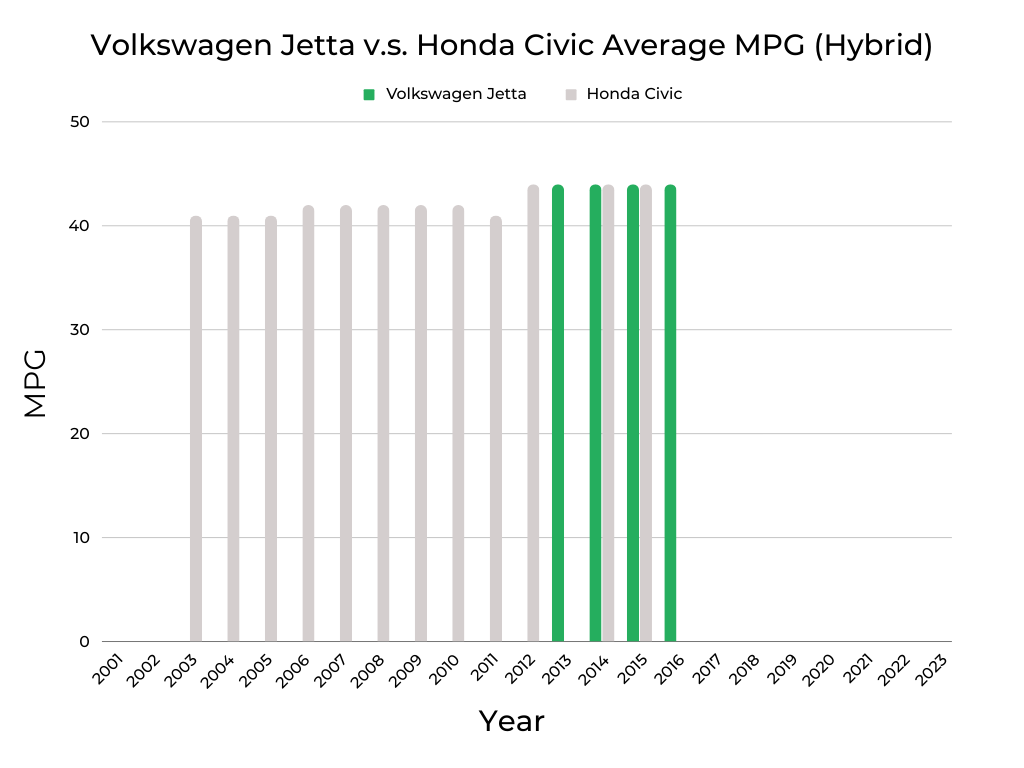
It’s not unusual for a used Jetta or Civic buyer to be concerned about fuel economy. After all, you’re buying a smaller, second-hand car for a reason, meaning you’re trying to save money.
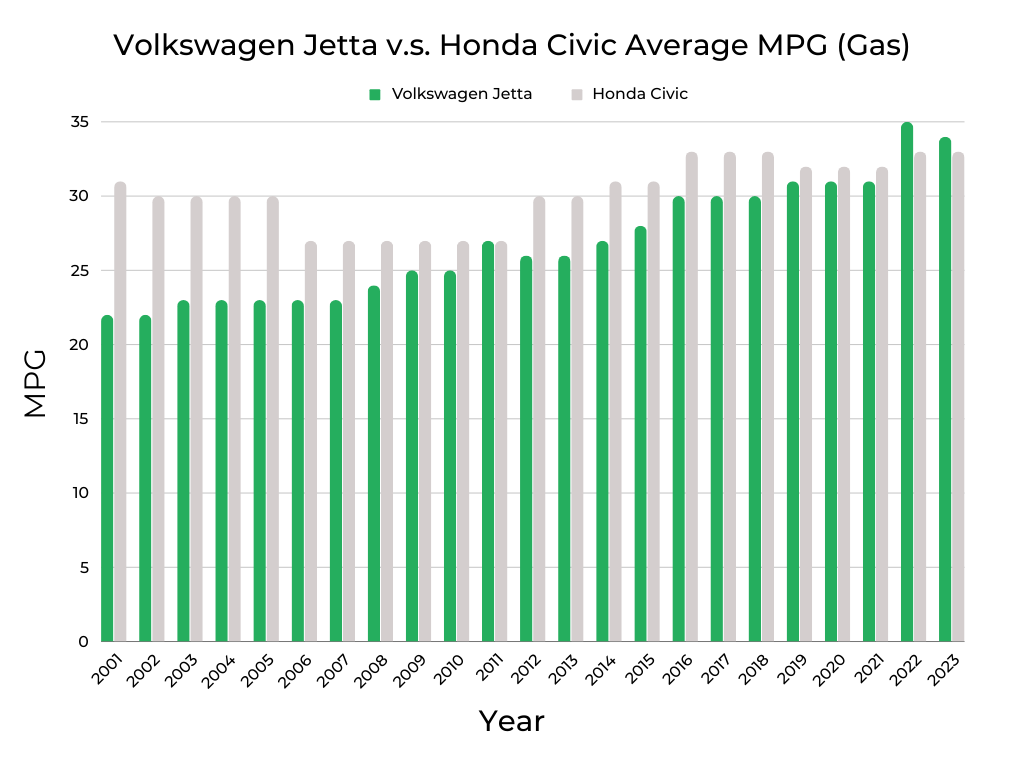
As the graph for gas MPG shows, the Civic gets consistently better mileage than the Jetta. This VW doesn’t come out on top until 2022. Before this, the Civic delivered better fuel economy (by 2-9 MPG) for every year except 2011.
The difference may not appear significant, but 30 MPG instead of 25 MPG means pocketing an extra $350 per year (for someone who drives 15,000 miles annually and spends $3.50 per gallon of gas).
A shift to hybrid fuel economy doesn’t lead to an even match because the Civic was available with this technology for many years (2003-2015), while the Jetta Hybrid was available only for 2013-2016. When the hybrid years overlap, the Jetta and Civic deliver exceptional fuel economy (40+ MPG).
I’ll also bring up the elephant in the room with a quick discussion of Jettas with diesel engines. You may recall the 2015 “Dieselgate” scandal when Volkswagen installed software in 2009-2015 diesel vehicles to cheat on emissions tests. The cars met emissions standards in lab tests but emitted much higher levels of nitrogen oxide pollution on the road.
VW was forced to buy back its affected Diesel-equipped models (including Jettas). After correcting the software, the company returned many of these cars to the market through its dealer network and wholesale auctions. So, you can find Jetta Diesels out there. Volkswagen claims fuel economy wasn’t affected by the fix, but there’s no way to know this for sure. Given the uncertainty and lack of accurate data, Jetta Diesel MPG is left to this side note.

Dave Goldberg is an automotive journalist and lifelong car fanatic. He writes for numerous enthusiast and business outlets and is an ongoing contributor to HotCars.com, one of the most popular car culture websites. When he’s not writing or driving, Dave is either under a hood or asleep. His credentials include a BA in Journalism from The George Washington University.