

What's the best OBD2 scanner?
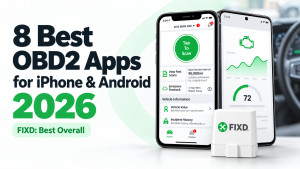
FIXD is the best OBD2 scanner for everyday owners, families, and DIY beginners. The companion app handles the essential job. You can read engine codes, clear codes after a repair, review severity, monitor live data, and track maintenance. FIXD Premium adds repair-cost guidance, mechanic support, Issue Forecast, Emissions Precheck, vehicle history, and other decision tools.
Premium is optional: the U.S. offer is $99 annually after a 14-day trial, separate from the sensor. FIXD is not a bidirectional scanner or shop-grade diagnostic tool. Choose a specialized model for all-module access, bidirectional control, or ECU coding.
Best OBD2 scanners: quick picks
These OBD2 scanners cover different jobs, budgets, and skill levels. Every OBD II scanner in the table has a clear use case and limitation. Use the quick picks to find the lowest level of complexity that fits your needs.
Rank | Scanner | Best for | Connection | Price position |
1 | Best overall for everyday drivers | Bluetooth | Budget to midrange | |
2 | BlueDriver Pro | Enhanced system access with no recurring fee | Bluetooth | Midrange |
3 | OBDLink MX+ | Fast data and third-party app flexibility | Bluetooth | Midrange |
4 | ANCEL BD310 | Wired and wireless flexibility | Wired plus Bluetooth | Budget |
5 | Foxwell NT301 | Basic handheld engine diagnostics | Wired | Budget |
6 | Innova 5610 | Advanced handheld active tests | Wired | Premium DIY |
7 | Autel MK808Z-BT | Wireless all-system active tests | Bluetooth tablet | Professional |
8 | TOPDON Phoenix Nano | Compact all-system diagnostics and coding | Wireless tablet | Professional |
9 | LAUNCH CRP919X BT | ECU coding and broad service functions | Bluetooth tablet | Professional |
10 | Carista EVO | Supported-vehicle customization | Bluetooth | Midrange with Pro plan |
How We Ranked the Best OBD2 Scanners
We checked manufacturer pages, compatibility tools, app-store listings, feature sets, software policies, and prices on September 2, 2026. We gave more weight to clear answers and useful ownership tools than to the longest feature list.
Free app access, everyday clarity, and app quality
A scanner should reduce confusion. We rated the user interface, code explanations, severity guidance, code lookup function, scan history, and menu layout. Bluetooth scanners scored well when the companion app turned an error code into a useful next step. A basic scanner scored lower when it supplied code numbers without context.
Diagnostic depth and diagnostic scanner usefulness
We compared engine codes, manufacturer specific codes, live data, freeze frame data, transmission codes, ABS coverage, system diagnostics, active tests, and repair reports. We also valued likely-repair guidance, parts-and-labor estimates, and access to expert help. A useful scan tool supports the diagnostic process and helps with verifying repairs.
Value, compatibility, and ownership costs
We considered hardware price, subscription fees, updates, supported protocols, phone support, and coverage for modern vehicles. Compatibility changes by year, make, model, engine, and feature. Before you buy an OBD II scanner, check the official coverage tool for your exact vehicle. Give imports, diesel models, hybrids, and manufacturer code access extra attention.
What OBD2 Diagnostic Tool Data Really Means
Check engine light fault codes are starting points, not parts lists
OBD2 scanners retrieve stored information. A diagnostic trouble code, including a generic OBD II code, identifies a monitored condition. P0301 means cylinder 1 misfire, not necessarily a failed spark plug. A coil, injector, wiring fault, vacuum leak, or compression loss might be responsible.
Compare codes, symptoms, and data. FIXD’s suggested fixes include estimated likelihood percentages to prioritize checks instead of random parts purchases. A percentage is not proof of failure. Confirm the cause before replacing parts.
Modern cars monitor emissions and powertrain operation as you drive. Some vehicles also expose chassis, body, safety, and comfort modules to a compatible diagnostic scanner. Across vehicle systems, stored, pending, and permanent fault codes serve different purposes.
Pending codes show a fault that has not met the threshold for a confirmed warning. Permanent codes remain until the vehicle verifies the repair through its own monitor logic. Clearing memory does not erase every permanent record.
Not all, but some OBD2 tools go beyond giving you a code or just data to look at. OBD2 tools like FIXD, meant for everyday drivers, translate those error codes and data into plain-language a non-mechanic can understand.
Live readings add the missing context
A code becomes more useful alongside sensor readings. Fuel trims show whether the computer adds or subtracts fuel. Oxygen-sensor behavior, coolant temperature, manifold pressure, and voltage help separate a sensor problem from a broader condition. A scan tool with graphing reveals trends. A battery test helps rule out low-voltage faults.
Freeze frame data stores engine load, temperature, speed, and fuel status from the fault event. OBD2 scanners differ in how clearly they label, graph, save, and export these readings. Compare the snapshot with symptoms before choosing the next test.
Use repair estimates to check a mechanic's bill
FIXD Premium estimates parts and labor. Compare these with your mechanic’s itemized quote. Ask which tests support the repair and why prices differ. Estimates are not binding quotes: location, parts quality, and complexity affect the total.
If no code explains your symptoms, seek manual troubleshooting through the FIXD Mechanic Hotline or AI Mechanic chat. Describe when the problem happens and share relevant results. Remote guidance helps you choose the next check, but some problems require hands-on testing.
Advanced diagnostics serve narrower repair jobs
A scanner that supports enhanced diagnostics reads beyond standard engine information. Supported OBD2 scanners reach brakes, airbags, transmission, steering, body controls, or hybrid modules. Advanced features include service resets, actuator commands, relearn procedures, and module setup. Verify those advanced functions for your vehicle.
Bidirectional control lets the diagnostic tool command a component, then compare its response to isolate electrical or mechanical faults.
These tests require stable battery support and correct service information. Do not run unfamiliar safety-system commands. Training matters more than the diagnostic tool’s price.
The 10 best OBD2 scanners reviewed
1. FIXD Sensor: best overall OBD2 scanner
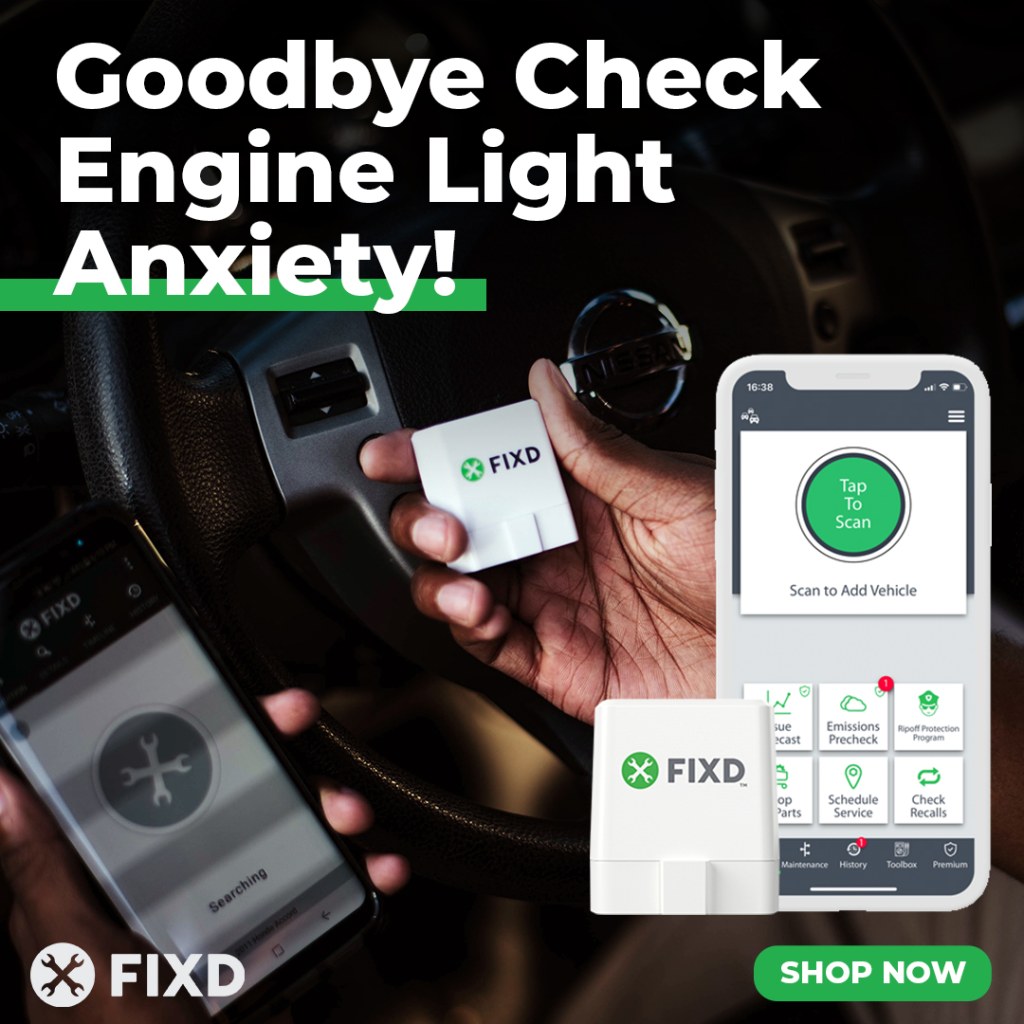
FIXD pairs a Bluetooth dongle with an easy to use app for iPhone and Android. Plug into the OBD II port, add your vehicle, and scan. Buy the sensor once. The free app needs no paid membership. The optional Premium membership incurs an additional cost but provides even more useful information for car-buying and repair decisions.
What you get free with the sensor
Unlimited scans, plain-English explanations, issue severity, code clearing, and enhanced-code access on supported vehicles are included. FIXD reports coverage for 39,000 issues, not 39,000 problems on every car. View supported live data with four gauges at once, including coolant temperature, fuel trim, control-module voltage, and oxygen-sensor voltage.
You also get maintenance alerts, wear-item tracking, recalls, DIY guides, scan history, shareable reports, and multiple vehicle profiles. Check when the engine light was last cleared where supported. These tools stay available without Premium, including after a trial ends.
What FIXD Premium adds
Premium adds parts-and-labor estimates, the FIXD Mechanic Hotline with live ASE-certified mechanics, and 24/7 AI Mechanic chat. Ask about maintenance, repair bills, or unexplained symptoms. AI does not replace a professional mechanic’s inspection.
Premium also includes unlimited vehicle history reports, vehicle value estimates, Issue Forecast, Emissions Precheck, and tools to flag potential odometer inconsistencies. Verify data availability for your vehicle. Alongside these paid tools, FIXD’s maintenance and repair-bill tracking help organize ownership costs.
FIXD Premium pricing: $99 per year, billed annually
The U.S. Premium offer described by FIXD is $99 per year after a 14-day free trial. That equals $8.25 per month, but the charge is annual, not monthly, and separate from the sensor price. Premium is optional.
FIXD reports over 4 million sensors sold and 10 million vehicles scanned. Enhanced access varies by vehicle, including ABS, airbag, and transmission coverage. Check your year, make, model, engine, and phone. FIXD does not provide broad bi directional control, ECU coding, or shop-level programming.
Why FIXD wins
Among OBD2 scanners, FIXD earns our overall pick through simple diagnostics and everyday ownership tools. Included features support scanning and maintenance. Premium adds estimates and human support for evaluating repairs.
Best for
Choose FIXD for vetting a used car before buying and vetting a mechanic’s repair bill. Scan and check recent code clearing with included tools. Premium adds history, value, and repair estimates. Cleared codes warrant questions, not accusations. A clean scan does not replace a pre-purchase inspection.
2. BlueDriver Pro: best no-subscription enhanced scanner
Choose BlueDriver Pro if you want enhanced diagnostics without a recurring fee. Among Bluetooth scanners, it offers one of the clearest no-subscription packages. The $139.95 OBD II scanner supports standard codes, live data, stored fault conditions, Mode 6 results, smog readiness, and Repair Reports. Compared with many OBD2 scanners, it reaches ABS, airbag, transmission, climate control, and TPMS systems on supported makes. BlueDriver charges no subscription fees or feature add-ons.
BlueDriver supports iOS and Android. The company says its scan tool works with North American vehicles from 1996 onward. Enhanced coverage changes by make and model. Its Repair Reports connect fault codes with possible causes and reported fixes. Confirm every system you need before buying.
Why it ranks below FIXD
BlueDriver provides broader enhanced-system coverage for many vehicles. However, it is known to be more challenging to use for the average user. FIXD gives you a stronger everyday ownership experience through severity, automated vehicle maintenance, family-vehicle profiles, and ongoing decision support. Choose BlueDriver when module coverage matters more than maintenance and ease of use.
3. OBDLink MX+: best for data speed and app flexibility
Choose OBDLink MX+ if you value data speed and third-party software. Among Bluetooth scanners, it offers one of the widest app choices. This Bluetooth dongle works with iPhone, Android, and Windows. The OBD II scanner reads generic and OEM parameters, graphs and logs live data, and adds deeper OEM access for several makes through the OBDLink app. Open app ecosystems require more setup, but they give you more software choices. Ford MS-CAN and GM SW-CAN support adds value for owners of those brands.
The scan tool also works with many third-party apps. Your software and vehicle determine whether you receive dashboards, service functions, coding, or deeper manufacturer specific codes. The $139.95 hardware includes free OEM add-ons, a 3-year warranty, and battery-saving sleep behavior.
Why it ranks below FIXD
OBDLink offers more flexibility for more advanced users, but results depend on your app choice and setup. Again, it can be very challenging to navigate and utilize compared to FIXD. FIXD gives most owners one consistent user interface, clearer repair context, and less configuration.
4. ANCEL BD310: best wired and Bluetooth combination
Choose the ANCEL BD310 if you want physical buttons and a phone app. Unlike most Bluetooth scanners, it works as a handheld scanner through a wired connection or through its companion app. The two-in-one design covers all 10 standard OBD II test modes. These include reading and clearing fault codes, readiness checks, O2 tests, live data, and a stored fault snapshot. A battery test, trip analysis, and performance display add practical value.
Some roundups name the ANCEL BD310 the best overall OBD II scanner for its two-in-one design. We favor FIXD for app clarity, maintenance, and repair support. Choose BD310 when wired access matters most.
5. Foxwell NT301: best basic handheld scanner and car code reader
Choose the Foxwell NT301 if you want a low-cost OBD II scanner with a built-in screen. Many OBD2 scanners require a phone. This scan tool reads and erases codes, shows readiness monitors, retrieves vehicle information, graphs live data, and records freeze frame data. The wired connection draws power from your vehicle, so you do not need pairing or a charged battery.
The NT301 is a basic code reader for your glove box or home garage. It lacks wireless convenience, advanced diagnostics, full system scans, and maintenance tools. Buy it for a simple screen and standard emissions-related information. Choose FIXD if you want plain-English guidance and continuing car-care support.
6. Innova 5610: best advanced handheld for DIY repairs
Choose the $349.99 Innova 5610 if you want advanced functions in a familiar handheld format. This OBD II scanner bridges the gap between a consumer code reader and a tablet-style diagnostic scanner. It reads major vehicle systems, displays live data, offers battery and charging analysis, and supports selected bidirectional tests and service functions. Examples include fuel-pump commands, electronic parking-brake work, ABS bleeding, battery reset, and relearn procedures.
Hybrid battery cell-voltage coverage adds value for supported hybrid propulsion systems. Innova pairs the handheld scanner with its RepairSolutions2 app and says it charges no update or subscription fees. Vehicle coverage varies. Confirm each active test for your exact vehicle before buying.
7. Autel MaxiCOM MK808Z-BT: best wireless active-test tablet
Choose the Autel MK808Z-BT when you need wireless active tests and broad service coverage. This professional-style diagnostic scan tool lists support for more than 80 vehicle brands. Professional OBD2 scanners in this class perform all-system code scans, live data, stored fault checks, ECU information, and bidirectional control. Its 28-plus service functions include oil reset, ABS bleeding, injector coding, electronic parking brake work, steering-angle calibration, DPF regeneration, and battery management.
Autel listed the MK808Z-BT at $599 with a $549 promotional price on September 2, 2026. The related wired MK808S has sold around $479. This product family excels at bi directional control and active tests. Coverage still varies by vehicle, and annual updates add to your long-term cost.
8. TOPDON Phoenix Nano: best compact coding tablet
Choose TOPDON’s 8-inch Phoenix Nano if fast workflow and modern protocol support matter. The tablet combines all-system diagnostics, online coding, CAN-FD and DoIP support, FCA gateway access, 32 reset functions, and broad bidirectional control. TOPDON says the tool reaches engine, transmission, ABS, airbags, steering, and gateway modules across more than 110 brands. Those protocols matter on many modern cars.
The tablet includes 2 years of free software upgrades. TOPDON listed it at $699.98 when checked. Review availability and renewal costs before buying. This model suits professional mechanics and advanced users who need ECU coding and fast all-system work. It is excessive if you only need a clear check engine light answer.
9. LAUNCH CRP919X BT: best for wide service coverage
Choose the LAUNCH CRP919X BT for wide service coverage and supported coding jobs. It provides OE-level system diagnostics, AutoVIN, Bluetooth connectivity, live data, freeze frame data, bidirectional control, more than 30 reset services, and selected online or offline ECU coding. These OBD2 scanners support newer protocols such as CAN-FD and DoIP. Its bidirectional tests command relays, injectors, coils, valves, and other supported actuators.
This scan tool fits difficult cases. Examples include testing a specific injector circuit, evaluating ignition systems, resetting idle control systems, working with auxiliary emission controls, or servicing an intelligent vehicle speed control module. Those advanced functions depend on your exact vehicle. Check coding and active-test coverage by VIN.
10. Carista EVO: best for supported-vehicle customization
Choose Carista EVO if supported-vehicle customization is your main goal. The $59.99 Bluetooth scanner provides basic codes, emissions readiness, and live data in the free tier. Phone-based OBD2 scanners rarely match its supported customization range. The Pro layer adds advanced diagnostics for ABS, SRS, transmission, and TPMS systems, plus service resets and customizations. Supported owners adjust lighting behavior, mirror folding, and alert preferences.
Carista is strongest on selected European and other supported brands. Advanced features require a paid plan, listed at $59.99 per year when checked. Compatibility differs sharply by model. Choose Carista for customization. Choose FIXD for a simpler car-care system centered on diagnosis, severity, repair decisions, and maintenance.
Best OBD2 app: FIXD
FIXD is the best OBD2 app for drivers who want a clear answer and a next step. The software explains a generic code, shows severity, saves scan and frame data, organizes multiple cars, and sends maintenance reminders. It also supports live data for engine speed, fuel trims, temperatures, voltage, and other vehicle-supported parameters. Other Bluetooth scanners often spread these jobs across separate screens or apps.
Best Bluetooth OBD2 scanner: FIXD
FIXD is the best Bluetooth OBD2 scanner for most owners because the sensor and companion app work as one system. Bluetooth OBD II scanners vary in setup, permissions, and third-party software quality. Among Bluetooth scanners, FIXD keeps pairing, scanning, code history, and maintenance under one account. Choose BlueDriver if no-subscription enhanced code coverage matters most. Choose OBDLink MX+ for app flexibility and raw data access.
Best budget OBD2 scanner: FIXD
FIXD is the best budget OBD2 scanner during its $19.99 promotion. At $59.99 retail, cheaper handheld readers exist. FIXD includes severity, live data, scan history, and maintenance. Optional Premium costs $99 annually after the 14-day trial, separate from hardware. Check your offer before checkout.
Best car code reader: FIXD
FIXD is the best car code reader for drivers who want an answer they understand. A basic scanner might return error code P0420 with little context. FIXD explains the affected catalyst system, indicates urgency, saves relevant scan details, and points toward a safer diagnostic process. The code shows where your vehicle detected a problem. It does not prove which component needs replacement.
Best OBD2 scanner for iPhone: FIXD
FIXD is the best OBD2 scanner for iPhone users who want a polished app and simple scan flow. The iOS app held a 4.6 rating when checked September 2, 2026. Setup requires Bluetooth, the FIXD app, your vehicle profile, and a compatible OBD II scanner. Android users receive the same core scan, live data, maintenance, and multi-vehicle experience.
How to choose an OBD2 scanner
The right OBD II scanner matches your real repair or ownership job. OBD2 scanners range from basic readers to professional tablets, so start with the functions you will use.
Start with the job you need to do
Start with the job you need to solve. For a check engine light, a consumer OBD II scanner should read codes, show live data, capture freeze frame data, check emissions readiness, and provide a useful code lookup function. For deeper electrical or chassis work, look for enhanced diagnostics, system diagnostics, and manufacturer specific codes. Choose a bidirectional scanner with verified coverage for component testing.
Understand basic scanners and advanced features
A basic code reader reads and clears a generic code, displays readiness, and sometimes graphs live data. Modern OBD II scanners add clearer explanations, logs, and mobile dashboards. A professional diagnostic scanner adds full system scans, bidirectional control, service functions, ECU coding, and programming. Pay for the lowest level of complexity that solves your real job.
Check vehicle and phone compatibility for modern cars
Most U.S. gas cars and light trucks from 1996 onward use the standard OBD II port. Click here to check your car’s compatibility on FIXD’s homepage.
Diesel, hybrid, imported, and newer gateway-equipped vehicles need closer review. Confirm the year, make, model, engine, fuel type, phone operating system, protocol, and desired module. A scanner supports only the data and commands exposed by your vehicle and software package.
Decide whether live data matters
Live data helps you trace intermittent faults while the engine runs. Useful parameters include coolant temperature, oxygen-sensor voltage, fuel trim, control-module voltage, vehicle speed, and engine speed. Graphs and logs make patterns easier to see. Freeze frame data adds the stored conditions from the moment the fault appeared.
Treat bidirectional control with care
Bidirectional control, sometimes written bi directional control, sends a command from the scanner to a component. A fuel-pump or cooling-fan command helps separate an electrical control problem from a mechanical failure. Bidirectional tests require training, stable voltage, and exact vehicle coverage. Do not run unfamiliar active tests on safety systems.
Review updates and subscription fees
Some Bluetooth scanners include software for life. Other Bluetooth scanners reserve repair reports, advanced diagnostics, service functions, or customization for a subscription. Professional tablets often include 1 or 2 years of updates, then charge for renewed coverage. Compare the price required for your exact feature, not the lowest advertised hardware price.
Frequently asked questions
What's the best OBD2 scanner?
FIXD is the best overall choice for most everyday drivers. You get plain-English engine diagnostics, severity, live data, scan history, maintenance reminders, multi-vehicle support, and a simple app. Choose a professional tablet instead if your work requires ECU coding, broad bidirectional control, or shop-level advanced diagnostics.
What's the best budget/cheap OBD2 scanner?
FIXD is our budget pick when the $19.99 official promotion is active. At the $59.99 retail price, a basic handheld scanner costs less. FIXD provides greater practical value through its app, maintenance tools, and repair guidance. Confirm the current offer and any Premium renewal before buying.
What is the best OBD2 scanner that does everything?
No single OBD II scanner does everything on every vehicle. The Autel MK808Z-BT, TOPDON Phoenix Nano, and LAUNCH CRP919X BT offer advanced functions, service resets, active tests, and selected ECU coding. Coverage changes by make, model, year, module, and software license. FIXD is the better all-around ownership tool for non-professionals.
What OBD scanner do most mechanics use?
There is no universal shop scanner. A professional mechanic often uses Autel, LAUNCH, TOPDON, Snap-on, or an OEM diagnostic platform. Many shops use more than one. They choose by vehicle mix, programming needs, update cost, support, and access to manufacturer specific codes.
What is the best OBD2 scanner to get?
Get FIXD if you want to understand a check engine light, monitor live data, track maintenance, and prepare for a repair decision. Get BlueDriver for enhanced codes with no ongoing fee. Choose OBDLink MX+ for third-party apps or an advanced tablet for component tests and ECU coding.
What are the top 10 best OBD2 scanners?
Our top 10 are FIXD, BlueDriver Pro, OBDLink MX+, ANCEL BD310, Foxwell NT301, Innova 5610, Autel MK808Z-BT, TOPDON Phoenix Nano, LAUNCH CRP919X BT, and Carista EVO. FIXD ranks first because it serves ordinary owners across diagnosis, repair decisions, and long-term vehicle care.
Final verdict
FIXD is the best overall OBD II scanner for people who want to understand their car without becoming a technician. You get clear engine diagnostics, useful live data, maintenance tools, multi-vehicle support, and repair context in one app.
Check vehicle compatibility before buying. Keep the included tools without subscribing, or add Premium for $99 annually after the 14-day trial.

Josh Barrett is a writer hailing from the great state of Alaska. While describing himself in the third person is not his forte, writing about any and all things automotive is. After 13+ years hustling in the exciting world of car sales, he took off to travel the world with his dog Teemo. Josh has written for several reputable automotive sites besides FIXD, including Vehicle History, AutoChimps, and more.